
Two weeks is the version of Tunisia with the rush taken out. Everything a shorter trip has to sacrifice — the cork-oak forests of the northwest, the garden peninsula of Cap Bon, a genuine rest day on a Djerban beach — comes back onto the table, and the country reveals the thing it does better than almost anywhere: layering. Phoenician, Roman, Arab, Andalusi, Ottoman, French, all still talking to each other in the same streets. With fourteen days you can follow that conversation across all nine regions and still have time to sit on a rooftop and let an afternoon go by. This is the trip we’d take ourselves.
A word on logistics before the days begin. A rental car is the right tool for a route this wide, though the major north–south legs can be flown or taken by train to save a day — our guide to getting around Tunisia covers it all. Go in the shoulder seasons for the kindest weather across both the green north and the desert south. Sort a local SIM, some dinar, and your visa position before you fly.
Days 1–3 — Tunis and Its Coast, Unhurried
Give the capital the three days it actually deserves. The first goes to the medina of Tunis — thirteen centuries of souks and palaces — and a slow evening down Avenue Habib Bourguiba; our honest guide to Tunis maps it. The second is the postcard day: ancient Carthage in the morning, the blue-and-white village of Sidi Bou Said at golden hour, and the Bardo’s Roman mosaics — the best collection on earth — in between. Use the third for the corners most visitors miss: the marooned island fortress of Fort Santiago on Chikly, the wedding-cake Municipal Theatre, a long lunch built around the food worth seeking out, and a first pass at the souks with our what-to-buy guide in hand.
Day 4 — Cap Bon, the Garden Peninsula
Head out along Cap Bon, the citrus-and-jasmine peninsula that locals call the garden of Tunisia. In one easy day you can take in the pottery workshops of Nabeul, the only purely Punic ruins on earth at Kerkouane, the cliff fortress at Kelibia, and the faded Roman-era hot springs at Korbous — then end with a swim and a long, slow lunch in Hammamet, the original Tunisian beach town.
Days 5–6 — The Green North
This is the Tunisia no brochure prepares you for. Drive northwest into mountain country — cork oaks, cooler air, mist in the mornings — and base yourself in or around Aïn Draham, the forest town up near the Algerian border. Break the inbound drive at the extraordinary underground Roman villas of Bulla Regia, where wealthy Romans built whole floors below ground to escape the heat and the mosaics still lie in place. Spend the second day among the forests and the Mediterranean coast around Tabarka, and — if the sea is calm and you’re feeling intrepid — look into a boat out to the wild, uninhabited Galite Islands, the country’s last true wilderness.
Day 7 — Through Testour to Kairouan
Turn south. Pass through Testour, the little town built by Andalusian Muslims and Jews who fled Spain, with its Spanish-tiled minaret and its layered heritage worn openly in the streets. Continue to Kairouan, Islam’s fourth-holiest city, and arrive in time to catch the medina in the late light. Overnight here.
Day 8 — Kairouan and the Roman Interior
Give the Great Mosque of Kairouan a proper morning — a vast, austere forest of columns and one of the Maghreb’s most moving spaces — and browse the carpet souks and makroudh stalls of the working medina around it. Then drive southwest toward the desert, breaking the journey at the Roman ruins of Sbeitla, three honey-coloured temples standing almost whole, before reaching Tozeur for the night.
Day 9 — The Oases and the Salt Lake
Spend the day in the most cinematic country in Tunisia. The mountain oases of Chebika and Tamerza spill green out of bare rock; the Chott el Jerid shimmers white and mirage-haunted to the horizon; and out at Ong Jmel, the abandoned Star Wars sets that became Tatooine stand half-claimed by the sand.
Day 10 — Into the Sahara
Drive to Douz and trade the car for a camel. A desert trek to a dune camp — fire, tea, dinner cooked in the sand, and a sky thick with stars — is the heart of the whole fortnight. Our Tunisian Sahara guide walks through how to do it well. Wake for the sunrise over the sand sea before you turn back east.
Day 11 — Matmata to Djerba
Cross the lunar hills of Matmata, where Berber families still live in homes dug underground around sunken courtyards — lunch in the Sidi Driss, the cave hotel that played the Lars homestead — then drop to the coast and cross to the island of Djerba for the night.
Day 12 — Djerba: The Rest Day
Do almost nothing, on purpose. Djerba pairs long Mediterranean beaches with one of the oldest Jewish communities on earth, gathered around the El Ghriba Synagogue, the oldest in Africa. Swim, wander the souks of Houmt Souk, eat slowly. Two weeks earns you this.
Day 13 — Up the Sahel Coast
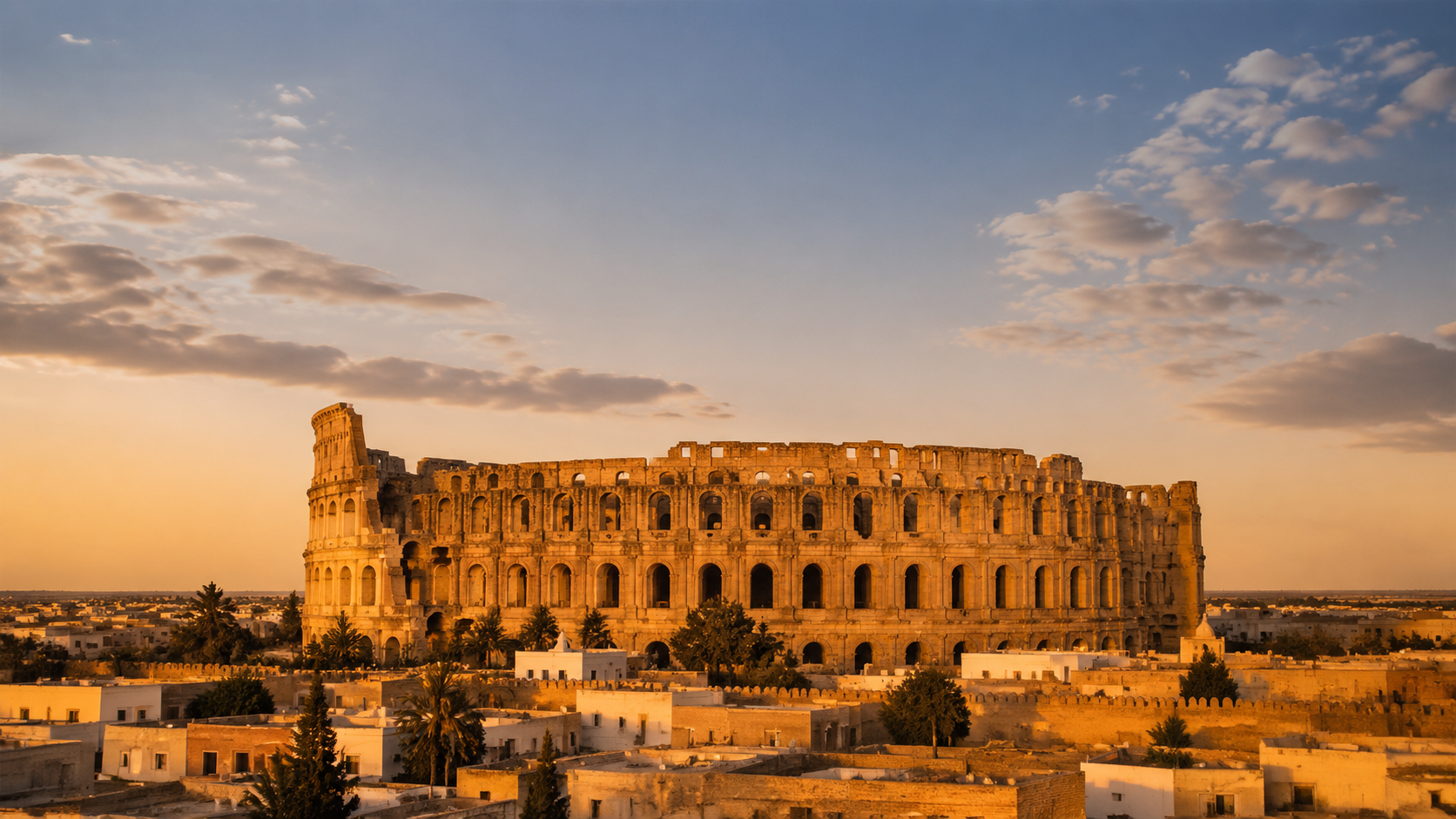
Begin the climb north along the holiday coast. Break it where you like among the Sahel’s three anchors: walled Sousse, the “Pearl of the Sahel”; sea-facing Monastir with its luminous ribat; and the quiet old Fatimid capital of Mahdia on its peninsula. If you didn’t catch it on the way down, the colossal amphitheatre at El Jem sits a half-hour inland and is unmissable.
Day 14 — Back to Tunis, and Home
The last leg returns you to the capital. Spend a final morning closing out the souk shopping and saying goodbye to the city where the trip began — a glass of mint tea on the rooftop, the whole medina humming below — then to the airport, already arguing with yourself about when you’ll be back.
The Honest Part: What to Cut if You Only Have Twelve
Two weeks is generous, and the honest truth is you can flex it. If you’re closer to twelve days, the cleanest cuts are the green north (drop Days 5–6 and run straight from Cap Bon to Kairouan) or the second Djerba night — both hurt, but neither breaks the trip. If you’d rather not drive the long southern legs, fly one: domestic flights, the resumed Tozeur–Tunis service, and the scenic Red Lizard train all turn a day in the car into something better. And if your trip is shorter than this from the start, our 10-day itinerary keeps the Sahara, the 7-day version keeps the north and the Sahel, and even a long weekend in the Tunis triangle is a complete experience.
A Few Honest Notes
The rule that protects a two-week trip is the same one that protects a two-day one: don’t over-schedule. Distances feel longer on the road than they look on the map, and a fortnight’s real luxury is the permission to spend a whole afternoon doing nothing. Book your nights along the route rather than in one base — our where-to-stay guide breaks it down region by region. Tunisia is welcoming and easy to travel; see our notes on staying safe and our guide for solo and female travelers, and pick up a few words of Tunisian Arabic before you go. For everything this route couldn’t fit, our things-to-do hub is the wider map. Fourteen days, all nine regions, and a country that does not so much end the trip as postpone it.
From the Carthage Magazine Bookshelf
If the route’s taking shape — or the flight’s already booked — three Carthage Magazine ebooks were built for the days between arrival and departure:
- All About Tunisia — the definitive English-language traveler’s guide. 572 pages, 27 chapters, all nine regions, every UNESCO inscription, five thematic trails — and the practical answers (visa, currency, transport, etiquette) most travelers wish they’d had on the plane. $24.99 · PDF & EPUB
- Speak Like a Local — 200+ Tunisian Arabic phrases with native audio recorded in Tunis. The phrases for the taxi, the souk, the café, and the dinner table. $14.99 · PDF, EPUB, MP3
- The Authentic Tunisian Cookbook — sixty traditional recipes from the heart of North Africa. For when you get home and find yourself missing the food. $9.99 · PDF & EPUB
All three available as a bundle for $39.99 — guide, language, and food, delivered together.
