
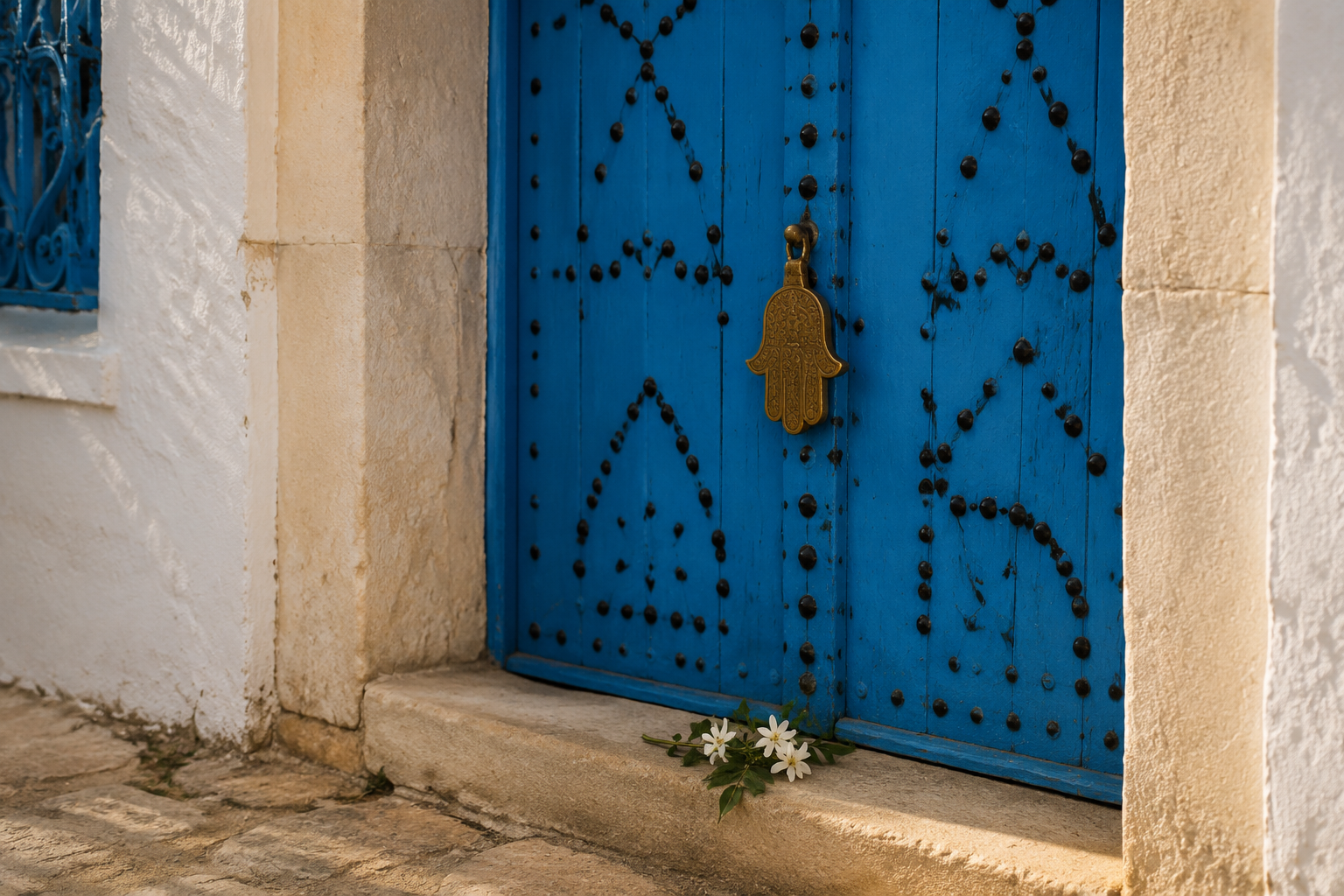
Quick Answer Tunisian names are layered the way the country is. On the surface, most are Arabic and Islamic — Mohamed, Ahmed, Yasmine, Nour. Underneath sit older strata: Amazigh (Berber) names that predate the Arab conquest, a small but proud revival of Carthaginian names like Hannibal and Elyssa, an Andalusian inheritance carried by families expelled from Spain, and an Ottoman-Turkish thread in certain surnames. Over all of it lies a French spelling overlay — the reason a Tunisian Yasmine is spelled the French way, and a Skander drops the “I” from Iskander. A Tunisian name is rarely just a name. It is a small piece of the country’s history, worn daily.
Ask a Tunisian what their name means and you will rarely get a short answer. You will get a grandfather it was borrowed from, a month of the Islamic calendar it marks, a flower, a virtue, a verse — and, just as often, a shrug and a smile, because the meaning has been worn smooth by a thousand years of use. Names in Tunisia are not chosen from a clean slate. They are inherited, layered, and quietly political, in the way that all questions of identity are political in a country that has been conquered, courted, and reinvented more times than most.
This is a guide to what those names mean, where they come from, and how the system actually works — for the diaspora parent choosing one, the traveller charmed by them, or anyone curious about the history folded into a Tunisian introduction.
A Name Is a Layered Thing
To read a Tunisian name properly, you have to know the layers it might be drawn from.
The Arabic and Islamic layer is the broadest. After the seventh-century Arab conquest, Islam reshaped the naming landscape, and to this day the most common names honour the Prophet, his family, his companions, and the ninety-nine names of God. This is the stratum that gives Tunisia its endless Mohameds and Ahmeds.
Beneath it lies the Amazigh (Berber) layer — the names of the people who were here first, before Phoenician, Roman, or Arab. Long suppressed, these names are quietly returning, part of the wider revival of Tunisia’s Amazigh heritage.
Older still, and uniquely Tunisian, is the Carthaginian layer — the Phoenician-Punic names of the civilisation that built the city that rivalled Rome. No other Arab country names its children after a general who crossed the Alps with elephants. Tunisia does.
Then there are the Andalusian names and surnames carried by the Muslims and Jews expelled from Spain after 1492, many of whom settled in towns like Testour; and an Ottoman-Turkish thread that surfaces mostly in family names. Finally, a French overlay sits across everything — not in the names themselves but in how they are spelled in Latin script, a legacy of the protectorate and of Tunisia’s enduring bilingualism.
Keep those layers in mind, and a guest list at a Tunis wedding starts to read like a core sample of North African history.
Popular Tunisian Names for Girls
These are among the names you will actually meet — grandmothers, classmates, and newborns alike. Meanings are the traditional ones; transliteration varies (more on that below).
- Yasmine / Yasmin — jasmine, the small white flower that is Tunisia’s national emblem and the scent of a Tunisian summer evening. Perhaps the most quintessentially Tunisian girl’s name there is.
- Nour — light. Simple, luminous, evergreen.
- Amira — princess.
- Maryzm / Mariem — Mary; revered by Muslims and Christians alike, which gives it a quiet universality.
- Salma — safe, at peace.
- Rim — the white gazelle, a classical Arabic image of grace.
- Amel / Amal — hope. You will also see the French-influenced Amèl, with the accent — a small artefact of colonial-era spelling.
- Dorra — a pearl.
- Emna — safety, serenity of heart.
- Khaoula — after an early Muslim woman remembered for her courage.
- Ines, Farah, Aya, Hiba — companionship, joy, a sign or verse, a gift, respectively — all common modern favourites, along with distinctly Tunisian-popular choices like Syrine and Eya.
Popular Tunisian Names for Boys
- Mohamed — “the praised one,” the Prophet’s name, and year after year the most common male name in the country. It frequently leads a compound — Mohamed Amine, Mohamed Ali — where the second element does the work of telling two Mohameds apart.
- Ahmed — “most praiseworthy,” from the same root.
- Youssef — Joseph.
- Amine — trustworthy, faithful (an epithet of the Prophet himself).
- Yassine — from Ya-Sin, the title of a chapter of the Qur’an.
- Khalil — close friend; an echo of Ibrahim, called Khalil Allah, the friend of God.
- Hamza — strong, steadfast; the Prophet’s uncle.
- Aziz — dear, mighty — and in the compound Abdelaziz, “servant of the Almighty,” one of the theophoric names built on the attributes of God.
- Skander — Alexander, after Alexander the Great, with the opening “I” of Iskander worn away in the Tunisian mouth.
- Hatem — the decisive one, the judge; bound up with the legend of Hatem al-Tai, a byword for generosity.
- Wassim — handsome, graceful — alongside perennial favourites like Aymen (blessed), Seifeddine (sword of the faith), Oussama (lion), and Anis (good companion).
One name deserves its own line: Habib, “the beloved.” It is an ordinary, warm Tunisian name made permanent by Habib Bourguiba, the man who built the modern state — proof that in Tunisia a single life can colour a name for a century.
The Carthaginian Revival: Hannibal, Elyssa, and Tanit
Here is where Tunisian naming becomes unlike anywhere else in the Arab world.
A Tunisian boy may be called Hannibal — not as a curiosity, but as a real, living name, carried by footballers and accountants and the man who fixes your car. The name is Phoenician to its bones: Hanni-baʿal, “the grace of Baal,” the god of Carthage. To name a son Hannibal is to reach back past the Arab and Roman conquests to the general who terrified Rome for sixteen years, and to claim him as kin.
Girls carry the revival too. Elyssa (also Alissa, Elissa) is the name of the Phoenician queen who, in legend, founded Carthage itself — known to the Romans as Dido. And Tanit, the great moon-goddess of Carthage whose sign Tunisians have never stopped drawing, now occasionally adorns a birth certificate. These names are statements: that the deepest layer of Tunisian identity is not Arab or Roman but Carthaginian, and that three thousand years later it still answers when called.
The Amazigh Names
The other reclaiming runs through the Amazigh, or Berber, heritage — the oldest layer of all. For generations these names were discouraged; today a growing number of Tunisian parents choose them precisely as an act of memory.
The standout is Dihya — the Berber warrior queen the Arab chroniclers called Al-Kahina, who led the last great resistance to the Arab conquest of North Africa. To name a daughter Dihya is roughly as pointed, and as proud, as naming a son Hannibal. On the male side, Massinissa and Yugurtha reach back to the Numidian kings, and gentle nature-names like Thiziri (“moonlight”) carry the Amazigh languages forward without the politics. They remain a minority choice in Tunisia — more common among the Amazigh communities of the south and the diaspora — but they are unmistakably on the rise.
How Tunisian Surnames Work
If the first name tells you what a family hoped for, the surname usually tells you where it came from — and Tunisian surnames follow a handful of readable patterns.
The patronymic — “Ben.” The most recognisable Tunisian surname form is Ben (بن), “son of”: Ben Ali, Ben Salah, Ben Youssef, Ben Romdhane. The older Bou / Abou, “father of,” sits inside names like Bouzid and the surname of the street vendor whose self-immolation began the 2011 revolution, Bouazizi.
The origin marker — the “-i” ending. A great many surnames are a nisba, an adjective of belonging formed by adding -i: Jendoubi (from Jendouba), Sfaxi (Sfax), Gafsi (Gafsa), Bizerti (Bizerte), Djerbi (Djerba), Kairouani (Kairouan). The name is a map reference — it tells you which town the family answers to.
The tribal and the foreign. Some surnames preserve old tribal affiliations — Hannachi, for instance, marks descent from the Amazigh Hanencha. Others record arrival from elsewhere: Trabelsi points to Tripoli, Stambouli to Istanbul and the Ottoman centuries, and a whole quiet set of Andalusian surnames traces back to the Muslims and Jews expelled from Spain, many of whom rebuilt their lives in towns like Testour.
The occupational and descriptive. And then the plainest layer of all: Najjar (carpenter), Haddad (smith), Attar (perfumer), Gharbi (“the westerner”), Chaabane (born in the month of Shaʿban). Ordinary trades and circumstances, fossilised into family names.
The Customs Behind the Name
A Tunisian name is given inside a ritual. Traditionally the baby is named on the seventh day, at the seboua (سبوع) — a celebration of the new child where the chosen name is announced to family and neighbours, often over sweets and the same festive energy you’ll find at a Tunisian wedding. The choice itself is rarely free of obligation: the first son is very often named for his paternal grandfather, the first daughter for a grandmother, so that names cycle through a family across generations like heirlooms.
Two more things shape what you’ll see written down. The first is the theophoric compound — Abd (“servant of”) joined to one of the ninety-nine names of God: Abdallah, Abderrahmane, Abdelaziz. The second is French spelling. Because of the protectorate and Tunisia’s deep bilingualism, the Latin-script version of a Tunisian name follows French phonetics, not English ones: ch for the “sh” sound (Chaker, Chedly), ou for “oo” (Oussama, Mongi), and the occasional acute accent (Amèl). It is why the same Arabic name can look so different on a Tunisian passport than on an Egyptian or a Gulf one — and why pronunciation rewards a little Tunisian Arabic.
Choosing — or Just Understanding — a Tunisian Name
If you are a member of the diaspora choosing a name for a child, the live question is usually how a name will travel. The most portable choices are the ones that already cross borders gracefully — Yasmine, Nour, Adam, Selim, Maryam, Mehdi — names that sit comfortably in French, English, and Arabic at once. The most meaningful are often the ones that don’t travel as easily: a Hannibal, a Dihya, an Elyssa, that plant a flag in three thousand years of Tunisian history and ask the world to learn how to say them.
And if you are simply a traveller who keeps meeting the same beautiful names, now you know what they carry. A Tunisian introduction is a compressed history lesson. The grace of a Carthaginian god, the light of a single word, the jasmine of a summer night, a grandfather honoured, a town remembered — all of it, handed over in a single word at a café table, usually with a smile and a shrug, because to the person saying it, it is simply their name.
From the Carthage Magazine Bookshelf
A name is the first Tunisian word most visitors learn to say properly. Three Carthage Magazine ebooks help with the rest of them — useful whether you’re planning a trip or reconnecting with the culture from afar:
- Speak Like a Local — 200+ Tunisian Arabic phrases with native audio recorded in Tunis, so the names, greetings, and pleasantries land the way they’re meant to. $14.99 · PDF, EPUB, MP3
- All About Tunisia — the definitive English-language traveller’s guide. 572 pages, 27 chapters, all nine regions, every UNESCO inscription, and the practical answers most travellers wish they’d had on the plane. $24.99 · PDF & EPUB
- The Authentic Tunisian Cookbook — sixty traditional recipes from the heart of North Africa, for when the culture is best understood at the table. $9.99 · PDF & EPUB
All three are available as a bundle for $39.99 — guide, language, and food, delivered together.
