
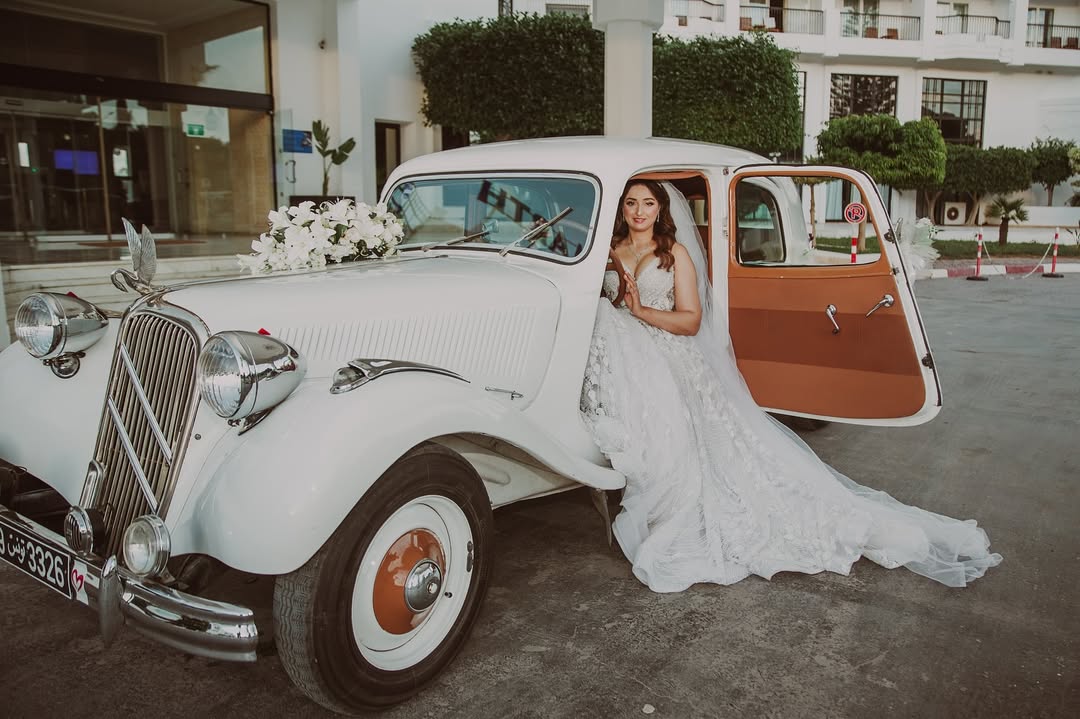
Quick Answer A traditional Tunisian wedding is a multi-day celebration — historically seven days, more commonly three or four in modern practice — built around a sequence of distinct ceremonies that move the bride and groom through engagement, ritual purification, the henna night, the marriage contract, and the public reception. The bride wears a series of traditional dresses, each from a different region or era of Tunisian history. The whole event is loud, generous, expensive, and unmistakable. Wedding season runs from late May through September, and in any given Tunisian neighbourhood during these months you will hear at least one zaghrouta — the high-pitched ululation that signals a celebration is in full swing — drifting through an open window after sunset.
It is the third hour of the reception. The bride has changed dresses four times. The mother of the groom is dancing with a tray of small gold cups balanced on her head. A child somewhere has fallen asleep across two chairs pushed together, undisturbed by music that is currently registering at concert volume. The DJ — every Tunisian wedding now has a DJ, who is also somehow always a cousin — switches from a slow malouf track to the wedding’s eighth or ninth round of mezoued, the bagpipe-driven dance music that nobody can resist. A circle forms. A second circle forms inside the first. The groom’s grandmother, eighty-four years old, sets down her tea glass and stands up.
This is a Tunisian wedding. There is no other event quite like it.
When wedding season happens
Tunisian weddings are seasonal in the most practical sense: they happen in the warmer months, when families can travel, when hall venues are open, and when an outdoor courtyard or rooftop can be pressed into service for the larger ceremonies. The unofficial calendar runs from late May through September, with two clear peaks: the weeks immediately after Eid al-Adha in early summer, and August, when the diaspora returns from France, Italy, Germany, and Canada to be married at home in front of grandparents.
Few weddings happen during Ramadan. Almost none happen during the cold months between October and April, though city-based modern weddings are starting to break that pattern. If you visit Tunisia in August and find your hotel quieter than expected, it is because half the country is in a wedding hall in Sfax, Sousse, or Hammamet.
The seven (or so) ceremonies
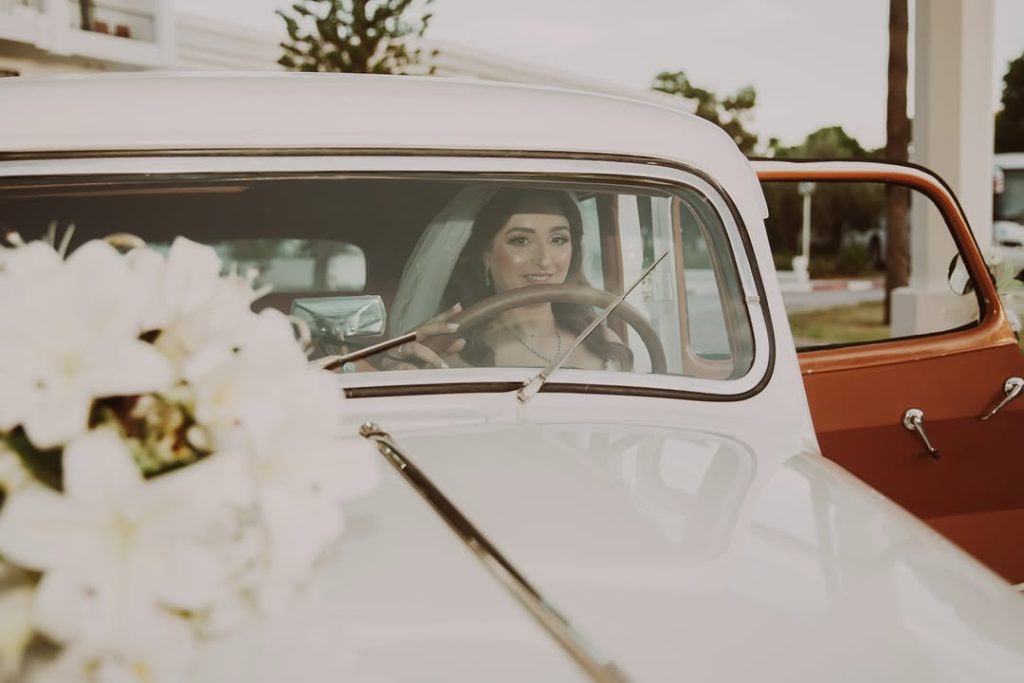
A traditional Tunisian wedding is not a single event. It is a sequence — a slow building of ritual energy across days, often weeks, that culminates in the public celebration that outsiders tend to think of as “the wedding.” The full sequence varies regionally and by family, but the broad arc has held for at least two centuries.
1. Khotba — the engagement
The groom’s family visits the bride’s family with sweets, perfume, and a formal proposal. If accepted, gold is exchanged — at minimum, an engagement bracelet, often a full set of jewellery (shkika) that signals the family’s seriousness. The couple is now publicly engaged. The wedding date is set, usually several months out.
2. El-Houli — the dowry transfer
In the weeks before the wedding, the groom’s family delivers gifts to the bride’s home: gold, fabric, perfume, sometimes furniture. This is El-Houli (or in some regions El-Khouli), the formal handover of the dowry. Traditionally these arrived on a procession of decorated trays carried by women through the streets, and in some families that practice continues. In urban modern weddings, it has often been streamlined into a single ceremonial visit.
3. El-Hammem — the ritual bath
Two or three days before the wedding, the bride visits the hammam with female relatives — mother, aunts, cousins, future sisters-in-law — for a ceremonial purification. The atmosphere is part spiritual, part bridal-shower, part deeply social. Songs are sung. Sweets are eaten. The bride emerges purified, exfoliated, and ready for the next ceremony. In some regions the groom has his own equivalent on the same day, with his uncles and friends.
4. El-Outia / Hennana — the henna night
This is the night that anyone who has attended a Tunisian wedding remembers most vividly. The bride sits on a raised platform, often wearing a fouta wa blouza — the elegant Tunisian dress made of silk woven in striped patterns — surrounded by the women of both families. Henna paste is applied to her palms and feet in intricate patterns, often by a professional hannena (henna artist), accompanied by traditional songs that have been sung at Tunisian henna nights for generations.
The henna is meant to bring good fortune, ward off the evil eye, and mark the bride visibly as a woman about to be married. The patterns can take hours. The party that goes on around her — food, music, tea, sweets, more music — usually lasts until well after midnight.
In some regions a parallel outia is held for the groom on the same evening, with male relatives. He, too, receives a small dot of henna on his palm.
5. Akd al-Qiran — the marriage contract
This is the legally and religiously binding part of the wedding — the actual marriage. An imam or adoul (a notary specialised in personal status matters) presides. The contract is signed, witnesses confirm, the dowry is formally noted, and the couple is married. In modern practice this often happens at the baladia (municipality) or at the bride’s family home, with a small group present rather than the full guest list.
Tunisia’s Code du Statut Personnel, enacted in 1956, gives this contract real legal weight — Tunisia is the only Arab country to have outlawed polygamy outright, and a Tunisian marriage contract is genuinely a contract between two equal parties.
6. Le Mariage — the wedding reception
This is the night the eight hundred guests are invited to. (You read that correctly. A “modest” Tunisian wedding is two hundred guests. The standard is around four to six hundred. A large family wedding can comfortably cross a thousand.) The venue is a wedding hall, a hotel ballroom, or — increasingly common in coastal areas — a beachfront resort.
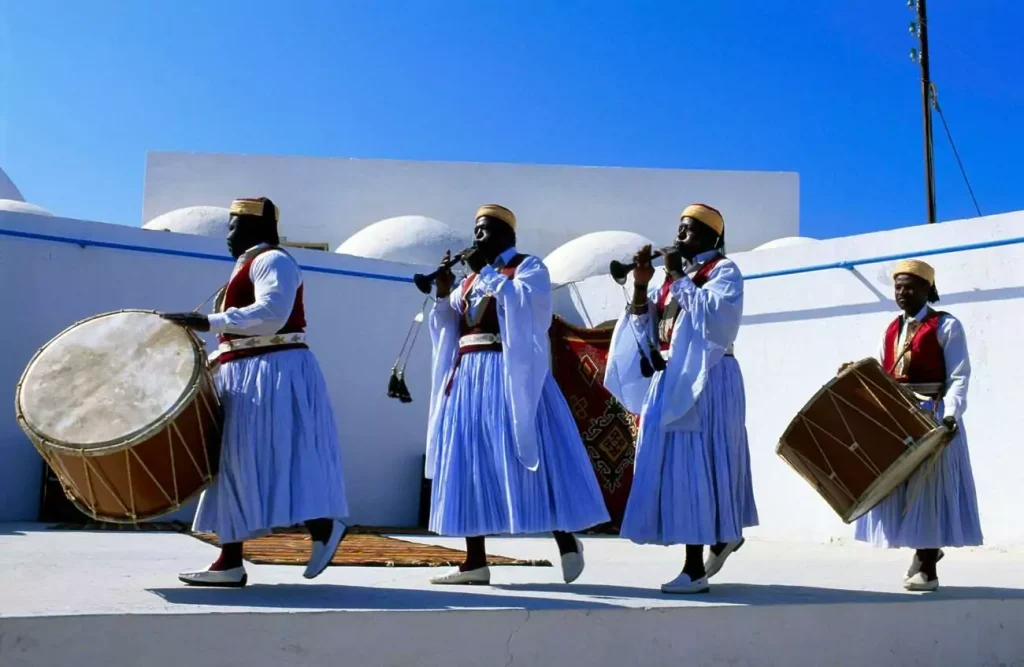
The bride arrives in spectacular fashion, often on a raised throne carried by men of the family, or in some regions on horseback through a procession (zaffa) accompanied by trumpets, drums, and the zaghrouta of the women. She is dressed first in her keswa kbira — the most elaborate of her dresses, region-specific (more on this below). The groom is seated beside her. Photographs are taken endlessly. A meal is served — typically a multi-course feast culminating in the inevitable platter of couscous.
Then the music starts in earnest, and does not stop for hours.
7. Sebbouhya — the morning after
The day after the wedding, the immediate families gather for a quieter meal at the bride and groom’s new home. Sweet pastries — see our Tunisian sweets guide — appear in industrial quantities. The bride often wears one final dress. Photos are taken with the older generation. By evening, the celebration is finally, formally over. The couple is married.
The dresses: seven costumes for seven occasions
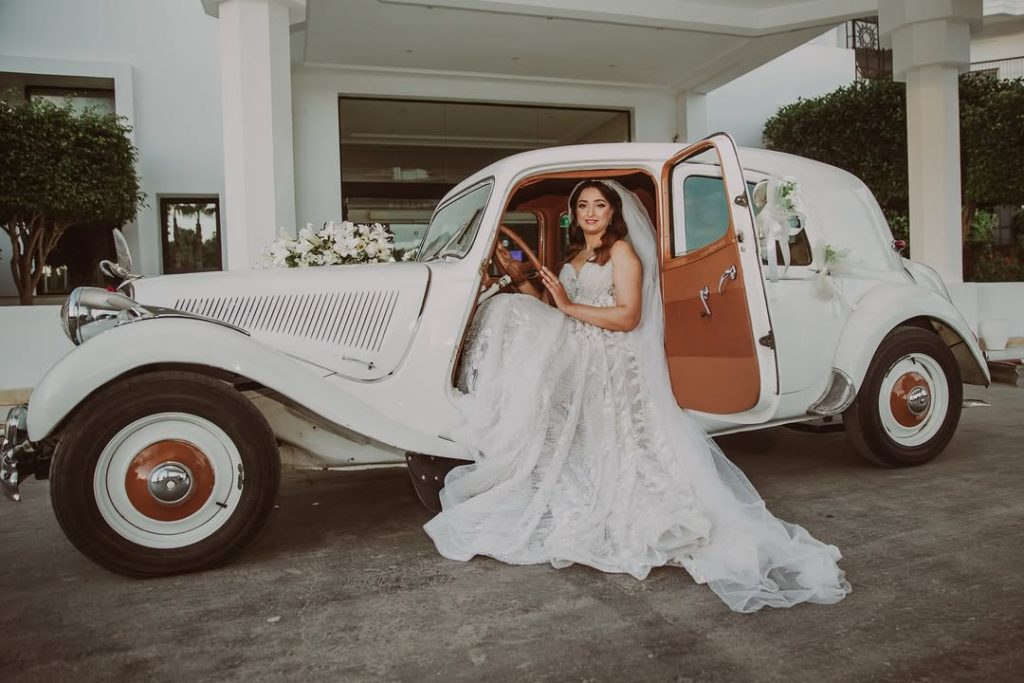
If there is one thing that distinguishes a Tunisian wedding from any other Maghrebi wedding, it is the bride’s wardrobe.
A traditional Tunisian bride does not wear one dress. She wears a sequence of them — historically seven, often more — each from a different region of Tunisia or a different period of its history. The tasdira, as the sequence is called, is a living museum of Tunisian textile craft.
- The fouta wa blouza from Hammamet — striped silk in earth tones, worn at the henna night, embroidered with gold thread.
- The keswa kbira from Sfax — the heavy ceremonial dress of the southern coastal city, a brocaded velvet gown of deep red or green, weighted with gold embroidery so dense that two women are needed to help the bride walk in it.
- The jebba zarbia from Mahdia — the lighter, brighter dress of the Sahel, woven with the city’s distinctive geometric patterns.
- The Djerbian dress — white-and-gold, with the island’s specific style of head ornament; if you have seen wedding photographs from Djerba, this is what you remember.
- The Berber dress — silver jewellery rather than gold, indigo and red textiles, regional variations from Matmata, Tataouine, or the Cap Bon hinterland.
- The white European-style gown — usually saved for the entrance to the main reception, a nod to twentieth-century influence.
- The baroun or modern evening gown — for the dancing portion of the night, more comfortable, sometimes designer.
Many modern brides shorten this sequence to three or four dresses. A few traditional families still do all seven. The cost of the wardrobe alone, including gold jewellery, regularly runs into the tens of thousands of dinars — a significant outlay against the broader Tunisian cost of living, and a topic of ongoing conversation about how weddings have inflated over the past two decades.
The music
A Tunisian wedding has its own soundtrack — and it is unlike anything you will hear at a Moroccan, Egyptian, or Lebanese wedding.
- Malouf — Tunisia’s classical Andalusi music tradition, with origins in 15th-century Granada — opens the more formal moments. Slow, ornate, played on the oud and qanun, sung in classical Arabic poetry, it is the music of dignity. The bride enters to malouf.
- Mezoued — the bagpipe-driven, percussion-heavy folk music that nobody can sit through — fills the dance floor. It is the music of joy, of letting go, of grandmothers dancing on tables at 1 a.m. If a Tunisian wedding has a defining sound, it is the high-pitched whine of the mezoued bag and the answering crash of the darbouka drum.
- Modern Tunisian pop — rap tunsi, the latest Lotfi Bouchnak release, anything that has been on Radio Mosaïque this summer — closes the night. The DJ is in charge from midnight onward.
The zaghrouta threads through all of it — the ululating women’s call that punctuates every entrance, every dance, every announcement, and that no amount of urbanisation has managed to dim.
The food
There is no Tunisian celebration without food, and a Tunisian wedding is the maximalist expression of this principle.
The reception meal traditionally moves through three to five courses, each more substantial than the last. Brik — see our guide to Tunisia’s iconic crispy pastry — is often the opening course. A fish or seafood dish follows in coastal weddings. A meat course — usually lamb, often mosli or kabkabou — anchors the middle. The meal builds to couscous with lamb, served from large communal platters, and finishes with an array of Tunisian sweets (kaak warka, baklawa, makroudh) and strong mint tea.
Between courses, trays of grilled meats, salads, and small pastries circulate. The eating slows down only when the dancing starts. By 2 a.m., a final round of frika (a warm freekeh soup) often appears to settle the stomach before guests begin to leave. Many do not leave until 4 or 5 in the morning.
What it costs
A Tunisian wedding is a significant family undertaking. The widely-cited figure for a mid-range urban wedding in 2026 is between 30,000 and 60,000 Tunisian dinars (roughly €9,000–18,000), with the higher end climbing well into six-figure territory for premium hotels, large guest lists, and full traditional dress sequences. The groom’s family traditionally bears the larger share of the cost, including the gold dowry; the bride’s family contributes the henna night, the trousseau, and a portion of the reception.
It is, by any honest measure, a heavy financial burden — one that many Tunisian couples now share between both families more equally than tradition once required, and that some are choosing to scale down significantly. Modern micro-weddings of 80–100 guests, held in smaller venues with one or two dresses, are increasingly common among younger urban Tunisians. The tradition is adapting, slowly, the way Tunisian traditions always do.
If you are invited
A wedding invitation in Tunisia is a serious honour, and a few things are worth knowing if you receive one.
- Dress. Formal. Men in a suit and tie, women in evening wear that respects the dressy bar set by Tunisian wedding standards (which is high). Bring a wrap or shawl if the wedding is at a religious venue or includes the contract ceremony; women are expected to cover their hair during those moments.
- Gift. Cash is standard and welcome, presented in a sealed envelope. The amount varies — 100 to 300 dinars is a reasonable range for a non-family guest at a standard wedding. If you are part of the groom’s family, the expectation is significantly higher.
- Arrival time. Whatever time the invitation says, add at least one hour. The wedding will not actually start when it says it will. Plan accordingly.
- The food. Eat it. All of it. Refusing food at a Tunisian wedding is interpreted as a critique. (Our guide to Tunisian eating customs covers the broader hospitality logic.)
- The dancing. You will be pulled onto the dance floor whether you want to be or not. Resistance is futile. Surrender early and enjoy yourself.
- Leaving. Do not leave before the couscous is served and the bride has made her final entrance. Leaving before then is considered rude. The acceptable window for departure is between 1 a.m. and 3 a.m., depending on how long the music holds out.
A tradition still very much alive
For all the modernisation — the DJs, the Instagram photographers, the destination weddings in Hammamet beach resorts — the core architecture of the Tunisian wedding has held. The henna night still happens. The seven dresses still get worn (perhaps three or four of them, but still). The grandmother still dances. The couscous still arrives. The zaghrouta still cuts the night air at exactly the right moments.
It is one of the most powerful expressions of what makes Tunisia distinctive: a country that has spent three thousand years absorbing influences — Phoenician, Roman, Arab, Andalusi, Ottoman, French — and turning them into something unmistakably, irreducibly its own. A Tunisian wedding holds all of that, in compressed form, across one extraordinary week.
If you ever receive an invitation to one — go.
— ✦ —
If the food side of all this draws you in, the wedding-table dishes are covered in detail in The Authentic Tunisian Cookbook — the couscous, the kabkabou, the sweets, the soups. The recipes are the same ones that travel from mother to daughter to bride.
Mabrouk — congratulations, in advance, to whichever Tunisian couple you are about to celebrate with.
