

Quick Answer — Tunisian couscous is the red one: fine steamed semolina crowned with a tomato-and-harissa-based stew, and therein lies the whole national identity. Where Moroccan couscous runs golden and sweet-savoury, Tunisia’s is brick-red, peppery, and unapologetic. It’s eaten as the Sunday family ritual, the wedding centrepiece, and the answer to every occasion in between — and Tunisia is the only country on the Mediterranean where fish couscous is a mainstream classic, not a curiosity. Since 2020, couscous carries UNESCO Intangible Cultural Heritage status, in a rare joint listing by Tunisia, Algeria, Morocco, and Mauritania. The full recipe — steamed properly, twice — is below.
Ask a Tunisian abroad what they miss and the answer arrives before the question ends. Not the beach, not the weather: couscous — and specifically their mother’s, on a Sunday, with the steam fogging the kitchen windows. Every Maghrebi nation makes couscous; each is privately certain the others mean well. This is the case for Tunisia’s.
What Makes Couscous Tunisian
Three things, and the first is the colour. Tunisian couscous is built on a base of tomato paste bloomed in olive oil with harissa — the sauce goes red before anything else happens, and everything that follows (the meat, the vegetables, the broth ladled over the grain) carries that warm, peppery depth. A Tunisian glancing at a pale couscous experiences something between confusion and concern.

The second is the sea. Tunisia’s 1,300 km of coast produced what no inland couscous culture could: couscous bel hout — fish couscous — the pride of Sfax, Djerba, and the Kerkennah islands, made with grouper, sea bream, or whatever the morning boats argued about, the broth sharpened with extra spice to stand up to the sea. If you eat one couscous in Tunisia as a visitor, eat this one; it’s the version you genuinely cannot get properly anywhere else on Earth.
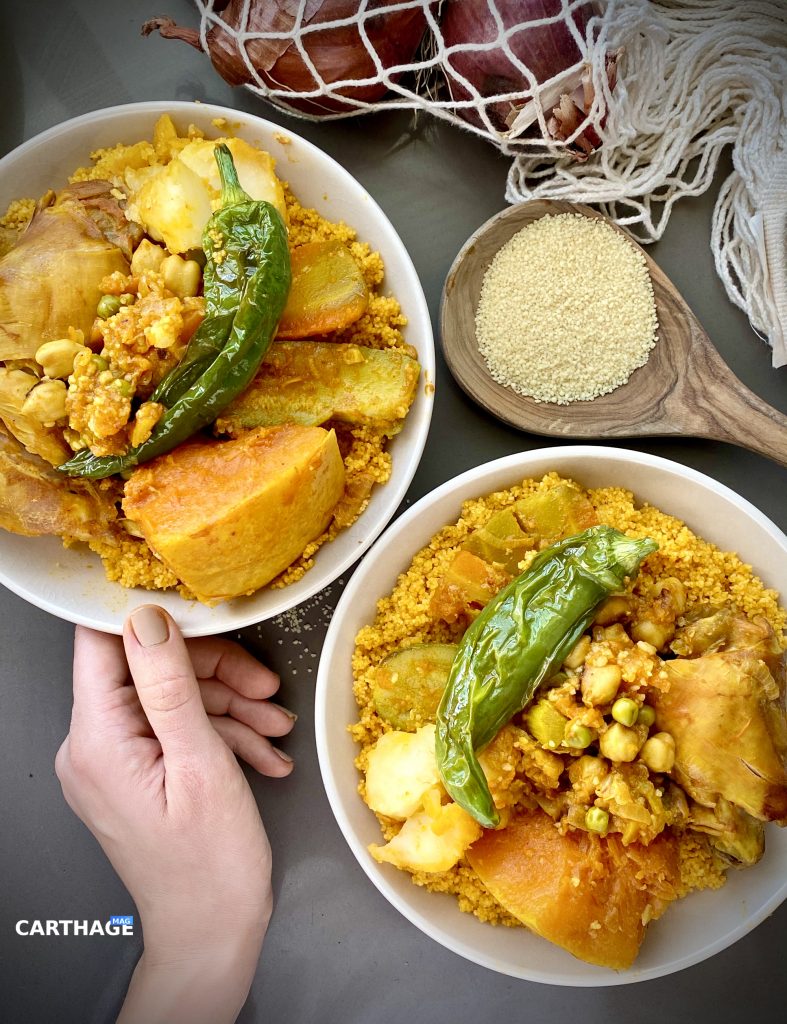
The third is temperament. Tunisian couscous is spiced with intent — not scorching, but present: harissa in the base, black pepper, sometimes dried rosebud and cinnamon in festive versions, the whole register our food guide calls the national palate. The garnish tells you the occasion: hard-boiled eggs quartered over the mound for family Sundays, whole green chillies grilled and laid on top for the brave, and for weddings the sweet-savoury borzguen of the northwest, strewn with dates and nuts.
The UNESCO Listing — and Why It Took Four Countries
In December 2020, UNESCO inscribed the “knowledge, know-how and practices pertaining to the production and consumption of couscous” on the Intangible Cultural Heritage list — jointly nominated by Tunisia, Algeria, Morocco, and Mauritania.
The joint bid was the point: after years of good-natured (and occasionally less good-natured) rivalry over ownership, the four Maghreb states submitted together, and the listing celebrates the shared civilization of the grain — the rolling, the steaming, the vessel, the gathering — rather than any one nation’s pot. Diplomacy achieved over semolina what summits never quite managed. Tunisia, characteristically, celebrated by insisting its version was still the best.
A Regional Map of the National Dish
Tunis and the north: the canonical lamb-or-beef red couscous with the full vegetable senate — turnip, carrot, potato, chickpeas, squash in season.
The Sahel and Sfax: fish couscous territory, with quince sometimes sweetening the autumn pots.
Djerba: its own school entirely — fish, but also an herb-green vegetarian couscous the island’s Amazigh and Jewish kitchens perfected.
The south: couscous with kadid (spiced sun-dried lamb), richer, saltier, built for the desert; barley couscous (malthouth) rules the countryside.
Everywhere, for dessert: masfouf — sweet couscous with raisins, dates, and nuts, the Ramadan sohour classic. One grain, a whole atlas.
The Sunday Ritual
Couscous in Tunisia keeps a calendar. Sunday is its day — the mosque, then the family table, the week’s true punctuation mark. It anchors weddings (where the couscous is judged with the severity other cultures reserve for the dress), welcomes newborns, comforts mourners, and feeds the harvest.
The UNESCO dossier is really about this: couscous less as a dish than as the country’s way of gathering. Invited to a Tunisian home for Sunday couscous? That’s not lunch, that’s admission to the family — accept, arrive hungry, and read our guide to Tunisian table etiquette for the finer points.
The Recipe: Classic Red Couscous (Serves 6)
You need: 500 g medium couscous · 800 g lamb shoulder or beef, in chunks (or a whole fish, for the coastal version) · 3 tbsp tomato paste · 1–2 tbsp harissa · 1 large onion, chopped · 4 garlic cloves · 2 tbsp olive oil plus more for the grain · 1 tbsp ground coriander-caraway mix (tabel) · turnips, carrots, potatoes, and a wedge of squash, in large pieces · a handful of soaked chickpeas · salt, black pepper · water.
1. Build the red base. In the bottom of a couscoussier (or a deep pot), sweat the onion in olive oil, add the meat and brown it, then the tomato paste, harissa, garlic, and spices. Fry until the oil turns brick-red and fragrant — this tahmira is the soul of the dish; don’t rush it.
2. Make the broth. Add water to cover generously, plus the chickpeas. Simmer 45 minutes before the vegetables go in (roots first, squash last).
3. Steam the grain — twice. Rub the dry couscous with a little olive oil and water, fluff, and steam it uncovered over the simmering broth for 20 minutes. Turn it out, sprinkle with water, break every clump with wet hands (or a fork, coward’s version), and steam again. This double steaming is the entire difference between couscous and wet sand; instant “just add water” couscous is legal in Tunisia but discussed in lowered voices.
4. Assemble. Mound the grain on the great platter, moisten it with ladles of the red broth until it gleams, crown with the meat and vegetables, and bring the remaining broth to the table for the inevitable requests for more. Quartered boiled eggs and grilled chillies on top, per taste and courage.
This is one of sixty. The fish couscous of Sfax, masfouf, and the rest of the repertoire — measured, tested, and written for home kitchens abroad — are in The Authentic Tunisian Cookbook: 60 traditional recipes from the heart of North Africa, $9.99, PDF & EPUB.
Eating It in Tunisia
Restaurant couscous is a lottery the visitor should play strategically: the great versions live in homes, at weddings, and in the handful of unfashionable lunch places where the pot is Sunday-only and gone by two.
Rules of thumb: order fish couscous on the coast and lamb inland; Sunday is the day everywhere; and if a place lists couscous seven days a week alongside pizza, keep walking. The dishes around it — brik to start, mint tea after — are mapped in our Tunisian food guide.
From the Carthage Magazine Bookshelf
The national dish deserves the full library.
- The Authentic Tunisian Cookbook — sixty traditional recipes from the heart of North Africa, couscous school included. $9.99 · PDF & EPUB
- All About Tunisia — the definitive English-language traveler’s guide. 572 pages, 27 chapters, all nine regions, every UNESCO inscription — the couscous listing included. $24.99 · PDF & EPUB
- Speak Like a Local — 200+ Tunisian Arabic phrases with native audio recorded in Tunis. Including how to ask for seconds. $14.99 · PDF, EPUB, MP3
All three available as a bundle for $39.99 — guide, language, and food, delivered together.

2 comments
Thanks for sharing, Rahma — great recipe! Tunisian Couscous is definitely the best and most delicious Couscous, and this isn’t up for discussion!
Thank you for sharing this recipe! Tunisian couscous is the BEST and ONLY couscous I will eat! My best friend is from Tunis and makes this for me. I love her food. The Brik, wheat soup (that is how she explained it to me, not the actual name of it) recipes are also my favorite.