
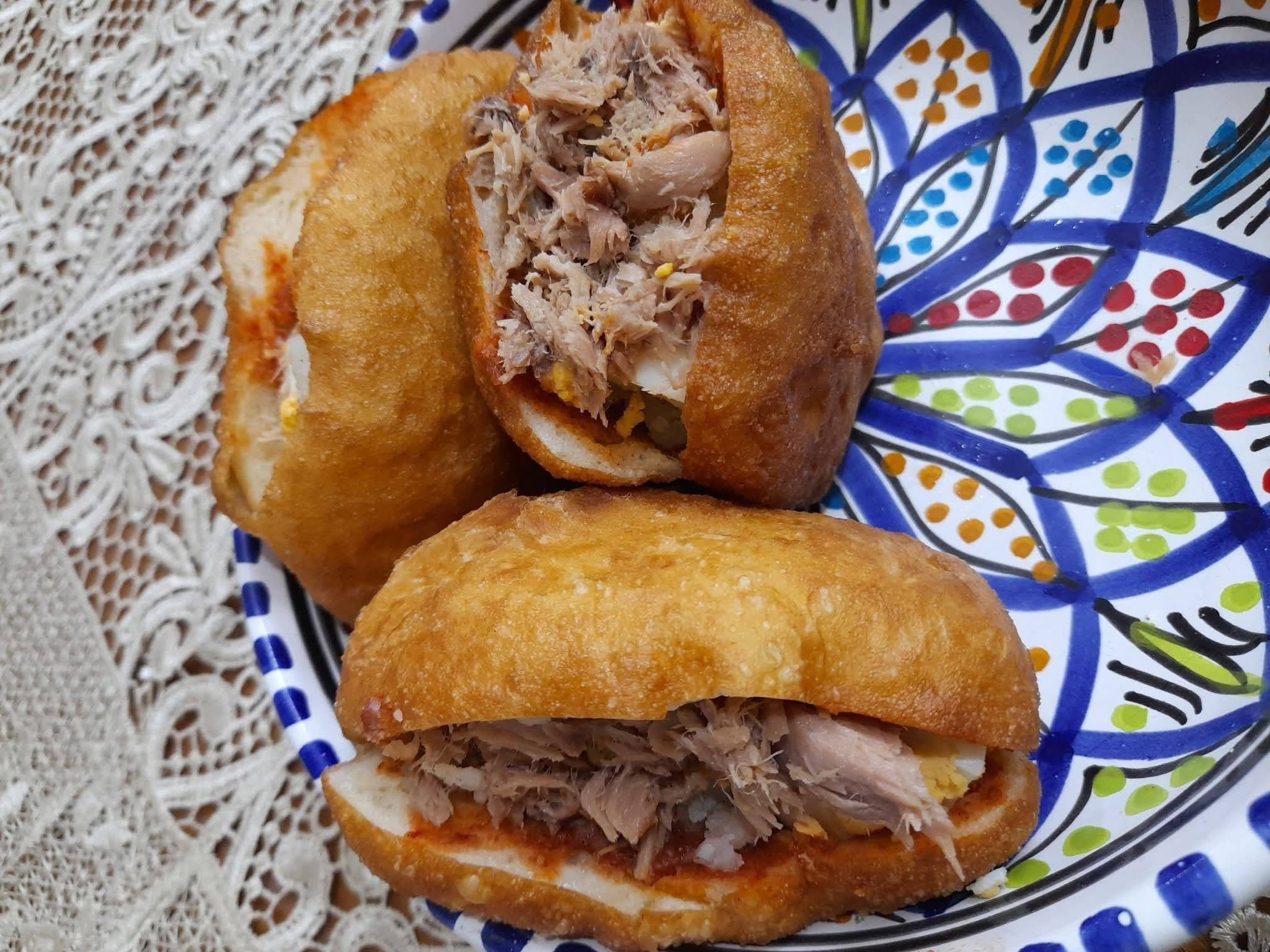
Quick Answer A fricassé (pronounced free-kah-SAY) is a small, slightly sweet bread roll, deep-fried until golden, then split and packed with tuna, harissa, sliced boiled potato, black olives, capers, and wedges of hard-boiled egg. It is not a baguette sandwich; the fried, faintly sweet roll is the whole point, and the contrast between that sweetness and the salty, fiery filling is what makes the dish. It is street food, beach food, after-school food — one of the cheapest and most beloved snacks in the country, sold from bakery counters and seaside kiosks for the price of a bus ticket.
It is four o’clock on a summer afternoon in a coastal town, and the queue at the pâtisserie counter has not moved in five minutes, because no one is in a hurry. A man in a damp swimming shirt orders three. A girl with sand still on her shins holds up two fingers and a fistful of coins. Behind the glass, the cook lifts a small golden roll from a tray, splits it with a thumb, and begins to build: a spoon of oil-dark tuna, a red swipe of harissa, two coins of boiled potato, three olives, a quarter of a hard-boiled egg, a scatter of capers. He folds the paper around it and hands it across without a word.
This is fricassé. And the first bite — the faint sweetness of the fried bread giving way to salt, then oil, then the slow heat of the harissa — is one of the small, perfect, repeatable pleasures of a Tunisian summer.
What is a fricassé, exactly?
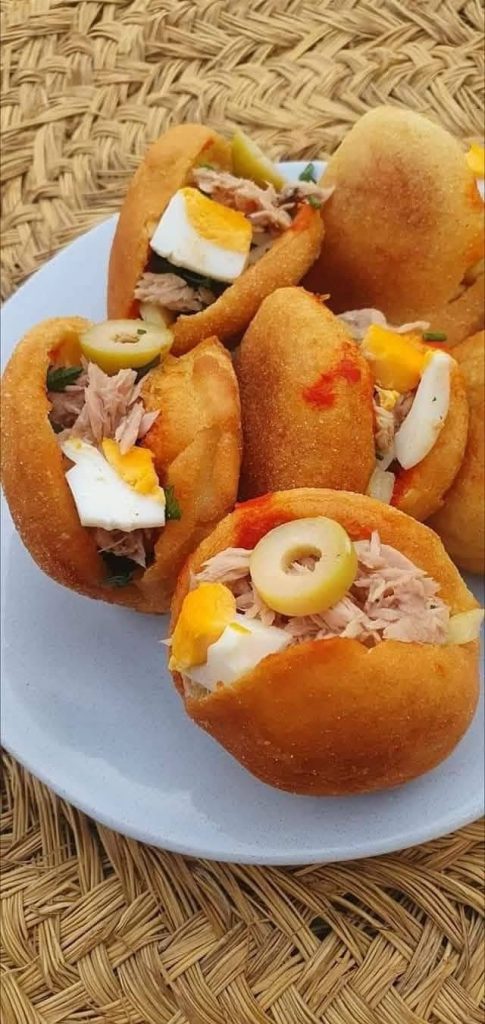
The first thing to understand is that a fricassé is not, despite the way it gets translated, really a sandwich — not in the way Tunisians mean when they say kaskrout. The defining element isn’t the filling, which it largely shares with half of Tunisian street food. It’s the bread.
A fricassé is built on a small roll of enriched, lightly sweetened dough that has been deep-fried rather than baked — closer in spirit to a savoury doughnut than to a baguette. Fried, it comes out burnished and glossy on the outside, soft and faintly sweet within. That sweetness is not a mistake or an afterthought. It is the dish’s entire architecture. Everything packed inside the roll — the salt of the tuna, the brine of the olives and capers, the slow burn of the harissa — is there to argue with the sweetness of the bread, and the pleasure of a fricassé lives in that argument.
The name is French — fricassée — borrowed during the protectorate era and then quietly detached from anything a French cook would recognise. There is no fricassée in France that looks remotely like this. The word came to Tunisia, the Tunisians kept it, and the thing it now describes is entirely their own.
The bread: a fried roll, not a baguette
If you want to understand why a fricassé tastes different from every other Tunisian sandwich, watch one being made from scratch.
The dough is a soft, slightly sweet, slightly enriched mix — flour, yeast, sugar, a little oil, sometimes an egg — kneaded until elastic and left to rise into something between a bread dough and a brioche. It is shaped into small ovals, proved a second time, then lowered into hot oil and fried until deep gold on both sides. The result puffs slightly, crisps at the surface, and stays pillowy inside.
This is the step that separates fricassé from the rest of the family. The casse-croûte tounsi, Tunisia’s everyday baguette sandwich, runs on crusty French-style bread. The fricassé runs on fried sweet dough. Same fillings, often the same counter, completely different sandwich. One is lunch; the other is a treat, and Tunisians feel the difference in their bones.
The frying also means the bread carries oil the way pastry does, which is why a good fricassé feels richer than its modest size suggests — and why two is the standard order and three is not unusual.
The filling: tuna, harissa, and the supporting cast
The canonical fricassé filling is the same quintet that runs through much of the country’s street food, assembled with a little more care because the roll is small and every component has to count.
- Tuna. Tinned, in olive oil, drained but not bone-dry. Tunisia is one of the great tuna nations of the Mediterranean — the bluefin grounds off Cap Bon and Sidi Daoud have been worked since Phoenician times — and the better local tinned tuna is taken seriously enough to outprice the imported brands. It is the heart of the filling.
- Harissa. The red line down the middle of the roll. A proper fricassé is built mharher — spiced — and the harissa is not a garnish but a structural ingredient, cutting the sweetness of the bread and the richness of the oil.
- Potato. A few coins of boiled potato, for body and to keep the filling from sliding out the ends.
- Olives and capers. Black olives, usually whole or halved; capers for the sharp brine that lifts everything.
- Egg. Wedges of hard-boiled egg — never raw, which is the brik’s trick, not the fricassé’s.
Some cooks add a spoon of slata mechouia, the grilled-pepper salad, which makes the whole thing softer and smokier. A few add a slice of kashkawal cheese. The frying oil matters less here than in brik, but the better bakeries still fry in Tunisian olive oil or a blend, and you can taste it.
Fricassé, brik, and the rest of the family
It helps to place the fricassé among its relatives, because Tunisians eat across a whole spectrum of fried-and-filled things and a visitor can lose track fast.
The closest cousin is brik — also fried, also built on tuna and harissa, also eaten with the fingers. But brik is a thin, shattering pastry around a molten egg, and it belongs to the table, to Ramadan, to the start of a meal. The fricassé is bread, not pastry; it belongs to the street, to the beach, to the gap between lunch and dinner. They share a flavour family and almost nothing else.
Then there is the wider world of the casse-croûte and its variations — the kaskrout kafteji built on fried vegetables, the kaskrout lablebi that turns lablabi into a portable thing, the Bizerte lablabi sandwich that the north claims as its own. The fricassé sits among these as the sweet one, the fried one, the one that feels most like a small indulgence rather than a working lunch.
How to order one
There is no elaborate eating ritual the way there is with brik — no yolk to manage, no shirt to ruin. The fricassé is a stand-up, walk-away food. But there is a way to order one well.
First, order it mharher if you can take the heat — without the harissa speaking up, the sweet bread has nothing to push against and the whole thing falls flat. Second, order two. One fricassé is a tease; the standard unit of fricassé consumption is the pair, and a single will leave you back in the queue within the hour. Third, eat it immediately, while the bread still carries the warmth of the fryer. A cold fricassé is a sad object, and the dish does not reward patience.
If you are handed a fork, you are in the wrong establishment. The fricassé is eaten with the hands, in three or four bites, ideally somewhere within sight of the sea. (There are other quiet ways a visitor gets identified at a Tunisian table.)
The seasonal and regional accents
The fricassé is genuinely national — you will find it from the bakeries of the capital to the kiosks of the deep south — but it has its moods.
- Summer and the coast. This is the fricassé’s natural season. It is, more than almost any other Tunisian food, a beach snack — sold from seaside stands and small pâtisseries in every coastal town, eaten with sandy hands between swims. A Tunisian summer without a beach fricassé is missing something.
- The bakery version, year-round. Inland and out of season, the fricassé lives at the neighbourhood bakery counter, an afternoon snack for schoolchildren and office workers alike, sold for small change beside the day’s bread and pastries.
- Spice and richness. Coastal versions tend to lean harder on tuna and harissa; some bakeries make a milder, more bread-forward fricassé aimed at children. The cook’s hand with the harissa is the main variable.
- The diaspora. Like brik and the rest of the canon, the fricassé has travelled with Tunisians to Paris, Marseille, and Montreal, where it turns up in North African bakeries and tastes, to anyone who grew up with it, exactly like a summer afternoon at home.
Where to try it in Tunisia
There is no authoritative list of “best fricassé,” because the best fricassé is almost always the one being lifted out of the fryer at a nameless bakery in a town you happen to be passing through. But a few honest pointers:
- Any pâtisserie with a fryer going. Walk past one in the afternoon. If you can smell the oil and see a tray of small golden rolls, go in and order two mharher.
- A seaside kiosk in summer. Sousse, Hammamet, La Marsa, Bizerte — any beach town’s snack stands will have them. This is the fricassé in its element.
- The corner bakery at four o’clock. In any neighbourhood, in any city, the afternoon fricassé is a fixture. Follow the schoolchildren.
The point of a fricassé was never to be sought out at a famous address. The point is that it is everywhere, cheap, warm, and reliably good — one of the small democratic pleasures of Tunisian daily life.
Making your own
The filling is the easy part — tuna, harissa, boiled potato, olives, capers, egg, assembled to taste. The challenge, and the reason most people order rather than make, is the bread: a soft, lightly sweetened, twice-proved dough, fried rather than baked, which takes a little practice to get right. Get the dough wrong and you have a doughnut or a dinner roll; get it right and you have the real thing.
The sixty recipes in The Authentic Tunisian Cookbook include the fried-dough techniques behind the street-food classics — the ones that turn a bowl of familiar ingredients into a fricassé, a brik, or a kaskrout kafteji — written by the Tunis cooks behind some of Carthage Magazine’s most-read recipes.
Bsaha, as one says in Tunis — to your health, and enjoy.
From the Carthage Magazine Bookshelf
If a Tunisian summer is on the calendar — fricassé on the beach, brik at the table — three Carthage Magazine ebooks were built for the days between arrival and departure:
- All About Tunisia — the definitive English-language traveler’s guide. 572 pages, 27 chapters, all nine regions, every UNESCO inscription, five thematic trails — and the practical answers (visa, currency, transport, etiquette) most travelers wish they’d had on the plane. $24.99 · PDF & EPUB
- Speak Like a Local — 200+ Tunisian Arabic phrases with native audio recorded in Tunis. The phrases for the bakery counter, the souk, the café, and the dinner table — including how to ask for your fricassé mharher. $14.99 · PDF, EPUB, MP3
- The Authentic Tunisian Cookbook — sixty traditional recipes from the heart of North Africa, fricassé and brik among them, for when you get home and find yourself missing the food. $9.99 · PDF & EPUB
All three available as a bundle for $39.99 — guide, language, and food, delivered together.
