

Last reviewed: May 2026. We refresh this guide when exchange rates or foreign-exchange rules change materially.
Quick Answer
The currency of Tunisia is the Tunisian Dinar (TND), divided into 1,000 millimes. As of May 2026, 1 US dollar buys about 2.89 dinars; 1 euro buys about 3.27 dinars; 1 British pound buys about 3.84 dinars. The dinar is a closed (non-convertible) currency — you cannot legally exchange it outside Tunisia, and you cannot legally take more than a small amount of it out of the country. Plan to exchange money after you arrive, not before. Card payments are accepted in hotels, mid-range restaurants, and supermarkets in major cities; cash is still king everywhere else.
What the Tunisian Dinar Looks Like
The dinar is issued in seven banknote denominations — 5, 10, 20, 30, 40, 50, and (newly introduced) 100 dinar notes — and a set of coins running from millimes up to 5 dinars. Each banknote features a different Tunisian historical figure or landmark on its face: Hannibal Barca, Ibn Khaldoun, Aboul-Qacem Echebbi, Habib Bourguiba, and the great mosques of Kairouan and Tunis among them. The coins are mostly used for small purchases — buying a baguette, paying for a café direct, tipping a porter.
Tunisians regularly quote prices in two ways. “Dinar” is the unit you’ll see on price tags. But in colloquial speech, prices under a dinar are often given in millimes (“c’est huit cents millimes” = 800 millimes = 0.8 dinar = roughly 28 cents). Larger sums are sometimes spoken in thousands of millimes — a Tunisian shopkeeper saying “vingt mille” usually means twenty thousand millimes, which is twenty dinars, not twenty thousand. It throws every first-time visitor.
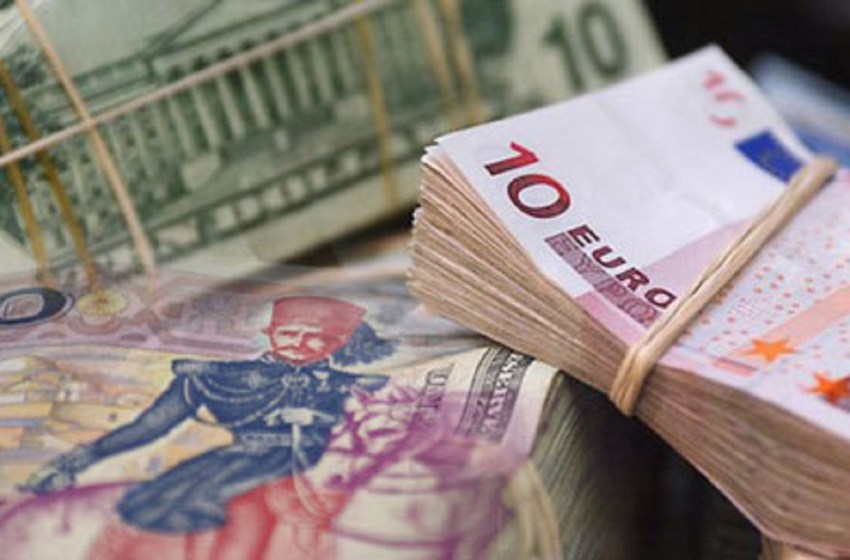
Current Tunisian Dinar Exchange Rate
Current mid-market Tunisian currency exchange rate can be found with the help of this currency exchange calculator.
Tunisian Dinar to USD:
Tunisian Dinar to Euro:
You can check the current Tunisian currency rate against other currencies using the below widget.
The Closed-Currency Rule — Important
The Tunisian dinar is a closed currency, meaning it cannot legally be traded outside Tunisia. Three practical consequences for travelers:
1. You can’t buy dinars before you fly. No Western currency exchange or airport bureau outside Tunisia carries it (or if one claims to, the rate will be punitive). Don’t waste time looking.
2. You can’t take significant amounts of dinar out at the end of your trip. Tunisian customs limits the amount of dinar you can export — small amounts as souvenirs are tolerated, but bringing back a wad to spend on your next visit is not. Spend down before you leave the country.
3. Re-exchange is possible but requires receipts. If you have leftover dinar at the end of your trip and want to convert it back to euros or dollars, you can do so at the airport — but only up to roughly 30% of what you originally exchanged, and only against your original exchange receipts. Keep every receipt.
Where to Exchange Money
In rough order of best rate to worst:
Bank branches. Tunisia’s main banks — BIAT, Attijari, STB, UIB, BNA, Amen Bank — all offer foreign-exchange counters at most branches. Rates are close to the BCT reference rate, with a small commission. Bring your passport. Branches are open weekdays 8:30 a.m. to 4:30 p.m. (lunch closure 12:00–2:00 in some) and Saturday mornings.
Hotel front desks. Major hotels exchange money at a slightly worse rate than banks but with the convenience of being open at night and on Sundays. Fine for a small amount on arrival; not where you should change your whole travel budget.
Bureau de change kiosks. Found in tourist areas (Sidi Bou Said, Hammamet, Sousse medina, the Tunis medina near Bab el Bhar). Rates vary; always check the displayed rate before handing over money.
Tunis-Carthage Airport. Convenient and 24/7, but the worst rate you’ll find. Exchange only what you need for the taxi into town (around 30–50 dinars is plenty) and do the rest in town the next day.
Avoid: the street touts who will approach you in tourist areas offering rates that sound suspiciously good. The notes are sometimes counterfeit or short-counted. Use a bank.
ATMs — The Easy Way
Tunisia has a dense ATM network. Every Tunisian bank, plus the postal service (La Poste), runs ATMs that accept Visa, Mastercard, and most international debit cards. Withdrawals are dispensed in dinar at a competitive rate.
Practical notes:
- The per-transaction limit is typically 400–600 dinars, with a daily limit of around 1,500 dinars on most cards.
- Your home bank’s foreign-transaction fee is usually the biggest cost. Cards from fintech providers (Revolut, Wise, Monzo, N26) generally have lower fees than traditional bank cards.
- ATMs at airports and in central Tunis are reliable; ATMs in smaller southern towns occasionally run out of cash on Fridays and weekends.
Card Payments
Card acceptance has grown significantly in Tunisia’s main cities over the past five years. As of 2026, you can expect to pay by card at:
- All international hotels and most three-star-and-up Tunisian hotels.
- Mid-range and upscale restaurants in Tunis, Sousse, Hammamet, Sfax, and Djerba.
- Supermarkets (Carrefour, Monoprix, Géant, MG, Aziza).
- Pharmacies and most chain stores.
- Petrol stations on major roads.
You should still expect to pay cash for:
- Taxis (almost universally).
- Cafés, louage (shared minibus) tickets, and most local food stalls.
- The medinas — particularly the smaller souks.
- Small artisan shops and roadside markets.
A good rule of thumb: in the centre of Tunis, Sousse, La Marsa, or Sidi Bou Said, you can survive on cards. Outside those cities, carry cash.
Mobile Payments — The TUNPAY Revolution
In May 2026 the Central Bank of Tunisia unified the country’s mobile-payment ecosystem under a single visual label: TUNPAY. Sixteen payment service providers — including the long-established Flouci digital wallet, D17 from La Poste, and a handful of new bank-backed wallets — now operate under the TUNPAY mark, accepted at a fast-growing list of merchants identified by a “Wallet Acceptance Point” sticker. Mobile-payment transaction value grew 31% in 2025 and looks set to outpace that in 2026.
For Tunisian residents, opening a TUNPAY-compatible wallet is straightforward. For tourists, the practical impact is that more and more Tunisian merchants will accept domestic mobile wallets and contactless cards, but most international travelers will still rely on cards and cash during a short visit.
The 2026 Finance Law — What Changed for Foreign Exchange
In December 2025, Tunisian Parliament passed an amendment to the 2026 Finance Law that allows Tunisian residents to open foreign-currency or convertible-dinar bank accounts without prior approval from the Central Bank — a change that ends a 50-year-old restriction. A broader new Foreign Exchange Code is currently working its way through final adoption and would, among other things, authorize private exchange offices for the first time, formally recognize crypto-assets, and grant residents and businesses far more flexibility in cross-border transactions.
For most short-term visitors, none of this changes anything practical. For Tunisian residents, freelancers, startups, and expats living in Tunisia, the reform is significant — and we cover it in more detail in our news piece on the 2026 foreign-currency accounts.
Tipping and Small-Cash Etiquette
Tipping in Tunisia is appreciated but not at the levels expected in North America. Practical norms:
- Restaurants: Round up the bill, or leave around 5–10% if service was good. The bill itself usually does not include a service charge.
- Taxis: Round up to the nearest dinar; no formal tip expected.
- Hotel porters: 1–2 dinars per bag.
- Tour guides: 10–20 dinars per person for a half-day, more for a full day.
- Café waiters: Leave the small change.
Always keep a few small notes (5s and 10s) and millime coins for tips and small purchases. Tunisia is a cash-coin culture in everyday life — change is precious, and breaking a 50-dinar note for a 2-dinar coffee will make you no friends.
Frequently Asked Questions
What is the currency of Tunisia?
The Tunisian Dinar (TND), divided into 1,000 millimes. It is issued by the Central Bank of Tunisia (BCT).
Can I use US dollars or euros in Tunisia?
Not directly. Tunisia is a closed-currency country and merchants are legally required to price and accept payment in dinars. You must exchange to dinars or pay by card. Hotels occasionally accept hard currency at the front desk, but you will always lose on the rate.
Can I exchange Tunisian dinars before traveling?
No. The dinar is a closed currency and cannot be legally obtained outside Tunisia. Exchange after you arrive, at a bank or ATM.
Are ATMs widely available in Tunisia?
Yes, especially in major cities and tourist areas. Most accept Visa, Mastercard, and major international debit cards. Per-transaction withdrawal limits are typically 400–600 dinars.
Are credit cards accepted in Tunisia?
In hotels, supermarkets, mid-range and upscale restaurants in major cities — yes. In taxis, cafés, medinas, and smaller towns — usually no. Always carry some cash.
How much cash should I bring to Tunisia?
Bring small amounts of euros, dollars, or pounds to exchange on arrival (enough for the first day or two), then use ATMs for the rest of your stay. A first-day buffer of €100–200 is plenty.
What is the best currency to bring to Tunisia?
Euros get marginally better rates than US dollars or British pounds at most exchange offices, because Tunisia’s largest trading partner is the European Union. Either of the three is widely accepted.
Useful Reads:
