

Quick Answer — Tunisian street food is built on a holy trinity: fried dough, tuna, and harissa, deployed in endless combinations for one to five dinars a serving. The essentials: fricassé (the fried mini-roll), kafteji (chopped fried vegetables and egg), the kaskrout tounssi (Tunisia’s baguette masterpiece), the s’han tounssi (the loaded Tunisian plate), chapatie and mlewi (the griddle-bread sandwiches), makloub (the grilled folded wrap), lablabi (the chickpea bowl that is practically a citizenship test), brik (the shattering egg-filled pastry), and mraweb (the milk-bar classic that washes it all down). Here’s what each one is, where it lives, and how to eat it without embarrassing yourself.
Tunisia’s real national restaurant has no name, no door, and no menu. It’s the counter — the tiled hole-in-the-wall with a vat of oil, a drum of harissa, a stack of baguettes, and a man who has made one thing ten thousand times. Around noon, the whole country queues at some version of it: students, taxi drivers, lawyers with their sleeves rolled, everyone holding the same greaseproof paper, everyone’s wrist about to be stained by the same runny yolk.
This is the food the top-tier restaurant guides can’t give you, because it was never restaurant food. It’s fast, ferociously cheap, spicier than the tourist coast admits, and — this is the part visitors don’t expect — genuinely excellent, refined by a century of daily repetition rather than any chef’s ambition. What follows are the ten that matter. (For the sit-down canon — couscous, mloukhiya, the grilled fish — start with our top 20 foods in Tunisia instead.)
1. Fricassee

A fricassé is a small oval of dough, deep-fried until it’s somewhere between a doughnut and a roll, then split and packed with tuna, potato, boiled egg, olives, and harissa. It is sold from glass cases at cafés and bakeries in every town in Tunisia for about a dinar, it is engineered to be eaten in four bites standing up, and The New York Times only discovered it in 2023 — roughly a century after the four o’clock fricassé became a Tunisian institution. Order two. Nobody orders one.
2. Kaftejji
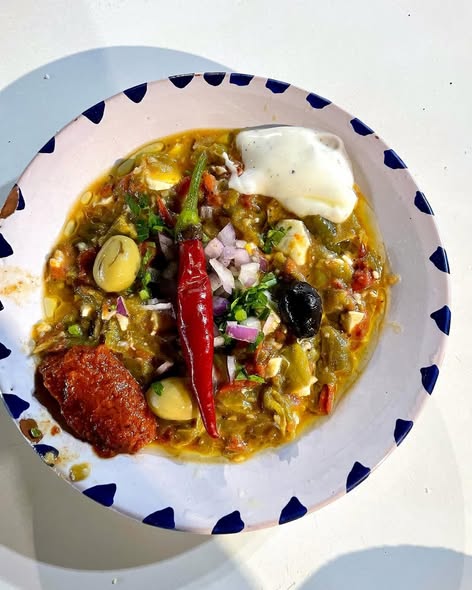
Fried pumpkin, peppers, potatoes, and tomatoes, chopped together on a board with a fried egg until everything becomes one glistening, harissa-laced whole — kafteji is what happens when a cuisine decides that a plate of fried vegetables should be greater than the sum of its parts. Served on a plate with bread or stuffed straight into half a baguette as a kaskrout kafteji, it’s the working lunch of the entire country and the dish most likely to make a vegetarian weep with relief.
3. Kaskrout Tounssi

The French left the baguette; Tunisia weaponized it. The casse-croûte tunisien is half a baguette scooped and loaded with tuna, salade méchouia, olives, boiled egg, potatoes, capers, and a stripe of harissa that means it. It costs two or three dinars, it is available within two hundred metres of wherever you are standing, and it is — this is said with full knowledge of what France would think — the best thing ever done to that bread. The whole extended family of Tunisian sandwiches has its own field guide.
4. S’han Tounssi

Literally called the Tunisian dish. This is a plate garnished with Tunisian grilled salad (Mechouia), cucumber, olives, baked potatoes, onion, tomatoes, harissa and topped off with a half-cooked egg.
5. Chapatie

The Chapatie is garnished with omelette and you can add various ingredients such as tuna, cheese, or others.
6. Mlewi

Mlewi is a semolina flatbread folded and refolded like laundry until it fries up in thin, buttery layers — then it’s slathered with harissa, layered with tuna, egg, or cheese, and rolled like a burrito. Watch it being made if you can; the dough-flattening is street theatre. It shares the griddle with its cousin the chapati tunisien (no relation to India’s — a dense round bun grilled and stuffed with omelette, cheese, and the usual suspects), and between them they own the country’s evening snack economy.
7. Makloub
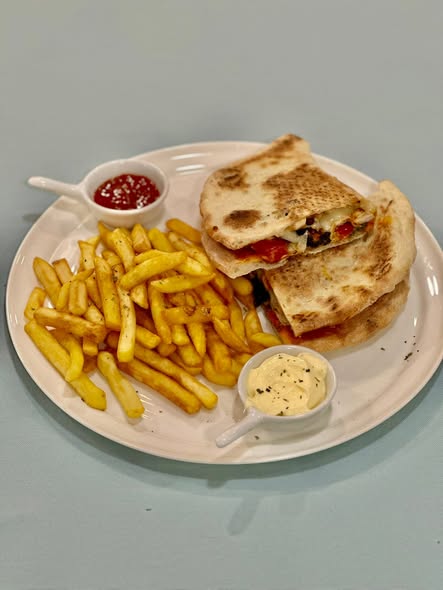
The makloub (“folded”) is the newer classic: a round of dough grilled, folded over merguez, grilled chicken, or escalope with cheese, fries, and sauce, then pressed like a calzone that chose the street over the oven. It’s the after-dark order, the post-match order, the student order — the dish that proves Tunisian street food is a living tradition rather than a museum, still minting classics.
8. Lablabi

Lablabi is the deepest thing on this list: a bowl of chickpeas in garlicky, cumin-heavy broth, built over torn stale bread, crowned with harissa, olive oil, a soft egg, and — at a proper counter — your choice from a battery of extras: tuna, capers, preserved lemon. You tear the bread yourself; this is not optional, it is the ceremony. Eaten mostly in the cooler months and properly eaten in the morning, at a counter, quickly, before the bread sinks. Three to five dinars for what is essentially a complete nutritional and spiritual experience. Bizerte even folds the whole dish into a sandwich, because Tunisia.
9. Brik
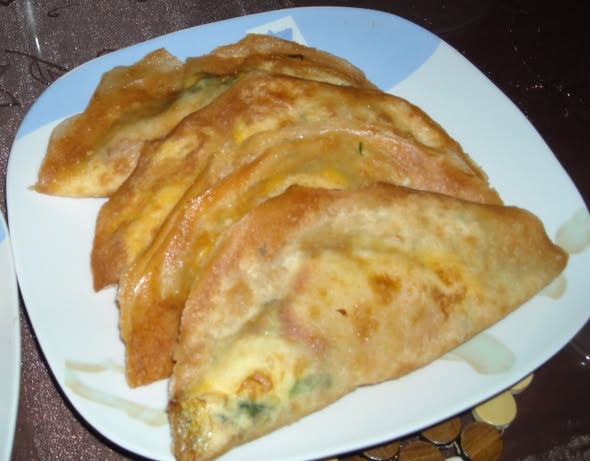
The initiation rite of Tunisian street food. A square of tissue-thin malsouka pastry is folded around a whole egg, a flake of tuna, capers, and parsley, then slipped into hot oil for under a minute — just long enough to blister gold and go glass-crisp at the edges. Eaten from the corners, folded inward, standing up, with the yolk making its inevitable run toward your wrist. Two to four dinars anywhere in the country, non-negotiable on the Ramadan table, and the dish first-time visitors are still talking about a year later.
10. Mraweb

The quietest institution on the Tunisian street. Mraweb is milk left to set until it’s thick, cool, and gently sour — somewhere between yogurt and a drink — served in a plain glass at the mahlaba, the neighborhood milk bar that has anchored Tunisian streets since long before anyone said “smoothie.” You drink the first half and spoon the rest, often with a sweet bun or a slice of cake on the side, and in summer it does what no soda can: it resets you. A dinar or so, no branding, no menu — just the glass, the counter, and a tradition of turning milk into the country’s most underrated street pleasure.
How to Eat All This Without Getting It Wrong
Follow the queue, not the sign. The best counters have no branding and a line of locals at 12:30; that line is the only review that matters. Carry small cash — nothing on this list has ever met a card terminal, and a pocket of coins and five-dinar notes is the whole payment infrastructure (our money guide covers keeping it stocked). Calibrate the harissa — say shwaya (a little) your first day; you’ll be saying barsha (a lot) by day four. Time it like a local: lablabi in the morning, casse-croûte and kafteji at lunch, fricassé at four, mlewi and makloub after dark. And budget travelers should note the happy math: eating brilliantly from this list costs 10–20 dinars a day, which is why street food is the engine of every Tunisian budget trip.
The oil, the tuna, the harissa, the queue — it never changes, and that’s the point. Tunisia’s street food isn’t a trend and was never designed for you. Which is exactly why it’s worth crossing the Mediterranean to stand in line for.
From the Carthage Magazine Bookshelf
When the trip ends and the four o’clock fricassé craving doesn’t, these three are the cure.
- All About Tunisia — the definitive English-language traveler’s guide. 572 pages, 27 chapters, all nine regions, every UNESCO inscription, five thematic trails — and the practical answers (visa, currency, transport, etiquette) most travelers wish they’d had on the plane. $24.99 · PDF & EPUB.
- Speak Like a Local — 200+ Tunisian Arabic phrases with native audio recorded in Tunis. The phrases for the taxi, the souk, the café, and the dinner table. $14.99 · PDF, EPUB, MP3.
- The Authentic Tunisian Cookbook — sixty traditional recipes from the heart of North Africa. For when you get home and find yourself missing the food. $9.99 · PDF & EPUB.
All three available as a bundle for $39.99 — guide, language, and food, delivered together.
