
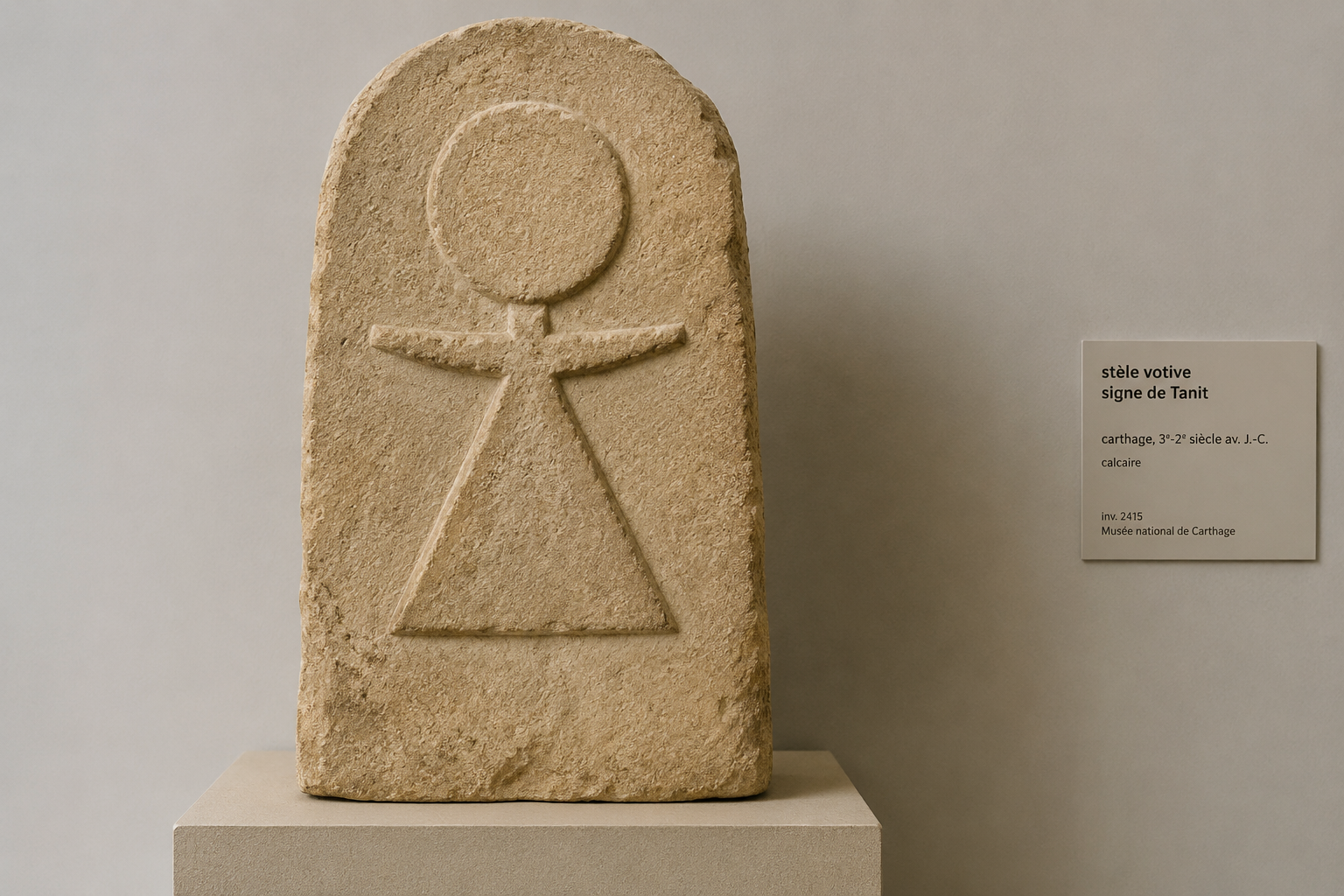
Stand long enough on Byrsa Hill, in the cool gloom of the Carthage National Museum, and you start to feel watched. Hundreds of stelae lean against the walls in patient rows, weathered by sun and salt and twenty-five centuries, and on most of them is carved the same small persistent figure: a circle balanced atop a triangle, two arms outstretched as if to bless or to gather. The figure could be a child’s drawing of a person. After the third stele, you notice you can read it. After the tenth, you cannot stop reading it.
That figure is Tanit. She was the great goddess of Carthage — the moon held in a woman’s body, mother and warrior and mystery all at once — and her city was burned to the ground by Rome more than two thousand years ago. Her temples were dismantled. Her name was pushed out of the official record. Her priests were scattered, her cult absorbed, her sanctuaries rededicated to other gods. And yet, in almost any museum, medina, or jewelry shop in modern Tunisia, you will find her. She is on coins, on pendants, on house walls in Sidi Bou Said, on the bases of clay figurines that women still hand-shape in the hills of Sejnane. She has outlived her empire by every conceivable measure.
You just have to know how to see her.
Who Was Tanit?
Tanit — sometimes written Tinnit, sometimes Tannit — was the chief goddess of Carthage from at least the fifth century BCE, though her roots reach much further back, all the way to the Phoenician homeland in what is now Lebanon. An ivory plaque found at the Phoenician port of Sarepta names her alongside Astarte, the older Levantine goddess of love and war, and it is from that tradition she seems to have grown. When the Phoenicians sailed west and founded Carthage on the Tunisian coast around 814 BCE, they brought their gods with them. In the new city, on the new shore, one of those imported goddesses kept growing.
She kept growing until she became something Carthage had never quite seen before: a national goddess.
Her consort was Baal Hammon, the storm god, the Carthaginian face of the supreme deity. One of her titles was Tanit Pene Baal — “Tanit, Face of Baal.” Some scholars read that as subordination, a goddess defined by the god she stood beside. But the Carthaginian inscriptions almost always name her first. To our Lady Tanit, Face of Baal, and to our Lord Baal Hammon. In a culture that put men’s names before women’s by default, that small reversal was not an accident.
She was, in the end, the goddess Carthage prayed to first.
The Sign That Stayed
The sign is what survived. A triangle for the body. A horizontal bar for the arms. A disc on top for the head. Sometimes a crescent floats above the disc; sometimes a palm frond rises beside her like punctuation. It is one of the most pared-down divine images the ancient Mediterranean ever produced, and once you have seen it, you cannot unsee it.
You will find it carved on the votive stelae at the Bardo National Museum and the Carthage National Museum. You will find it scratched onto the bases of figurines hauled from a shipwreck off the coast of modern Israel. You will find it stamped on Carthaginian coins struck in cities Carthage no longer ruled. You will find it sketched on the doors of old houses in Tunis to ward off the evil eye — the same impulse that two thousand years later sees Tunisians hanging the Khomsa above their doorways for the same purpose.
This is why Tanit and the Khomsa are kin. Some Tunisian scholars have argued, with reasonable confidence, that the modern Hand of Fatima is the descendant of the ancient Tanit sign: the open palm above the body, the protective gesture, the moon-curve of the fingers — all of it Tanit, redrawn for a new religion. The shape changed. The job didn’t.
A Goddess of Many Faces
Tanit was not a specialist. She was a moon goddess, yes, but she was also a goddess of fertility — the rains that filled the wadis, the wombs that filled the city, the wheat that filled the granaries. She was a war goddess, depicted in Punic art with wings spread, sword and palm in hand. She was a maternal protector, called upon at the birth of children and the burial of the dead. She was a sky deity and an earth deity at once, the line of her body bridging the two.
It is tempting, with so many centuries between us and her worshippers, to flatten her into a single role — fertility goddess, moon goddess, whatever modern shorthand best matches her image. The Carthaginians were not that tidy. Their goddess was sky and field and battlefield and birthing room. She did everything because the city needed everything from her.
She was also, crucially, the protector of Carthage itself. When Roman soldiers finally breached the city in 146 BCE, they performed a ritual the historians called evocatio — luring an enemy’s gods to switch sides before erasing the enemy. They called Tanit out of her own temple before they burned it. The fact that Rome bothered with the ceremony tells you what they thought she was capable of.
The Tophet, and the Question No One Has Closed
No essay on Tanit can pretend the Tophet isn’t there.
Just south of the ruins of ancient Carthage, in the district modern Tunisians know as Salammbô, lies a sanctuary that has divided scholars for more than a century. It is a field of small stelae, hundreds of them, and beneath each stele is a buried urn, and inside each urn are the cremated remains of an infant or a young animal. The stelae are inscribed To Tanit and to Baal Hammon. The Roman writers who recorded Carthage’s fall — Diodorus Siculus, Plutarch, Tertullian — described the Carthaginians as a people who burned their firstborn children as offerings to their gods.
Some modern archaeologists take the Roman accounts at face value. Others argue the Tophet was a cemetery for stillborn babies and infants who died young — a sanctified resting place, not a slaughtering ground. The bones themselves don’t fully settle the question, and probably never will. What the Romans called infanticide the Carthaginians may have called committing a lost child to the goddess most likely to receive her gently. We cannot quite reach across the gap.
What is certain is that Tanit’s name is on the stelae. Whatever happened at the Tophet, her worshippers believed she was the one to address. Reading those inscriptions today — the same dedicatory formula repeated again and again, To our Lady Tanit — is one of the most disquieting experiences Tunisian archaeology has to offer. It is also one of the reasons Tanit refuses to be folded into a sentimental story. She was a goddess of a city that built its identity around her, and that city did things we still don’t fully understand.
How a Goddess Survives a Destroyed City
When Carthage fell, Tanit should have ended.
The city was razed. The population was killed or enslaved. The religious infrastructure was dismantled. Rome poured curses and salt on the soil and resolved that the place would never rise again. And yet a few decades later, the Romans were already rebuilding Carthage as a colony of the Empire. A century after that, in a great temple they raised on Byrsa Hill, they were worshipping a goddess named Juno Caelestis — Heavenly Juno. Across Roman North Africa, the cult of Juno Caelestis spread and held for three hundred years. She received offerings at Tanit’s old sites. She inherited Tanit’s old attributes. She was Tanit, wearing a Latin name.
Something similar, quieter, happened in the Christian centuries that followed. The Virgin Mary inherited many of the protective and maternal roles that had belonged to Juno Caelestis, who had inherited them from Tanit. By the time the Arabs arrived in the seventh century, the goddess had vanished from any official theology — but the sign was still scratched on the walls of houses, the protective figure with arms outstretched, and the human impulses Tanit had answered for two millennia had not gone anywhere.
There is also a folk thread that has never been broken. In parts of Tunisia, when the rains failed and the fields cracked, women would gather in procession and call on Omek Tannou — Mother Tannou — to send the rain. The ritual is older than anyone can date. The name is recognizably hers. Twenty-five centuries after Carthage burned, in villages where no one would call themselves a worshipper of an ancient goddess, the rain was still being asked for in Tanit’s name.
This is the long, patient way some figures survive. Not by being kept, but by being repurposed.
Where to Find Her in Tunisia Today
The best place to meet Tanit is the Bardo National Museum in Tunis. Its Punic galleries hold votive stelae lifted directly from the Carthage Tophet, the sign of Tanit incised into the limestone with such directness that you can still see where the chisel slipped. Take your time in the Punic rooms. The Roman mosaics get most of the attention; Tanit is the older story.
A short drive away, the Carthage National Museum on Byrsa Hill displays more stelae alongside marble fragments of the goddess herself, and from the museum’s terrace you can look out across the bay her sailors crossed. Below the museum, the Tophet of Salammbô remains open to the public — quiet, treeless, the stelae still standing where they were placed two and a half thousand years ago. It is one of the most unsettling and most necessary visits in Tunisia.
The Archaeology Museum of Nabeul, in Cap Bon, is the underrated stop on the Tanit pilgrimage. Its collection includes terracotta statues of Tanit with a lion’s head — a striking, less-seen version of her, the protector aspect made explicit.
But you do not need a museum ticket to find her. Walk through the medina of Tunis and you will see Tanit smuggled into modern jewelry — silver and gold pendants, sometimes plain, sometimes set with coral, sold a few steps from where her ancient worshippers once bought their sacrificial doves. In the Mogod hills, the women of Sejnane still shape the clay figurines whose forms — disc head, triangular body, outstretched arms — are unmistakable, even if the women themselves call them, simply, dolls. When UNESCO listed the Sejnane tradition as intangible cultural heritage in 2018, what they were listing was, in part, a goddess.
You will see her on the walls of houses in Sidi Bou Said, sometimes painted in the same blue as the doors. You will see her tattooed on the forearms of young Tunisians reclaiming a pre-Arab identity. You will see her, occasionally, on European fashion runways — though she was already there, three thousand years before anyone needed her to be a trend.
Why She Still Matters
There is a temptation, when writing about Tanit, to make her a metaphor — for women, for North Africa, for survival, for the female divine. She is all of those things, but flattening her into a single symbol is exactly the move that erased her in the first place.
The honest thing to say is simpler. Tanit is the first thing Tunisia gave the world that the world has still not stopped using. Before Hannibal crossed the Alps, before the Great Mosque of Kairouan was raised, before the Khomsa became the country’s most photographed amulet, there was a goddess standing on a triangle with her arms out, and her city was named — by the Phoenicians who built it — Qart-ḥadašt, the New City. From Phoenicia to independence, every layer Tunisia has lived through has had to make a decision about what to do with her. None of them have erased her.
Stand in the Bardo for an hour, watching the light shift across her stelae, and you can feel that.
The arms are still out.
