
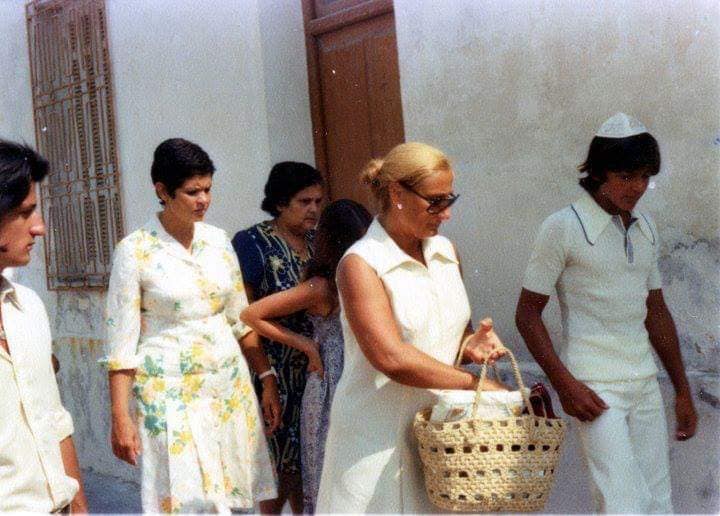
Quick Answer Tunisia has been home to one of the oldest continuous Jewish communities in the world — present since the Babylonian destruction of Solomon’s Temple in 586 BCE, by the community’s own oldest tradition, and demonstrably so since at least the 2nd century CE. At its 20th-century peak the community numbered over 100,000. Today, roughly 1,500 Jews still live in Tunisia, the great majority on the island of Djerba. The wider inheritance — synagogues, cemeteries, neighbourhoods, recipes, songs, and a 2,700-year layer of Tunisian identity — runs through Tunis, Sfax, Gabès, Sousse, Le Kef, Nabeul, and Kairouan, in places most visitors never know to look.
If you visit Tunisia and read the standard travel literature, you will hear that the country has a Jewish heritage and that the heritage is on the island of Djerba. Both statements are true. Both are also incomplete.
Tunisia’s Jewish community is older than Carthage by a generation. It is older than Islam by a thousand years. It once made up around 5% of the country’s population and produced rabbis, scholars, doctors, civil servants, musicians, and merchants who shaped Tunisian life in every domain. Its presence is woven into the medinas of every major Tunisian city. Its absence — for the community that left, mostly between 1948 and 1967 — is a shape in the country’s twentieth century that anyone serious about Tunisia eventually learns to see.
This is a guide to what was, what remains, and where to look.
Beginnings
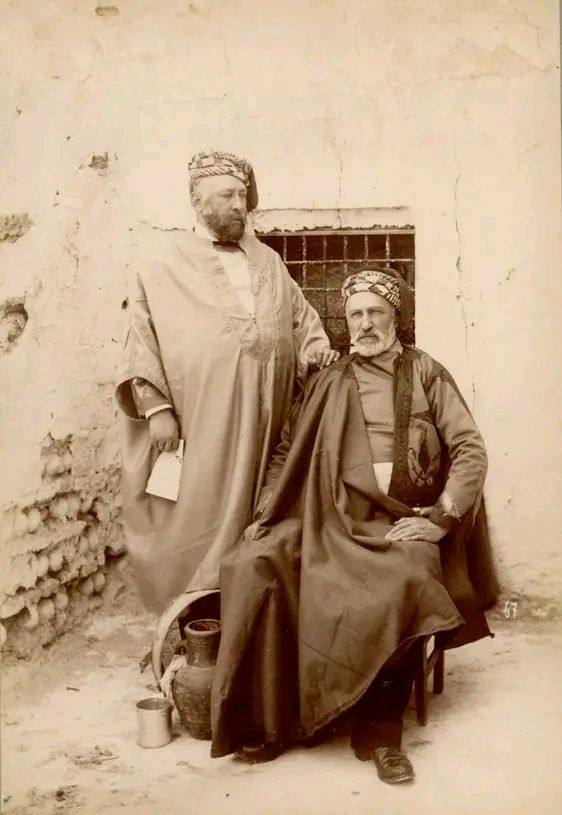
Three traditions account for the founding of the Tunisian Jewish community.
The First Temple tradition. When the Babylonian army under Nebuchadnezzar II destroyed Solomon’s Temple in 586 BCE, a small group of priests fled Jerusalem with relics — possibly a stone, possibly a door, possibly a fragment of the original altar — and travelled west across the Mediterranean. They settled on the island of Djerba and built a sanctuary around the relic. This sanctuary, by the local tradition, became the El Ghriba synagogue — the miraculous one, the oldest synagogue in Africa, still in continuous use today. There is no archaeological proof of this story. There is also no good reason to dismiss it: the genetic, linguistic, and ritual continuity of the Djerba community is consistent with an origin in the late Iron Age, and the tradition is itself part of what makes the community what it is.
The Second Temple tradition. A second group of refugees is said to have arrived after the Roman destruction of the Second Temple in 70 CE, this time settling not only on Djerba but also at Carthage and, by tradition, in the southern oases.
The Roman period. Whatever the truth of the older stories, the historical record is clear from at least the 2nd century CE. Roman Carthage had a substantial and well-organised Jewish community: their inscriptions, in Latin with occasional Hebrew names and motifs like the menorah, the shofar, and the lulav, have been excavated from the necropolises of the city. Tertullian, writing in Carthage in the late 2nd century, refers repeatedly to Jewish neighbours. The Bardo Museum holds a small but important collection of Jewish funerary material from this period.
By the time the Arab conquest of Tunisia was complete in the late 7th century, the Jewish community had been continuously present on this coast for somewhere between five and twelve centuries, depending on which tradition you trust. They were no longer immigrants. They were one of the indigenous peoples of the country.
The Long Tunisian Centuries
The medieval and early-modern history of Tunisian Jewry has two strands.
The interior strand — the Toshavim. These were the descendants of the ancient communities: Djerba, the southern oases, the towns of Le Kef, Béja, Testour, Nabeul. They spoke Judeo-Arabic — a Tunisian Arabic dialect written in Hebrew script — and followed the legal traditions of the geonim of Babylonian Iraq, with strong connections to Kairouan, which from the 9th to the 11th centuries was one of the great centres of Talmudic scholarship in the world. The Kairouan academy under figures like Hushiel ben Elhanan and Hananel ben Hushiel produced rabbinical authorities whose opinions were cited from Baghdad to Andalusia. This was a golden age that almost no one outside Jewish historiography now remembers.
The Iberian strand — the Megorashim. After the Spanish expulsion of 1492 and the Portuguese expulsion of 1497, a wave of Sephardi Jews arrived in Tunisia, settling principally in Tunis. They spoke Ladino, followed the Spanish liturgical tradition, and maintained for centuries a degree of separation from the indigenous community. In Tunis, the two communities had their own neighbourhoods, their own rabbis, their own synagogues, and — until the French Protectorate forced administrative unification in the 19th century — their own legal courts.
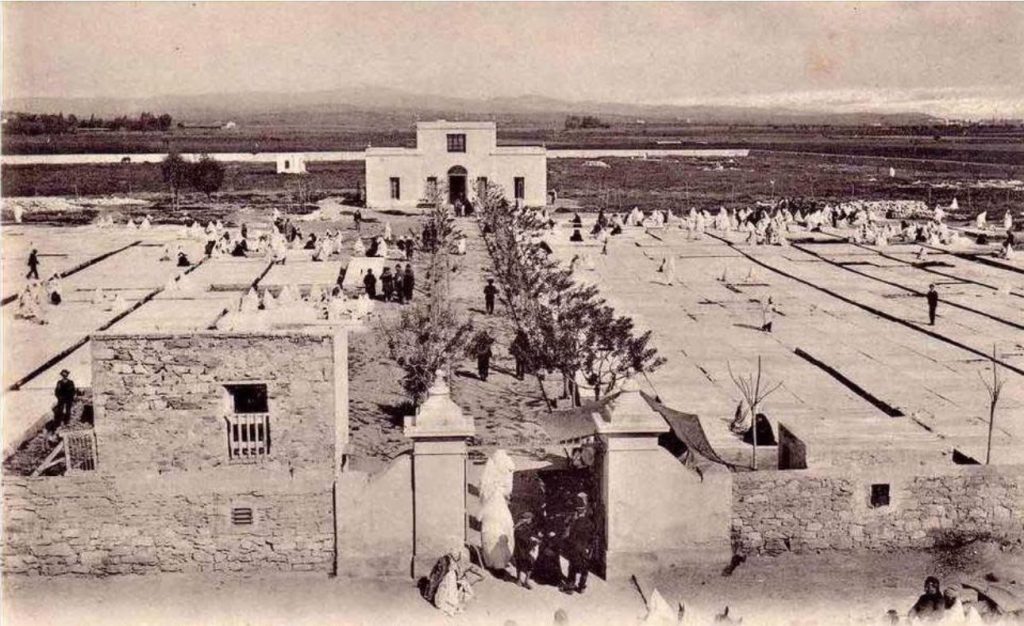
The two communities lived alongside the Muslim majority under the dhimmi system — a status that imposed taxes and social restrictions but also offered legal protection and a degree of communal autonomy. The relationship was not equal and there were periodic episodes of violence (notably in 1864 and during the 1881 French invasion). It was also durable, in a way that nothing in the political category of minority now quite captures.
By the 19th century, the Jewish community was a recognised part of every major Tunisian city. Most were poor; some were wealthy and influential; many sat in between. The Hara of Tunis — the Jewish quarter immediately west of the Zitouna mosque — was at one point one of the most densely populated neighbourhoods in North Africa.
The Hara of Tunis
If you want to walk the most important single piece of Tunisian Jewish heritage outside Djerba, walk what is left of the Hara.
The neighbourhood occupied the area immediately north and west of the Zitouna mosque, bounded roughly by today’s Rue de la Kasbah, Rue Bab Souika, and the line of the old Hafsid walls. By the early 20th century it held perhaps 30,000 people. The lanes were narrower than those of the surrounding medina, the houses taller, the courtyards smaller, the trades — silversmithing, dyeing, tailoring, certain forms of commerce — distinctively Jewish.
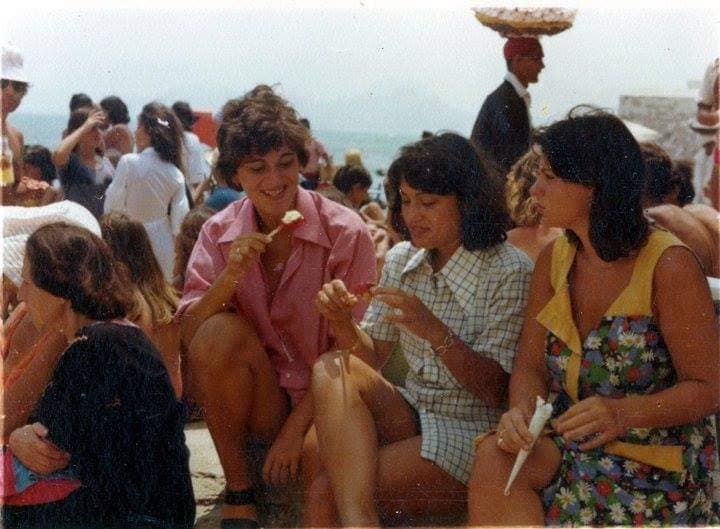
After Tunisian independence in 1956, the new state demolished most of the Hara in a program of urban modernisation. The justification was sanitation and traffic; the effect was the erasure of the central physical fact of Jewish life in Tunis. The neighbourhood was rebuilt as Hafsia, a planned modernist housing project, with a few of the original buildings preserved as token markers. You can still walk it today. The Or-Thora synagogue still stands, though it has not held regular services since 1967. The Tunis Jewish Hospital, established in 1879, operated through the 1960s and is now a clinic. A small number of older Tunisian Muslims, in their sixties and seventies, can still point out which buildings used to belong to which Jewish families.
This is what departure looks like, on a city scale. The buildings are still mostly there. The people are gone.
The Great Departure
Tunisia in 1948 had a Jewish population of approximately 105,000. Tunisia in 1976 had a Jewish population of approximately 5,000. The story of how one became the other is the central fact of modern Tunisian-Jewish history, and it is more complicated than the standard narrative — they were forced out — allows.
Three things happened, more or less simultaneously, between 1948 and 1967.
Israel. The creation of the State of Israel in 1948, and the subsequent Arab-Israeli wars, made the position of Jewish communities across the Arab world untenable in ways that varied by country and by year. In Tunisia, the immediate post-1948 emigration was relatively modest; the larger waves came after the Suez crisis of 1956 and the Six-Day War of 1967. Most went to Israel; a substantial minority went to France.
Independence. Tunisia became independent from France in 1956. The new Tunisian state, under Habib Bourguiba, was officially and visibly committed to inclusion: Bourguiba protected the Jewish community from anti-Israeli violence on several occasions, kept a Jewish minister (André Barouch) in his first cabinet, and personally guaranteed the safety of the El Ghriba pilgrimage. He was also, like every newly independent Arab nationalist leader of his era, building a state whose official identity was Arab and Muslim, and the Jewish community correctly read the medium-term writing on the wall.
The wars. The Six-Day War of 1967, in particular, produced anti-Jewish riots in Tunis. Bourguiba quickly restored order and publicly condemned the violence, but the message had landed. The exodus accelerated. By the early 1970s the great majority had gone.
By 2026, the resident Jewish community in Tunisia numbers somewhere between 1,300 and 1,800 people, the great majority on Djerba, with smaller groups in Tunis (perhaps 200), Zarzis, and a scattering elsewhere. Most are Toshavim — descendants of the older indigenous community, particularly the Djerbi families who chose to stay. The Sephardi Megorashim of Tunis are, with rare exceptions, gone.
For the cuisine, the language, and the small surviving community life of those who remained on Djerba, see Tunisian Jewish cuisine in Djerba and the El Ghriba synagogue piece. The wider community story, summarised, is at Jews of Tunisia.
Where to See It Now
Outside Djerba and the Hara, the visible Tunisian Jewish inheritance is scattered across the country in a series of synagogues and cemeteries — some active, most not, almost all worth a visit if you know where to look.
Tunis. The Grande Synagogue de Tunis on Avenue de la Liberté, completed in 1933, is the principal active synagogue in the capital. It is a large, ornate, art deco-influenced building behind security walls (visitors should arrange access in advance through the community). Friday and Saturday services draw a small congregation; the building’s full ritual life ended in 1967, but it has not been abandoned. The Jewish cemetery at Borgel, on the western edge of central Tunis, holds tens of thousands of graves, including chief rabbis of Tunisia going back to the 19th century. It is open to visitors, slowly being conserved, and a moving place to spend an hour.
Sfax. The city of Sfax had a Jewish population of perhaps 4,000 at its peak. The principal Synagogue Beth-El on Avenue Habib Bourguiba still stands but no longer holds services; it is occasionally accessible by arrangement. The Jewish cemetery is on the city’s western outskirts.
Gabès and the southern oases. The southern Jewish communities — at Gabès, Zarzis, El Hamma, and in the oases around them — were small but very old, and were the Toshavim community in its most archaic form. Most synagogues are no longer in use; one or two in Zarzis are still occasionally active. The community has dwindled to a handful of elderly residents.
Le Kef. The hill town of Le Kef, three hours west of Tunis, had a small but significant Jewish community since at least the Roman period. The 18th-century synagogue, Ghriba el Kef, has been carefully restored and is open to visitors; it sits in the old medina, just below the kasbah. Pair the visit with the Museum of Popular Arts and Traditions of El Kef, which preserves some Jewish ceremonial material.
Nabeul. Until the early 20th century, Nabeul had a Jewish community of perhaps a thousand, principally involved in the ceramics trade — the famous Nabeul tiles, painted with their distinctive yellow-green-blue palette, are partly a Jewish craft inheritance. The synagogue is no longer in use; the cemetery is on the southern edge of town. See the field guide to Cap Bon and Nabeul for the wider context.
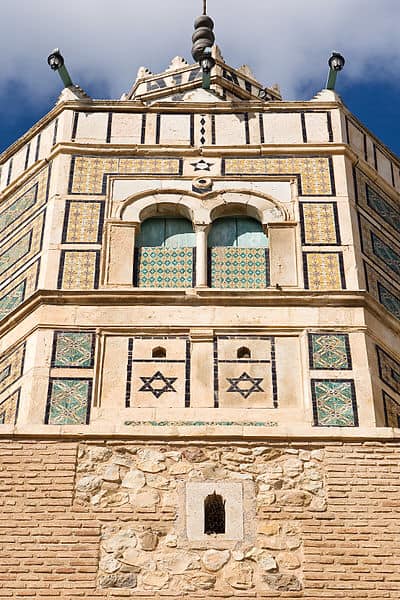
Testour. This small town on the Medjerda river, founded by Andalusian refugees in the 17th century, was for centuries home to both Muslim and Jewish Moriscos — descendants of Spain’s expelled Moors and Jews. The old synagogue is closed; the town’s mosque famously has both a crescent and a small star of David carved into the minaret, a quiet memorial to the dual community that once built the place.
Bardo Museum. Tunisia’s national museum holds an important Jewish collection: ceremonial objects, Hebrew manuscripts, photographs of the community in the early 20th century. It is worth a dedicated visit.
The Lag B’Omer Pilgrimage

Every spring, on the 33rd day of the Omer (typically in late April or May, depending on the Hebrew calendar), the El Ghriba synagogue on Djerba hosts the largest Jewish pilgrimage in North Africa. It has been an annual fixture since at least the 19th century. At its modern peak, in the 1990s and early 2000s, it drew six to eight thousand pilgrims — Tunisian Jews from France and Israel returning to the island of their ancestors, plus a wider Sephardi diaspora.
The pilgrimage has had a difficult quarter-century. A 2002 al-Qaeda truck bombing at the synagogue killed nineteen people, mostly German and French tourists. The 2023 attack — a Tunisian National Guard member who opened fire on the synagogue compound during the pilgrimage, killing five — was the most recent. Both attacks were rare and exceptional, and the Tunisian state’s response, on both occasions, was unambiguous. But they have changed the texture of the pilgrimage. Numbers are down. Security is more visible. The community continues.
If you are not Jewish but want to witness the pilgrimage at a respectful distance, the surrounding village of Hara Sghira (now officially called Erriadh, and famous in its own right for the Djerbahood street art project) fills with visitors and food vendors during the festival days. The atmosphere, in normal years, is closer to a North African moussem than a religious procession: cooking smells, music, families on rented mats, and at the centre of it all the small white building with its blue door and its 2,500 years of continuous use.
What Was Lost — and What Wasn’t
A Tunisian Jewish writer of the older generation, asked what was lost when most of the community left, gave an answer worth remembering: We did not all leave. We just stopped being here in the way we used to be.
What he meant was this. The community that emigrated in 1948–1967 took with it a particular form of Tunisian Jewish life — the synagogues, the schools, the kosher butchers, the piyyutim sung at weddings, the Judeo-Arabic dialect, the Friday-night dinner that had its own Tunisian Jewish vocabulary. That form is now lived in Tel Aviv and Marseille and Paris, where the Tunisian Jewish diaspora is large and culturally vivid.
What did not leave Tunisia is the deeper Jewish layer in the country’s history: the food (Tunisian chakchouka, brik, bouza, and the entire culture of preserved lemons and slow-stewed couscous owes more to the Jewish kitchen than most cookbooks now acknowledge); the silver and the textile trades; the musicians who shaped malouf and other Tunisian forms; the rabbis of Kairouan whose legal opinions still circulate. The Jewish layer in Tunisian culture survives the departure of most of its carriers because it had, by then, become part of what Tunisia is.
The visible remnant — the buildings — is harder to keep. Synagogues are expensive to maintain when there is no congregation. Cemeteries are easy to forget. Some local associations and the small remaining community do what they can. Several restorations have been carried out in recent years, often with French or Israeli funding, sometimes with quiet Tunisian state support, occasionally with local Muslim families who simply remember what the building used to be.
What This Means
Tunisia is one of a small number of countries where Jewish, Muslim, and Christian populations lived alongside each other continuously for nearly two millennia, in patterns that were unequal and occasionally violent but mostly, by the standards of the world, durable. That history is the country’s, not someone else’s. To walk a Tunisian medina is to walk past Jewish doors and Jewish shops, even when the families who built them now live somewhere else.
To recognise that is not nostalgia. It is, simply, an accurate way of seeing what is in front of you.
The synagogue at Hara Sghira is the oldest in Africa. The one at Le Kef is the most beautifully restored. The buildings of the old Hara are tucked behind the rebuilt Hafsia. The cemetery at Borgel is enormous and worth an afternoon. Lag B’Omer comes back every spring.
A community of fifteen hundred is small. Twenty-seven centuries is long. Both numbers are true.
From the Carthage Magazine Bookshelf
If Tunisia’s deeper history is what brought you here — or is what will bring you back — three Carthage Magazine ebooks were built for the trip:
- All About Tunisia — the definitive English-language traveller’s guide. 572 pages, 27 chapters, all nine regions — including the southern oases, Djerba, and the inland towns where the older communities lived. $24.99 · PDF & EPUB
- Speak Like a Local — 200+ Tunisian Arabic phrases with native audio recorded in Tunis. The Derja you hear in any Tunisian medina carries Judeo-Arabic, Andalusian, and Berber substrate. $14.99 · PDF, EPUB, MP3
- The Authentic Tunisian Cookbook — sixty traditional recipes from the heart of North Africa, including the briks, chakchoukas, and slow-stewed dishes that the Jewish and Muslim kitchens of Tunisia shaped together over a thousand years. $9.99 · PDF & EPUB
All three available as a bundle for $39.99 — guide, language, and food, delivered together.
