
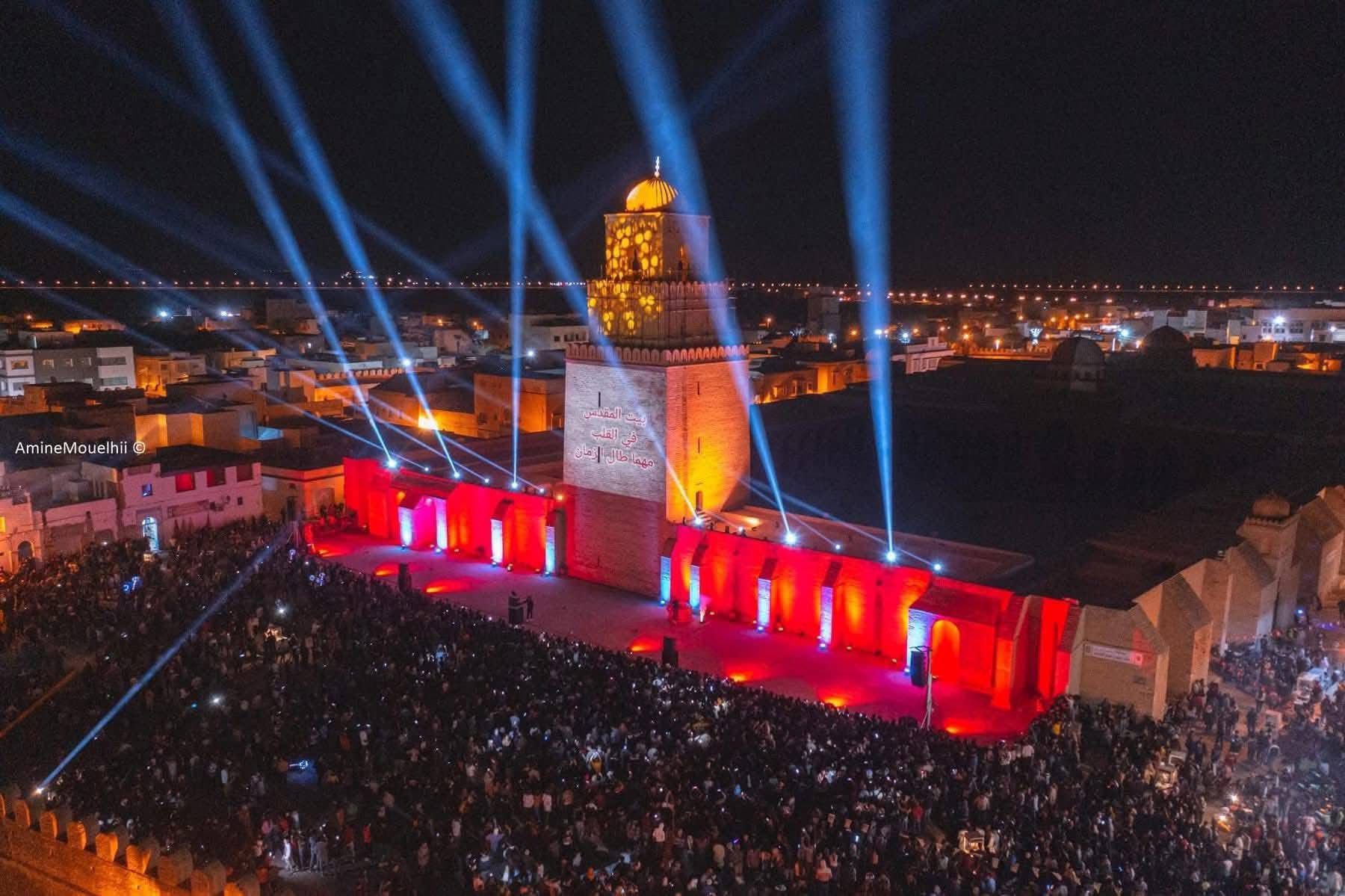
Quick Answer Kairouan is the spiritual capital of Tunisia, a UNESCO World Heritage city founded in 670 CE and considered the fourth-holiest city in Sunni Islam, after Mecca, Medina, and Jerusalem. It sits about 160 kilometres south of Tunis on the dry inland plain, reachable in two and a half hours by car or louage. A full day covers the essentials; a night in the medina gets you the morning before the tour buses arrive, which is the thing most visitors miss.
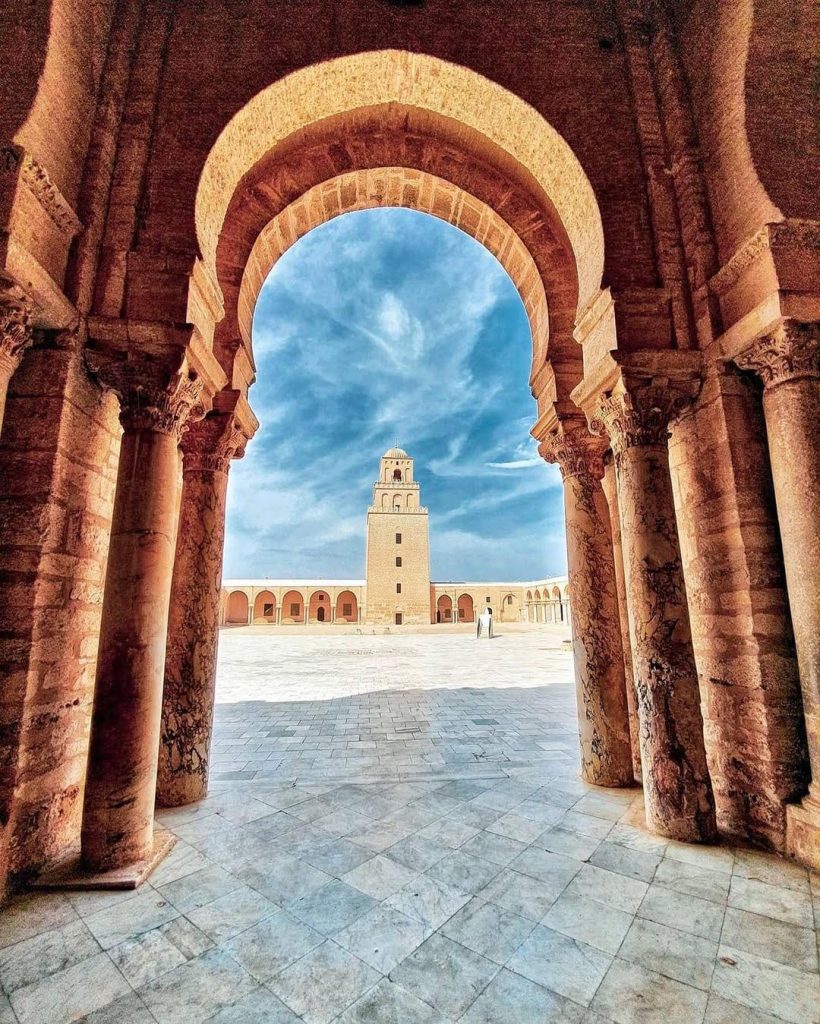
The drive from the coast to Kairouan does something to the landscape. You leave the Mediterranean somewhere around Enfidha — the olive groves close in, the road climbs imperceptibly, the air dries out — and after an hour the country has stopped looking like the Tunisia of postcards and started looking like the Tunisia of the interior. Low hills. Cactus. Whitewashed villages with one minaret each. Then, an hour later, on a plain so flat you can see weather a hundred kilometres away, a city appears: low, ochre, walled, and topped by a single square minaret that has been the highest thing for miles for twelve centuries.
This is the city that Tunisia is named holy for. And it is the one most foreign travellers, on a week-long swing from Tunis to Sousse to the desert and back, never quite get to.
Why Kairouan Matters
Kairouan was founded in 670 CE by Uqba ibn Nafi, an Arab general dispatched by the Umayyad caliphate to subdue North Africa. He pitched camp on a featureless plain — the legend, the standard origin story for cities like this, says he found a golden goblet from Mecca buried in the sand and took it as a sign — and ordered a garrison built. The garrison became a city. The city became, within a century, the most important Islamic centre west of Egypt.
This is what came after Carthage and before everything else. You can read the longer arc of Tunisia’s history elsewhere; what matters here is that the Aghlabid emirs who ruled from Kairouan in the 9th century made the city the intellectual capital of the Maghreb. They built the Great Mosque you can still walk into today. They funded the schools that produced the scholars of the western Islamic world. They commissioned the Blue Qur’an — a manuscript written in gold on indigo-dyed parchment, considered among the most beautiful single objects produced anywhere in the medieval Mediterranean — pages of which are still held at the Raqqada Museum on the city’s outskirts.
The pilgrimage tradition follows from this. The popular saying — that seven pilgrimages to Kairouan equal one hajj to Mecca — is folk theology, not orthodox doctrine, and you will find Tunisian scholars who roll their eyes at it. But the underlying point holds. For most of the Muslims who lived in Spain, North Africa, and Sicily over the last twelve centuries, Mecca was unreachable. Kairouan was not. The city carries the weight that comes from being the place where ordinary people could go.
UNESCO listed the medina in 1988. The boundary they drew protects, in addition to the mosques, perhaps the most intact pre-modern Islamic city centre in the country — narrower than Tunis, quieter than Sousse, more conservative than either, and visibly poorer. That last detail matters. Kairouan is not a curated heritage town. It is a working provincial capital that happens to have a mosque from the year 670 at its centre, and the gap between the two registers — sacred and ordinary — is most of what makes the place worth the drive.
The Great Mosque of Uqba
Begin at the Great Mosque. You almost have to. It is the reason you came, even if you have not yet realised it.
The mosque is the oldest in North Africa and one of the oldest anywhere in the Muslim world. The current building dates to the Aghlabid rebuilding under Ziyadat Allah I in the 9th century, but the foundation goes back to Uqba himself and the courtyard you walk into has been a courtyard, in some form, for thirteen and a half centuries.
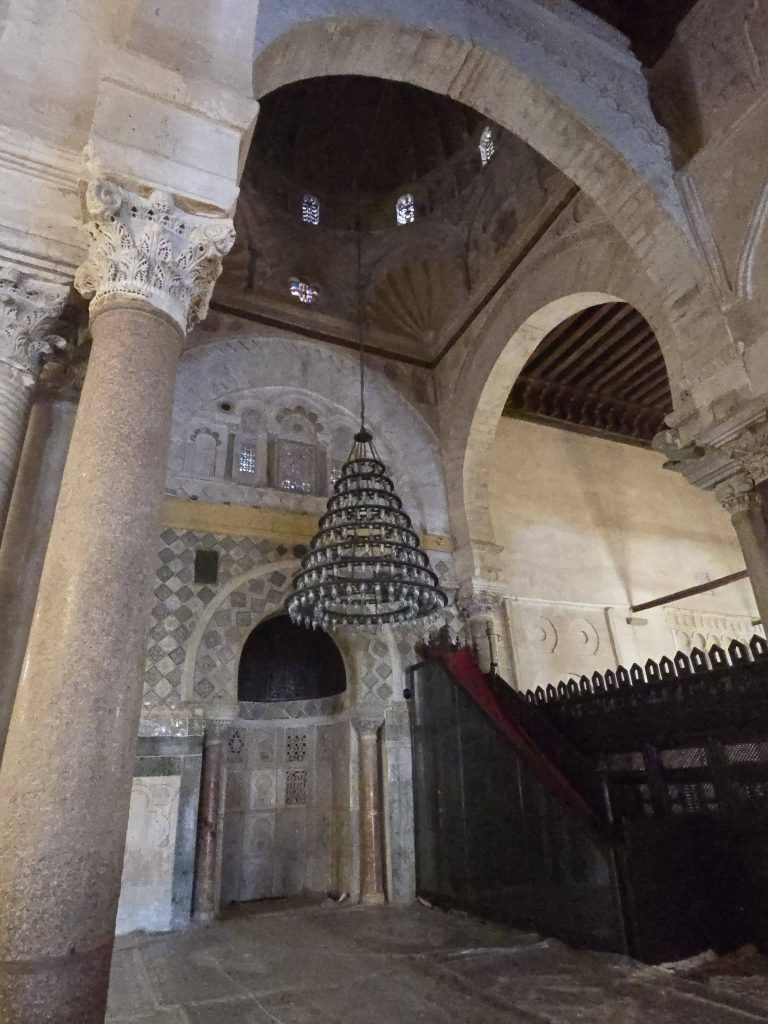
What strikes most first-time visitors is the columns. There are hundreds of them in the prayer hall — granite, marble, porphyry — and they are not, in any consistent way, the mosque’s columns. They are scavenged. The Aghlabids took them from the ruined Roman cities of the African province: from Carthage, from Hadrumetum, from Sufetula, sometimes from buildings that had been standing for half a millennium. You can stand at one of the open doors and look down a row of them and see, within ten metres, a column from a Carthaginian temple and one from a Roman basilica, dressed and re-dressed for the new purpose. It is the architectural equivalent of a city rewriting itself in its predecessor’s handwriting.
Non-Muslims cannot enter the prayer hall — this is consistent practice across Tunisia’s working mosques — but the great rectangular courtyard is open, and the hall is visible through the doors. Photographs from the courtyard are permitted. Modest dress is expected; shawls are available at the entrance if you arrive without one.
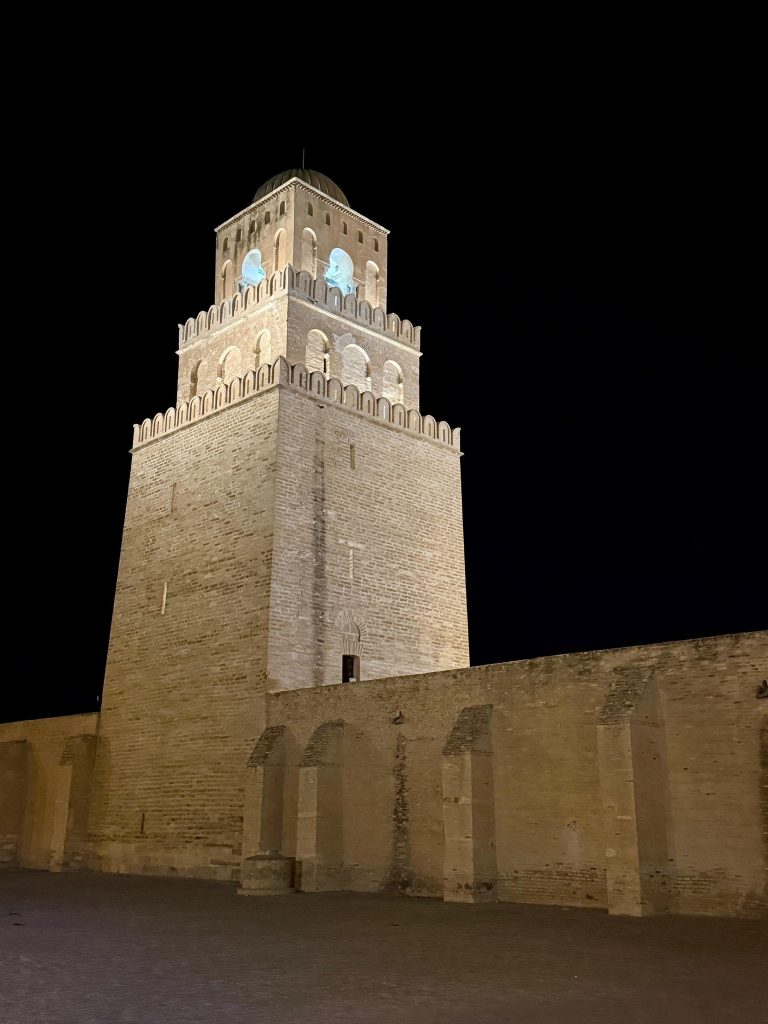
The minaret — three storeys, square, austere, almost military — is the model from which every minaret in the Maghreb descends. If you have seen a minaret in Andalusia, in Morocco, in Algeria, you have seen the silhouette of this one.
The Medina
Step out of the mosque and into the medina proper, and you are in a different city.
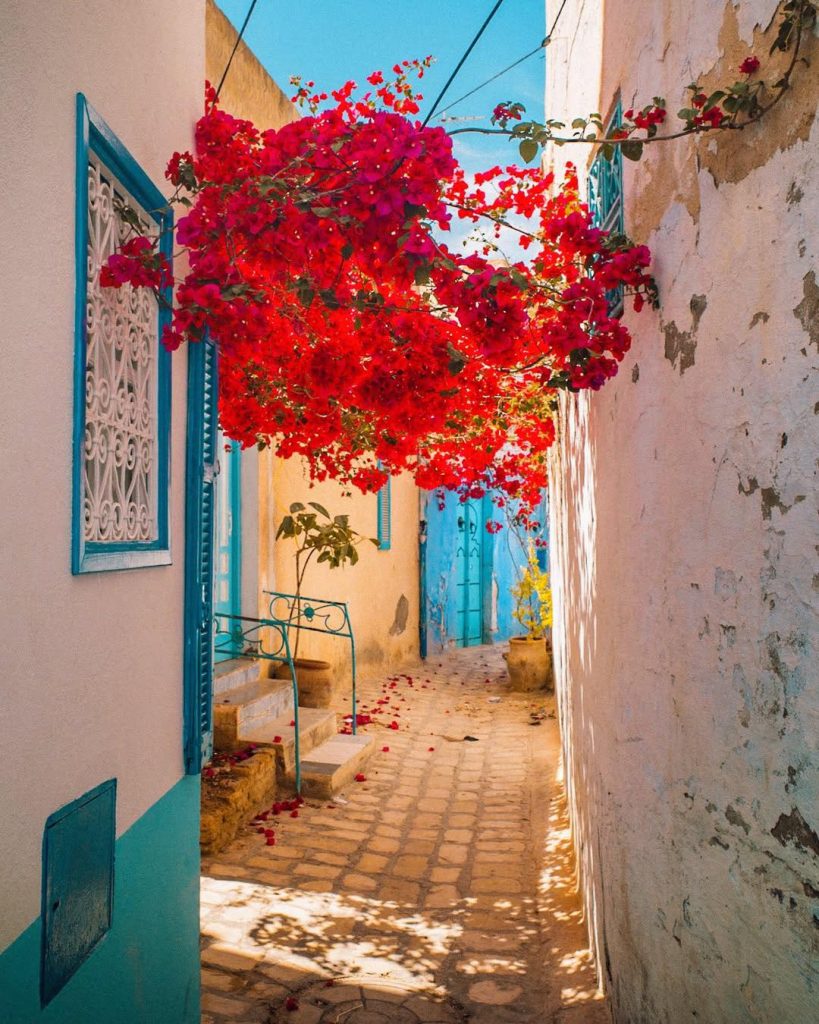
Kairouan’s medina is small enough to walk in two hours and dense enough to spend a day in. The walls are still mostly there; the gates — Bab Tunis to the north, Bab el Chouhada to the south — are still the working ones. The lanes are narrower than the medina of Tunis, the souks more compressed, the trade more clearly local than tourist-facing. Hardware shops still outnumber souvenir shops. The smell, in the morning, is bread and donkey and last night’s charcoal, in that order.
The Mosque of the Three Doors sits a hundred metres from the Great Mosque and is almost as old; the carved façade dates to 866 CE and is considered the earliest example of decorated mosque architecture anywhere in the Islamic world. The mosque is closed to non-Muslims, but the façade — three doorways under a band of Kufic inscription — is what people came to see anyway.
Around the corner is the Zawiya of Sidi Sahbi, known to everyone as the Barber’s Mosque. Sidi Sahbi — Abu Zama’ al-Balawi — was a companion of the Prophet who, tradition holds, always carried three hairs from the Prophet’s beard with him, and was buried in Kairouan with the hairs intact. The shrine is 17th-century Ottoman in its current form, the tilework is some of the finest in the country, and the courtyard at the centre — a small jewel of cut plaster and Andalusian ceramic — repays an unhurried visit. Non-Muslims are welcome.
A third stop, smaller and stranger, is Bir Barouta — a covered building in the heart of the medina that houses a sacred well, drawn (in the older days, and still occasionally for visitors) by a blindfolded camel walking in slow circles around the wellhead one floor below. The water is said to be linked, through some unmapped subterranean route, to the holy well of Zamzam in Mecca. The hydrology is not strictly defensible. The detail is wonderful.
The Aghlabid Basins
A kilometre north of the medina, on what was once the city’s edge, sit two great circular reservoirs — one large, one smaller — built by the Aghlabids in the 9th century to supply Kairouan with water.
The Basins are functional engineering, not decoration, and that is part of what makes them remarkable. The larger one is 128 metres across. The water came from the Cherichira hills, forty kilometres away, through a covered channel that fed a settling tank before reaching the main reservoir. The system worked for three hundred years and was, in its day, one of the most sophisticated water infrastructures in the Islamic world.
What survives is mostly the basins themselves: emptied, sun-bleached, surrounded by a low wall. There is a small viewing platform you can climb. There is not much in the way of interpretation on site, and the surrounding area has filled in with car parks and modern housing in a way that does the engineering no favours. But the scale is real, and from above, in the light of late afternoon, the geometry is exactly what the Aghlabid architects intended.
A combined ticket — buy it at the Great Mosque or at the Basins — covers the Mosque, the Basins, Sidi Sahbi, and Bir Barouta. At the time of writing it runs around 12 dinars; ask for the billet groupé. For more on what your dinars buy in 2026, see Tunisia’s currency guide and the cost of living.
Where to Eat, and the Makroudh
Kairouan is the home of makroudh — the diamond-cut semolina pastry stuffed with date paste and soaked, after frying, in honey or sugar syrup. Every Tunisian city has a version. Kairouan’s is the original.
The shops along Avenue Bourguiba and around the medina gates sell it by the box. Masmoudi is the most famous brand and the most reliable for travellers; the small bakeries inside the medina are better if you know what you are looking at and don’t mind paying market rate. A kilo is too much for one person and exactly right for two. It keeps for weeks.
Beyond the makroudh, Kairouan cooks distinctively for a city its size. The local lablabi — chickpea soup poured over crumbled bread — is heavier on cumin than the coastal version, lighter on harissa, and almost always served with a hard-boiled egg dropped in at the table. The local couscous is small-grained and dry, suited to slow-stewed lamb. Look for the late-afternoon café around Sidi Sahbi for tea and a plate of ftaïer — the local fried doughnut, eaten with honey.
For the wider context, see Tunisia’s twenty essential dishes. In Kairouan, eat what the locals are eating, which means street food at midday and family-style restaurants at dinner. The high-end options are limited; this is not a city for hotel restaurants.
The Carpets
For at least eight centuries, Kairouan has been Tunisia’s carpet city. The two great traditions are the alloucha — the heavy knotted-pile wool carpet, often in deep reds and indigos, that is the city’s signature — and the mergoum, the flat-woven kilim done in geometric Berber patterns. UNESCO inscribed the zarbia el qayrouania on its Intangible Cultural Heritage list in 2020.
You will be approached by carpet sellers. This is not a problem. It is the trade of the city and the approach is part of the trade.
The honest advice is this. If you want to buy and you want a guarantee, the ONAT — the Tunisian state’s National Crafts Office — has a Kairouan branch a block from the Great Mosque, with fixed prices, certificates of origin, and an export-tax stamp included. If you want the bazaar experience, the carpet houses around the medina will give it cheerfully and at length, and the better ones will take you upstairs to the looms and let you watch a piece in progress. Either way, expect to spend time. Carpet buying in Kairouan is not a transaction; it is an afternoon. You will be offered three glasses of tea before anyone unrolls anything. This is correct.
For a sense of how Kairouani patterns — the diamond, the lozenge, the eye — connect to the broader symbolic vocabulary of the country, the pieces on Tanit and the Khomsa are good companions.
Getting There, Getting Around, Staying the Night
From Tunis, Kairouan is about 160 kilometres south on the A1 motorway. By car, the drive is two hours. By louage — the shared minivan that is Tunisia’s intercity workhorse — it is two and a half, leaves when full from the louage station at Moncef Bey, and costs around 10 dinars. There is no passenger rail line that reaches Kairouan; the last one closed in the 1990s. Day trips from Tunis are common and easy. Day trips from Hammamet and Sousse are also common.
If you can spend the night, do.
The two boutique options inside the medina — Dar Hassine Allani and La Kasbah — occupy restored 17th- and 18th-century houses and are the closest the city has to character hotels. The chain options on the outskirts are functional rather than memorable. Outside the medina there is little reason to be in Kairouan after dark.
What you get for staying is the morning. Tour buses begin arriving from Sousse around 10 a.m. and from Hammamet around 11. Between sunrise and 9 a.m. the medina belongs to the people who live in it: the bread carts, the men gathering at the café opposite the Mosque of the Three Doors, the cats. There is no equivalent half-hour in the city’s day.
When to Go
Kairouan is interior Tunisia, which means hot summers and cool winters. April, May, October, and November are the obvious sweet spots: daytime temperatures between 20°C and 28°C, manageable evenings, and the light at its kindest for the stonework. July and August are honest about themselves — 38°C is normal, 42°C is not unheard of — and the medina becomes a furnace by noon. December through February are fine for sightseeing if you can tolerate cold evenings and the occasional rain. For the broader picture see the best time to visit Tunisia.
If your visit coincides with Mawlid an-Nabi, the celebration of the Prophet’s birthday, Kairouan is the place to be. The city’s processions are the most elaborate in Tunisia, the medina fills with pilgrims from across the Maghreb, and the Mosque of Uqba stays lit until dawn. The date moves through the Gregorian calendar with the Islamic one — check the year before you book.
The summer ahead is shaping up to be a busy one for inland Tunisia in particular, with Tunis having just been named Arab Capital of Tourism 2027 and a wave of regional tour operators repackaging Kairouan into their itineraries as a result. If you want the city quiet, go before August.
A Few Practical Notes
- Dress. Kairouan is more conservative than coastal Tunisia. For women, a scarf is not required outside mosques but is helpful inside them, and covered shoulders and knees are expected throughout the medina. For men, long trousers and shirts with sleeves are the norm. Nothing about this is enforced; it is a matter of fitting in.
- Cash. Kairouan is heavily cash-based outside the hotels. ATMs cluster around the medina gates and on Avenue Bourguiba.
- Friday. The Great Mosque closes to visitors during the midday prayer, between roughly noon and 2 p.m. depending on the season. Plan around it.
- Alcohol. Not sold inside the medina. The hotel bars on the outskirts serve, but quietly. For the wider picture see alcohol in Tunisia.
- Photographs. Of the architecture, freely. Of people, with permission, particularly women. Of the inside of any prayer hall, not at all.
What Kairouan Is, Quietly
Kairouan does not have the photographic shorthand of Sidi Bou Said, the resort polish of Hammamet, or the Roman drama of El Jem. It will not give itself up in an afternoon. But it is the place where Tunisia became Muslim, where the architectural vocabulary of the Maghreb was first written down in stone, and where — twelve centuries later — that vocabulary is still being spoken in the lanes around the Mosque of Uqba.
It is also, on a Friday morning in October, with the light coming sideways across Uqba’s courtyard and the muezzin beginning the call to noon prayer, one of the quieter great places in the world.
You should go.
From the Carthage Magazine Bookshelf
If Kairouan is on the itinerary — or you’ve just come back and the date paste from a Masmoudi makroudh is still on your fingers — three Carthage Magazine ebooks were built for the days around the trip:
- All About Tunisia — the definitive English-language traveler’s guide. 572 pages, 27 chapters, all nine regions including the holy cities of the interior, every UNESCO inscription, five thematic trails — and the practical answers (visa, currency, transport, etiquette) most travelers wish they’d had on the plane. $24.99 · PDF & EPUB
- Speak Like a Local — 200+ Tunisian Arabic phrases with native audio recorded in Tunis. The phrases for the taxi, the souk, the café, and the dinner table — the difference between makroudh and makroudha, and how to ask the carpet seller, politely, for his best price. $14.99 · PDF, EPUB, MP3
- The Authentic Tunisian Cookbook — sixty traditional recipes from the heart of North Africa, including the Kairouani lablabi and the makroudh you’ll spend years trying to recreate at home. $9.99 · PDF & EPUB
All three available as a bundle for $39.99 — guide, language, and food, delivered together.
