
Some announcements feel like ceremony. This one feels like a long-deferred acknowledgment.
In December 2025, at the 28th Arab Ministerial Council for Tourism in Baghdad, the assembled tourism ministers of the Arab League voted to name the next Arab Capital of Tourism. The choice was Tunis — and to anyone paying attention to the cultural map of the Arab world over the last decade, the surprise was less that Tunis won than that it had taken this long.
A city that has been continuously inhabited for more than three thousand years, that holds the bones of one of antiquity’s great civilizations, that walks the line between Mediterranean and Arab as elegantly as any capital alive — that city had never previously been named what it has now been named. Three weeks later, on 22 December 2025, the program was officially launched at the Théâtre Municipal de Tunis. Tunis, Arab Capital of Tourism for 2027.
This is the story of what that designation actually means, what Tunisia is planning to do with it, and why — for the country, the region, and the city itself — the timing might matter more than the title.
The headline, plainly
Each year, the Arab Ministerial Council for Tourism — the tourism ministers of all Arab League member states — names one city as the Arab Capital of Tourism for the following year. It is a rotating designation, modeled loosely on the European Capital of Culture, but with a sharper economic edge. The chosen city receives twelve months of pan-Arab tourism focus: coordinated promotion across Arab markets, a packed events calendar, infrastructure investment, and the kind of soft-power dividend that lasts well beyond the year itself.
In December 2025, the council met in Baghdad and chose Tunis for 2027. At the same session, Tunisia was elected to the executive bureau of the Council and, separately, to its vice-presidency — three quiet wins in a single day. And earlier in 2026, Tunis was admitted to the UNESCO Network of Creative Cities, a designation that no other Arab capital can currently pair with the 2027 title.
That double recognition — Arab Tourism Capital and UNESCO Creative City inside the same eighteen-month window — is the part of the story almost no one is reading correctly yet.
What Tunis actually has to show for itself
Most cities awarded a tourism title have to invent a story. Tunis does not.
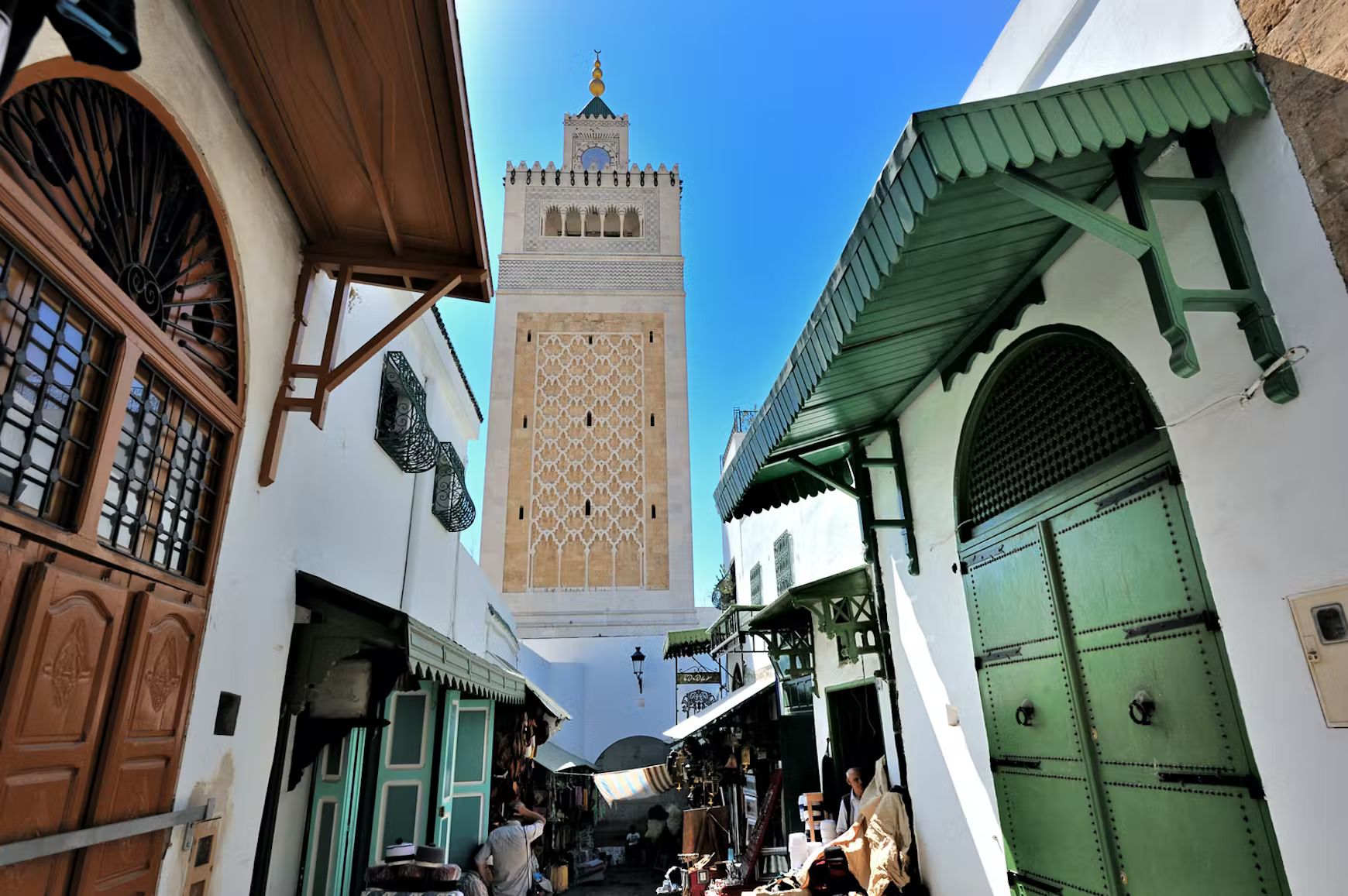
Inside roughly thirty kilometers of one another sit several of the country’s nine UNESCO World Heritage sites. The medina of Tunis itself — a living medieval city of nearly seven hundred monuments, mosques, madrasas, fondouks, and tiled palaces, almost all of it still doing its original job. The archaeological remains of Carthage, including the Antonine Baths, the Roman Theatre, the Punic ports, and Byrsa Hill. Dougga, the most complete Roman city in North Africa, two hours west. The amphitheater of El Jem, the largest preserved Roman colosseum on the continent, two and a half hours south. Kairouan, the spiritual capital of North Africa and one of Islam’s four holy cities. The medina of Sousse. Kerkouane, the only purely Punic archaeological site on earth. Ichkeul National Park, the last great Mediterranean wetland.
To this, you add what doesn’t show up on the UNESCO list and probably should: Sidi Bou Saïd, the blue-and-white village that defined Mediterranean aesthetic taste for a century. La Marsa and La Goulette, the seaside extensions of the capital. The Bardo National Museum, which holds the largest collection of Roman mosaics anywhere in the world. The Cathedral of Saint-Louis at Carthage. The hill at Byrsa, where the modern visitor can still stand in the literal foundation trench of the Punic empire.
Tunis, in other words, is not a city that needs to invent a 2027 program. It needs to organize one.
The plan, in early outline
Tourism Minister Sofiane Tekaya has been unusually direct about how the government intends to use the title. In his first major comments after the Baghdad announcement, he framed Tunis 2027 not as an event but as “a national strategic project” — language that mattered because it implied permanence, budget, and cross-ministerial buy-in rather than a one-off.
The early scaffolding is visible. In February 2026, the ministry met with DMO Tunis-Carthage — the destination management organization for the capital and its archaeological hinterland — to accelerate preparations and align the city’s tourism actors with the 2027 calendar. In late March, the ministry launched a national competition for the program’s logo and visual identity, opened to Tunisian universities, design schools, and creative practitioners, with an explicit brief: reflect Tunis’s natural, cultural, architectural, and intangible heritage through a contemporary visual language.
By the end of Q2 2026, the program’s structure had begun to take shape: upscale tourism positioning, year-long cultural programming, infrastructure improvements concentrated in Tunis, La Marsa, Carthage, Sidi Bou Saïd, and the medina, and a marketing push targeted at the inter-Arab market that the Arab Tourism Capital designation is specifically designed to mobilize.
Why this matters, for Tunisia and for Tunis
The Arab market is, statistically, the fastest-growing inter-regional tourism market in the world. Algerian visitors to Tunisia approached one million in 2026 alone. Saudi outbound tourism has more than tripled in the last five years. Egyptian, Iraqi, and Gulf middle-class travelers have all begun looking for Arab capitals that combine cultural depth with summer-friendly climate and Arabic-speaking ease — and Tunis, frankly, has been an underused option for all of them.
The Capital of Tourism title is built precisely for this. It opens promotional channels through every Arab state’s tourism ministry. It coordinates direct flights, visa simplifications, festival reciprocity, and the kind of cross-border cultural press that doesn’t happen without an official frame. In a normal year, a Saudi family planning a Mediterranean holiday picks Turkey or Egypt. In 2027, they will be told — by their own ministry’s tourism communications — to consider Tunis.
For the city itself, the title is something more interesting than a marketing win. It is an excuse to look at itself honestly, and to fix the things it has been politely overlooking. The medina’s roof tiles. The signage. The accessibility of Carthage. The lighting around the Antonine Baths after dark. The waterfront from La Goulette through La Marsa. A capital that hosts the Arab world for a year is a capital that has, by the same logic, finally given itself permission to invest in being seen.
What a visitor in 2027 will actually find
Most readers of this piece will not visit Tunis to attend a council session. They will visit because — if the program lands — Tunis in 2027 is going to be the most concentrated showcase the city has ever staged of what it has always been.
Expect a year of festivals layered onto the city’s existing cultural calendar. Expect the Carthage International Festival, already one of the great Mediterranean summer programs, to scale. Expect new programming around the medina’s seven hundred monuments, including night openings, restored fondouks turned into temporary galleries, and concerts in courtyards that have spent fifty years closed to the public.
Expect, finally, the food. Tunisian cuisine has been quietly waiting for an audience equal to it — and 2027 is the most plausible year that audience finally arrives. Carthage Magazine’s Tunisian cookbook, sixty recipes across ten chapters, is, in that sense, a primer for the year ahead: the food the country is about to be eaten for.
And expect, if you arrive without speaking the language, to discover something most first-time visitors don’t realize until they’re inside it: the language of Tunis is not the Arabic of any textbook. It is Derja, the Tunisian spoken Arabic that lives in the souks, the cafés of Avenue Bourguiba, the side streets of Sidi Bou Saïd, and the taxi to the airport at four in the morning. Modern Standard Arabic won’t land in a Tunis café. Derja will. Carthage Magazine’s Tunisian phrasebook, over two hundred phrases recorded with native Tunis speakers, exists for exactly this kind of arrival.
A capital that has waited its turn
Tunis has been many things. The neighbor of Carthage, then its heir. An Aghlabid and Fatimid stronghold. A Hafsid capital. An Ottoman regency. The most important free port of the western Mediterranean. The cradle of the Arab Spring. It is one of the only cities in the world that can produce, on demand, a Phoenician layer, a Roman layer, a Byzantine layer, an early Islamic layer, an Ottoman layer, a French colonial layer, and a contemporary layer — and let you walk between them in a single afternoon.
A title, in the end, does not change a city. But this one comes at a moment when the world is more curious about the southern Mediterranean than it has been in a generation, when the Arab world is rediscovering its own cultural map, and when Tunisia itself is choosing — quietly, deliberately — to be looked at again.
It took the Arab Ministerial Council until December 2025 to name Tunis.
The honest answer is that Tunis has been an Arab Capital of Tourism for about three thousand years. 2027 is just the year the title finally caught up.
