
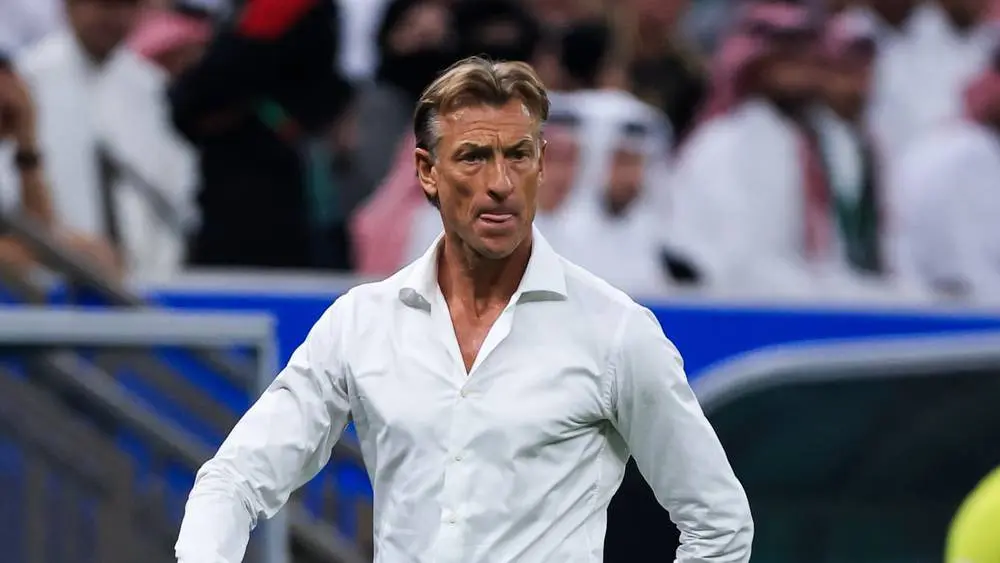
He has won the Africa Cup of Nations with two different countries, knocked the world champions out of their own opening game, and managed at a men’s and a women’s World Cup inside the same year. Now, with the Eagles of Carthage bottom of Group F and a nation furious, Hervé Renard has four days and one cleaned-up defense between Tunisia and the exit.
When the Tunisian Football Federation sacked Sabri Lamouchi barely 24 hours after the 5-1 collapse against Sweden, it did not reach for a caretaker. It reached for one of international football’s great rescue artists. The man who walks the touchline in a spotless white shirt, who has built a career out of making unfancied teams believe — and who, more than most, knows exactly what it means to start from the bottom.
Here is the story of the coach Tunisia is now betting its World Cup on.
The white shirt and the legend
Hervé Jean-Marie Roger Renard was born on 30 September 1968 in Aix-les-Bains, in the French Alps. At 57, he is one of the most recognisable figures in the international game — partly for his results, partly for the immaculate open-collared white shirt that has become a personal trademark, and partly for the matinee-idol looks that, during the 2018 World Cup, had Moroccan fans only half-joking that their coach looked like he had wandered in off a film set.
But the image of polish is a recent luxury. Renard’s path to the top is one of the most improbable in modern football.
From scrubbing floors at 2:30am to the dugout
Renard’s playing career was modest: a defender in the French lower divisions for clubs including Cannes and Draguignan, before a knee problem ended it around the age of 29. Coaching was the dream, but it did not pay. So for years he lived a punishing double life — rising in the dead of night to run an industrial cleaning round, hauling bins and keeping an apartment block in order until midday, then turning up to coach lowly SC Draguignan in the evening.
He eventually founded his own cleaning company to fund the ambition. He has never hidden any of it. Renard has called those years harder than anything he experienced as a player, and described the grind as the finest education he could have asked for. That refusal to feel sorry for himself — and his insistence that no situation is beneath rescue — is the thread running through everything that followed.
His break came through mentor Claude Le Roy, the well-travelled French coach who took Renard to China as his assistant and then to England, where Renard had a brief, unhappy spell in charge of Cambridge United in 2004 with the club near the foot of the Football League. Short stints in Vietnam and at French side Cherbourg followed. It was unglamorous, itinerant work. It was also the apprenticeship that made him.
The making of an Africa specialist
Everything changed when Renard moved into international management with Zambia in 2008. He guided the Chipolopolo to their first Africa Cup of Nations quarter-final in 14 years, left briefly for Angola, then returned — and in 2012 authored one of the most emotional triumphs the tournament has known, winning the title on penalties. The final was staged in Libreville, close to the waters where Zambia’s national team had perished in a 1993 air disaster; Renard’s victory was dedicated to those players, and it sealed his bond with African football forever.
Three years later he did the near-impossible again, leading Ivory Coast to the 2015 AFCON crown and becoming the first coach in history to win the trophy with two different nations. CAF named him its Coach of the Year in 2012, 2015 and again in 2018 — a hat-trick of recognition no rival can match.
A short, unsuccessful return to club football with Lille in 2015 was the exception that proved the rule: Renard’s gift is for national teams, for galvanising a group and a country at once.
Morocco, and the Argentina earthquake
With Morocco (2016–2019) he restored a sleeping giant, qualifying the Atlas Lions for the 2018 World Cup — their first appearance at the finals in two decades. Then came the chapter that made him globally famous.
As coach of Saudi Arabia, Renard sent his side out against Lionel Messi’s Argentina in the opening match of the 2022 World Cup and won, 2-1. It remains one of the greatest upsets the tournament has ever produced — Argentina, of course, went on to lift the trophy. Saudi Arabia did not survive the group, but the result rewrote what a Renard team was understood to be capable of on the biggest stage.
He even crossed football’s other great divide: in 2023 he took charge of the France women’s national team months before the Women’s World Cup, becoming one of the very few coaches to manage at a men’s and a women’s World Cup within a single year.
Renard later returned to Saudi Arabia and secured their qualification for the 2026 World Cup — only to be dismissed in April, leaving the sport’s most reliable turnaround man unexpectedly available at the precise moment Tunisia needed one.
Why Tunisia, and why now
The fit is almost too neat. Tunisia have reached seven World Cups and never once escaped the group stage — exactly the kind of ceiling Renard has spent his career shattering for others. He knows the African game intimately, speaks the language of motivation fluently, and arrives with the credibility to demand an immediate response from a squad that looked broken in Monterrey.
He was appointed on 16 June, through the end of the tournament, with both sides open to discussing a longer arrangement afterwards. He flew straight into camp and went to work. His first address to the players — a short, fierce call to restore pride — leaked online and was embraced by supporters back home almost instantly. At his pre-match press conference he refused to hide behind the chaos of the week, insisting there were no excuses and that Tunisia’s only hope against Japan would be a flawless collective effort.
Whether anyone can re-shape a shaken team in four days is the open question of Tunisia’s must-not-lose meeting with Japan. If it can be done, the man in the white shirt is as good a bet as football has. And if Tunisia are still alive when the final-day permutations arrive, it will be because the cleaner from Draguignan found, once again, that nothing is beyond rescue.
Hervé Renard: quick facts
- Born: 30 September 1968, Aix-les-Bains, France (age 57)
- Playing career: Defender in the French lower divisions (Cannes, Draguignan and others)
- Trademark: Crisp white shirt on the touchline; renowned motivator
- AFCON titles: Zambia (2012) and Ivory Coast (2015) — the only coach to win it with two nations
- CAF Coach of the Year: 2012, 2015, 2018
- World Cups coached: Morocco (2018), Saudi Arabia (2022), and now Tunisia (2026); also managed France at the 2023 Women’s World Cup
- Signature result: Saudi Arabia 2-1 Argentina, 2022 — one of the World Cup’s biggest shocks
- Tunisia role: Appointed 16 June 2026, through the end of the World Cup, replacing the sacked Sabri Lamouchi
Frequently asked questions
Who is Tunisia’s new head coach?
Hervé Renard, a 57-year-old French coach appointed on 16 June 2026 after Sabri Lamouchi was sacked following Tunisia’s 5-1 defeat to Sweden. He will lead the Eagles of Carthage for the rest of the 2026 World Cup.
What has Hervé Renard won?
He is the only manager to win the Africa Cup of Nations with two different countries — Zambia in 2012 and Ivory Coast in 2015 — and was named CAF Coach of the Year three times. He also masterminded Saudi Arabia’s famous 2022 World Cup win over Argentina.
Is it true Hervé Renard worked as a cleaner?
Yes. Before his coaching career took off, Renard worked for years as an industrial cleaner — running a night-time round and later his own cleaning company — to support his ambition while coaching lower-league SC Draguignan. He has often described it as the best education of his career.
Which national teams has Renard coached?
Zambia, Angola, Ivory Coast, Morocco, Saudi Arabia (twice) and the France women’s national team, before taking charge of Tunisia in 2026. He also had earlier club spells including Cambridge United, Sochaux and Lille.
Can Renard take Tunisia past the group stage?
That is the challenge. Tunisia have never advanced beyond the group stage in seven World Cup appearances. Renard’s record of transforming underdog sides is the reason the federation turned to him — but with the team bottom of Group F, he must first avoid defeat against Japan.
Editor’s note: Hervé Renard’s appointment was confirmed by the Tunisian Football Federation on 16 June 2026. This profile will be updated as his Tunisia tenure unfolds, beginning with the Group F match against Japan on 21 June.
