
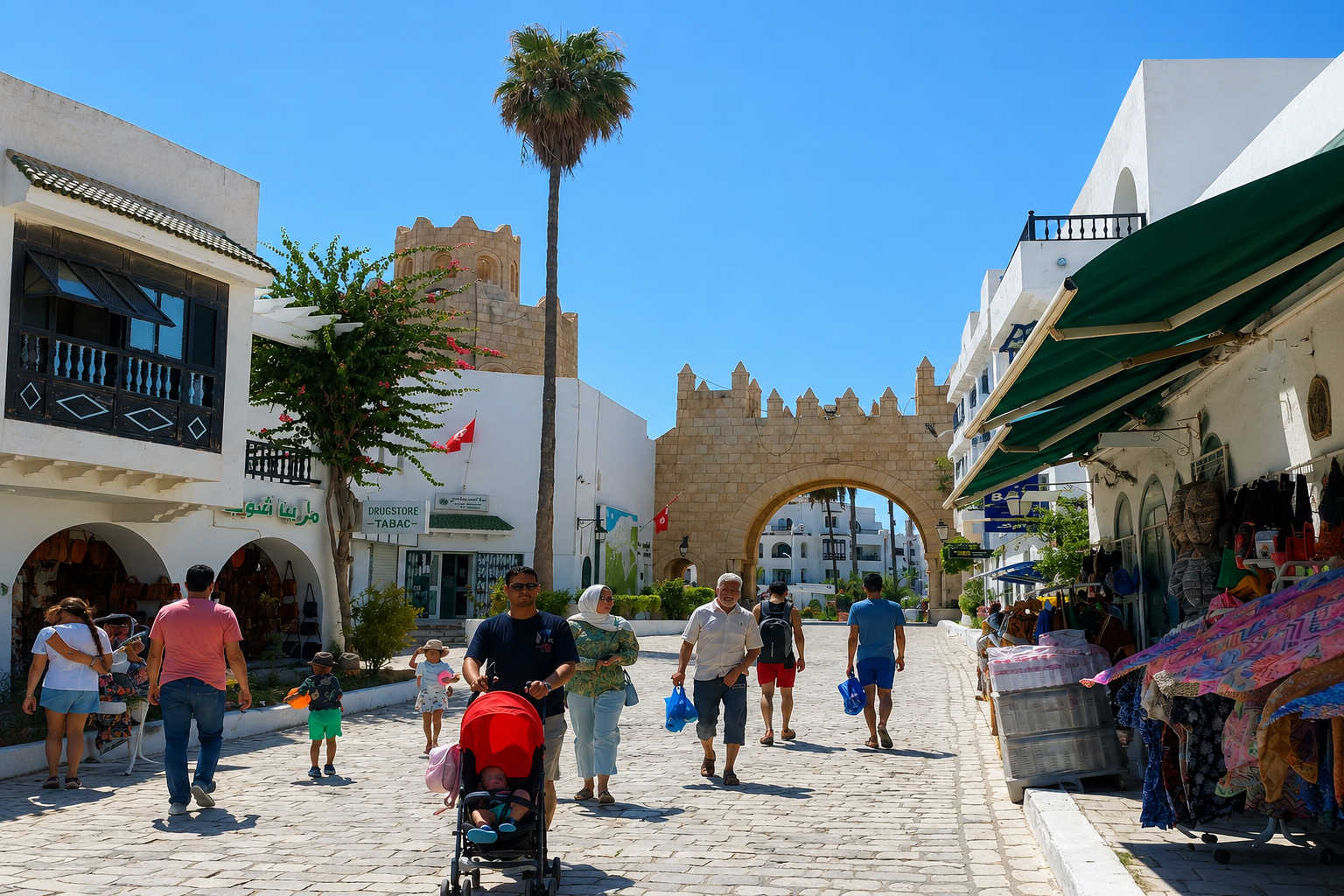
At some point in the first week of August, on almost any street in Sousse or Hammamet or Nabeul, the same small ritual repeats: the hum of the neighbourhood drops away for a beat as the power cuts, generators cough awake behind hotel walls, and somewhere a rooftop pump falls silent mid-fill. Nobody panics. People check their phones, order another coffee, wait. It has become the sound of the season — as reliable as the cicadas, and much better documented.
Earlier this summer, we wrote about why a country can have its wettest January in seventy years and still ration water in July: the dams are in the north, the pipes lose roughly a third of what they carry, and agriculture takes four-fifths of the total before a household sees a drop. That piece was about supply — where the water goes before it reaches you. This one is about the other side of the ledger, because supply alone doesn’t explain why the system fails hardest in the same six weeks every year.
August is not simply a hot month in Tunisia. It is the month the entire national calendar conspires against the grid and the network at once — and that part of the crisis has nothing to do with rainfall.
Three curves, one peak
Consider what happens to the coast between mid-July and late August.
The heat arrives first, and with it the air-conditioning load that pushed the grid back into rolling blackouts this July. Nearly all of Tunisia’s electricity comes from imported natural gas, and summer afternoons are when the system runs closest to its ceiling.
Then the visitors arrive — twice over. European tourists fill the resort zones from Hammamet down to Djerba. And on top of them comes the annual homecoming of the diaspora: hundreds of thousands of Tunisians from France, Italy, Germany and Canada, back for the summer, doubling and tripling the population of coastal towns that spend the winter half-asleep. Every arrival showers daily. Every hotel fills its pools and runs its chillers through the hottest hours of the afternoon.
So water demand hits its annual maximum, electricity demand hits its annual maximum, and the population of the thirstiest strip of the country hits its annual maximum — simultaneously, and predictably, every single year. The record January rain changed the reservoir levels. It did not change the calendar.
One crisis, two uniforms
Here is the mechanism that turns a strained system into a failing one: the water network runs on the power grid.
Moving water in Tunisia means pumping it — often hundreds of kilometres, often uphill from the northern dams toward the people who need it — and the water cycle already consumes a meaningful share of the national energy budget. The desalination plants meant to relieve the coast are the most energy-hungry links in the whole chain, and they run on the same imported gas whose price and supply the blackouts expose as the grid’s weak point. When the power fails on an August afternoon, pumping stations and treatment plants feel it along with everyone else.
The dependency runs the other way too. Rationing water raises electricity demand in a dozen small ways — every rooftop pump refilling a household tank after the night cut, every hotel running its private systems a little harder. The two crises are not neighbours that happen to share a season. They are one crisis wearing two uniforms, and August is when both uniforms are on parade.
Desalination, the official escape hatch, deserves its honest arithmetic here. Tunisia’s four operating plants have a combined nominal capacity of roughly 250,000 cubic metres a day — around 13 percent of the country’s annual drinking-water consumption if they ran flawlessly, and closer to a tenth in practice once maintenance stoppages are counted; the Zarat plant alone spent ten days offline this spring. New plants are tendered for Tozeur, Kébili, Sidi Bouzid and Ben Guerdane, with studies under way for Mahdia and Zarzis. All of it matters, and genuinely carries the south. None of it is a way out of the August squeeze — not least because every cubic metre of desalinated water deepens the gas bill that strains the grid producing it.
What the coast doesn’t say out loud
The tourism industry is the August economy’s engine and its most awkward witness. Together with transfers from Tunisians abroad, tourism receipts had brought in more than 9.6 billion dinars by the end of July — hard currency the country cannot do without. The industry’s job is to advertise a seamless Mediterranean summer. Its daily reality, as the trade press has begun reporting with unusual bluntness this season, is generators, private boreholes, rooftop tanks and quiet workarounds that guests are never meant to notice: refrigeration nursed through outages, pools topped up at dawn, showers that run because a hotel bought its own resilience.
Those workarounds have consequences of their own. Private boreholes draw down coastal aquifers that seawater is already infiltrating. Diesel generators are a private tax on a public failure — affordable for a four-star, out of reach for the family guesthouse next door, and invisible to the residential quarters a street behind the beachfront, where the same cuts arrive without backup. Every August, the coast quietly privatises its resilience, one hotel at a time, while the public systems carry everyone who cannot.
The government, for its part, promised in June that there would be no drinking-water shortage this summer, and approved a programme of 81 emergency projects — wells drilled, pumping stations serviced, network segments patched. It is real work, and it is also the fourth consecutive summer of emergency programmes. A crisis that arrives on schedule every year is not an emergency. It is a design flaw.
The number to watch
The reservoir gauge, as we argued in July, is the wrong instrument for judging Tunisia’s water future. For the August squeeze specifically, the right instruments are two numbers that rarely appear in any official communiqué: the peak-day electricity demand the grid can carry without shedding load, and the summer population the coastal water network is actually engineered to serve. The second figure may be the most quietly revealing statistic in the country — because stating it would mean admitting the size of the gap between the Tunisia of February and the Tunisia of August.
The heat will come back next year. So will the tourists, and the cousins from Marseille and Milan — and the country needs all three of the things that break its August: the sun, the receipts, the returns. A wet winter bought Tunisia a better starting position this summer. Only infrastructure built for the country it becomes in August will buy it a better ending.
From the Carthage Magazine Bookshelf
If you’re heading for the Tunisian coast this summer, a little local knowledge goes further than a backup generator.
- All About Tunisia — the definitive English-language traveler’s guide. 572 pages, 27 chapters, all nine regions, every UNESCO inscription, five thematic trails — and the practical answers (visa, currency, transport, etiquette) most travelers wish they’d had on the plane. $24.99 · PDF & EPUB.
- Speak Like a Local — 200+ Tunisian Arabic phrases with native audio recorded in Tunis. The phrases for the taxi, the souk, the café, and the dinner table. $14.99 · PDF, EPUB, MP3.
- The Authentic Tunisian Cookbook — sixty traditional recipes from the heart of North Africa. For when you get home and find yourself missing the food. $9.99 · PDF & EPUB.
All three available as a bundle for $39.99 — guide, language, and food, delivered together.
