
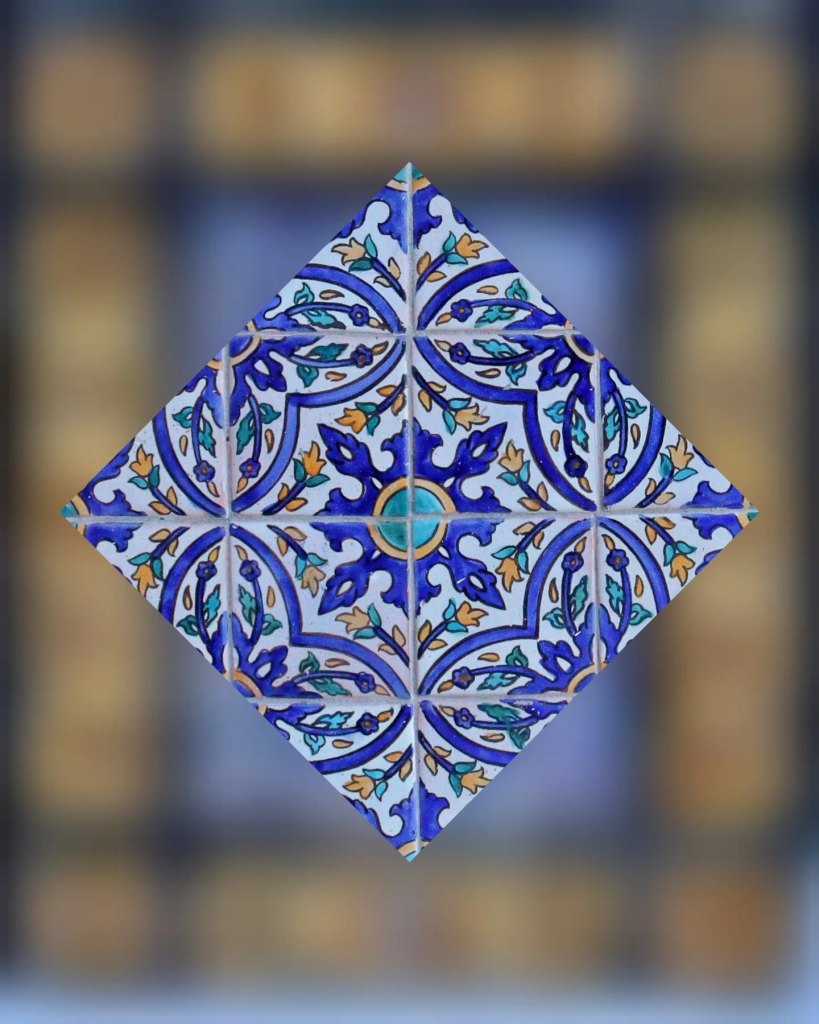
Stand in any courtyard of the medina of Tunis long enough and your eye stops reading the room and starts reading the wall. A vase, drawn in a line of cobalt, sits inside a pointed arch. Flowers pour out of it in green and a yellow the color of old mustard. Around the panel runs a border of leaves, and around the border, more tile, and more, until the whole surface hums. Nobody painted this on a canvas. A potter stamped it, glazed it, fired it, and set it into the wall two or three centuries ago, and it has not faded since.
That panel is the Tunisian tile. It is not Moroccan zellige, cut by hand into a thousand chips. It is not Portuguese azulejo, blue on white and telling a story. It is something the rest of the Mediterranean borrowed from and then forgot to credit.
Quick Answer — Tunisian tiles are the painted, glazed square tiles made in the Qallaline potters’ quarter of Tunis from the 16th century to the end of the 19th, recognizable by their blue, green, and ochre palette and their vase-of-flowers panels. The craft moved to Nabeul in the 20th century, where it is still made today. The best place to see the originals is the medina of Tunis; the best place to buy new ones is Nabeul, an hour south.
What makes a tile Tunisian
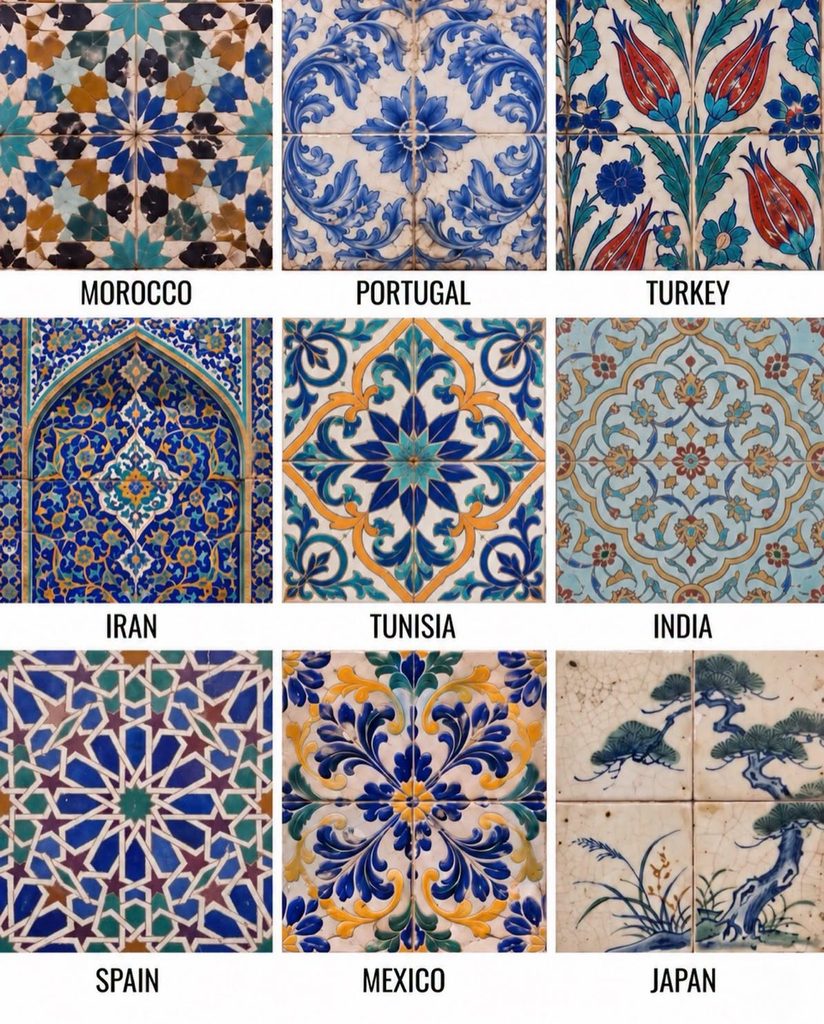
The shared image that sent you here lines up nine countries’ tiles side by side, and the Tunisian one holds its own without a caption. Here is how to tell it apart once you are standing in front of the real thing.
Start with the color. Three shades do almost all the work: a cobalt blue, a copper green that leans toward turquoise, and a yellow-ochre that can read as honey or as mustard depending on the light. Where Ottoman tiles from Iznik reach for tomato red and Portuguese tiles stay in blue and white, the Tunisian palette is these three on a milky, slightly off-white ground. The glaze is tin-based and thick, so the surface has a soft, pooled quality that modern factory tiles never quite manage.
Then the subject. The signature Tunisian form is the panneau, a picture made of many square tiles, and its signature image is a vase or a lamp sitting inside a horseshoe or pointed arch, with flowers, cypresses, and vines spilling out of it. You will also find eight-pointed stars, interlaced geometry, and borders of stylized leaves. Birds appear now and then; human figures almost never. Each tile is a fragment, so the design only resolves when the panel is assembled, and a single loose tile in a souk will look oddly incomplete, like one puzzle piece.
Finally the technique. These are not mosaics. Moroccan zellige is chiseled from fired slabs into tiny geometric chips and set like a jigsaw. The Tunisian tile is painted whole: a square of local clay, a white glaze, the pattern brushed or stamped on top, a second firing. It is closer in method to Spanish and Italian maiolica than to anything in Fez, which is the first clue to where it came from.
Qallaline: the potters’ quarter that named a style
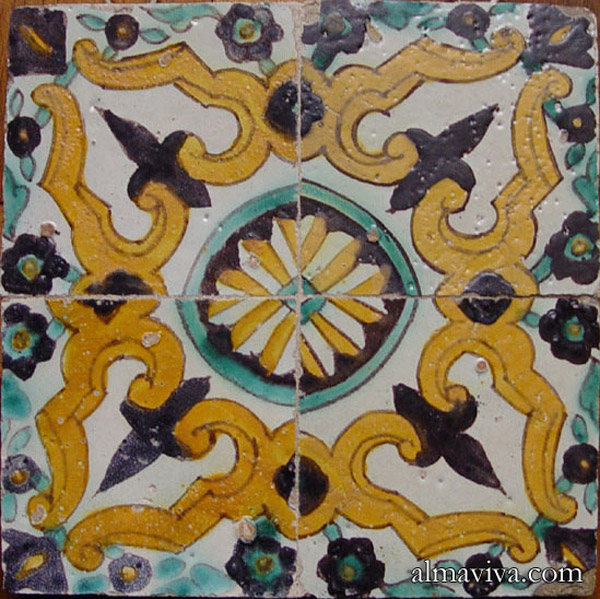
The word every collector, museum label, and auction catalogue uses for these tiles is Qallaline (you will also see Kallaline and Qallalin). It is not a technique or a dynasty. It is a neighborhood.
Qallal is Arabic for potter, and the Qallaline was the potters’ district on the northern edge of the medina of Tunis, beside a city gate called Bab Carthagena that has since vanished. Workshops fired tiles there from the 16th century until the end of the 19th, and the 18th century was their golden age. The name of the quarter became the name of everything that came out of it, the way Delft and Iznik did elsewhere.
The kilns were close to the clay, close to the water, and close to the clients. When a Bey built a palace, when a merchant restored a dar, when a brotherhood raised a zaouia for a saint, the order went to the Qallaline. Signed work survives: a potter named Usta Mas’ud al-Saba’ put his name on panels in the zaouia of Sidi Ali Azzouz, one in Tunis and one in Zaghouan, in the second half of the 18th century. A craftsman signing a wall was a rare thing in the Islamic world of the time; it tells you how highly the work was regarded.
And the work travelled. Qallaline panels went by sea to Tripoli, where the Gurgi Mosque still wears them, and overland to Kairouan. The reason it stopped is the usual one. Cheap industrial tiles from Italy and France flooded the market under the French Protectorate, the last Qallaline kilns went cold around the turn of the 20th century, and the quarter itself was absorbed into the ordinary streets of the city. Walk there today and nothing announces it.
Two currents: Andalusia from the west, Istanbul from the east
Two things happened to Tunis within a single generation, and the Tunisian tile is what they look like together.
In 1574 the Ottomans took the city from the Hafsids and Tunisia turned to face Istanbul. With the new rulers came Turkish taste: the tulip and the carnation, the cypress, the curling saz leaf, the idea that a wall could be a garden. Tunisian potters saw Iznik and wanted it.
Then, in 1609, Spain expelled its last Muslims, the Moriscos. Tens of thousands of them, perhaps 80,000, crossed to Tunisia and settled in Tunis, in Testour, in Zaghouan, in the towns of Cap Bon. They brought the citrus, the chechia, the tabouna, and, crucially for this story, the tile-making of Valencia and Seville: tin glaze, painted maiolica, the vase-in-arch composition that Spain had itself inherited from the Renaissance. The shared history we traced in Tunisia or Spain? is nowhere more literal than on a tiled wall.
The Qallaline potters did not choose between the two. They took the Ottoman flowers and the Andalusian method and the older Hafsid geometry that was already on the walls, and they fired all of it in local clay with the three colors they could make reliably. A 2025 materials study of 18th-century Qallaline fragments found that the cobalt for the blue came from a different source than the cobalt in Iznik or in Meissen porcelain, which is to say the potters were not importing finished pigments. They were working out their own recipe. That is why a Tunisian tile reads as its own thing and not as a provincial copy of Turkey or Spain.
Before the glaze: the tiles of Carthage
It is worth knowing that Tunisia was decorating walls with tile a thousand years before the Qallaline, because it changes how you look at the later work.
In the 5th and 6th centuries, under the Vandals and then the Byzantines, churches across the country were lined with square terracotta tiles pressed in moulds. Lions, deer, vines, crosses, and geometric knots stand out in relief on their faces. More than five thousand of them have been recovered from some ninety sites, and the type is found nowhere else in the Roman world. Several from the Carthage museum have travelled to the Met in New York on loan. The motifs, the scholars think, borrowed from Amazigh visual culture, the same vocabulary of lozenges and stars that the women of Sejnane still paint onto their pots by hand.
So when a Qallaline potter set an eight-pointed star into a border in 1750, he was not inventing. He was repeating something the walls of Carthage had already said.
Nabeul: where the craft went to survive
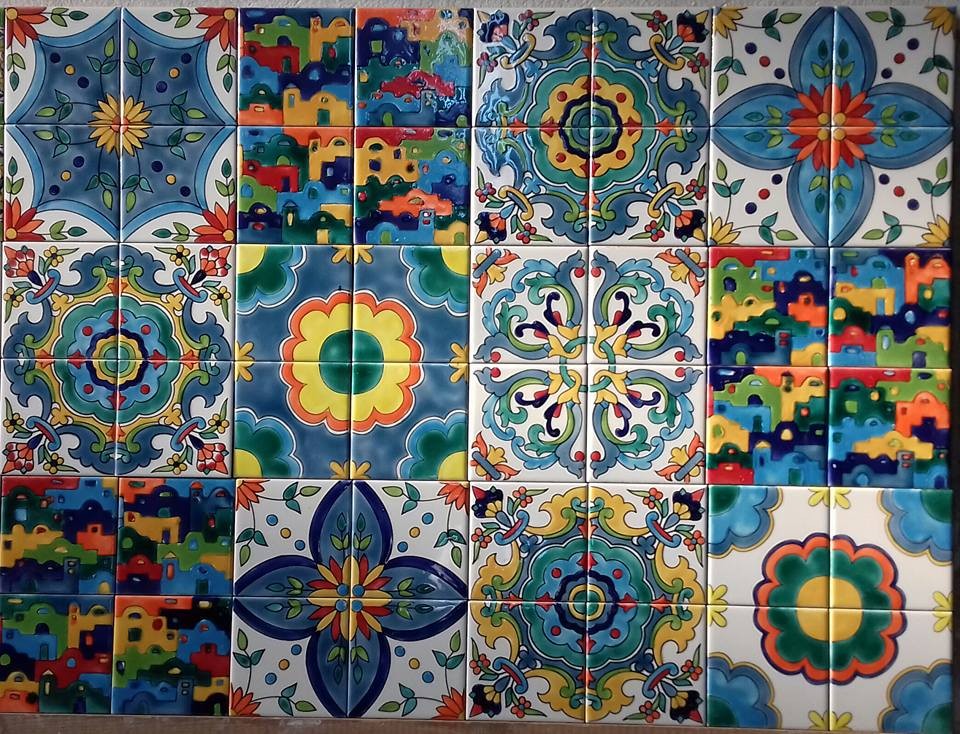
When the Qallaline kilns closed, the knowledge did not die. It moved an hour down the coast to Nabeul, the main town of Cap Bon, which had been throwing pots since it was the Roman Neapolis and had taken in its own share of Andalusian families after 1609.
The revival was partly a French project. In the 1920s and 30s, a handful of workshops, among them those of Jacques Tissier, Pierre de Verclos, and the Chemla family, set out to reproduce the Qallaline repertoire for the colonial market and the first wave of tourists. They hired Nabeul’s potters, studied the old panels, and put the vase-in-arch back into production. A great deal of what is sold today as “traditional Tunisian tile” descends from those three decades rather than directly from the 18th century, which is not a scandal, just a fact worth knowing.
By the early 2000s Nabeul counted more than 350 pottery workshops and factories, and ceramics was the town’s largest employer. Clay came in from Tabarka in the north; tiles went out to Germany, France, and Spain. The pattern on the butcher’s shopfront, the giant glazed jar in the main roundabout, the souvenir plates stacked at the roadside: all Nabeul.
The honest part is this. Since 2011 the handmade end of that trade has thinned out badly. Many of the small workshops that stamped tiles by hand have closed, and the survivors increasingly make factory-pressed, screen-printed tile for the tourist shelf. The real thing still exists in Nabeul, but you have to look for it, which is the point of the last two sections.
Where to see Tunisian tiles
You do not need a museum ticket to see Qallaline work; you need to walk into a courtyard. But a few places concentrate the best of it.
The medina of Tunis. This is the open-air gallery. The restored dars that now operate as guesthouses and museums keep their original panels in place, and most will let a polite visitor look at the patio. Dar Ben Abdallah, the museum of popular arts and traditions in the southern medina, is a good first stop. So is the Zaouia of Sidi Ali Azzouz, with the signed panels mentioned above. Our guide to the medina covers how to find your way; once you are in, look up at every entrance hall.
Dehliz El Zliz. In the basement of Dar Ben Gacem Kahia, at 16 Rue du Kahia in the medina, is a small museum built around a single family’s obsession. Alia and Hmida Ben Gacem spent fifty years buying back Tunisian tiles from around the world; their daughter Leila, who restored the house, has laid out more than two hundred of them to tell the Qallaline story from the 15th century to the quarter’s closure. It is the only place in the country where you can see the whole arc on one wall. Ask at the guesthouse to visit.
The Bardo. The Bardo National Museum is famous for its Roman mosaics, but it is housed in a Beylical palace, and the palace rooms themselves are the exhibit for our purposes: tiled dadoes, carved plaster, painted ceilings, exactly the setting these panels were made for.
Kairouan. The Zaouia of Sidi Sahbi, better known as the Barber’s Mosque, is the best Qallaline interior outside Tunis. The passages leading to the tomb of the Prophet’s companion Abu Zama’a are lined with 18th-century panels in the full blue-green-ochre palette, and because it is a working shrine the tile is kept, not curated. Pair it with the Great Mosque on the same morning; our Kairouan guide has the practicalities.
Sidi Bou Said. Not for antique panels, but for the living habit. Every blue door in Sidi Bou Said has a tiled threshold or a tiled bench beside it, and the village shows you how Tunisians still use tile the way other countries use paint.
How to buy real Tunisian tiles
Go to Nabeul, not the Tunis souk. The medina shops in the capital buy from Nabeul and mark up; the workshops themselves line the streets off Avenue Habib Thameur and the roads toward the beach, and most will let you watch. Friday is market day, and the busiest, but any weekday morning is better for a workshop visit. From Tunis it is an hour by louage or train; from Hammamet it is a 15-minute taxi.
Ask for zliz (tiles) made bil yed, by hand, and then check. A handmade tile is stamped or painted one at a time, so no two in a stack are identical: the line wobbles slightly, the glaze pools thicker in one corner, the back is rough and unglazed and often carries a thumbprint. A factory tile is perfectly square, perfectly repeated, and light in the hand; the pattern sits on the surface like a decal because that is what it is. Turn it over. Hold two side by side. The difference is obvious within a minute.
On price, the honest answer is that a handmade decorative tile has cost somewhere between a few dinars and ten for years, depending on size and complexity, and a full panel is priced as a commission. Do not expect to bargain a hand-stamped tile down to the price of a printed one; if the seller agrees, you have just found out which one it is. Pay in cash, in dinars, and read our currency guide before you go so the ATM does not surprise you.
Two practical notes. Tiles are heavy and glaze chips, so ask the workshop to wrap each one in newspaper and box them; most will, for a small fee, and a dozen will fit in a cabin bag. And if you want the real antique Qallaline, be careful. Genuine 18th-century panels are stripped from old houses and sold on the European antiques market, which is exactly how they vanish from the medina. A new tile from a Nabeul potter is the better purchase and the better conscience.
For the older, unglazed end of the tradition, the hand-built, smoke-blackened pots of the north, read our story on the women potters of Sejnane; the two crafts bracket three thousand years of Tunisian clay between them.
The wall remembers
There is a reason the image of nine countries’ tiles travelled so far, and it is not nostalgia. A tile is the one piece of a building that keeps its color. Stone weathers, plaster cracks, paint goes, but a glaze fired in the Qallaline in 1750 is the same blue tonight that it was the night it cooled. Walk the medina and you are looking at the only part of the 18th century that has not aged.
The potters’ quarter is gone. The potters are not.
Suggested Read: The Khomsa: Tunisia’s Hand of Fatima
Suggested Read: Tunisia or Morocco? An Honest Comparison from Tunis
From the Carthage Magazine Bookshelf
If a tiled wall is where Tunisia keeps its color, these three are where we keep the rest of the country.
- All About Tunisia — the definitive English-language traveler’s guide. 572 pages, 27 chapters, all nine regions, every UNESCO inscription, five thematic trails — and the practical answers (visa, currency, transport, etiquette) most travelers wish they’d had on the plane. $24.99 · PDF & EPUB.
- Speak Like a Local — 200+ Tunisian Arabic phrases with native audio recorded in Tunis. The phrases for the taxi, the souk, the café, and the dinner table. $14.99 · PDF, EPUB, MP3.
- The Authentic Tunisian Cookbook — sixty traditional recipes from the heart of North Africa. For when you get home and find yourself missing the food. $9.99 · PDF & EPUB.
All three available as a bundle for $39.99 — guide, language, and food, delivered together.
