
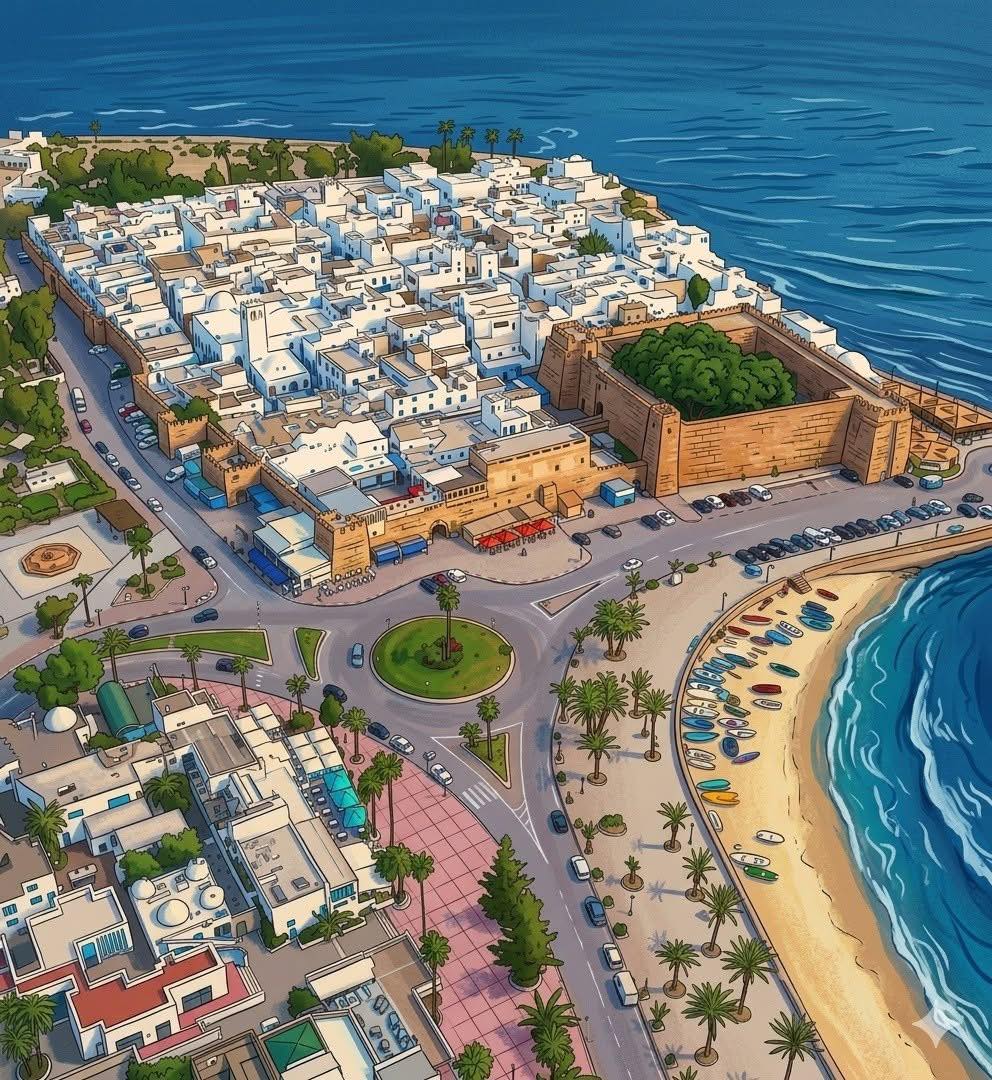
Quick Answer Hammamet is a coastal city on Tunisia’s Cap Bon peninsula, about an hour southeast of Tunis. It has two faces — an old town built around a 15th-century kasbah and walled medina, and a modern resort district called Yasmine Hammamet, eight kilometres south. The town was Tunisia’s first true beach resort, and a century before the big hotels arrived it was already pulling in writers, painters, and one very famous Romanian millionaire. Allow three days minimum; five if you want the beach and the day trips both.
The first thing that strikes you about Hammamet is the white. Not the resort white of glossy hotel brochures — the older white, the kind that has been sun-bleached for six hundred years. The medina walls come at you out of the Mediterranean haze and they are the same colour as the lime-washed houses behind them, and the same colour as the foam breaking against the kasbah below, and after a while you stop noticing the buildings as separate things and start seeing the whole town as one long bright line drawn against the sea.
This is what Tunisians have known for a century and what travellers keep rediscovering: Hammamet is not just a beach. It is the country’s oldest holiday town, the one Tunisia learned to be a destination in, and the layers of that learning are still visible if you slow down long enough to look. The fortress was built to keep Spanish raiders out. The medina was built to keep ordinary life in. The villa on the headland was built by a man who decided this was the most beautiful piece of coastline in the world and proceeded to invite Churchill and Garbo to agree with him. The marina to the south was built last, and the most loudly, and is in some ways the easiest part to see and the hardest part to love.
Hammamet, in short, is layered. Here is how to read the layers.
Where Hammamet Sits
Hammamet is at the base of Cap Bon, the green agricultural peninsula that juts out of Tunisia’s northeast coast like a thumb pointed at Sicily. The Gulf of Hammamet swings around it in a long, gentle arc. Tunis is fifty-eight kilometres northwest. Enfidha-Hammamet International Airport is forty kilometres south. Tunis-Carthage Airport, the country’s main hub, is about an hour by road if traffic cooperates.
You will hear the town described, often, as two places. It is. The original Hammamet — what locals just call el Medina or la Vieille — is the walled town on the headland, with the kasbah, the souks, the small fishing port, and the long curve of Plage Hammamet directly below. Yasmine Hammamet, eight kilometres south, is the planned resort city built in the 1990s and 2000s, with a 700-berth marina, a recreated Medina Mediterranea full of cafés and shops, and the cluster of large hotels most package tours land in. The two are connected by a steady stream of louages (shared taxis) and individual cabs, and you should plan to see both.
If you only have one day, pick the old town. If you have three days, see both, and use the second and third for the wider Cap Bon and a Carthage run.
The Medina and the Kasbah
The medina of Hammamet is small — small enough that you cannot really get lost, large enough that you can spend a morning in it without realising the time has moved. Its walls were raised in the fifteenth century, under the Hafsid dynasty, and they have stayed up ever since. Three gates pierce them. The streets inside are narrow, white, and patterned with the bright blue and yellow and green of painted Tunisian doors, the same colour palette that gave Sidi Bou Said its postcards.
What is in the medina, in a sentence: souks selling embroidery, ceramics, leather, perfume, jasmine, and — inevitably — a great deal of mass-produced souvenir kitsch you should walk past politely; the Grand Mosque, also fifteenth-century and still active; the Dar Khadija Museum, a small but genuinely affecting collection of traditional costumes and household objects laid out across the three floors of a restored old house; and the tomb of Sidi Bou Ali, the patron saint of the city, where Hammamet women still leave wishes and the occasional meshmoum of jasmine.
At the medina’s seaward edge, sharing a wall with it, sits the Kasbah. The fortress dates in its current form to the fifteenth century, though there has been some sort of stronghold on the spot since at least the ninth. It was built to keep out the Spanish — Hammamet sat directly in the line of raiding fleets coming out of Sicily and the Iberian coast — and it served as a working military post until the nineteenth century. Today you can walk its ramparts for the equivalent of a coffee, and you should. From the upper walls, the Gulf of Hammamet opens out in a way that flattens the photograph and astonishes the person taking it.
Inside the Kasbah is Café Sidi Bou Hdid, set into the seaward rampart, with white-painted benches and a low parapet between you and a forty-metre drop to the surf. Order a Tunisian mint tea, pay attention to the pine nuts at the bottom of the glass, and stay for an hour. Almost no other view in Tunisia is better paired with a glass of tea.
A note on the souks: this is a tourist town, and the medina vendors know it. Prices start high and come down with patience. Walk through twice before you buy, and never accept the first quote on anything you actually want. If you don’t speak Arabic or French, a few key Tunisian phrases will change the negotiation more than you’d expect — bechehel (how much), ghali barcha (way too expensive), naqes shwaya (lower it a bit) — and a polite smile when you say them goes further than fluency. Carthage Magazine’s Tunisian Arabic phrasebook was put together precisely for this kind of moment, with native audio recorded in Tunis.
Dar Sebastian — The Villa That Hosted the Twentieth Century
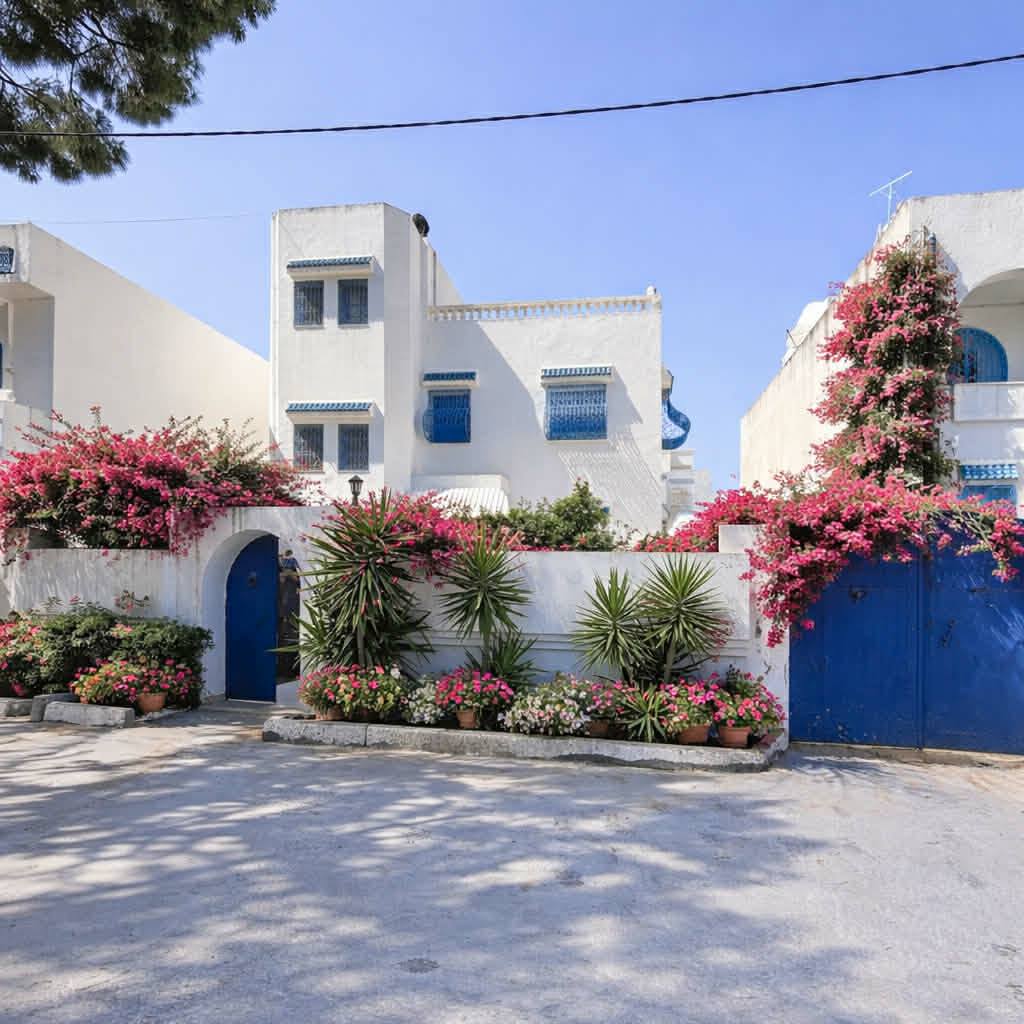
A ten-minute walk north of the medina, set back from the road in nine hectares of garden, sits the most surprising address in the country.
Dar Sebastian — the Sebastian House — was built in 1927 by George Sebastian, a Romanian aristocrat who fell in love with what was then a sleepy fishing port and decided to plant the most beautiful house in the Mediterranean on its headland. The villa is low and white and impossibly elegant, designed in a style Sebastian seems to have invented on the spot — Tunisian bones, art-deco furniture, a black marble dining table that seats twenty, a sunken bath for four, and a colonnaded swimming pool that the architect Frank Lloyd Wright reportedly called one of the most beautiful pieces of design he had ever seen.
Sebastian threw parties. The guest list, over the next decade, would be the most improbable in twentieth-century North African history: André Gide, Paul Klee, Jean Cocteau, Greta Garbo, King George VI, Georges Bernanos, Alberto Giacometti. Winston Churchill wrote part of his memoirs in one of the upstairs rooms. During the Second World War, when Sebastian had fled to California, Erwin Rommel briefly used the house as a headquarters. After the war Sebastian returned, restored what the Desert Fox had disturbed, and in 1962 left the property to the Tunisian state.
It is now the International Cultural Centre of Hammamet, and every summer its outdoor amphitheatre — built into the garden, with the Mediterranean as the back of the stage — hosts the Hammamet International Festival, a month of music, dance, and theatre that has been running for more than half a century. If your trip falls in July or August, find out what’s on. The setting alone justifies the ticket; the programming, increasingly, is doing the same.
Walk the gardens even if the festival isn’t running. Find the amphitheatre. Stand in the middle of the stone stage and say something, anything, in the direction of the sea. The acoustics will surprise you. So will the silence afterward.
Beyond the Walls: Pupput, Nabeul, Zaghouan
Hammamet is older than its medina. Three kilometres south of the old town, on the road to Nabeul, lies Pupput — the Roman settlement that occupied this coastline from the first to the fifth centuries CE. Pupput is not Dougga, and it is not El Jem. What survives is modest: mosaics in the floor of a Roman house, the foundations of a small basilica, the remains of a necropolis. But it is the kind of place you can have almost to yourself on a weekday morning, and that is its own quiet luxury.
Nabeul, twelve kilometres further north, is the working capital of the Cap Bon peninsula and worth a Friday morning. The weekly market is one of the biggest in northern Tunisia, and the city is the country’s pottery centre — the painted ceramics you’ll see in every Tunisian souvenir shop almost all come from here, and visiting the workshops directly is both cheaper and more honest. Nabeul is also the heartland of Tunisian harissa; the chillies of Cap Bon, sun-dried and pounded into the country’s most famous condiment, were what UNESCO inscribed when it added harissa to the list of intangible cultural heritage in 2022.
Forty-five minutes inland, Zaghouan sits at the foot of its own mountain, and there the Romans built the great Temple of the Waters — a sanctuary around a natural spring, the head of the aqueduct that fed water to Carthage seventy kilometres away. The ruins are partial, the views are not. On a clear afternoon you can see all the way back to the Gulf of Hammamet from the temple steps.
What to Eat in Hammamet
Hammamet is on the sea, on the country’s most fertile peninsula, and at the centre of the country’s most prolific wine region. Eat accordingly.
Order grilled fish — dorade (sea bream), loup de mer (sea bass), or the whole local mérou (grouper) if you see it on the board — with a wedge of lemon and a side of slata mechouia, the smoky char-grilled pepper-and-tomato salad TasteAtlas recently ranked the second-best salad in the world. Eat at least one brik — the crisp, folded pastry with a runny egg inside, the country’s most photogenic snack — and forgive yourself for the inevitable yolk on your shirt. Cap Bon olive oil is some of the best in the Mediterranean; the Tunisian olive oil tradition is older than Rome, and you will taste why in the bread that comes to the table before your meal.
In Yasmine Hammamet, the Medina Mediterranea has the most international choices — pizza, sushi, a casino, the lot — and the most predictable food. The old town has the quieter, better restaurants. Look for the places where Tunisians are also eating.
A glass of Magon or a Vieux Magon — the Cap Bon red named for the Carthaginian agronomist who wrote the first known treatise on wine-making, twenty-two centuries ago — pairs honestly with most of what you’ll order. For more on what you can and can’t drink in Tunisia, including the country’s quietly excellent wine industry, see our guide to alcohol in Tunisia.
If the food sticks — and it tends to — the country’s home recipes are mostly translatable. Amira Ben Harcha’s Authentic Tunisian Cookbook collects sixty of them, written in a style designed for a home kitchen anywhere in the world.
When to Go
Hammamet has a Mediterranean climate softened by sea breezes, which means it is comfortable for more of the year than its latitude would suggest. The peak season runs July and August, when the resort hotels fill, the festival is in full swing, and the beaches turn into a continuous strip of umbrellas. Many travellers will prefer the shoulder months. May, June, September, and early October are, by most accounts, the best windows — warm enough to swim, light enough to walk the medina without melting, and cheap enough that the same hotel will cost you a third less than it did in August.
Winter is quiet, often cool, and surprisingly green; the rains are short, the light is long, and the festival town becomes a place where Tunisians come for the weekend. If you want Hammamet without the queue, come in February. We’ve written a full month-by-month guide to visiting Tunisia for the longer view.
How to Get There and Get Around
From Tunis-Carthage Airport: roughly 65 km, about an hour by taxi (expect 60–90 TND with a metered cab, more from the airport rank — confirm the meter is on or agree the price upfront).
From Enfidha-Hammamet Airport: roughly 40 km, about 30–40 minutes. Most package tours land here.
By train: the SNCFT operates a regular service between Tunis and Hammamet — about an hour and a half, cheap, and the most pleasant way in if you have time.
Around town: the medina, the kasbah, the Cultural Centre, and Plage Hammamet are all walkable from each other. To reach Yasmine Hammamet, take a local taxi (10–15 TND) or the local bus. Bolt operates as a ride-hailing app across Hammamet and is usually the easiest option after dark.
A common-sense word on safety: Hammamet is one of the calmer tourist towns in the country. The usual precautions apply — keep an eye on your bag in the souk, agree taxi fares before you sit down, don’t flash a phone you can’t afford to lose. For the broader picture, our Is Tunisia Safe? explainer goes deeper.
A Reasonable Three-Day Itinerary
Day one — the old town. Morning in the medina. Walk the souks early, before the cruise crowds. Tea at Café Sidi Bou Hdid on the Kasbah wall. Lunch in the medina; afternoon at Plage Hammamet directly below. Evening at Dar Sebastian, then dinner at a small restaurant in the old town.
Day two — Cap Bon. Drive or louage up the peninsula. Morning at the Nabeul market (Friday is best), pottery workshop visits, lunch at Kelibia or Korbous. Afternoon at the Roman ruins of Pupput on the way back. Evening at the Yasmine Hammamet marina for the contrast.
Day three — Carthage day trip. Hammamet to Tunis is a comfortable hour. Spend the day with the ruins of Carthage and the Bardo Museum, then walk the Roman Theatre and the Carthage National Museum on Byrsa Hill. Lunch in Sidi Bou Said. Back to Hammamet for dinner.
If you have a fourth day, add Kairouan and the Great Mosque of Uqba. If you have a fifth, El Jem, the largest Roman amphitheatre in Africa, is two hours south.
Why It Stays With You
The longer you spend in Hammamet, the more you notice that the town doesn’t really want to be Saint-Tropez. The comparison flatters the south of France more than it flatters the south of Cap Bon. What Hammamet is, more honestly, is a working Tunisian coastal town that happens to have been beautiful for long enough that the rest of the world noticed.
The fishermen still leave in the morning from the old port below the Kasbah. The medina shopkeepers still open up at nine and shut for siesta at one. The jasmine sellers still walk the Avenue de la République in July, holding their tiny white bouquets out to passing cars. The villa on the headland is still standing in its garden, still echoing, in the right light, with the conversations of the people who once stood in its rooms.
You can come for the beach. Most people do. But the reason to stay — the reason Hammamet keeps pulling its visitors back — is what’s quietly underneath the beach. A medina that is older than most European capitals. A fortress that watched off the Spanish. A villa where the twentieth century took a long, sun-warmed pause. A coast that has been doing this for a very long time and is in no particular hurry to stop.
From the Carthage Magazine Bookshelf
If you’re planning the wider trip, three Carthage Magazine ebooks were built for exactly this kind of reader:
- All About Tunisia — the definitive English-language traveler’s guide, 572 pages and 27 chapters across all nine regions of the country, every UNESCO site, and five thematic trails from the Sahara to the Roman ruins. The Hammamet chapter goes deeper than this article can. $24.99 · PDF & EPUB
- Speak Like a Local — 200+ Tunisian Arabic phrases with native audio recorded in Tunis. The phrases for the souk, the taxi, and the café are all in chapter four. $14.99 · PDF, EPUB, MP3
- The Authentic Tunisian Cookbook — sixty recipes for what you’ll wish you could keep eating once you’re home, including the brik and the slata mechouia you’ll meet in Hammamet. $9.99 · PDF & EPUB
All three are available as a bundle for $39.99 — guide, language, and food in one delivery.
