
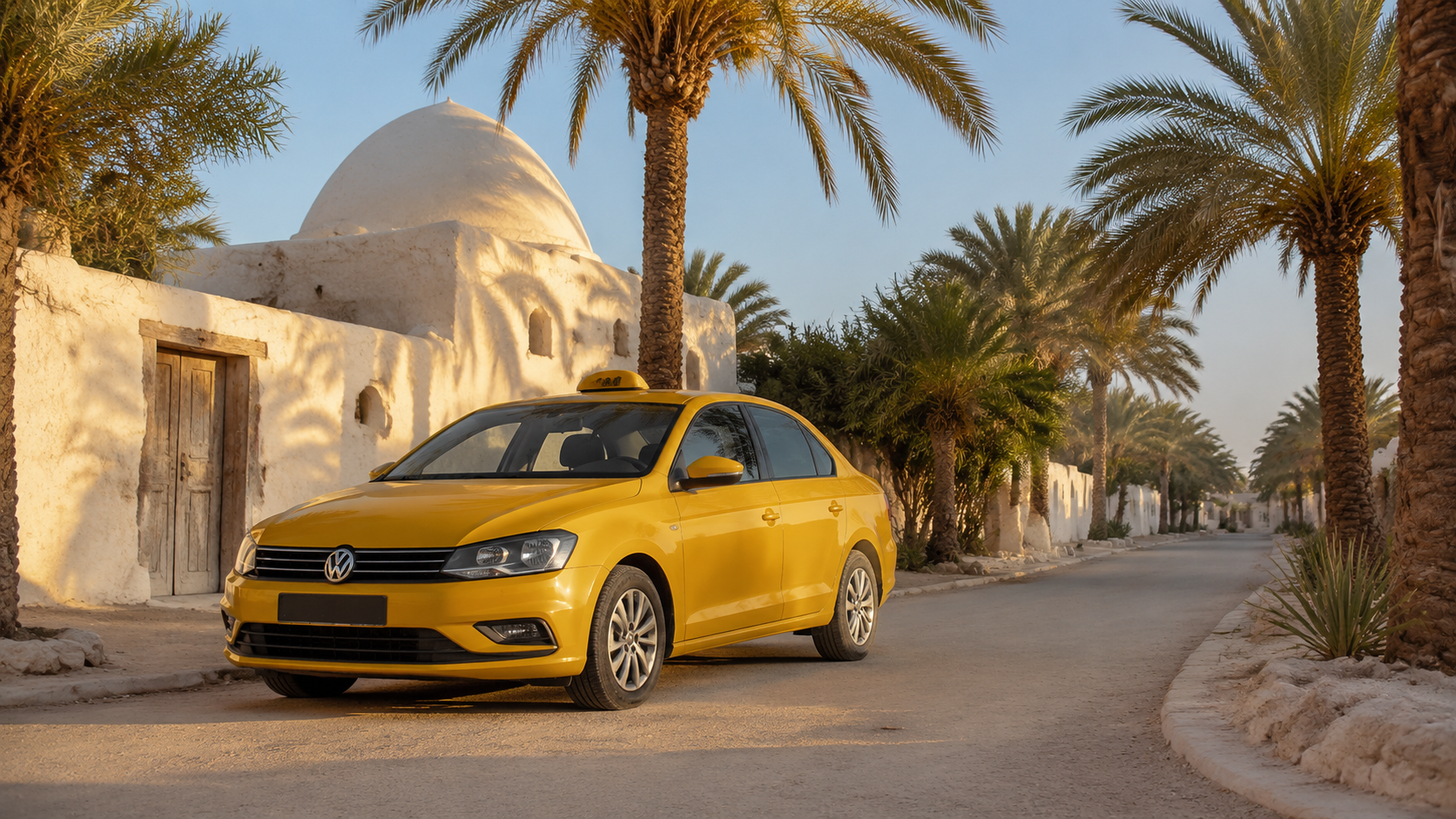
You land at Djerba-Zarzis airport, step out into the dry southern light, reach for your phone — and there is no Uber. No Bolt. No app at all. This is the moment most visitors realise that Djerba runs on a different logic than the cities they flew in from, and that the island will not be navigated by tapping a screen.
That is not a problem. It is, in fact, one of the better things about the place. But it does mean a little knowledge goes a long way. Djerba is 514 square kilometres of palm groves, whitewashed villages, fishing ports, and beach strip — the largest island off the coast of North Africa — and how you move across it shapes the entire trip. Get it right and the island opens up: the pottery kilns of Guellala in the morning, a flamingo lagoon by midday, grilled sea bass in Houmt Souk by dusk. Get it wrong and you spend your holiday waiting on a kerb in the heat, haggling over fares you don’t understand.
Here is how the island actually works, written for the traveller who wants to spend less time worrying about logistics and more time on the beach.
First, the thing nobody tells you: there is no ride-hailing in Djerba
Uber, Bolt, Careem — none of them operate in Tunisia, and Djerba is no exception. This catches a lot of first-time visitors off guard, because the modern travel reflex is to assume a car is always one tap away. On the island, it isn’t.
What replaces the app is older and, frankly, more human: you arrange your ride directly, ideally with someone you can reach again tomorrow. The island’s transport is a patchwork of metered yellow taxis, shared minibuses called louages, hotel shuttles, and private drivers. Each has its place, and the trick is knowing which one to reach for and when.
Djerba-Zarzis Airport: the first ride sets the tone
Djerba-Zarzis International Airport (airport code DJE) sits near the centre of the island and handles seasonal European charters alongside year-round connections to Paris, Frankfurt, and a handful of other hubs — the deep-south gateway in Tunisia’s four-airport network. It is small, walkable, and rarely chaotic. The arrivals hall empties out fast.
The catch is that the resort zones are spread along the eastern and northeastern coast, and the airport taxi rank can be a scrum when two flights land at once. Fares from the airport are not metered the way an in-town ride is — they depend on where your hotel sits, whether it’s Houmt Souk, Midoun, the zone touristique, or a villa down a sand track — and the negotiation happens at the worst possible moment, when you’re jet-lagged and your luggage is heavy.
The cleanest solution is to have your transfer arranged before you arrive, with the price agreed in advance and a driver who tracks your flight and waits with a sign. It removes the one piece of friction that can sour an otherwise smooth landing. More on that below.
Taxis, the meter, and how to not overpay
Within Djerba’s towns, the standard yellow taxis run on a meter — the compteur — and for ordinary point-to-point hops this is genuinely the fair way to travel. A ride across Houmt Souk, or from your hotel to a restaurant, should cost a modest, metered fare, and an honest driver will simply switch the meter on without being asked.
The friction comes in two situations. The first is the airport, as above, where set-price negotiation replaces the meter. The second is the longer island crossing — say, from the resort strip out to Guellala or down to Ajim — where a metered taxi may be reluctant to take you, or where the trip is long enough that a flat agreed price makes more sense for everyone. Tunisia generally adds a surcharge for night rides, so a fare that felt high at 11pm may simply reflect the after-dark rate rather than a scam.
Two habits will save you grief throughout your stay. Confirm before you set off whether the ride is on the meter or a fixed price, and if it’s fixed, agree the number out loud before the doors close. And keep small dinar notes on hand — drivers rarely have change for large bills, and “I have no change” is a time-honoured way to round a fare upward. For a fuller sense of what daily costs look like across the country, Carthage Magazine’s guide to the cost of living in Tunisia is a useful baseline.
Louages and buses: cheap, characterful, and slow
If you’re travelling on a budget and not in a hurry, the louage — a shared minibus that leaves when it fills up rather than on a schedule — is the most authentically Tunisian way to move. They connect Djerba to the mainland and run between the island’s main towns for a few dinars. They are also unpredictable, often crowded, and not built for travellers hauling beach gear and children. As a way to feel the rhythm of local life, they’re unbeatable. As a way to make a lunch reservation across the island, they’re a gamble.
Regional buses, run by the national operator, cover the longer hauls — including the long road connection up to Sfax and onward to Tunis for those skipping the domestic flight. For getting around the island itself, though, most visitors find buses too infrequent to plan a day around.
Renting a car: freedom with a catch
A rental car gives you the run of the island, and Djerba’s flat, compact geography makes it less daunting to drive than mainland Tunisia. Roads to the main sights are reasonable, and parking is rarely a battle. Agencies cluster at the airport and in Houmt Souk; to compare them — international chains and local outfits side by side, with the deposit and insurance excess shown before you commit — check your dates on DiscoverCars.
The honest caveats: Tunisian driving habits take some adjusting to, signage is inconsistent once you leave the main roads, and the paperwork, deposit, and insurance excess can eat into the savings — our guide to renting a car in Tunisia covers all of it, fine print included. For a couple planning to range widely and confident behind the wheel in an unfamiliar country, a rental can be the right call. For a family that mainly wants the beach, a few day-trips, and zero stress, the maths often favours hiring a driver for the days you actually need one — and leaving the car keys out of the holiday entirely.
The case for a private driver who knows the island
For most visitors, the sweet spot between the helplessness of no app and the hassle of a rental is a private driver booked in advance — someone who handles the airport pickup, builds a half-day or full-day tour around what you actually want to see, and stays reachable on WhatsApp for the rest of your stay.
This is where a local name matters. Marwen Gzam was born and raised on Djerba and has spent more than fifteen years driving visitors across every corner of it — the quiet backroads, the right time to reach each landmark before the tour buses arrive, the photo stops most itineraries miss. He runs a brand-new, air-conditioned car, speaks French, English, and Arabic (plus some German), tracks incoming flights so there’s no waiting on the kerb, and agrees prices clearly up front: the official meter for ordinary point-to-point rides, and a set, agreed fare for airport transfers and custom tours, so there are no surprises either way.
What you’re really buying is the thing the app took away — continuity. One driver, one number, for the whole week. The same person who collects you from arrivals can take you to the El Ghriba Synagogue on Tuesday, build a pottery-and-souks loop through Guellala and Houmt Souk on Thursday, and get you back to DJE in good time for your flight home on Saturday. For families and small groups especially, it’s the lowest-friction way to experience the island. Booking is simply a WhatsApp message away (+216 98 617 679).
A sample day, the easy way
To make it concrete: a classic half-day with a private driver might run Houmt Souk’s old town and harbour first thing, while the light is good and the market is busy; then El Ghriba and the Jewish quarter of Erriadh, with its open-air Djerbahood murals; then the pottery kilns of Guellala, where certain techniques have barely changed in centuries. A full day adds the crocodile farm at Djerba Explore, the flamingo lagoon, Midoun’s market, and a sunset over the water at Sidi Jmour. No timetables, no parking, no negotiating at each stop — just the island, at your pace.
The bottom line
Djerba is one of the easiest places in Tunisia to enjoy and one of the easiest to overthink. Forget the apps that don’t exist here. For short hops, use the metered taxis and confirm the meter is on. For the budget adventure, brave a louage. For genuine independence and confident drivers, consider a rental. And for the version of the trip with the logistics quietly handled — airport to beach to souk and back — book a trusted local driver and spend your attention on the island itself, which is, after all, why you came.
From the Carthage Magazine Bookshelf
If Djerba is on the itinerary, three Carthage Magazine ebooks were built for exactly the days between arrival and departure:
- All About Tunisia — the definitive English-language traveller’s guide. 572 pages, 27 chapters, all nine regions, every UNESCO inscription (Djerba included), five thematic trails, and the practical answers — visa, currency, transport, etiquette — most travellers wish they’d had on the plane. $24.99 · PDF & EPUB
- Speak Like a Local — 200+ Tunisian Arabic phrases with native audio recorded in Tunis. The phrases for the taxi, the souk, the café, and the dinner table. $14.99 · PDF, EPUB, MP3
- The Authentic Tunisian Cookbook — sixty traditional recipes from the heart of North Africa. For when you get home and find yourself missing the food. $9.99 · PDF & EPUB
All three available as a bundle for $39.99 — guide, language, and food, delivered together.
