
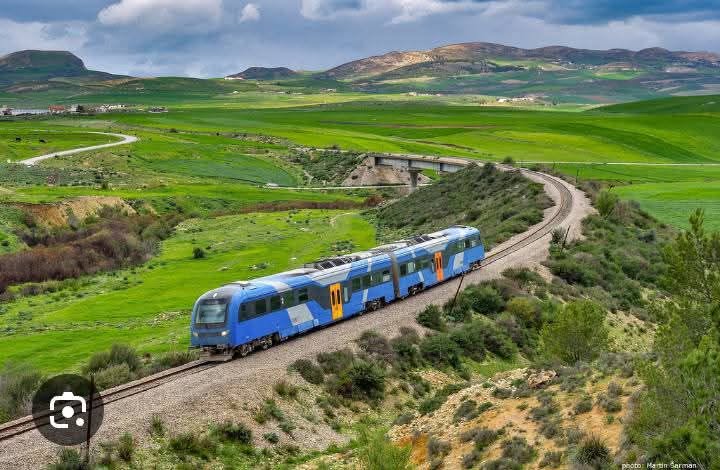
Quick Answer — Tunisia’s railway, SNCFT, runs 23 lines and about 2,170 kilometres of track out of Tunis, and it is cheap, sociable, and slow. Four journeys genuinely justify the train: the coastal spine south to Sousse, El Jem and Sfax; the Sahel Metro linking Sousse, Monastir and Mahdia; the TGM out to Carthage and Sidi Bou Saïd; and the Red Lizard through the Selja gorges. There is no rail to Djerba or the deep southeast. Tickets are sold at station counters, not online.
Somewhere past Enfidha the olive trees begin, and for the better part of an hour they refuse to stop — rank after silver-grey rank of them, planted to a geometry so old it predates the tracks by two thousand years. A train is the only sensible way to watch this. In a louage you are negotiating; behind a wheel you are watching the road. On the morning service out of Tunis you are simply sitting with a paper cup of over-sweet tea while central Tunisia unspools past the window, and somewhere around the second hour you understand why this railway, for all its faults, still has defenders.
Tunisia’s trains are not fast, not reliably punctual, and on certain lines in certain months not running at all. But on the right route they are the cheapest and by some distance the most companionable way to cross the country. This is a guide to which routes those are, and to what you should actually expect on board; our complete transport guide sets the railway alongside every other option.
What the Network Actually Looks Like
The operator is SNCFT — the Société Nationale des Chemins de Fer Tunisiens — and its shape is a French colonial inheritance Tunisia has been patching and occasionally rescuing ever since. The network runs to 23 lines and roughly 2,170 kilometres, serving 196 stations, stops and halts. Around 460 kilometres is standard gauge in the north; some 1,701 kilometres is the narrower metre gauge of the centre and south. Barely 90 kilometres is electrified. Everything else is diesel, which is part of the character and part of the problem.
Geographically it is a hub and spoke, with Tunis at the centre and five arms reaching out. South along the coast to Sousse, El Jem, Sfax and Gabès, then swinging inland to Gafsa, Metlaoui and Tozeur. West through Béja and Jendouba to Ghardimaou and the Algerian frontier. Northwest to Le Kef. North to Bizerte. East to Nabeul on Cap Bon.
What is missing matters just as much. There is no railway to Djerba, none to Tataouine or Douz, nothing at all in the far southeast. If your itinerary bends that way, plan for a flight or a louage early rather than discovering the gap in a station hall.
One statistic captures the whole system better than any map. The intercity main lines run about 38 services a day and carry somewhere near two million passengers a year. A single 65-kilometre commuter line along the Sahel coast carries more than eight and a half million. Tunisia’s railway, in practice, is a superb local network with a long-distance network attached.
The Spine: Tunis to Sousse, El Jem, and the South
This is the route most visitors will actually use, and the one the railway does best. Trains leave Tunis Ville — the handsome station on Place de Barcelone, a short walk from the medina — and run down through Bir Bouregba, Enfidha and Kalâa Sghira to Sousse in a little over two hours. It is comfortable, it costs a fraction of anything else, and it deposits you within walking distance of the ribat and the medina rather than at some ring-road station.
Keep going and the line threads through El Jem, where the amphitheatre rises out of a modest market town in a way that never stops being absurd. The station sits a few hundred metres from the arena, which makes this one of the great rail day trips in North Africa — easily done from Sousse in a morning. Beyond it the train reaches Sfax in roughly four hours from Tunis, and eventually Gabès, by which point you have given up most of a day.
Inland, the line continues to Gafsa, Metlaoui and Tozeur. That service returned after an eight-year absence, reconnecting the capital to the southwestern oases, and it is the most romantic long-haul on the network — an overnight-length run in seated coaches, no berths, ending near the edge of the Chott el Jerid. Romantic is doing some work in that sentence. It is also the sort of service suspended for maintenance without much warning, so treat it as a bonus rather than a fixed point.
The Sahel Metro: Tunisia’s Most Useful Train
If one line deserves to be famous, it is this one. The Sahel Metro runs 31 stations and stops between Sousse Bab Jedid and Mahdia, calling at Monastir, Moknine and Teboulba, with 46 services a day and roughly 23,600 passengers using it daily.
Crucially, it also serves Habib Bourguiba airport, which means anyone landing at Monastir can walk out of arrivals and take an electric train straight to their resort town for pocket change instead of negotiating a transfer. Almost nobody tells you this, and it may be the single most useful piece of transport information in Tunisian tourism.
Use it as a spine for a Sahel week: base yourself in Sousse or Mahdia, ride out to the ribats and the beaches, and never think about a car.
The TGM, and the Ride to Carthage
The little line out to the northern suburbs is not, strictly speaking, SNCFT at all — the TGM is run by Transtu, Tunis’s urban transport company, and it is a different beast entirely. From Tunis Marine it runs along the lagoon to La Goulette, then up the coast through Carthage — with separate stops for Salammbô, Byrsa and Hannibal, so you can hop off at whichever ruin you want — and on to Sidi Bou Saïd and La Marsa.
It is the backbone of any single day in Tunis, and it is also a moving target. The TGM has been mid-overhaul for some time: full service was restored in February 2026, further partial closures for bridge works followed, and a contract for eighteen new trainsets was signed that July. The honest advice is that it usually runs, it is worth using, and you should confirm on the day rather than build a tight schedule around it. Bus 347 shadows the route when the trains do not.
West, North, and the Train to Algeria
The other spokes are quieter and mostly for travellers with time. Bizerte is reachable via Manouba, Mateur and Tinja — unhurried, and a genuine alternative to the louage. Nabeul sits at the end of a Cap Bon branch. The line west to Le Kef via Gaâfour and Dahmani runs through some of the loveliest and least visited country in Tunisia.
The genuinely new development is international. After roughly three decades dormant, the Tunis–Annaba service was formally restored in December 2025 and now runs three times a week in each direction: out of Tunis on Mondays, Wednesdays and Fridays at 08:25, arriving Annaba around 18:20; back from Annaba on Sundays, Tuesdays and Thursdays at 09:00, reaching Tunis about 18:27. It calls at Béja, Jendouba and Ghardimaou on the Tunisian side and Souk Ahras on the Algerian, with border formalities handled at Ghardimaou and Souk Ahras respectively. Fares at relaunch sat in the region of forty dinars one way, and the service is occasionally suspended around major holidays — it went dark for ten days over Aïd al-Adha in 2026. Verify before committing, but it is a real and slightly wonderful thing: you can once again cross the Maghreb by rail.
The Red Lizard, and Trains That Are Destinations
Not every Tunisian train is transport. The Lézard Rouge — the Red Lizard — is a restored beylical train of six carriages, salon car and bar car included, that runs 43 kilometres from Metlaoui into the Selja gorges and back in under two hours. Tickets have hovered around 20 to 25 dinars for adults. It is spectacular and it is also famously unreliable, going quiet for months at a time for weather damage, low season, or reasons nobody explains. Phone ahead; do not build a day around it sight unseen.
SNCFT also runs a VIP carriage for charters and has revived the “Habib Bourguiba” presidential train, a 1960s German gift, as a slow tourism circuit through the interior. Neither is a service you can simply turn up for, but both are worth knowing exist.
Tickets, Classes, and What It’s Like on Board
There are three classes on most main-line trains: second, first, and confort. Second is very cheap and, on busy routes and around holidays, very full. First is a modest premium for a reclining seat and considerably more air, and in July and August it is money well spent. Confort is the top tier where it is offered. Some express services run first class only.
Buy at the station counter. SNCFT’s website will track a train in real time but will not sell you a ticket, and there is no dependable online booking for foreign cards — budget a little time at the window, especially on summer weekends. The Carte Bleue rail pass, valid seven, fifteen or twenty-one days for unlimited travel, is still sold at stations and is good value if you are genuinely criss-crossing the country; a week in second class has run somewhere around forty dinars. Bring your passport. Fares are quoted in dinars, cash is easiest, and the sums involved are small enough that the whole exercise feels faintly unserious to anyone arriving from Europe.
On board, expect a trolley with drinks, sandwiches and snacks on the longer runs, and expect it to be absent during Ramadan — pack your own food then, since station stops are far too brief to nip out. Air conditioning is generally present and occasionally theoretical. Trains are considered safe and entirely normal for women travelling alone, and a handful of Tunisian Arabic phrases will convert a seatmate into a guide within about ten minutes. That is not a small part of the appeal.
When the Train Is the Wrong Answer
Be honest with yourself about the map. If you are heading to Djerba, the ksour of the southeast, or the desert beyond Tozeur, the railway simply does not go there, and a louage or a hire car is the answer. If you are on a tight schedule, louages are frequently faster and leave the moment they fill, rather than the moment a timetable says. And if you want to reach Hammamet or the smaller inland towns, the road usually wins.
But for Tunis to Sousse, for the hop to El Jem, for the whole Sahel coast, and for the TGM run out to Sidi Bou Saïd, the train is not the compromise. It is the good version. Check the timetable, buy the ticket at the window, take the window seat facing forward, and let the olive trees do the rest.
From the Carthage Magazine Bookshelf
Rail travel puts you shoulder to shoulder with Tunisians for hours at a stretch, which is exactly when a few words of the language and a proper map of the country start to earn their keep.
- All About Tunisia — the definitive English-language traveler’s guide. 572 pages, 27 chapters, all nine regions, every UNESCO inscription, five thematic trails — and the practical answers (visa, currency, transport, etiquette) most travelers wish they’d had on the plane. $24.99 · PDF & EPUB.
- Speak Like a Local — 200+ Tunisian Arabic phrases with native audio recorded in Tunis. The phrases for the taxi, the souk, the café, and the dinner table. $14.99 · PDF, EPUB, MP3.
- The Authentic Tunisian Cookbook — sixty traditional recipes from the heart of North Africa. For when you get home and find yourself missing the food. $9.99 · PDF & EPUB.
All three available as a bundle for $39.99 — guide, language, and food, delivered together.
