
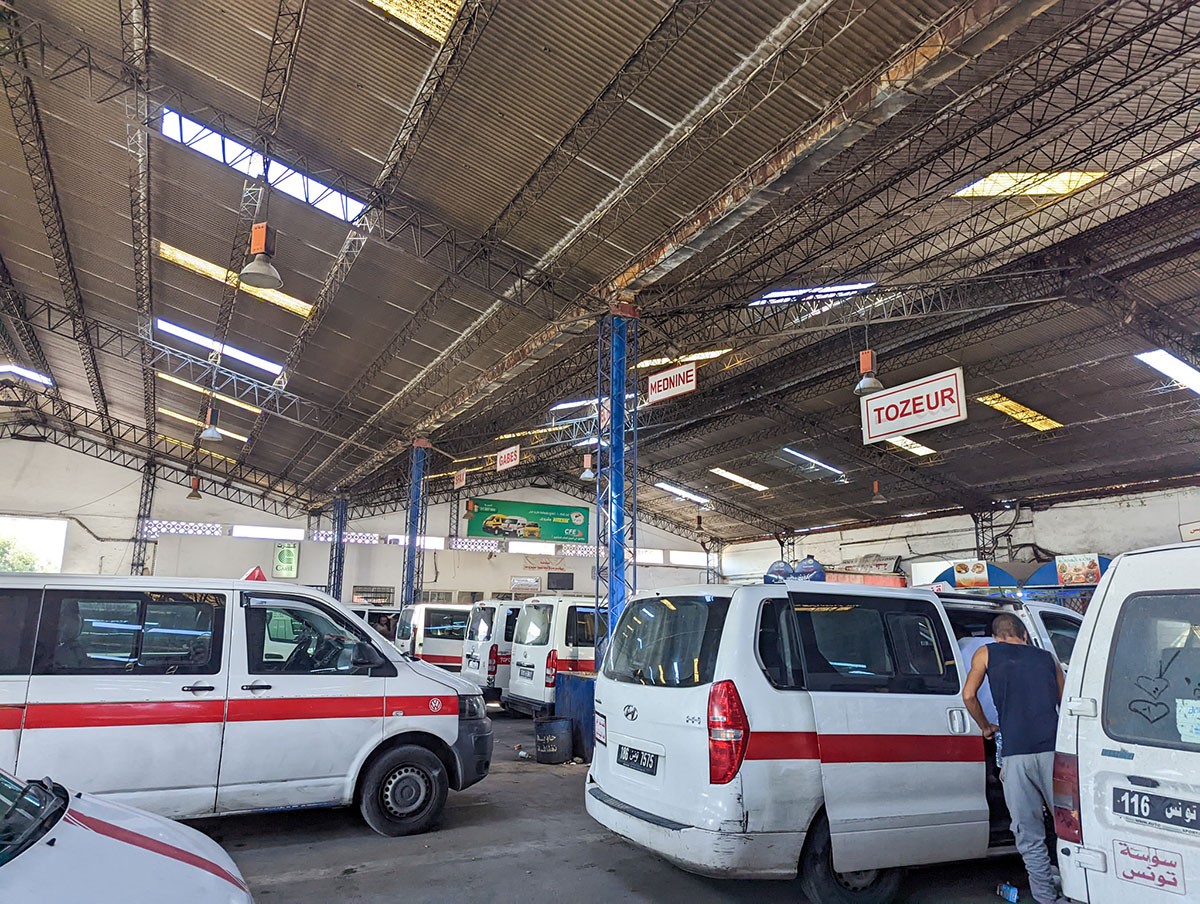
If you only learn one thing about getting around Tunisia before you arrive, make it this: the louage. It is the single most useful piece of local knowledge a visitor can carry, and the one that most reliably turns a stressful, expensive day into a cheap and easy one. Tunisians use louages constantly; most tourists never touch them, usually because nobody explained how the system works. So here it is, plainly, from someone who’s spent a lot of time in the back of them.
What a Louage Actually Is
A louage is a shared taxi. The word comes from the French louer, “to rent” — you are, in effect, renting one seat in a shared vehicle for the length of a journey. In practice it’s a white minibus (older ones were five-seat Peugeot estates; most now are eight-seat Mercedes or Toyota vans) that runs a fixed route between two towns, leaves from a dedicated station, and — this is the key rule — departs only when every seat is full.
There is no timetable and no booking. You turn up at the station, find the vehicle for your destination, take a seat, and wait for it to fill. On a busy route like Tunis–Sousse that can mean leaving within minutes; on a quiet rural run it can mean a longer wait. Once full, it goes, usually direct and usually faster than the equivalent bus. Fares are fixed by the government, paid in cash to the driver, and very low.
That combination — cheaper than a private taxi, faster and more direct than a bus, and running all day without a schedule to miss — is why the louage is the backbone of intercity travel in Tunisia.
Reading the Stripes
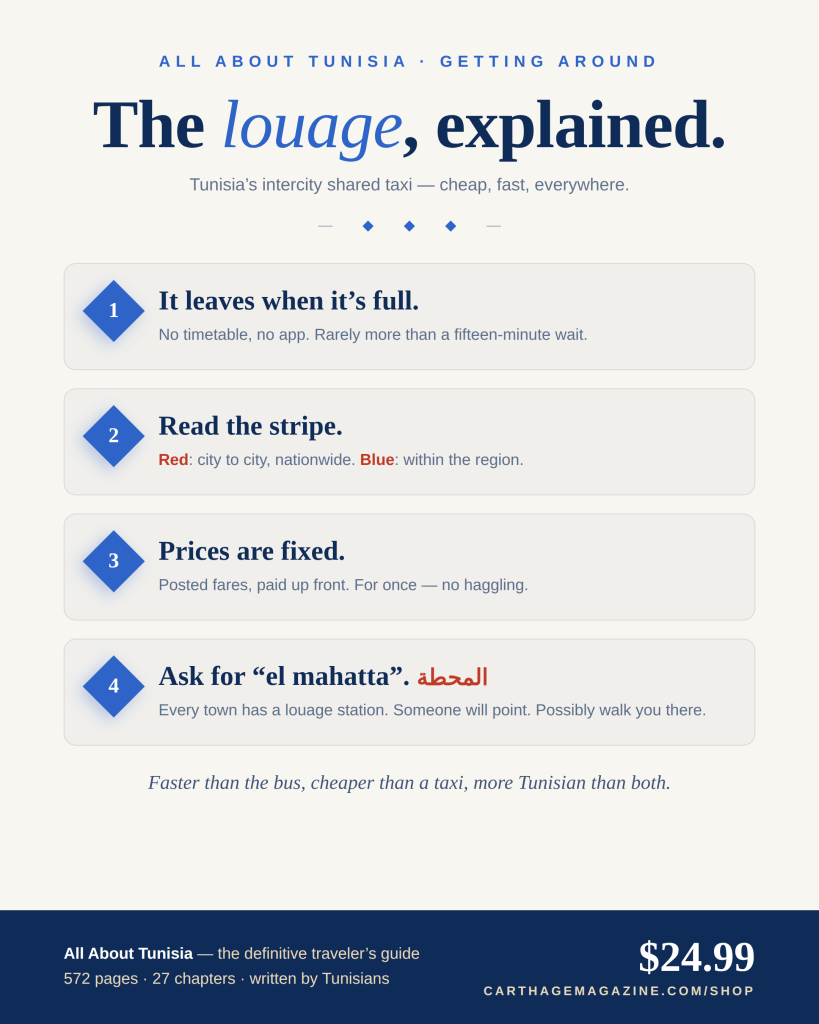
Every louage is white with a single coloured stripe down the side, and that stripe tells you its range. It’s worth knowing before you reach the station:
- Red stripe — long distance. These connect major cities across governorate lines: Tunis to Sousse, Tunis to Sfax, and so on. This is the one you’ll use most as a traveller covering ground.
- Blue stripe — regional. These run shorter hops within a region or between neighbouring areas.
- Yellow stripe — rural and local. These link smaller towns and villages to their regional hub, and their “station” may be little more than a gravel lot or a layby.
The system isn’t always policed to the letter, and you’ll see local variations, but the rule of thumb holds: red for the long hauls between cities, blue and yellow for shorter and more local trips.
Finding the Right Station
Every town has at least one station de louage, and they’re often on the edge of town rather than in the centre — so factor in a short city taxi to reach them. The thing that catches visitors out is that bigger cities have several stations, each serving a different direction. Tunis is the prime example, with three main ones that broadly split the country up between them:
- Bab Saadoun — the north and northwest (think Bizerte, Tabarka).
- Moncef Bey — the south and centre, including Sousse, Kairouan, Sfax, and Gabès.
- Bab Alioua — Cap Bon and the east, including Nabeul and Hammamet.
Always confirm which station serves your destination before you set off; locals and city-taxi drivers know them cold. Inside the station, vehicles are grouped loosely by destination, and you’ll often hear drivers and coordinators calling out where they’re headed — “Sousse! Sousse!” State your destination clearly (“Mashy l’Sousse” in Tunisian Arabic, or “Je vais à Sousse” in French) and someone will point you to the right queue. For the wider picture of how louages fit alongside trains and buses, our getting-around guide lays out all the options.
What It Costs
Fares are fixed and genuinely cheap. As a rough guide: a short local hop is a few dinars; a medium intercity trip of one to two hours typically runs somewhere around 10–16 dinars; and a long haul toward the far south can reach the low twenties. Tunis to Sousse, for instance, sits at roughly 12–13 dinars at the time of writing — a fraction of what a private taxi would charge for the same road.
A few money notes worth internalising: pay in cash, carry small notes and coins (drivers rarely make change for large bills), and you’ll usually pay the driver just before departure, or at a ticket booth in the more organised stations. Because the fare is fixed and known, overcharging is uncommon — but if you’re unsure, simply ask a fellow passenger what the fare is before you hand anything over. Bulky luggage occasionally attracts an extra dinar or two for the space it takes.
Etiquette and a Few Honest Caveats
Louages are, in my experience and that of most travellers, safe, friendly, and easy once you’ve done one. But it’s a local system, not a tourist product, and it helps to know its texture:
- It leaves when it’s full, not when you want. Build in flexibility. If you’re doing a day trip — say, El Jem or Kairouan from Sousse or Tunis — go early, and aim to start back by early afternoon, as departures thin out later in the day.
- The seats are tight when full, and the driving can be brisk. If you’re prone to car-sickness, angle for a front seat — and note that, realistically, it’s often only the front seat that has a usable seatbelt.
- Not everywhere has a direct connection. Major cities link up easily; remoter spots may need a change at a regional hub. Routes aren’t published online in any reliable way, so ask at the station.
- A little French or Arabic goes a long way at the ticket window and in the queue. Even a few words smooths the whole thing.
None of this is meant to put you off — quite the opposite. The first louage feels like a small adventure; by the third you’ll be treating it like the locals do, as simply the obvious way to get from one town to the next.
Why Bother, When There Are Taxis and Trains?
Because the louage unlocks independent travel in Tunisia at almost no cost. It lets you string together day trips — a Roman ruin here, a holy city there — without renting a car or paying private-transfer prices, and it runs when the trains don’t. It also drops you straight into ordinary Tunisian life in a way no resort shuttle ever will: shared space, shared road, a conversation struck up over the seat-back. For the curious, budget-minded traveller who wants to move around the country on its own terms, understanding the louage is one of the most useful things you can do before you arrive. Master it, and the whole map opens up.
From the Carthage Magazine Bookshelf
If you’re planning to explore Tunisia under your own steam, three Carthage Magazine ebooks were built for exactly that:
- All About Tunisia — the definitive English-language traveler’s guide. 572 pages, 27 chapters, all nine regions, every UNESCO inscription, five thematic trails, and the practical answers most travelers wish they’d had on the plane. $24.99 · PDF & EPUB
- Speak Like a Local — 200+ Tunisian Arabic phrases with native audio recorded in Tunis — including the ones that get you to the right louage. $14.99 · PDF, EPUB, MP3
- The Authentic Tunisian Cookbook — sixty traditional recipes from the heart of North Africa. $9.99 · PDF & EPUB
All three available as a bundle for $39.99 — guide, language, and food, delivered together.
