
Quick Answer — Almost nothing that gets called a “scam” in Tunisia is a crime. It is overcharging, and it clusters in a handful of predictable situations: the taxi meter that is suddenly broken, the friendly stranger who steers you toward a carpet shop, the café bill that arrives without a menu, and the sprig of jasmine pressed into your hand. Agree a price before anything begins and roughly ninety per cent of it evaporates. Genuine theft exists in crowded souks and on Avenue Bourguiba, and is best handled with the same instincts you’d use in Barcelona.
There is a particular expression a Tunis taxi driver makes when you ask him to turn on the meter — a half-second pause, a shrug, a glance in the mirror to see whether you meant it. Then, almost always, he leans over and turns it on, and the two of you spend the rest of the ride talking about football. That pause is the whole subject of this article. It is not menace. It is a question asked and answered, and it only has to be answered once.
The English-language internet has decided otherwise. Search for scams in Tunisia and you will find pages promising “fourteen documented scams across eight categories,” rated by severity, generated at scale by people who have plainly never stood in the Souk el Attarine. The numbers are invented and the tone is designed to frighten. What follows is the version from Tunis: the things that genuinely happen, the reason they happen, and the sentence or gesture that ends each one. Read alongside our fuller assessment of whether Tunisia is safe, it should leave you less anxious rather than more.
First, a Sense of Proportion
The British Foreign Office, which has no incentive to flatter anybody, puts it plainly: the majority of visits to Tunisia are unaffected by crime, and the most common crime experienced is theft. Violent crime against visitors is rare. What you are far likelier to meet is commerce with the volume turned up — a price quoted high to see whether you’ll take it, which is not the same as being robbed, however it feels at the time.
It also helps to know how geographically concentrated it is: the Tunis medina’s carpet lanes, the arrivals road at Tunis-Carthage, the resort strips of Hammamet and Sousse, the approach to the Great Mosque in Kairouan, and Avenue Habib Bourguiba after dark. Step half a kilometre outside those and the country reverts to being one of the more relentlessly hospitable places in the Mediterranean, where the likelier risk is being fed until you cannot stand.
The one genuine crime to guard against is opportunistic theft in crowds, where thieves sometimes use a confidence trick as the distraction — a spilled drink, directions asked with unusual persistence — while a second pair of hands does the work. Front pockets, bag across the body, nothing valuable on the café table. The same rules as anywhere.
The Taxi Meter, and the Word That Fixes It
This accounts for more traveller irritation than everything else combined. Tunisian taxis are yellow, cheap and metered, and the meter is compulsory. What you will occasionally meet is a driver who declares it broken, quotes a flat fare, or quietly runs the higher night tariff at two in the afternoon.
The fix is a single word: compteur — French for meter — delivered pleasantly, before you sit down. Add aychek (“please”) and you have said everything necessary. If the answer is no, thank him and take the next one; there is always a next one. In greater Tunis, Bolt and inDrive remove the negotiation entirely, which many travellers prefer after dark. Our guide to taxis in Tunisia goes into the tariffs and the night rate in detail, and the louage network runs on fixed posted fares with nothing to negotiate at all.
The pressure point is Tunis-Carthage airport, where men will approach you inside the terminal offering a ride. Walk past them to the official rank outside. That single instruction will save more money than everything else in this article.
The Man Who Knows You From Your Hotel
You are somewhere in the medina, pleasantly lost, when a well-dressed man greets you warmly. He works at your hotel — he was on the desk last night, don’t you remember? He is going your way. He knows a shortcut.
He does not work at your hotel. He has guessed the name, and he will try it on several tourists until one lands. What follows is a pleasant twenty minutes of real local knowledge, ending at a shop where he takes a commission on whatever you buy, or a restaurant where you are handed no menu.
The variant is the closed door: the mosque is shut for prayer, the museum closed today, but as it happens there is a Berber market this week only, just up here. The attraction is open. The market is a shop.
None of it is dangerous. It is unpaid guiding on a commission model, and the exit is to decline and keep walking — a smile, a la, shukran, and no explanation, because an explanation is an opening. If you do want a medina guide, the good ones are booked through your hotel or an agency and quote a fee in advance.
Tea, Carpets, and the Very Long Sit
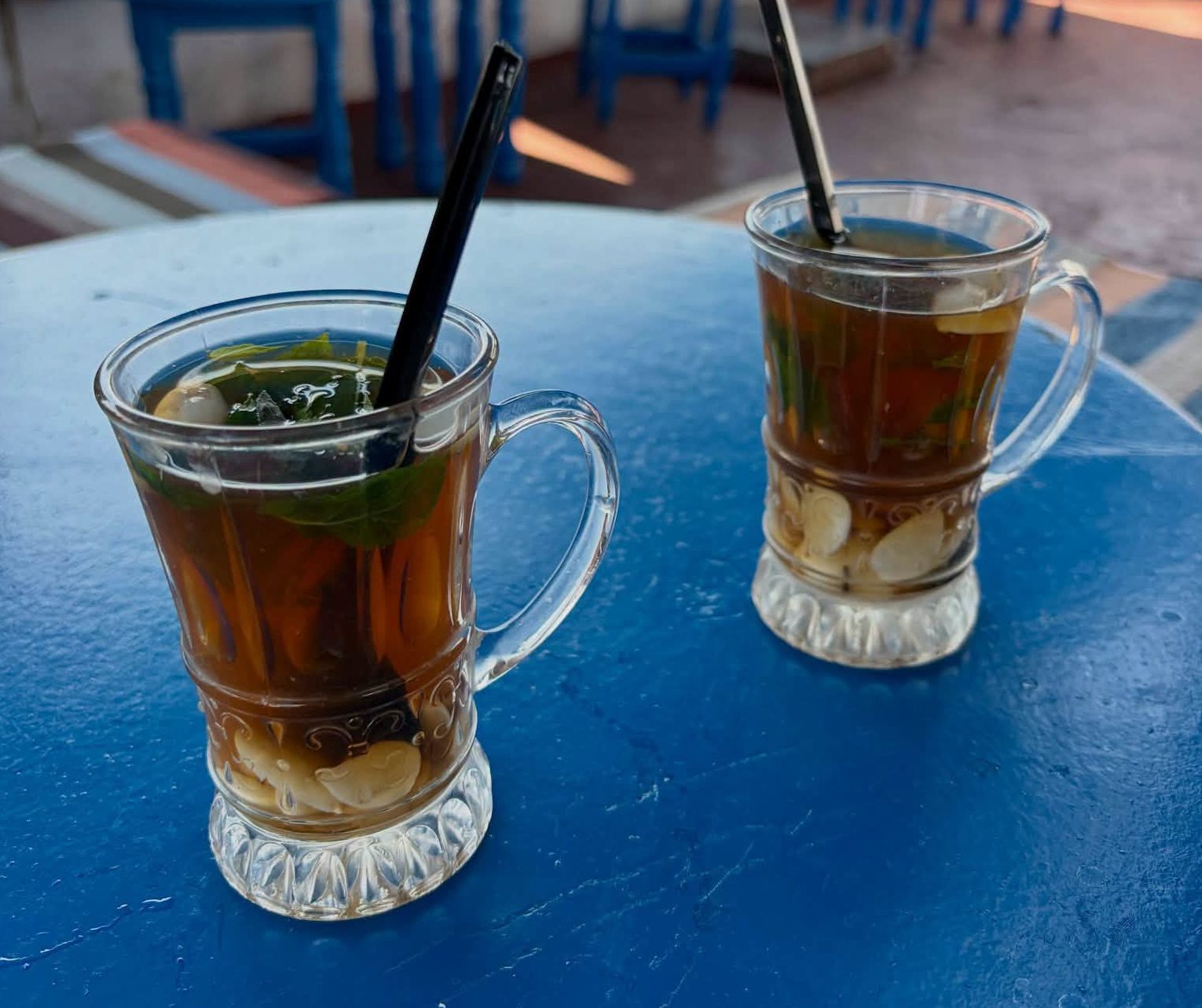
You will be invited for tea. Sometimes it is exactly what it appears to be, because Tunisians really do this, and refusing every offer means missing the best part of the country. Sometimes it is the opening move of a ninety-minute carpet presentation from which extraction feels socially impossible.
Tell them apart by where it happens. Tea in a café, in a home, at a stall selling nothing: accept, happily. Tea offered on the threshold of a shop full of rugs: you are in a sales meeting, and should decide before sitting down whether you intend to buy.
If you do, that is a fine thing — Tunisian margoum is genuinely worth owning. Know that the opening price bears no relation to the closing one, that bargaining is expected rather than rude, and that “this one is not for sale, it is from my grandmother” is a sales technique of great antiquity. Our guide to what to buy in Tunisia covers realistic craft prices. The strongest position in any Tunisian shop is genuine willingness to leave.
The Jasmine on Your Lapel
A man approaches with a machmoum — the small, exquisite bouquet of jasmine that is a national emblem and a genuine part of Tunisian summer life. He tucks it into your buttonhole, or hands it to your partner, with the unmistakable air of a gift. Then he waits.
This is the gentlest hustle in the country and the one that catches the most people, because refusing a flower already pinned to your jacket feels churlish. Two options, both fine: hand it back before it is attached, or accept it and pay a couple of dinars without drama. What you should not do is accept it, walk off, and then feel ambushed by the request — the request was always coming.
The Bill That Arrives Without a Menu
If a café has no written prices, prices will be invented for you. This is rare in ordinary Tunisian places, where a mint tea costs almost nothing and everyone pays the same, and common on the handful of terraces positioned squarely in front of a famous view.
Ask for the menu. If there isn’t one, ask the price before ordering, and if the answer is vague, leave — the next place along is better and cheaper anyway, as our guide to eating in Tunis makes clear. The same applies to camel rides, carriages and boat trips, where the price agreed at the start has a habit of becoming a per-person price at the end. Settle the total, in dinars, for the whole party, before anyone moves.
Bezness
This deserves candour rather than coyness. Bezness is a Tunisian word — a collision of the German Beziehung (relationship) and the English “business” — that entered wider use through the 1992 film of that name by the Tunisian director Nouri Bouzid. It describes a relationship pursued with a foreign visitor for money, gifts, or a route to a European residence permit rather than for its own sake, and it is a recognised feature of resort towns here as in Egypt, Turkey and the Caribbean.
Two things are true at once, and most of what is written on the subject manages only one of them. The phenomenon is real, and people have lost serious money to it. The online literature around it is also frequently ugly, treating every relationship between a Tunisian and a foreigner as fraud by default — which is both wrong and insulting to a great many real couples.
The practical line is about money, not about love. Requests for cash, for a phone, for help with a family emergency, for funds toward a visa or a business — especially early, especially urgent, especially by transfer — are the signal, regardless of how the relationship feels. Nothing about being genuinely fond of someone requires you to fund them. Hold that line and the rest can take whatever course it takes.
The Rules That Feel Like a Scam and Aren’t
Some of what most annoys arriving travellers is simply Tunisian law, applied identically to everyone.
The dinar is a closed currency. You may not take it out of the country, so do not change more than you’ll spend, and keep your exchange receipts — you’ll need them to convert what’s left on the way home. There are also declaration rules for bringing foreign cash in, and undeclared currency can be confiscated, so check the thresholds before you fly. Our guide to the Tunisian dinar explains the mechanics, and ATMs are the cleanest way to get cash. Never change money with anyone who approaches you on the street.
There is also a government hotel tax collected at check-in — currently 8 dinars per person per night at three-star properties, 12 at four- and five-star, capped at ten nights. Your reception desk did not invent it. Likewise, police may ask for identification at any time, and carrying a copy of your passport photo page is a legal requirement rather than a shakedown. A routine check costs nothing, and nobody legitimate collects a payment from you in the street.
What Isn’t a Scam at All
Bargaining is not a scam; it is the pricing mechanism of a souk, and shopkeepers respect people who enjoy it. Tipping a dinar or two is courtesy, not extortion. And when you ask where to buy olive oil and a Tunisian walks you to his cousin’s shop, that is not a con — that is how favours and family work here, closer to being included than fleeced. You are free to say thank you and buy elsewhere.
Every situation in this article is defused by the same two habits: settle the price before the thing begins, and be comfortable walking away. Master those and Tunisia stops being a country you have to be careful in and becomes what it is — a place where strangers go a long way out of their way for you, and where a few words of Tunisian Arabic get you further than any amount of vigilance.
From the Carthage Magazine Bookshelf
The surest defence against being overcharged is knowing roughly what things cost and being able to ask in the local dialect — which is precisely what these three are for.
- All About Tunisia — the definitive English-language traveler’s guide. 572 pages, 27 chapters, all nine regions, every UNESCO inscription, five thematic trails — and the practical answers (visa, currency, transport, etiquette) most travelers wish they’d had on the plane. $24.99 · PDF & EPUB.
- Speak Like a Local — 200+ Tunisian Arabic phrases with native audio recorded in Tunis. The phrases for the taxi, the souk, the café, and the dinner table. $14.99 · PDF, EPUB, MP3.
- The Authentic Tunisian Cookbook — sixty traditional recipes from the heart of North Africa. For when you get home and find yourself missing the food. $9.99 · PDF & EPUB.
All three available as a bundle for $39.99 — guide, language, and food, delivered together.
