
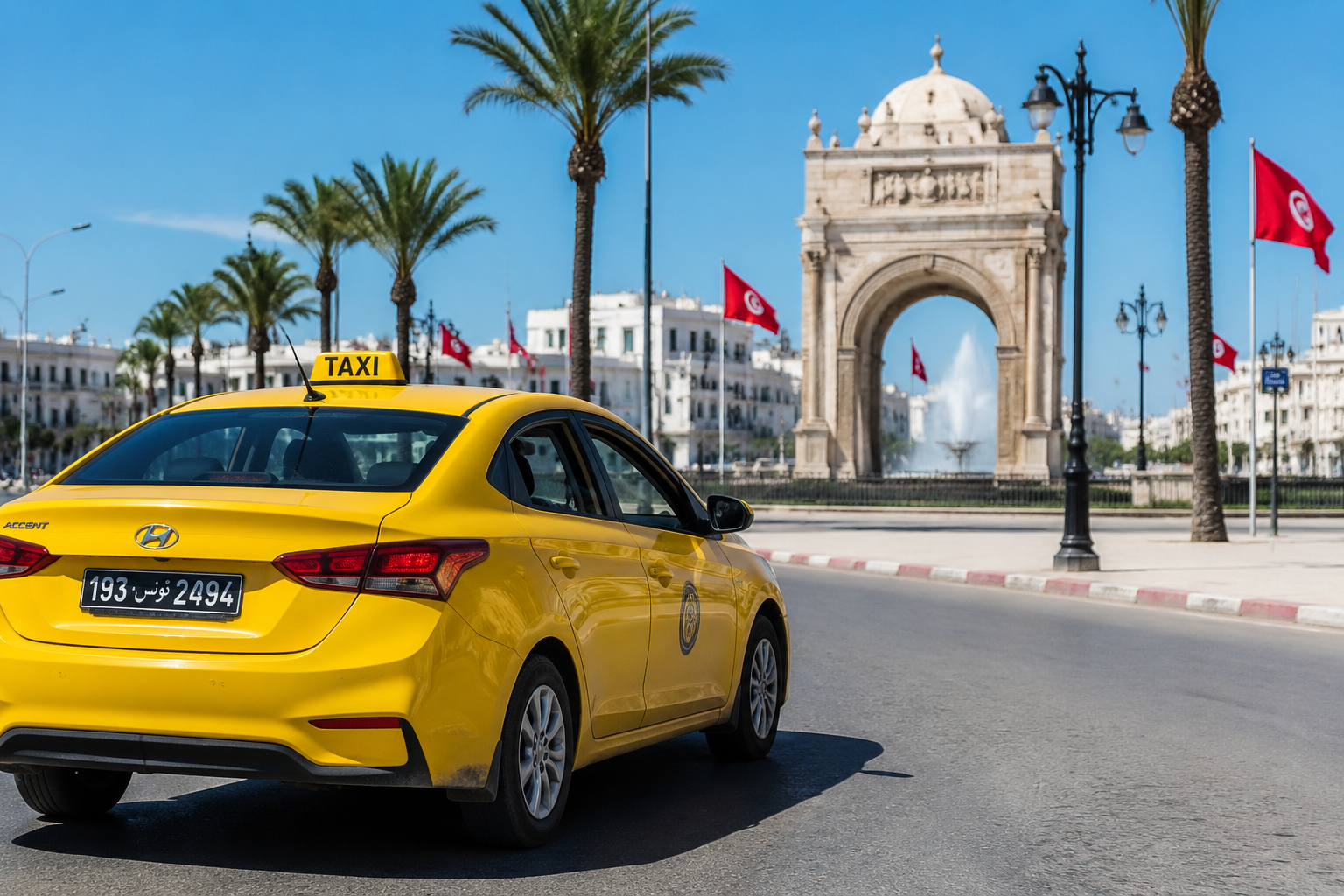
The yellow taxi is one of the small institutions of Tunisian life. There are tens of thousands of them, they cost less than almost anywhere on the Mediterranean, and for most journeys inside most cities they are the fastest, simplest way to move. Used well, the Tunisian taxi is a traveller’s best friend. Used naively — at the airport kerb, at midnight, with no idea what the meter should say — it is the source of the single most common complaint foreign visitors file about the country.
This guide closes that gap. How the meter works, what a fair fare looks like, what actually happened to the ride-hailing apps (short version: forget most of what the internet tells you), and how to handle the two or three situations where a visitor is genuinely at a disadvantage. It slots alongside our guides to getting around Tunisia and the louage, the shared taxi that handles everything between cities.
Quick Answer: City taxis in Tunisia are yellow, metered, and cheap — most rides within a city cost a handful of dinars. Insist on the meter (“compteur,” pointing helps), carry small notes, and expect a night tariff after dark. There is no Uber, and Bolt was suspended by the authorities in 2025; the apps that work now are local and regional ones — Yassir above all in Greater Tunis, plus inDrive, Heetch, and a rotating cast of Tunisian startups — with a state-run app in the works. The one place to keep your wits fully about you is the airport arrivals kerb, where the meter has a habit of being “broken.”
The Yellow Taxi, and the Meter That Rules It
Every legal city taxi in Tunisia is yellow, carries a roof sign, and has a meter — and the meter is the whole game. The flag-drop is under a dinar, the per-kilometre rate is modest, and the practical result is that a fifteen-minute ride across central Tunis typically lands in the mid-single digits of dinars — coffee money by European standards. Two things to know about how it runs. First, the night tariff: after dark the meter switches to a higher rate, roughly half again the daytime price, and this is legitimate — a jump in the numbers at 10pm is not a scam. Second, the culture: Tunisians take taxis constantly and pay what the meter says, plus perhaps rounding up. Your goal is simply to be treated like a Tunisian, and ninety percent of drivers will do exactly that without being asked. For the other ten percent, the phrase that matters is “compteur, s’il vous plaît” — meter, please — delivered pleasantly before the car moves. If the answer is a shrug and a flat price for a routine city ride, smile, close the door, and take the next one; there is always a next one. (The little vehicles have a longer story than most passengers suspect — our history of Tunisia’s “bibi” taxis tells it.)
One structural honesty note: at rush hour, in the rain, or late at night, drivers become choosers, and a short awkward ride may get waved off in favour of a better fare. This is annoying and universal, and it is the strongest practical argument for having an app on your phone.
The Apps in 2026: Forget What the Internet Told You
Here the standing advice online is dangerously stale, so let’s be current. There is no Uber in Tunisia, and there never has been. Bolt, which for several years was the standard traveller recommendation, was suspended by the Tunisian authorities in March 2025 amid a tax and licensing investigation and subsequently stopped operating — so the hundreds of blog posts and forum threads telling you to download Bolt are describing a Tunisia that no longer exists.
What works instead is a local and regional ecosystem. Yassir, the North African super-app, is the current leader — strongest in Greater Tunis, with upfront pricing, scheduled bookings that make it excellent for early-morning airport runs, and registration that travellers can complete with WhatsApp verification. inDrive operates in Tunis and Sousse on its haggle model: you propose a fare, drivers accept or counter. Heetch and a shifting roster of Tunisian startups — IntiGo and others — round out the field, and the government has announced a state-backed ride-hailing app, built around registered taxis and regulated fares, whose rollout is worth checking on arrival. Three practical notes for all of them: coverage thins fast outside Tunis, Sousse, and Sfax — on Djerba, for instance, apps are effectively absent, which is why our getting around Djerba guide leans on drivers arranged in advance; for the island, the booking service we recommend is Taxi Djerba, which fills the app gap with pre-arranged, fixed-price rides. Payment on the apps is usually cash, so they function as booking and pricing tools more than wallets; and you will need data, which is one more reason to sort a local SIM at the airport before you need a ride.
The Airport Question
Almost every taxi grievance a visitor to Tunisia ever airs was born at an arrivals kerb, so treat the airport as its own protocol. At Tunis–Carthage, the drivers who wait closest to the doors are the least likely to run the meter and the most likely to quote a flat price several times the fair fare; the countermeasures, in order of elegance, are booking a scheduled pickup on an app before you land, walking past the first rank and hailing a taxi dropping off departing passengers, or simply insisting on the meter with good-humoured persistence — into central Tunis, a metered ride is a modest sum even with the airport supplement and luggage. At the resort airports, Enfidha and Djerba–Zarzis, posted zone-fare boards take some of the theatre out of it — agree the board price before loading bags, or, for Djerba, book a fixed-price transfer with Taxi Djerba before you fly and skip the kerb negotiation entirely; our Djerba airport guide has the island’s specifics. Everywhere, the golden rule is the same: settle the basis of the fare — meter or agreed price — before the car moves, never after.
Shared Taxis, and What a Taxi Is Not
Two cousins of the city taxi cause confusion. The taxi collectif runs fixed urban and suburban routes with shared seating at fixed per-seat prices — locals use them constantly, and they are a bargain if you know the route. And the intercity workhorse is not a taxi at all but the louage, the eight-seat van that leaves when full and connects every town in the country; flagging a yellow taxi for a hundred-kilometre journey is possible but expensive, and the louage exists precisely so you never need to. For total independence in the countryside, renting a car remains the other honest option, and the city transport guide covers the metro, TGM, and buses that taxis compete with.
Paying Like a Local
Small mechanics that smooth everything: carry small notes and coins, because a driver genuinely may not have change for a fifty — our dinar guide explains the currency’s quirks — and round the fare up rather than tipping formally, which is exactly what Tunisians do (the fuller etiquette is in our tipping guide). Have your destination ready in French or Arabic, ideally with a nearby landmark, since street numbers mean little; a pinned map location does the job perfectly. And keep perspective: fare inflation for foreigners, where it happens, is usually a matter of two or three dinars — worth declining on principle, rarely worth a ruined morning.
A Word for Night Rides and Solo Travellers
After dark, and for women travelling alone, the app booking is worth its small premium: a named driver, a tracked route, a price fixed in advance. Where no app operates, ask your hotel or restaurant to call a taxi they know — a completely normal request in Tunisia — rather than hailing on an empty street. Our guide for solo female travellers covers the wider picture, but the summary is reassuring: Tunisian taxis are overwhelmingly safe, and the precautions are the same ones you would take in Rome or Marseille.
Master these few habits — the meter word, small notes, the airport protocol, one app installed — and the yellow taxi stops being a source of anxiety and becomes what it is for ten million Tunisians: the cheap, quick, faintly chaotic circulatory system of daily life. Hail with confidence.
From the Carthage Magazine Bookshelf
If the practical side of the trip is coming into focus — taxis, dinars, and how to ask for the meter like you mean it — these three ebooks were built for exactly that:
- All About Tunisia — the definitive English-language traveler’s guide. 572 pages, 27 chapters, all nine regions, every UNESCO inscription, five thematic trails — and the practical answers (visa, currency, transport, etiquette) most travelers wish they’d had on the plane. $24.99 · PDF & EPUB
- Speak Like a Local — 200+ Tunisian Arabic phrases with native audio recorded in Tunis. The phrases for the taxi, the souk, the café, and the dinner table. $14.99 · PDF, EPUB, MP3
- The Authentic Tunisian Cookbook — sixty traditional recipes from the heart of North Africa. For when you get home and find yourself missing the food. $9.99 · PDF & EPUB
All three available as a bundle for $39.99 — guide, language, and food, delivered together.
