
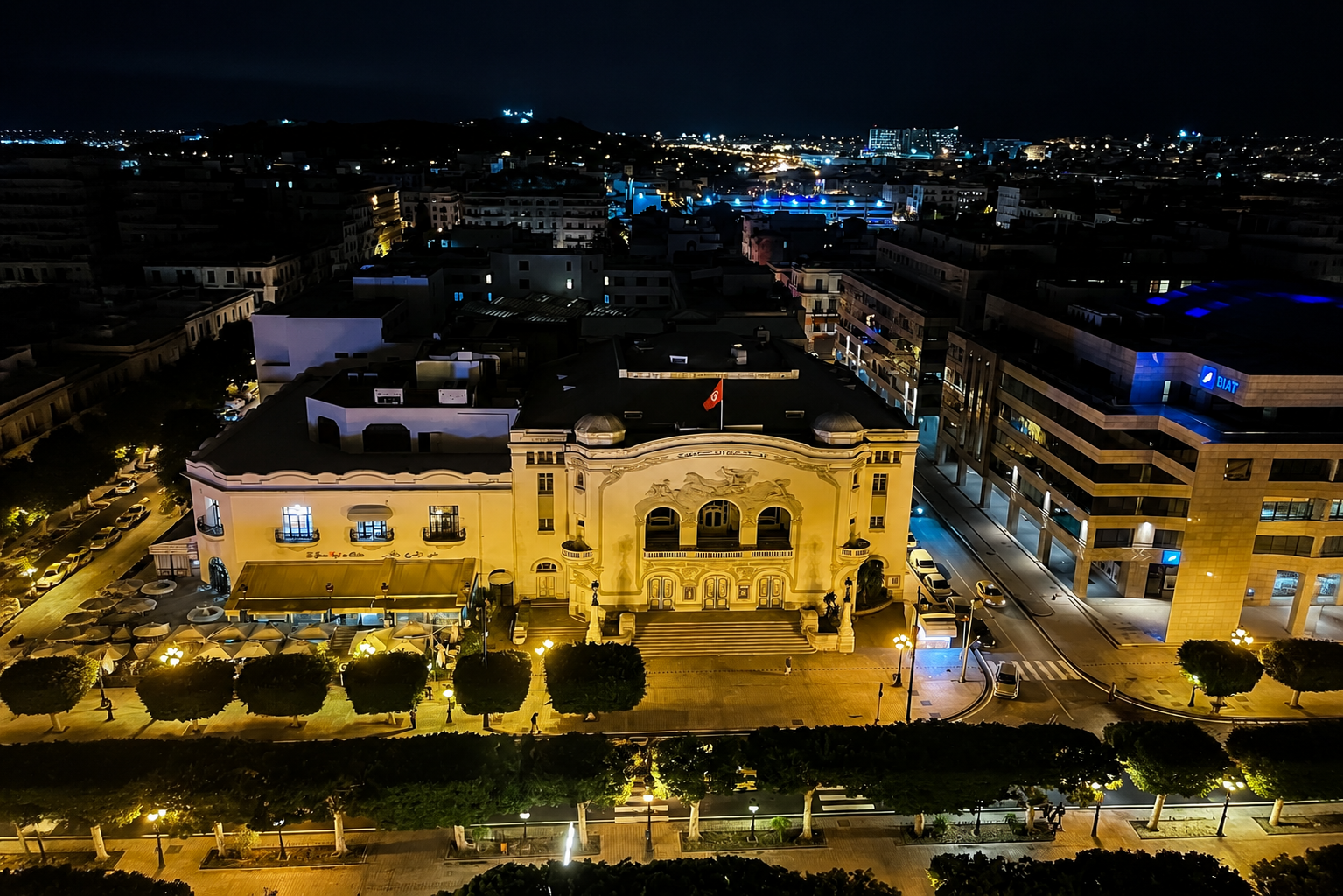
Tunis keeps a secret that most capitals would kill for: almost everything worth seeing in the northern half of Tunisia sits within two hours of it. A three-thousand-year-old rival of Rome is twenty minutes away by commuter train. The best-preserved Roman town in North Africa is a morning’s drive west. Hot springs pour off a cliff into the Mediterranean an hour to the east, the fourth-holiest city in Islam waits two hours south, and the northernmost point of the entire African continent is closer to your hotel than most airports are to most cities. You could base yourself in the capital for a week, sleep in the same bed every night, and still come home having seen Punic, Roman, Islamic, Andalusian, and colonial Tunisia — plus a fishing port, a mountain, and a flamingo-filled lake.
This is the guide to doing exactly that. Distances, transport, honest timings, and what each trip is actually for.
Quick Answer: The essential day trips from Tunis, in rough order of ease: Carthage and Sidi Bou Said (by TGM train, half a day, no car needed); Bizerte and Cap Angela (one hour north); the Cap Bon peninsula with the Korbous hot springs (one to two hours east, car recommended); Dougga and Testour (two hours west, car or tour); Zaghouan and the Roman aqueduct country (one hour south); Kairouan (two to two and a half hours south); and El Jem (two and a half hours, a long day but a common one). Most trips run 10–25 dinars each way by louage; a rental car opens up the countryside.
Carthage and Sidi Bou Said: The Classic
Start here. Everyone does, and everyone is right to. Carthage is technically a suburb of Tunis — fifteen kilometres up the coast, under half an hour on the TGM light rail — but calling it a suburb undersells what it is: the remains of the city that made Rome nervous for a century, spread across twenty hectares of seaside hillside, all covered by a single combined ticket. Climb Byrsa Hill for the view that explains three thousand years of Mediterranean history, spend forty minutes in the museum so the stones can speak, then walk down to the Antonine Baths, the largest Roman bath complex ever built outside Rome itself, sitting on a lawn at the edge of the gulf.
Then get back on the train. Three stops further is Sidi Bou Said, the blue-and-white village on its cliff, exactly as beautiful as the photographs and best experienced before ten in the morning or after four in the afternoon, when the tour buses have gone. The classic sequence — ruins in the morning, village at golden hour, mint tea with pine nuts as the sun drops into the Gulf of Tunis — remains the single best day within reach of the capital, and it costs about a dinar in train fare. If you have less time, our list of ten things to do in Sidi Bou Said trims the village to its essentials.
Bizerte and the Top of Africa
An hour north — by car, or by louage from the Bab Saadoun station — lies a Tunisia the resort crowds never see. Bizerte is the northernmost city in Africa, one of the oldest settlements in the country, and still, at heart, a working fishing town. The Vieux Port is the postcard: brightly painted boats, pastel houses, cafés at the water’s edge, and the walls of the Kasbah rising at one end. You don’t do much in Bizerte. You sit at the old harbour with a glass of mint tea, climb to the Spanish Fort for the view over channel and sea, eat grilled fish that was swimming that morning, and understand why the north gets under people’s skin.
Two add-ons turn Bizerte into a full and memorable day. Cap Angela, just outside town, is the northernmost point of the African continent — a windswept headland with a monument, a lighthouse view, and the strange satisfaction of standing at the edge of everything. And Lake Ichkeul, thirty kilometres southwest, is a UNESCO-listed wetland that fills each winter with tens of thousands of flamingos, storks, and ducks. If you’re travelling between November and February, Ichkeul alone justifies the trip north.
Cap Bon: Hot Springs, Punic Ruins, and the Garden Peninsula
East of Tunis, the Cap Bon peninsula juts into the Mediterranean like a thumb pointed at Sicily — eighty kilometres of citrus orchards, jasmine fields, pottery towns, and coastline that Tunisians from the capital have treated as their weekend country for two centuries. It is too rich for a single day, which is why it makes several different ones.
The nearest and strangest is Korbous, about an hour away on the peninsula’s western coast, where seven sulphurous springs have been drawing bathers since the Romans of Carthage crossed the gulf by boat to take the waters. The most famous, Aïn Atrous, pours off the rocks directly into the sea at around 50°C; bathers sit in the bay where scalding spring meets cold Mediterranean and find the bearable middle. It is free, spectacular, and almost unknown to foreign visitors. The cliffside corniche drive is part of the experience, so this is one to do by car or hired driver.
With an earlier start, push on to the peninsula’s eastern shore for Kerkouane — the only purely Punic city anywhere that was abandoned in antiquity and never built over, its grid of streets and famous pink-red private baths still lying exactly where the third century BC left them — and the fishing port and fortress of Kelibia next door. Count on an hour and forty-five minutes each way, and note that this corner of Cap Bon rewards a car; the louage connections exist but run on their own logic and stop by late afternoon.
Dougga and the Andalusian West
Two hours west of the capital, on a hilltop above a sea of olive groves and wheat, stands Dougga — by broad agreement the best-preserved Roman small town in North Africa, and a UNESCO World Heritage Site you will very possibly have to yourself. The Capitol with its three surviving temple niches, the 3,500-seat theatre, the Punic-Libyan mausoleum, the panorama over the plain: it is the kind of site that makes visitors quietly furious that nobody told them about it sooner. There is no train; go by rental car, hired driver, or organised tour, and leave Tunis by eight so you’re walking the ruins before the midday light flattens everything.
On the way back, most itineraries pause in Testour, the little town rebuilt by Muslim and Jewish refugees from Andalusia in the seventeenth century, with its Spanish-style main square and a Great Mosque whose minaret carries two Stars of David and a clock that runs backwards — a whole history of exile compressed into one façade. It is the perfect leg-stretch between Dougga and the motorway.
Zaghouan: The Mountain That Watered Carthage
An hour south of Tunis, the peak of Jebel Zaghouan rises abruptly from the plain, and at its foot the Romans built the Temple of the Waters — the sacred spring from which the Zaghouan aqueduct carried water 132 kilometres to Carthage, one of the longest aqueducts the empire ever built.
Long arcaded stretches of it still stride across the countryside near Mohammedia and Oudna, visible from the road and free to walk up to; combined with the spring, the mountain air, and (for the energetic) some of northern Tunisia’s best hiking, Zaghouan makes the ideal short, unhurried day out — and in spring, when the wildflowers come out between the olive trees, one of the loveliest.
Kairouan: The Holy City
The most ambitious of the comfortable day trips, and one of the most rewarding. Kairouan sits 160 kilometres south — two hours by car on the A1, two and a half by louage from Moncef Bey station, around 10 dinars a seat — on the dry inland plain where the Tunisia of postcards gives way to the Tunisia of the interior. Founded in 670 CE, it is the fourth-holiest city in Sunni Islam and the spiritual capital of the Maghreb, and its Great Mosque of Uqba, with the oldest standing minaret in the world, is worth the drive on its own. Add the ochre medina, the Aghlabid basins, and a box of makroudh — the city’s date-stuffed semolina pastry — for the road home. Day trips from Tunis are common and easy; just start early, because the medina belongs to the tour buses by eleven.
El Jem: The Long One
Two and a half hours south stands the amphitheatre of El Jem, the greatest Roman monument in Africa — a 35,000-seat colosseum rising out of a small Sahel town like a ship out of a field, better preserved in parts than the one in Rome and blessedly free of its crowds.
It is honestly at the outer edge of day-trip range from Tunis, and many travellers pair it with Kairouan on an organised tour to make the kilometres count. If your itinerary later takes you to Sousse or the coast, save it for then. If Tunis is your only base, it remains doable, unforgettable, and worth the early alarm.
Making It Work
A few practical notes from someone who does these roads often. The TGM handles Carthage and Sidi Bou Said entirely; no other trip on this list is train-friendly. Louages — the shared eight-seat vans that leave when full from Bab Saadoun (north and west) and Moncef Bey (south and east) — are cheap, fast, and safe, but they thin out by mid-afternoon, so always confirm the last departure back before you wander off.
A rental car is the key that unlocks Cap Bon, Dougga, and Zaghouan properly, and the roads are better than most first-timers expect. Organised day tours from Tunis are plentiful and reasonably priced for the longer runs, and for solo travellers or anyone short on planning energy they remove all the friction at once. Whatever you choose, the rule is the same everywhere in Tunisia: leave early. The country belongs to the people who arrive before the buses do — and where you sleep can stay exactly where it is. Our Tunis travel guide covers the neighbourhoods worth coming home to.
From the Carthage Magazine Bookshelf
If Tunis is your base camp, these three ebooks are the map, the phrasebook, and the reward for every road out of the capital:
- All About Tunisia — the definitive English-language traveler’s guide. 572 pages, 27 chapters, all nine regions, every UNESCO inscription, five thematic trails — and the practical answers (visa, currency, transport, etiquette) most travelers wish they’d had on the plane. $24.99 · PDF & EPUB
- Speak Like a Local — 200+ Tunisian Arabic phrases with native audio recorded in Tunis. The phrases for the taxi, the souk, the café, and the dinner table. $14.99 · PDF, EPUB, MP3
- The Authentic Tunisian Cookbook — sixty traditional recipes from the heart of North Africa. For when you get home and find yourself missing the food. $9.99 · PDF & EPUB
All three available as a bundle for $39.99 — guide, language, and food, delivered together.
