
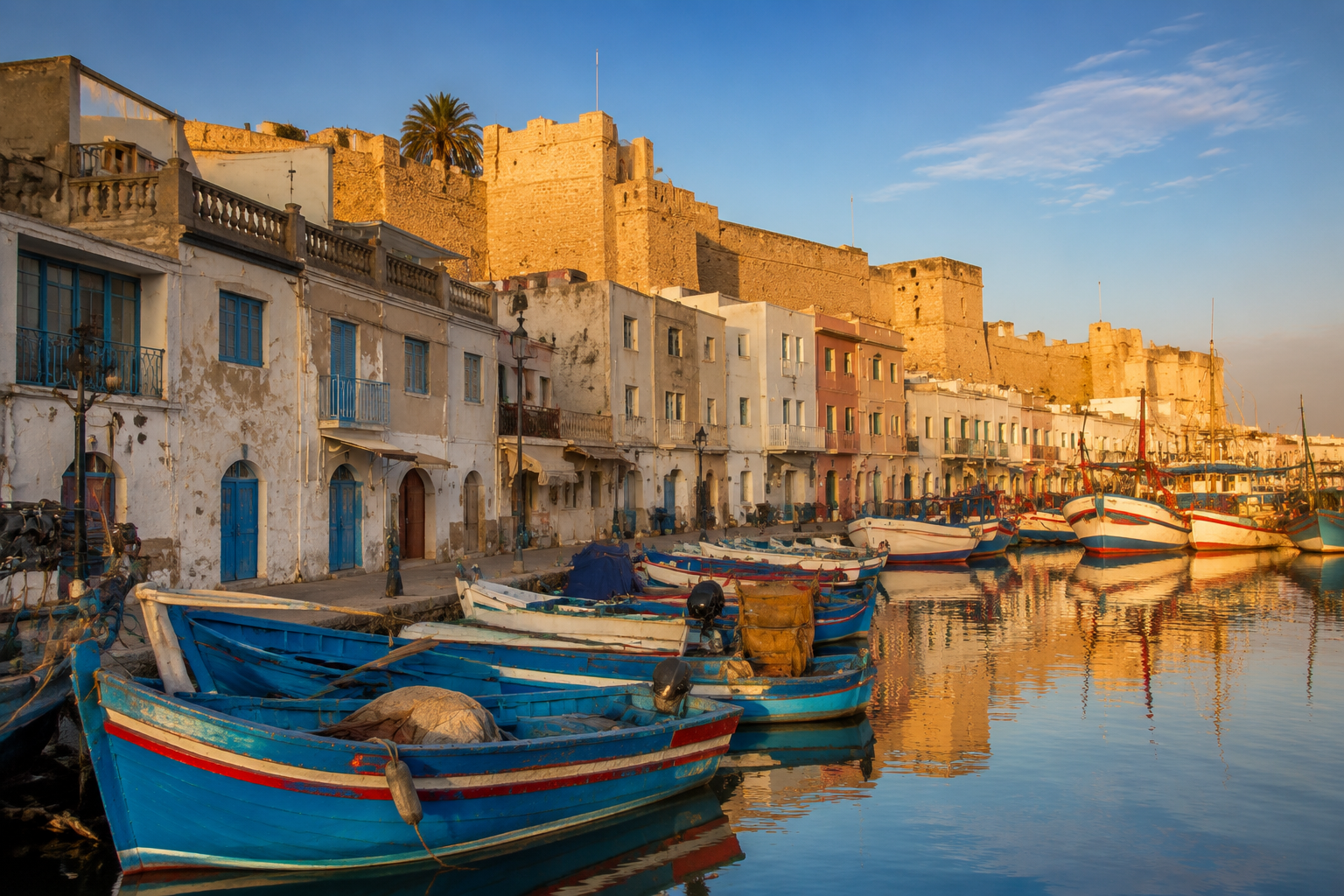
Quick Answer Bizerte is a laid-back port city on Tunisia’s northern coast — and, at the literal top of the continent, the northernmost city in Africa. It’s one of the oldest settlements in the country, founded by the Phoenicians, and it wears its long history lightly: a postcard-perfect old fishing harbour, a walled Kasbah, a hilltop Spanish fort, and a string of white-sand beaches. Just outside town lie Cap Angela — the northernmost point of Africa — and Lake Ichkeul, a UNESCO-listed wetland that fills each winter with flamingos and storks. Only about an hour from Tunis, Bizerte is the north coast’s most rewarding day trip, and a glimpse of a Tunisia that the resort crowds never see.
Most travellers to Tunisia rush south — to the beaches of Djerba, the ruins of Carthage, the dunes of the Sahara. Bizerte sits in the other direction entirely, at the country’s northern tip, and that geography has kept it honest. There are no mega-resorts here, no coaches idling by the dozen. There is a working fishing port where the boats still come in at dawn, a fort with one of the best views in Tunisia, and the strange thrill of standing at the very edge of a continent. It is, quietly, one of the loveliest places in the country — and one of the most overlooked.
Here is the honest guide to Bizerte.
Where Bizerte Is — and Why It Feels Different
Bizerte lies about 65 kilometres north of Tunis, roughly an hour by car or louage (the shared inter-city taxis that are the backbone of getting around Tunisia). That proximity makes it an easy day trip from the capital — but stay a night and you’ll feel the city’s real character, which is slower, saltier, and more northern than anywhere else in the country.
The north coast catches more weather than the sun-baked south: greener hills, more rain between October and March, and a wind off the Mediterranean that can sharpen even a summer evening. It gives Bizerte a moodier, more Atlantic feel than the Tunisia of the brochures — and, in spring and autumn especially, a soft golden light that photographers fall hard for.
A Little History: Oldest, Northernmost, Last to Be Free
Bizerte’s story is one of the longest in Tunisia. The Phoenicians founded it as Hippo Diarrhytus, building their port around a natural channel that links the sea to an inland lake — a piece of geography so useful that every power to pass through North Africa has wanted it since. Romans, Arabs, Spanish occupiers, and Ottoman corsairs all left their mark, and under the French it became a major naval base.
That naval base produced Bizerte’s most dramatic modern chapter. When Tunisia won independence in 1956, France held on to the strategic port — and in July 1961 the standoff erupted into violence, the Bizerte Crisis, which left hundreds of Tunisians dead before France finally withdrew in 1963. Bizerte was, in effect, the last corner of Tunisia to be freed, seven years after the rest of the country. The scars are still legible in the old fortifications, and the episode gives the city a quiet, hard-won pride.
The Old Port: The Heart of the City
Everything in Bizerte begins at the Vieux Port, the Old Harbour. This is the postcard: a tight rectangle of water lined with brightly painted fishing boats, backed by pastel houses and a row of cafés, with the Kasbah’s walls rising at one end. Fishermen mend nets and unload the morning’s catch; old men play cards over coffee; the light bounces off the water and turns the whole scene cinematic.
You don’t do much at the Old Port — you sit, you walk, you watch. Order a coffee, let an hour go, and understand why Bizerte gets under the skin of everyone who lingers. (One local writer’s account of falling in love with the city captures the feeling better than any guide can.)
The Kasbah and the Spanish Fort
Guarding the mouth of the channel is the Kasbah, a walled citadel whose origins reach back to the Byzantine era. Inside is a hushed labyrinth of narrow lanes, low houses, and small mosques — a living quarter rather than a museum — and you can climb the massive ramparts for sweeping views over the harbour and the sea.
For the very best view, though, walk up to the Spanish Fort (Fort d’Espagne), a sixteenth-century stronghold perched on the hill above the medina. From the top, the whole of Bizerte spreads out below: the channel, the old port, the lake glinting beyond the rooftops, and the Mediterranean running away to the horizon. It is the single best vantage point in the city, and worth the short climb at any time of day — but especially toward sunset.
Cap Angela: Standing at the Top of Africa
About half an hour’s drive from Bizerte is a spot that turns a pleasant trip into a memorable one: Cap Angela, the northernmost point of the African continent. A monument shaped like the map of Africa marks the exact edge, and the views over the wild, wind-scoured coastline are spectacular. There is a real, slightly absurd joy in standing there and realising that everything in Africa — all fifty-four countries, all 1.4 billion people — is behind you, and ahead is only sea. The road out is rough and it gets fiercely windy, so a taxi is the sensible way to go, but the payoff is one of the great “edge of the world” moments in Tunisia.
Lake Ichkeul: The Wetland That Breathes
Inland, about 30 kilometres southwest of the city, lies one of Tunisia’s natural treasures: Lake Ichkeul, the centrepiece of a national park and a UNESCO World Heritage Site. Ichkeul is unusual — its waters turn fresher in winter and saltier in summer, a seasonal rhythm that makes it one of the most important stopover points for migratory birds in the whole Mediterranean basin. Come in winter and the lake fills with tens of thousands of flamingos, storks, and ducks; year-round, you might spot the park’s famous water buffalo grazing the marshes.
It’s the kind of place that rewards a slow morning with binoculars, and it slots naturally into a wider exploration of Tunisia’s national parks and wild places. Even glimpsed from the road, it gives you the measure of how green and watery the far north of Tunisia really is.
The Beaches
Bizerte is a beach town, too, with several long stretches of white sand within easy reach. Sidi Salem, close to the city, is the biggest and most popular. La Grotte (“the cave”), about twenty minutes away, is the most dramatic — a sweep of sand framed by cliffs and sea-caves you can explore. Further out are quieter options like Rimel and the beaches near Ras Engela. None of them carry the resort infrastructure of the south, which is precisely their charm: these are beaches where Tunisian families spread out for the day, not packaged sun-loungers.
Where to Eat: Seafood and a Famous Sandwich
A working fishing port eats well, and Bizerte’s strength is seafood — grilled fish, calamari, and shellfish pulled in that morning, served simply at the restaurants around the harbour. Pair it with a cold drink and a harbour view and you have the perfect Bizerte lunch.
The city also has a claim on one of Tunisia’s great humble dishes. Lablabi — a soul-warming bowl of chickpea soup poured over torn bread — is beloved across the country, but the Bizerte version has its devotees who’ll argue it’s the best there is. On a windy northern morning, they have a point.
When to Go, and Is It Safe?
Late spring (April–June) and early autumn (September–October) are the sweet spots: warm, calmer weather and good light, without the peak-summer crowds or the winter wind and rain. Summer is the liveliest, with the Bizerte International Festival in full swing, but also the busiest with Tunisian holidaymakers. Winter is quiet and atmospheric — and, crucially, the best season for the birds of Ichkeul. For the full national picture, see our guide to the best time to visit Tunisia.
As for safety, Bizerte is a relaxed, family-friendly city with no particular concerns beyond the usual common sense — and the broader question of travelling safely in Tunisia is one we’ve answered honestly elsewhere.
A Natural Pairing: Cap Bon
If Bizerte gives you a taste for the parts of Tunisia the package tours miss, point yourself next at the garden peninsula across the gulf. Our guide to Cap Bon covers the other half of the north’s quiet pleasures — and together the two make the case that the best of Tunisia’s coast isn’t in the south at all.
The Honest Verdict
Bizerte will not overwhelm you with grand monuments, and that is the whole point. It is a city to be felt rather than ticked off — a morning at the old port, an afternoon at the top of Africa, a plate of grilled fish, a fort at sunset. If you want resorts and crowds, go south. If you want the real, unhurried, salt-aired north — the oldest port in Tunisia, still doing exactly what it has always done — Bizerte is waiting, and almost nobody is there.
From the Carthage Magazine Bookshelf
If the north has tempted you off the beaten track, these three Carthage Magazine ebooks were built for the days between arrival and departure:
- All About Tunisia — the definitive English-language traveller’s guide. 572 pages, 27 chapters, all nine regions — the north included — every UNESCO inscription, and the practical answers (visa, currency, transport, etiquette) most travellers wish they’d had on the plane. $24.99 · PDF & EPUB
- Speak Like a Local — 200+ Tunisian Arabic phrases with native audio recorded in Tunis. The phrases for the louage, the souk, the café, and the fish market. $14.99 · PDF, EPUB, MP3
- The Authentic Tunisian Cookbook — sixty traditional recipes from the heart of North Africa, for when you get home missing the grilled fish and the lablabi. $9.99 · PDF & EPUB
All three are available as a bundle for $39.99 — guide, language, and food, delivered together.
