
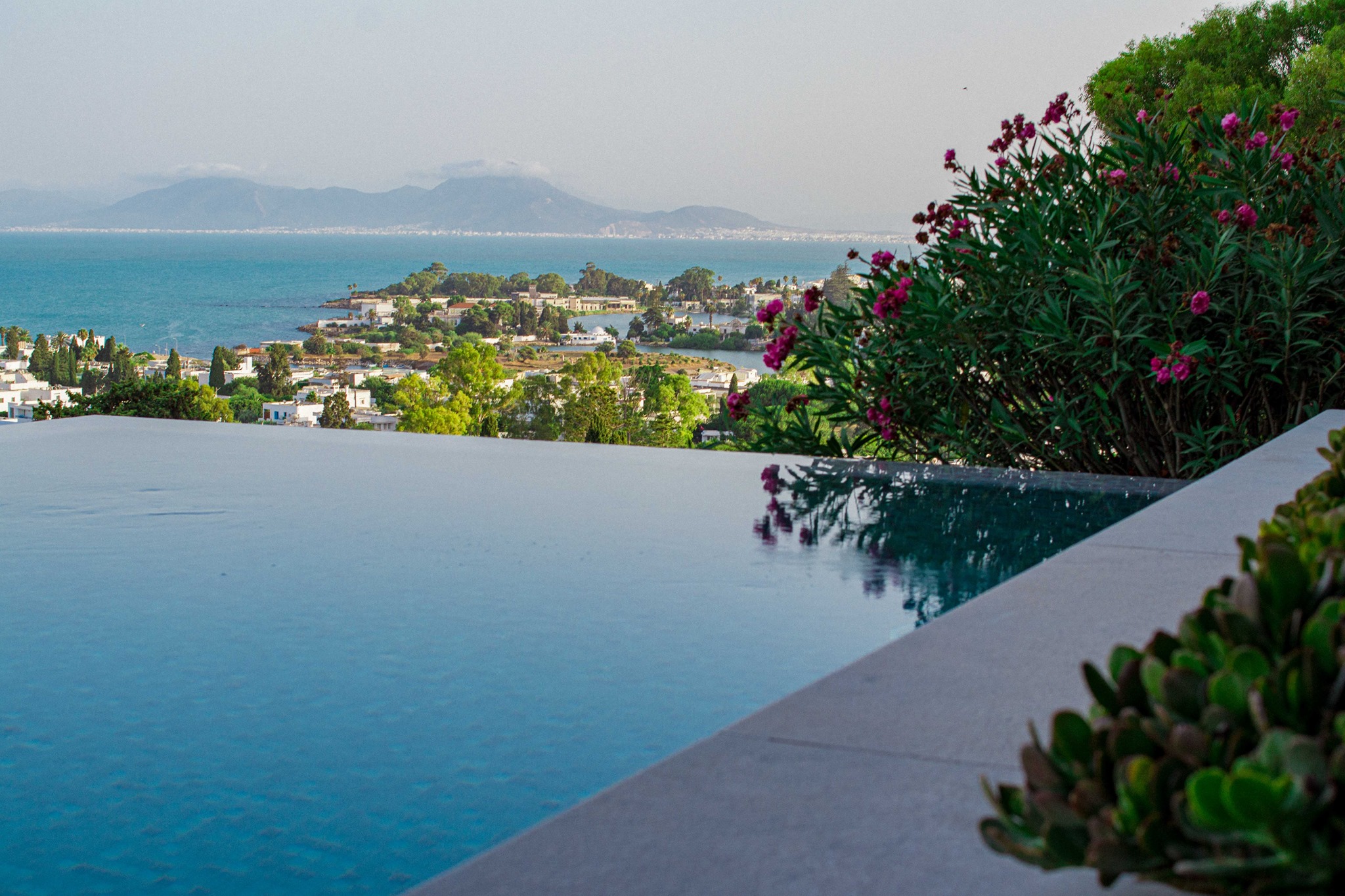
Quick Answer Carthage is a coastal suburb of Tunis, fifteen kilometres northeast of the capital, reachable in under half an hour by the TGM train. The archaeological remains — a UNESCO World Heritage Site since 1979 — are spread across roughly twenty hectares of seaside hillside and include Punic ports, Roman baths, a theatre, a basilica, an amphitheatre, and the country’s most important antiquities museum. A single combined ticket covers seven sites. Allow half a day at minimum; a full day if you want to take it slowly and finish in Sidi Bou Said.
You arrive in Carthage expecting ruins. What you find, mostly, is gardens — and a hill that watches the sea, and a coastline that has been someone’s prized possession for three thousand years.
This is the strange thing about visiting Carthage. The city that once held three hundred thousand people and a fleet large enough to make Rome nervous for a century is not, today, what you might call dramatic at first glance. There is no single skyline-defining ruin, no Colosseum, no Forum. The remains are scattered across a quiet residential district where the Tunisian president has his palace and the embassies keep their summer houses. You walk between sites along leafy streets. You crest a small rise and find columns rising out of a lawn. You round a corner and stand suddenly above the Mediterranean from the same headland Hannibal once paced.
To get Carthage, you have to do two things. You have to bring the history with you — because the ground itself has been so thoroughly worked over that it won’t supply it. And you have to slow down. Carthage rewards the patient visitor in a way it never rewards the rushed one. Here is how to read it.
What “Carthage” Actually Means Today
When Tunisians say Carthage — Qartâj in Arabic — they can mean three different things, and it helps to know which one is being talked about.
There is Carthage the ancient city, the Phoenician colony founded, by tradition, by the princess Elissa (better known as Dido) in 814 BC. By the third century BC it was the wealthiest port in the western Mediterranean. Rome destroyed it in 146 BC at the end of the Third Punic War, salted the earth, and walked away. A century later, on the same site, the Romans built a new Carthage that became the second city of the Western Empire. The Vandals took it in 439, the Byzantines in 533, the Arabs in 698 — and it is the layered remains of all of these that you visit today.
There is Carthage the modern commune, an affluent residential suburb of Greater Tunis with a population of about twenty-four thousand, the presidential palace, several embassies, two universities, and a sprinkling of villas hidden behind bougainvillea. It sits inside the same boundary as the UNESCO archaeological zone, which is unusual — most ancient sites have been emptied of people. In Carthage, modern life and the ruins share the same square kilometres.
And there is Tunis-Carthage International Airport, which is the country’s main hub and which most visitors pass through without realising the name is a tribute to the city next door. The airport is in the modern commune of Carthage, eight kilometres northeast of central Tunis. If you arrived in Tunisia, you arrived in Carthage. You just didn’t know it yet.
For the purposes of this guide, Carthage means the archaeological zone — the cluster of monuments inside the modern commune, all on or near the seafront, and all on the same combined ticket.
Byrsa Hill — Where to Start
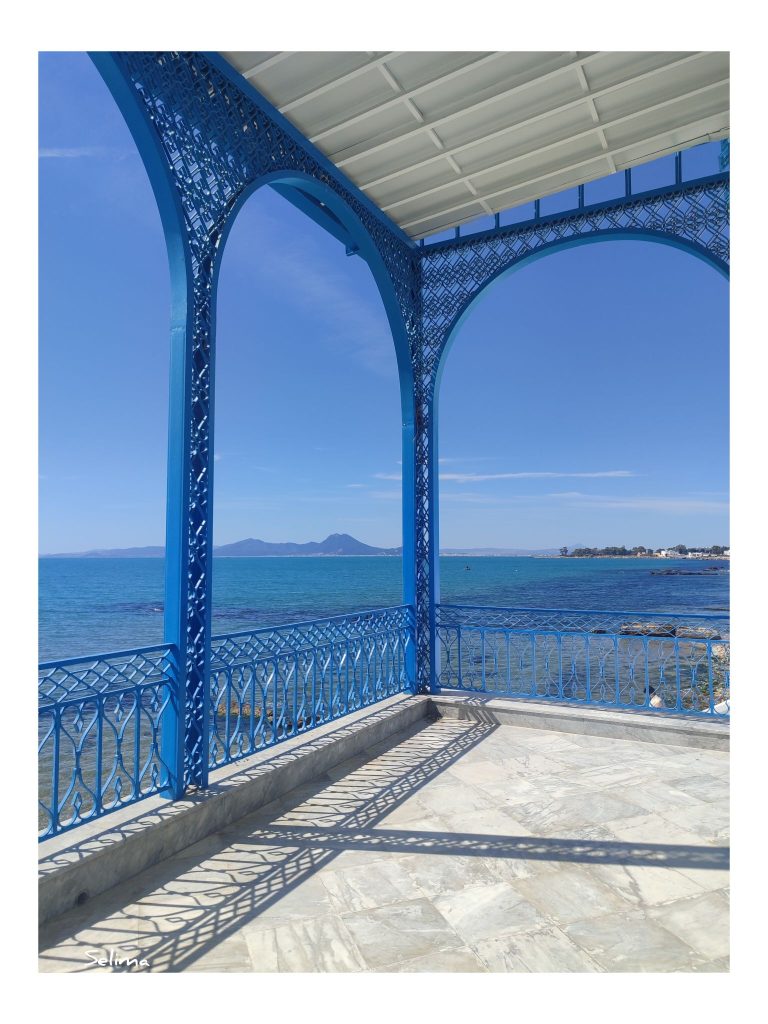
There is one and only one place to begin a visit to Carthage, and that is the top of Byrsa Hill.
Byrsa is the highest point in the ancient city, roughly fifty-seven metres above the sea. It was the acropolis of Punic Carthage — the citadel, the religious centre, the place from which the city was administered. It is also where the Romans built their main forum after they refounded the city in 29 BC. And it is where, in the nineteenth century, the French built the Acropolium, a great pale cathedral that still crowns the hill today, deconsecrated and now used for classical concerts.
From the terrace beside the cathedral, the whole site arranges itself for you. Below to the east, the Antonine Baths stretch toward the sea. To the south, the suburbs of Tunis. To the north, the white houses of Sidi Bou Said climb their own cliff. The Gulf of Tunis sweeps out in front in a long blue arc, with the Cap Bon peninsula closing the horizon. On a clear day you can see why the Phoenicians thought this was the best harbour site in the western Mediterranean. They were right.
The Byrsa terrace is also where the National Museum of Carthage lives, in a former monastery beside the Acropolium. Spend forty minutes inside. The Punic-era stelae carrying the sign of Tanit, the sarcophagi from the necropolis, the room of mosaics — they give the rest of your day the shape it needs. Without the museum, the outdoor sites are mute. With it, they speak.
The Antonine Baths and the Punic Ports
From Byrsa, walk downhill toward the sea. After ten or fifteen minutes you will reach the Antonine Baths, the largest Roman bath complex ever built outside the city of Rome itself.
What you see today is the substructure — the service level, where the furnaces ran and the slaves worked. The bathing floors, one storey above, were stripped of their marble centuries ago and have largely collapsed. But the columns that have been re-erected are enormous, and the setting is unimprovable: the entire complex sits on a lawn at the edge of the Gulf of Tunis, with the sea breaking just beyond the perimeter wall. The Romans understood the assignment. They put their grandest bathhouse exactly where the view was best.
Twenty minutes south on foot, or a five-minute taxi if your legs have already done a hill, lie the Punic Ports — two small, oddly shaped basins that are easy to walk past without realising what you are looking at. The rectangular one was the commercial harbour. The circular one, called the cothon, was the military port: a perfectly round basin with an island in the middle on which sat the admiralty buildings and the dry-docks. Two hundred and twenty warships could be sheltered inside, invisible from the sea. It is small for a modern eye and immense for a Phoenician one.
Stand on the verge and try to populate the water with quinqueremes. This was the engine room of the Punic Empire.
The Theatre, the Amphitheatre, and the Other Layers
The remaining major sites on the combined ticket can be done in any order, depending on how much walking you want to do and how the heat is treating you.
The Roman Theatre, heavily restored, still hosts the annual Festival International de Carthage every July and August, with concerts under the stars from a roster of Arab and international acts. If you visit in summer, check the programme — there are few more atmospheric venues anywhere.
The Amphitheatre, by contrast, is in ruins, and that is part of its power. This was once one of the largest amphitheatres in the Roman world, holding perhaps thirty-six thousand spectators. It is also where Saints Perpetua and Felicity were martyred in 203 AD, one of the most documented martyrdoms in early Christian history. Today the arena is a sunken bowl thick with wildflowers, and a small chapel marks the spot. It is the most contemplative site on the Carthage circuit.
The Tophet of Salammbô is the Punic-era sanctuary where children were ritually sacrificed — or, as a long scholarly debate now holds, where stillborn and infant children were ceremonially buried. Either way, the rows of small stelae carrying the sign of Tanit and the disc of Baal Hammon are quietly devastating. You walk among them in silence.
And there is, finally, the Magon Quarter — a fragmentary excavated residential block of Punic-era Carthage, the only place where you can stand inside something genuinely Phoenician rather than Roman. Most visitors skip it. It deserves twenty minutes.
Carthage in a Day, a Half-Day, or a Morning
If you have a full day, do all of it. Start at Byrsa for the museum and the view. Walk down to the Antonine Baths. Continue south to the Punic Ports and the Tophet. Lunch somewhere on the seafront. In the afternoon, take the Roman Theatre, the Amphitheatre, and the Magon Quarter. Finish in Sidi Bou Said for sunset (it is the next stop up the TGM line, fifteen minutes away).
If you have a half-day, do Byrsa Hill — the museum, the Acropolium terrace, and the immediate view — and then the Antonine Baths. Skip the rest with a clear conscience. You will have seen the two best things.
If you have only a morning, go straight to the Antonine Baths and Byrsa, in that order. Take a taxi between them. You will be back in central Tunis by lunch.
A few things will make any of these days better:
- Bring water. There is almost no shade on the sites.
- Wear shoes you can scramble in — the ground is uneven, and some of the loveliest corners involve a low wall.
- Carry small notes. Multi-site tickets are bought at the first site you enter and accepted at the rest, but small purchases at the entrances and stalls run on cash.
When to Visit
Carthage is open year-round and rewards every season, but the sweet spot is April through early June and mid-September through November. The air is mild, the light is long, and the wildflowers in the Amphitheatre are at their best in spring. July and August are hot — bring a hat — and the crowds peak with the festival; this is also when the Roman Theatre comes alive after dark, which is a fair trade-off if you can stand the noon heat. Winter is mild and quiet, with the occasional rain shower. A wider treatment of the seasons is in our guide on the best time to visit Tunisia.
Getting to Carthage from Tunis
Easy is the word.
The TGM train — the Tunis–Goulette–Marsa light rail — runs from Tunis Marine station at the foot of Avenue Habib Bourguiba up the coast every fifteen minutes or so, with five stops in the Carthage commune: Carthage Salammbô (closest to the Tophet), Carthage Byrsa (the museum and hill), Carthage Dermech (the Antonine Baths), Carthage Hannibal (central), and Carthage Présidence (closest to the presidential palace, which you cannot photograph). The fare is symbolic. The journey is about twenty-five minutes.
A taxi from central Tunis to Byrsa runs ten to fifteen dinars at the meter and takes twenty minutes outside rush hour. Make sure the meter is on; if the driver refuses, take the next cab.
A few visitors do Carthage as a day trip from Hammamet — about an hour each way by louage or hired car. It is doable, but you will be tired. Stay in Tunis if you can; our Tunis travel guide covers the neighbourhoods worth knowing.
After Carthage — Where to Go Next
Carthage flows naturally into Sidi Bou Said, the blue-and-white cliffside village three stops further up the TGM line. The classic afternoon is to finish at the Antonine Baths, hop the train, and arrive in Sidi Bou Said in time to climb to Café des Délices and watch the sun set over the Gulf you have just spent the day above. Order a mint tea with pine nuts. Stay for two.
Travellers with longer in the country and an appetite for Roman archaeology should look south. The greatest concentration of preserved Roman sites in North Africa is not, in fact, in Carthage — it is in the interior, at Dougga, Bulla Regia, Sbeitla, and the colossal amphitheatre at El Jem. Our field guide to Roman Tunisia is the place to start planning that route.
And for the broader question — whether to make the trip at all — we wrote a straight answer to that one too: Is Tunisia worth visiting?. The short version is yes, and Carthage is one of the reasons.
From the Carthage Magazine Bookshelf
- All About Tunisia — the definitive English-language traveler’s guide. 572 pages, 27 chapters, all nine regions, every UNESCO inscription, five thematic trails — and the practical answers (visa, currency, transport, etiquette) most travelers wish they’d had on the plane. $24.99 · PDF & EPUB
- Speak Like a Local — 200+ Tunisian Arabic phrases with native audio recorded in Tunis. The phrases for the taxi, the souk, the café, and the dinner table. $14.99 · PDF, EPUB, MP3
- The Authentic Tunisian Cookbook — sixty traditional recipes from the heart of North Africa. For when you get home and find yourself missing the food. $9.99 · PDF & EPUB
All three available as a bundle for $39.99 — guide, language, and food, delivered together.
