
Quick Answer Tunisia is one of the world’s great Roman archaeology destinations and almost no one outside the country knows it. Six sites do most of the work — Carthage, Dougga, El Jem, Bulla Regia, Sbeitla, and Thuburbo Majus — and several more reward the patient. The Romans called this province Africa, made it the breadbasket of the empire, and produced two emperors from it. What they left behind is, in places, more intact than what they left in Italy. You can see most of it in five days from Tunis.
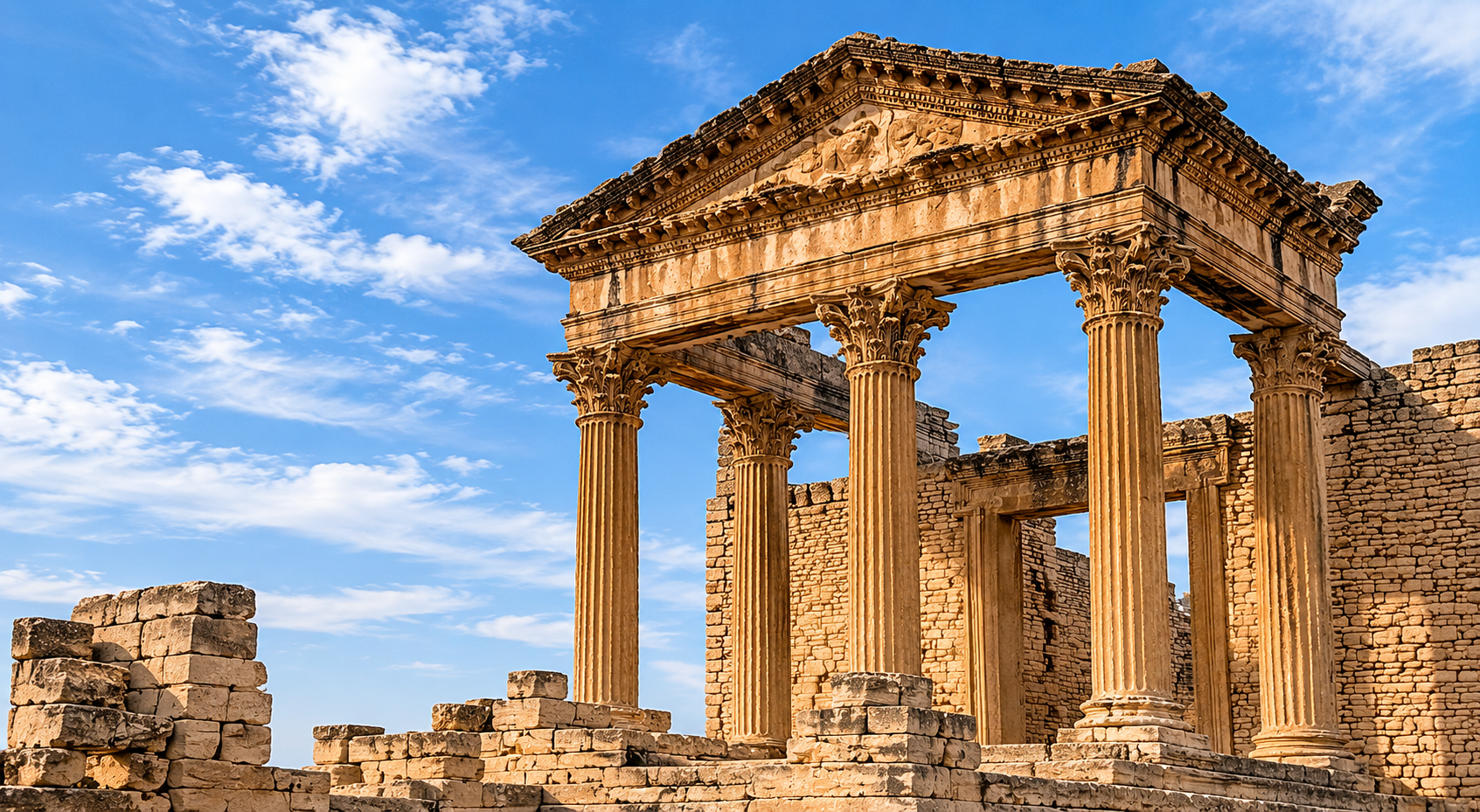
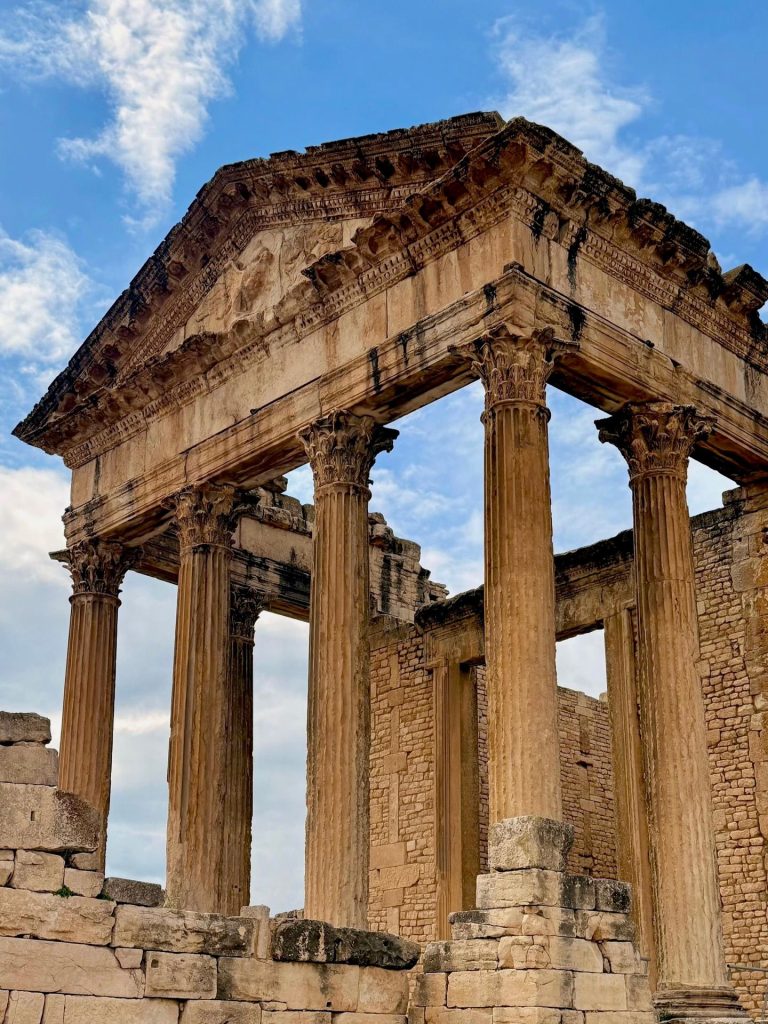
The first time you walk into the Capitol at Dougga — the great Roman temple set on a windy plateau in the Tunisian hills, three Corinthian columns still holding up a perfect pediment after eighteen centuries — something quietly rearranges itself in your head. You have seen this building before, in textbooks and on coins. You expected it in Rome. You did not expect it here, half a day’s drive from a sleepy provincial town, with no rope around it, no audio guide, no queue, and a shepherd’s dog watching you from the shade of an olive tree.
This is the Tunisia almost nothing in the English-language guidebooks prepares you for. The country has somewhere between two hundred and three hundred substantial Roman sites, six of them extraordinary, several of them better preserved than anything you will find in Italy, and most of them visited by fewer travellers in a year than the Colosseum sees in an afternoon. You can stand inside a Roman amphitheatre that once held thirty-five thousand spectators and have the place mostly to yourself. You can descend a staircase carved by a wealthy second-century landowner into the rock beneath his villa and find his mosaic floors still where he laid them. You can sit on the top tier of a small Roman theatre at sunset and watch the same light fall on the same stones it fell on when the play was new.
What follows is a field guide. Not exhaustive — Tunisia has too much Roman material for any one article to be — but honest about where to start, what to expect, and why the country deserves a place near the top of any list of the world’s surviving ancient cities.
Why Tunisia Is Roman
To make sense of any of this, you need the briefest possible version of the history.
Tunisia is Roman because Carthage was. The Phoenician colony founded on this coast around 814 BCE grew into the empire that fought Rome for two centuries across three Punic Wars, produced Hannibal Barca, and very nearly broke the Republic. Rome won, eventually, in 146 BCE, and was so frightened of Carthage that it razed the city, salted the ground, and forbade anyone to live there for a century. Then, in 122 BCE, the Gracchi tried to plant a Roman colony on the site. A hundred years later, Augustus succeeded. By the second century CE, Roman Carthage was the third-largest city in the empire after Rome and Alexandria, and the province around it — Africa Proconsularis — was producing roughly two-thirds of the grain that fed the capital.
This was the empire’s other Italy. The wheat fields of the Mejerda Valley, the olive groves of the Sahel, the marble quarries of Chemtou: Africa was rich, urbanised, fully Roman, and it stayed that way for five hundred years. It produced the emperors Septimius Severus and his son Caracalla. It produced the Latin writers Apuleius, Tertullian, and — eventually — Augustine of Hippo. By the time the Vandals arrived in the fifth century the province had been Roman longer than the United States has been American, twice over. Most of what you see in modern Tunisia’s Roman ruins was built between roughly 50 and 250 CE, when the province was at its peak.
You can read the longer arc of Tunisia’s history elsewhere on this site. For now, what matters is this: the ruins are not provincial. They are not consolation prizes for travellers who can’t get to Rome. In several cases they are what Rome would look like if Rome had not been continuously inhabited, demolished, rebuilt, and Renaissance-ed over the top of itself for two thousand years.
Tunisia preserved its Roman cities by largely walking away from them.
Carthage — Where It Started, and Ended, and Started Again
Begin in Carthage. You almost have to. The archaeological site sprawls across the suburbs of modern Tunis, on the headland fifteen kilometres northeast of the centre, and to walk it properly takes most of a day.
What survives, broadly: the Punic Ports, the small twin harbours from which Hannibal’s fleet once sailed, now silted into shallow lagoons but still legible if you know what you are looking at; the Antonine Baths, the largest Roman thermae outside Rome itself, with foundations the size of a small village and a single intact column standing like an exclamation mark against the sea; the Roman Theatre, partly reconstructed and still in active use for the Carthage International Festival every summer; the Punic Quarter on Byrsa Hill, where the houses Scipio’s soldiers torched in 146 BCE were excavated more or less untouched, the streets still arranged on the original Punic grid; and the Tophet of Salammbô, the sanctuary of votive stelae dedicated to Tanit and Baal Hammon, which is at once one of the most disquieting and one of the most important places in pre-Roman archaeology.
The Carthage National Museum on the top of Byrsa Hill ties it all together — Phoenician masks, Punic stelae, Roman sarcophagi, the model of the city under Rome — and from its terrace you can see the bay Hannibal’s ships once filled.
A single ticket gets you most of the sites. A single day will leave you wanting two.
Dougga — The Best-Preserved Roman Small Town in North Africa
If you only do one inland Roman site in Tunisia, do Dougga — Thugga in antiquity, UNESCO-listed since 1997, set in the rolling hills sixty-five kilometres west of the city of Tunis, in farming country that has changed very little since the Romans were here.
What is extraordinary about Dougga is not any single building. It is the town. Most Roman ruins survive as set-piece monuments scattered across cities that grew over them: the Pantheon in modern Rome, the amphitheatre in modern Arles. Dougga is something else. It was a small provincial town of perhaps five thousand people. When the population drifted away in the early Middle Ages, the town simply stopped — and was not built over.
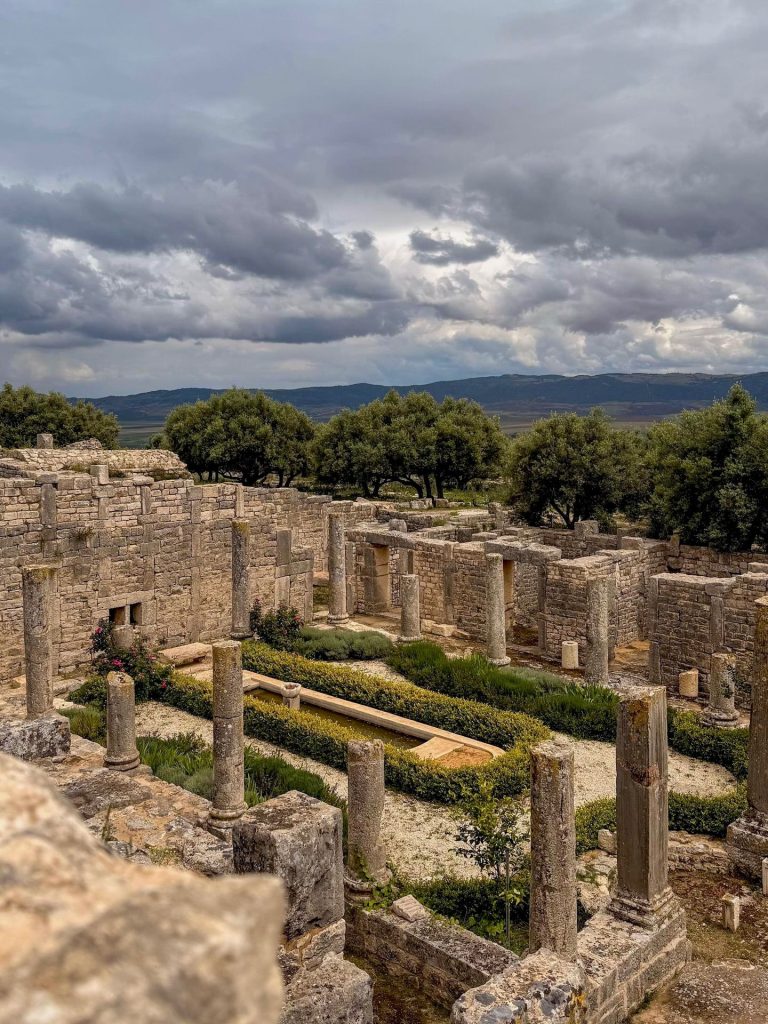
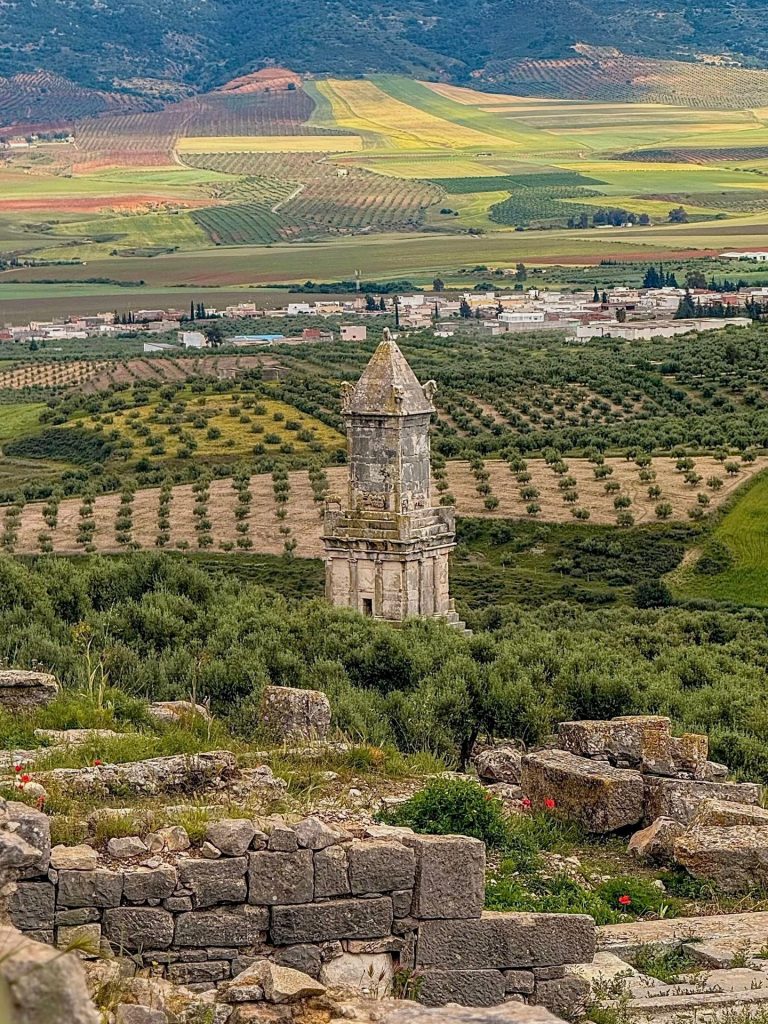
What you walk through, then, is a Roman small town more or less complete. The Capitol — the temple to Jupiter, Juno, and Minerva — stands at the top of the forum with its three Corinthian columns and its sculpted pediment intact, the most photographed Roman ruin in North Africa. Around it: the forum, the market square (the Macellum), the Theatre cut into the hillside with seats for thirty-five hundred and acoustics that still work, the Baths of Licinius, the Square of the Winds, the Trifolium House (a private home with a famously irregular floor plan that suggests it may have been a brothel), the temples of Saturn, Caelestis (the Roman name for Tanit), and Mercury, and — at the lower edge of the site, alone in its field — the Libyco-Punic Mausoleum, a Numidian tower-tomb that predates the Roman town by several centuries and is one of the only surviving monuments of pre-Roman Numidian architecture in the world.
You can spend three hours at Dougga and feel rushed. You can spend a full day and not see all of it. Bring water, a hat, and time. There is, mercifully, almost no signage to distract you — and almost no one else.
El Jem — Africa’s Colosseum

Two hundred kilometres south of Tunis, in a town that is otherwise almost nothing, sits one of the largest amphitheatres ever built.
The Amphitheatre of El Jem — Thysdrus in antiquity — was raised in the early third century CE by Gordian I, the proconsul who used it (briefly) as a platform to declare himself emperor. The arena seats anywhere between twenty-seven and thirty-five thousand spectators, depending on which historian you ask, on three tiers of arches, and is intact to a degree that the Colosseum in Rome is not. You can walk into the gladiators’ tunnels under the arena floor. You can climb to the topmost ring. You can sit on the stone seats and look across at the seats opposite and understand, in a way photographs cannot convey, how big these things actually were.
It is the third-largest Roman colosseum ever built — by some measures the second — and on any given afternoon outside high summer you may share it with a dozen other visitors. UNESCO inscribed it in 1979.
A short walk from the amphitheatre, the El Jem Archaeological Museum holds the city’s Roman mosaics in their original setting — including the spectacular “House of Africa” floor, one of the only ancient depictions of the African continent personified as a goddess.
You can do El Jem as a long day-trip from Tunis. It is better done as an overnight, with the colosseum at dawn before the buses arrive.
Bulla Regia — The City That Lived Underground
In the heat of Tunisia’s interior, a hundred and seventy kilometres west of Tunis, the wealthier Romans of Bulla Regia solved a problem most ancient cities did not solve: how to keep cool.
They went underground.
What you find at Bulla Regia, accordingly, is not a Roman city laid out at ground level but a Roman city with a second city beneath it. Each major villa — and there are several — has an upper floor at the surface, mostly ruined, and a lower floor cut into the rock below, often intact. You descend a flight of original stone stairs and emerge into a vaulted underground hall, the walls still plastered, the columns still standing, the mosaic floors still where they were laid in the second or third century CE. The famous “House of Amphitrite” is the showpiece — Amphitrite riding her seahorse across the floor of a subterranean dining room, attended by a tiny cupid, the mosaic so well preserved you can see the individual tesserae.
Bulla Regia is also, incidentally, the site whose mosaic figure recently inspired the design of ChatGPT’s logo — a story it is hard to read about and not want to visit the original.
The site is a four-hour drive from Tunis and the city of Jendouba is the natural overnight base. The mosaics alone are worth the journey. The fact that you stand on top of them, in the same rooms where they were laid, is what makes the journey unforgettable.
Sbeitla — Three Temples on the Edge of the Empire
Further south and inland, at the gateway to the Tunisian Sahel, the ruins of Sbeitla — Sufetula in antiquity — preserve something almost nothing else does: a forum with three intact Capitoline temples side by side.
In the standard Roman city plan, the Capitol was a single temple shared by Jupiter, Juno, and Minerva. At Sufetula, for reasons that are still debated, the city built each god his or her own temple, and arranged the three on the forum’s northern edge like a triple altarpiece. All three façades survive. All three pediments survive. The line they make against the sky is one of the most photogenic in Roman archaeology.
Sbeitla was also the place where, in 647 CE, the Byzantine governor of North Africa made the empire’s last stand against the Arab armies coming out of Egypt — and lost. The Byzantine baptistery in the church of Saint Servus, where he died, is still on the site. So is the Capitol. Empires layered on empires, all visible at once.
Thuburbo Majus, Utica, and the Other Half of the Country
The country is full of less-famous Roman sites that would be the headline attraction of any other country.
- Thuburbo Majus, sixty kilometres south of Tunis, was a smaller provincial capital with its own well-preserved Capitol and the Palaestra of the Petronii — a gymnasium with mosaic floors in mostly intact condition. It is an hour’s drive and almost no one goes.
- Utica, on the coast north of Tunis, is older than Carthage — a Phoenician city founded around 1100 BCE. Its harbour has silted in over the millennia and the ancient port is now eight kilometres inland, with archaeological remains from the Punic, Roman, and Byzantine periods overlapping on the same hill.
- Maktar (Mactaris), in the central highlands, has the only intact Roman triumphal arch in Tunisia visible without scaffolding, plus a remarkable necropolis of Numidian-era megalithic tombs.
- Haïdra (Ammaedara), out toward the Algerian border, is one of the largest unexcavated Roman cities anywhere — a vast field of ruins, mostly still in the ground, with a triumphal arch of Septimius Severus and a Byzantine fortress that was built directly on top of the Roman forum.
- Chemtou (Simitthus), in the Mejerda Valley, was where the famous giallo antico — the yellow marble that lined the floors of imperial Rome — was quarried, and the ancient quarries and the Roman engineers’ camp are still visible.
- Kerkouane, on the tip of Cap Bon, is the only Punic city that was not rebuilt as Roman after 146 BCE. Its houses, its streets, its bathtubs all preserve a daily Phoenician life that does not survive anywhere else.
You can spend a year visiting Roman Tunisia and not run out.
How to Visit Roman Tunisia
Most travellers see Roman Tunisia in two phases.
- Phase one, the day-trip phase. Carthage is a half-day from central Tunis by light rail (the TGM line runs to within walking distance of the main sites). Thuburbo Majus and Dougga can each be done as a full day from Tunis by hired car. The Bardo Museum — which holds the world’s largest collection of Roman mosaics, almost all of them lifted from these provincial sites — is the essential indoor companion. Plan two days for the Tunis-and-around cluster, minimum.
- Phase two, the road-trip phase. The southern and western sites take a car and at least three days. The standard route runs Tunis → Dougga → Bulla Regia → overnight in Jendouba → Chemtou → south to Kairouan → Sbeitla → El Jem → back to Tunis (or down to the Sahara). You can do this as a self-drive or with a licensed guide; for the inland sites, a guide who knows the small roads will save you hours.
Practical notes. Entry fees are modest — most sites are 10 to 12 dinars. Almost all sites are open 8 AM to 5:30 PM (later in summer), most with a short midday close. Bring water, a hat, sturdy shoes, and patience for unpaved last-mile roads. Most signage is in French and Arabic; some in English. A handful of Arabic phrases will smooth the day’s small interactions — “ya3tikom essaha” to the guards when you arrive, “chokran” when you leave — and our Tunisian Arabic phrasebook has these and more.
If you want the full route laid out by region — every chapter, every UNESCO inscription, every working ksar and every overlooked mausoleum — the Carthage Magazine travel guide All About Tunisia puts the country’s nine regions and five thematic trails into a single 572-page volume.
What These Ruins Are Doing for Us
There is a way to read all of this that is purely architectural — Tunisia as a great open-air museum of imperial Rome, a substitute Italy, a place where you can see, more clearly than in Italy itself, what the Romans actually built. That reading is true and it is not enough.
The fuller reading is harder, and quieter.
These ruins are what is left of a province that was conquered, then assimilated, then made wealthy, then made central, then made invisible. For five hundred years what is now Tunisia was as Roman as Rome — its temples Roman, its laws Roman, its language Latin, its emperors and its poets and its theologians Roman. Then it wasn’t. The Vandals came. The Byzantines came. The Arabs came. The Roman names were translated into Arabic and the Latin words went out of daily use and the towns shifted east, toward Kairouan and the new mosques, and the old cities emptied out.
What we are walking through, at Dougga and Sbeitla and Thuburbo Majus, is what happens to an empire that ends gradually. The buildings stay. The people leave. The grass grows. The marble columns settle into the soil at slight angles. Two thousand years pass. A traveller comes back, in 2026, and finds the temple to Jupiter still standing, and stands inside it, and tries to feel what the person who built it was feeling.
You will not always succeed. But you should try. That is the work these ruins are doing for us. They are letting an empire keep speaking, very slowly, to anyone who will sit on its stones and listen.
From the Carthage Magazine Bookshelf
For the wider trip — every region, every UNESCO site, every Roman ruin worth a detour:
- All About Tunisia — the definitive English-language traveler’s guide. 572 pages, 27 chapters, all nine regions, every UNESCO inscription, and five thematic trails — including the full Roman route from Carthage to Haïdra. $24.99 · PDF & EPUB
- Speak Like a Local — 200+ Tunisian Arabic phrases with native audio recorded in Tunis, including the polite formulas you’ll want at every site gatehouse. $14.99 · PDF, EPUB, MP3
- The Authentic Tunisian Cookbook — sixty recipes for what you’ll wish you could keep eating once you’re home. $9.99 · PDF & EPUB
All three available as a bundle for $39.99 — guide, language, and food, delivered together.
