
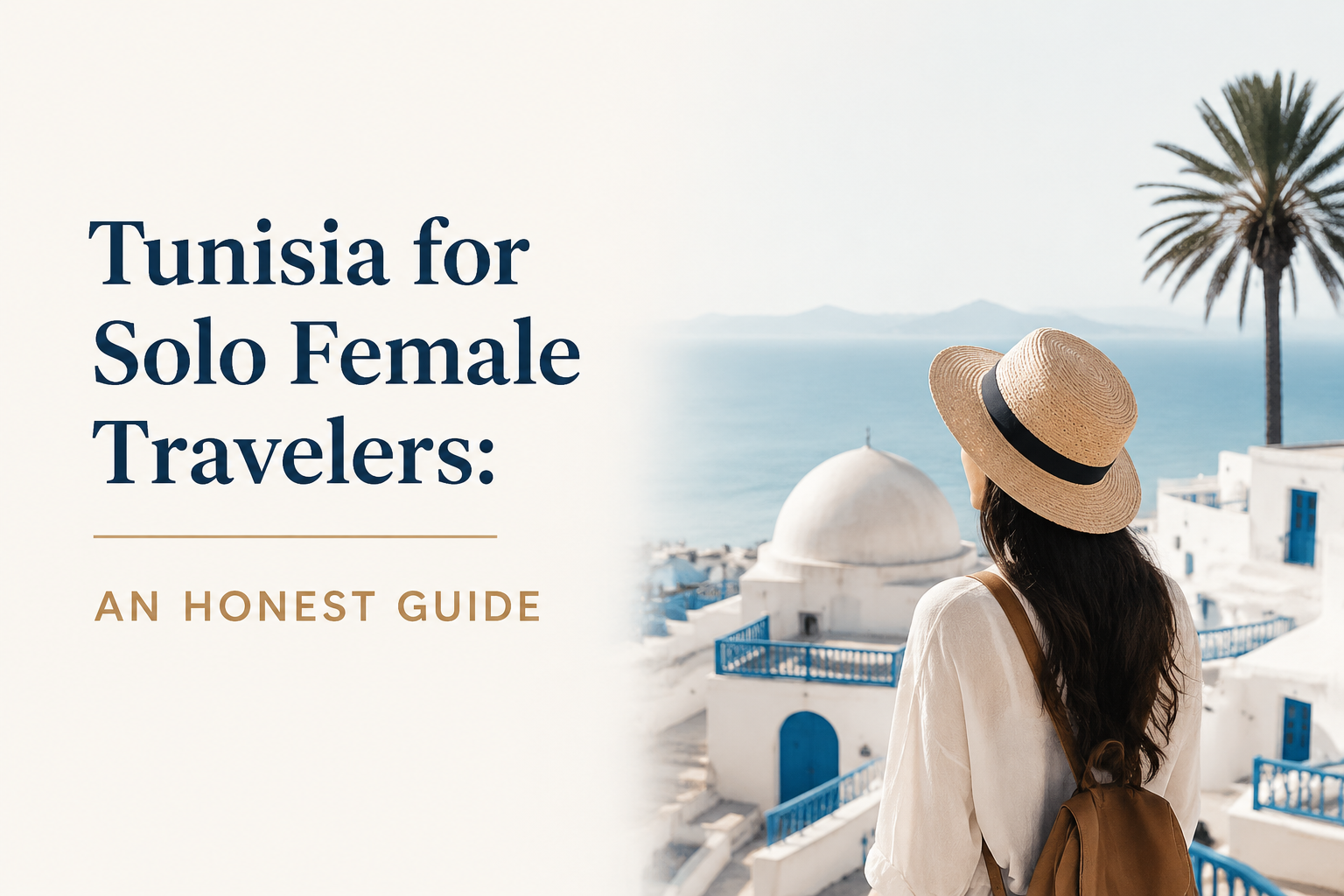
A woman sits alone at a café terrace in La Marsa, a glass of mint tea cooling beside her laptop, the Mediterranean doing its slow blue work in the distance. Nobody looks twice. Three tables over, a group of Tunisian women in their twenties are mid-argument about something that makes all of them laugh at once. This is the version of Tunisia that rarely makes it into the safety forums — and it is the truest one. But it isn’t the whole picture, and you came here for the whole picture.
So let’s be honest with each other, the way a friend in Tunis would be rather than a tour brochure. Tunisia is one of the easiest countries in the Arab world for a woman to travel alone, and it will still, on some afternoons, test your patience. Both things are true. What follows is everything we’d tell a sister, a friend, or a first-time visitor landing at Tunis-Carthage with a backpack and a few nerves.
The Honest Answer on Safety
Tunisia is genuinely safe for solo female travelers — meaningfully safer, in the everyday sense, than its reputation suggests. Violent crime against tourists is rare. The country has a long, real history of women in public life: it was the first in the region to abolish polygamy, back in 1956, under a Personal Status Code that remains the most progressive in the Arab world. Women here are doctors and judges and engineers and shopkeepers; the country produced North Africa’s first woman doctor and, more recently, its first female prime minister. You will see women everywhere — driving, working, sitting in cafés, running the show. That social reality is the single biggest reason solo travel here feels normal rather than brave.
The honest caveat is the one familiar to anyone who has traveled the northern Mediterranean too: street harassment exists, and it is mostly verbal. Expect the occasional comment, the lingering stare, the man who decides your “no” is the opening line of a negotiation. It is more tiresome than threatening, and it fades the moment you stop responding and keep walking. It is worth knowing about in advance precisely so it doesn’t rattle you when it happens. For the broader security picture — terrorism advisories, which regions to skip, what the government warnings actually mean in practice — our full breakdown of whether Tunisia is safe to visit right now goes deeper than we can here.
One practical safety layer that costs a few dollars: land already connected — an eSIM installed before you fly means maps, ride apps, and check-in messages work from the arrivals hall, with no dependence on airport Wi-Fi or a kiosk queue.
Where to Land First
If this is your first solo trip and you want to ease in, choose your base deliberately. The northern suburbs of the capital — La Marsa, Sidi Bou Said, Gammarth, Carthage — are about as gentle an introduction to Tunisia as exists. They’re walkable, café-dense, full of art galleries and women out on their own, and connected to central Tunis by the TGM light rail (whose front carriage is reserved for women if you’d rather). Spend your first two nights here, find your feet, then push outward.
Sidi Bou Said, with its blue doors and clifftop jasmine, is made for an unhurried solo afternoon. The medina of Tunis rewards a morning of getting pleasantly lost. When you’re ready for the coast, the resort towns are the path of least friction: Hammamet and Sousse are so accustomed to independent travelers that you’ll barely register as one, and Djerba — an island with a centuries-old habit of hospitality and a genuinely multicultural fabric — is one of the most relaxing places in the country to be a woman alone. Our city-by-city Honest Guide series covers each of these in detail when you’re ready to plan the actual days.
On Dress: Read the Room, Not the Rulebook
You do not need to cover up in Tunisia. In Tunis, Sousse, the beach resorts, and the wealthier coastal suburbs, women wear exactly what they’d wear in Marseille or Barcelona, and nobody minds. Tunisia is a secular-leaning country and dresses like one.
The nuance is geographic, not moral. The further you go from the cosmopolitan coast — into the rural interior, the small towns of the south, the conservative neighborhoods of any city — the more you’ll want to lean toward shoulders and knees covered, not out of obligation but out of the same instinct that tells you to lower your voice in a quiet room. A light scarf folded into your bag is the single most useful object you’ll carry: shade in the desert south, a shoulder cover at a mosque, an extra layer when the evening turns. Dressing with the context in mind isn’t about disappearing; it’s about spending your attention on the trip instead of on stares.
Getting Around Without a Co-Pilot
Moving around solo is straightforward once you know the options. Licensed yellow taxis in the cities are cheap and metered — insist on the meter (“compteur, s’il vous plaît”) and you’ll rarely have a problem. Ride-hailing apps operate in greater Tunis and take the negotiation out of the equation entirely, which many solo women prefer, especially after dark. For longer hops between cities, louages (shared minibuses) are the local bloodstream of the country: efficient, absurdly cheap, and a fast way to end up in a conversation. They’re fine to use alone; sit near other women if it makes you more comfortable, and you’ll often find someone keeping a quiet, grandmotherly eye on you whether you asked for it or not.
A few honest mechanics: keep your phone out of sight on busy streets and packed transport, the same as you would in any capital. Avoid walking alone in unlit, empty areas late at night — advice that is boring precisely because it is universal. And if you’re planning to drive yourself, read our field notes on Tunisian road habits first; the roads are an experience of their own. Sorting out a local SIM or eSIM on arrival is the smartest thirty minutes you’ll spend — maps, ride apps, and a working phone change everything about traveling alone.
The Practical Stack: Money, Tipping, Sleep
The logistics that make solo travel smooth are the same ones that make any travel smooth, just worth front-loading when there’s no one to split the thinking with. Tunisia runs on cash more than cards, and the Tunisian dinar is a closed currency you can’t get hold of until you arrive — so know how the ATMs and exchange work before you land. Tipping is a gentle, low-stakes art here, and our guide to who to tip and how much will save you the small daily friction of guessing.
For where to sleep, solo travelers tend to do best with a mix: a well-reviewed hotel or guesthouse in a central, walkable area for the first nights, with a 24-hour reception you can call from the lobby if a taxi feels off. Our breakdown of where to stay in Tunisia by style and region lays out the trade-offs. And timing matters more than people expect — the best months to visit for a woman traveling alone are the shoulder seasons of spring and autumn, when the weather is kind, the resort towns are lively but not overwhelming, and the daylight stretches long enough that you’re rarely navigating a new city in the dark. Check the month-by-month weather before you book.
Lean Into the Culture — It’s the Whole Point
Here’s the part the safety guides forget to mention: traveling Tunisia as a woman alone gives you access that men simply don’t get. You’ll be invited into kitchens and onto sofas. You’ll be folded into the gravitational pull of Tunisian hospitality, which treats a solo female guest as someone to be looked after with a seriousness that can be almost overwhelming. Say yes to the coffee. Say yes — within your own judgment — to the family that wants to feed you.
A handful of Tunisian Arabic phrases will multiply this tenfold; nothing disarms a would-be hassler or delights a shopkeeper faster than a foreigner who says aychek (thank you) and barsha (a lot) with a straight face. If you have time, the country is also one of the loveliest places anywhere to actually learn the language. Book yourself into a traditional hammam — the women’s hours are a world unto themselves, steam and gossip and zero pretension, and you’ll leave scrubbed pink and weirdly initiated. And if your trip happens to collide with a wedding, accept any invitation you’re lucky enough to receive. Few experiences will tell you more about this country, or make you feel less alone in it.
The Short Version
Tunisia is a yes — a confident one. Come with a light scarf, a working phone, a few words of the dialect, and the same situational good sense you’d carry through Naples or Marrakech. Expect a little noise and a great deal of warmth. Most women who travel here alone leave wondering what all the worry was about, already half-planning the trip back. If you’re still weighing it against the obvious alternative, our honest comparison of Tunisia and Morocco may settle the question.
From the Carthage Magazine Bookshelf
If you’re traveling Tunisia alone, the right reading does some of the work a companion otherwise would — context on the page, a phrase ready when you need it. Three Carthage Magazine ebooks were built for exactly the days between arrival and departure:
- All About Tunisia — the definitive English-language traveler’s guide. 572 pages, 27 chapters, all nine regions, every UNESCO inscription, five thematic trails — and the practical answers (visa, currency, transport, etiquette) most travelers wish they’d had on the plane. $24.99 · PDF & EPUB
- Speak Like a Local — 200+ Tunisian Arabic phrases with native audio recorded in Tunis. The phrases for the taxi, the souk, the café, and the dinner table. $14.99 · PDF, EPUB, MP3
- The Authentic Tunisian Cookbook — sixty traditional recipes from the heart of North Africa. For when you get home and find yourself missing the food. $9.99 · PDF & EPUB
All three available as a bundle for $39.99 — guide, language, and food, delivered together.
