
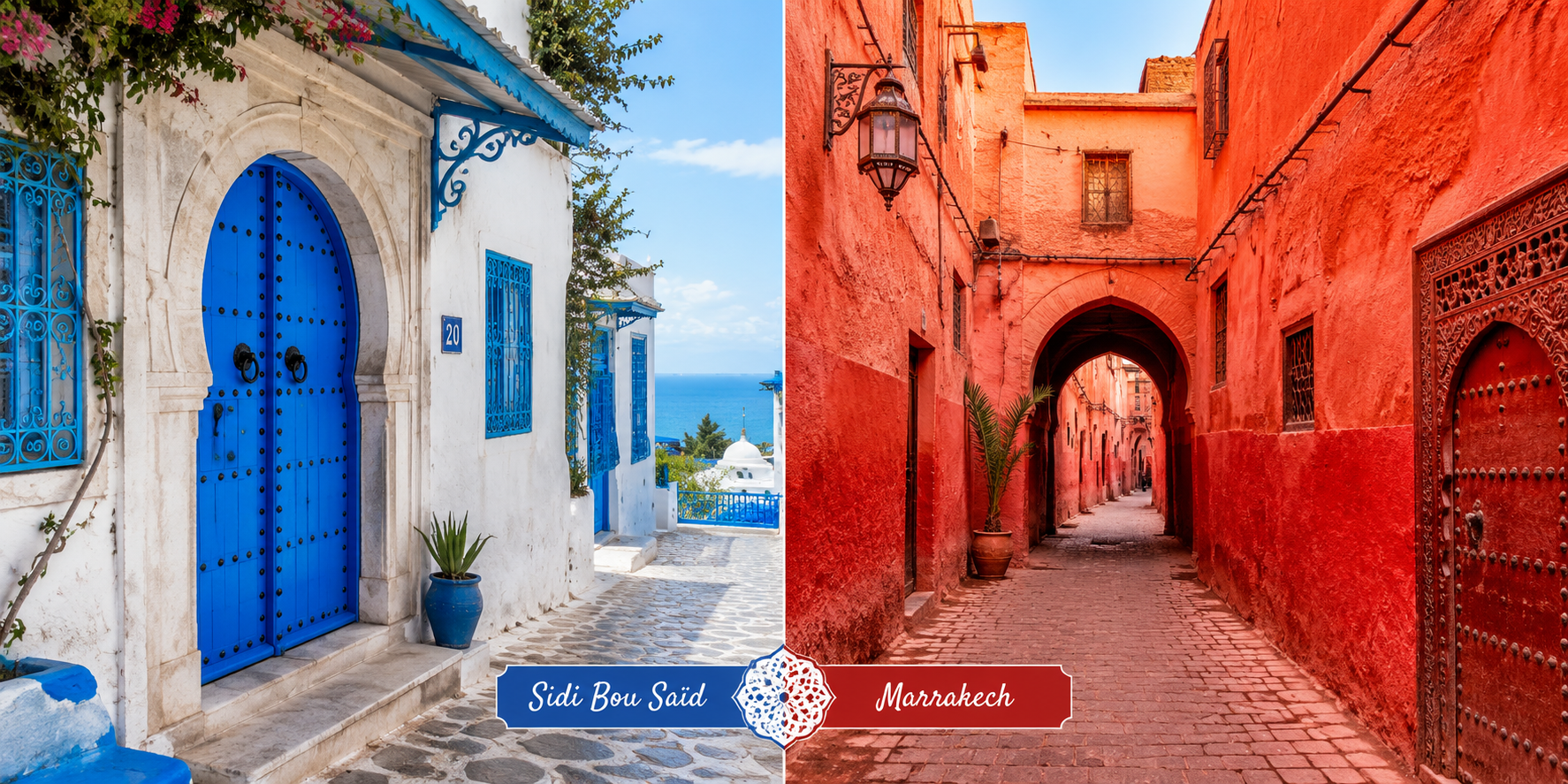
Quick Answer Both are wonderful and both deserve their reputations. Morocco is the more dramatic country — bigger, louder, more cinematic, more demanding, and considerably more expensive. Tunisia is the smaller, gentler, more affordable, more Mediterranean, and — for what it’s worth — far less crowded option. Morocco wins on cities and medinas. Tunisia wins on Roman ruins, beaches, value, and hassle-free travel. The food is closer than you think. If you only have one trip, your honest answer depends on what kind of traveler you are. If you have two, do both — they are different enough that one does not replace the other.
This article is going to be more useful to you if I begin by admitting two things.
The first is that I’m writing it from Tunis. The masthead at the top of this page makes that obvious, and you should factor in whatever home-team discount you think is appropriate. I have done my best to be fair to Morocco — a country I’ve spent real time in, a country I genuinely admire, a country that does several things better than Tunisia does. Where Morocco wins, I’ll say so plainly.
The second is that this is the wrong question for most readers. If you have the time and the budget for two North African trips, you should do both. They are different countries with different rhythms and different things to offer, and one does not substitute for the other. The honest comparison piece exists not because there’s a single right answer, but because most travelers can only do one of these trips in the next few years, and they want to know which one fits the trip they actually want.
So: which one fits the trip you actually want? Here is the framework.
The Honest Short Answer
If you are choosing your first North African country and you want the bigger, more dramatic, more famous experience — the Marrakech souks, the High Atlas, the Sahara dunes of Merzouga, the blue village of Chefchaouen — and you don’t mind paying for it, dealing with crowds, and being hassled in the medinas, go to Morocco. It is the right answer for a great many travelers and it is the right answer for very good reasons.
If you want a more relaxed, considerably cheaper, less crowded, beach-leaning Mediterranean trip with extraordinary Roman ruins, a UNESCO medina that isn’t being trampled, and the kind of warm Tunisian hospitality that doesn’t have an exchange-rate calculation behind it, go to Tunisia. It is the right answer for a different kind of traveler and the country is, by 2026, significantly underrated.
Most travelers will know which of those they are within the first paragraph. The rest of this article is for the ones who don’t.
How They Compare — Geography, Scale, Climate
Morocco is a country of forty million people on the far western edge of North Africa, with an Atlantic coast on one side, a Mediterranean coast on the other, and the High Atlas mountain range — peaks above four thousand metres — running diagonally through its middle. It is large. Driving from Tangier in the north to the Sahara at Merzouga in the southeast is more than a thousand kilometres. The country has roughly seventeen million international tourist arrivals a year and the infrastructure to absorb them.
Tunisia is a country of twelve million people on the eastern edge of the Maghreb, just south of Sicily, with a single long Mediterranean coast and the Sahara beginning about five hours’ drive south of the capital. It is small — about a third Morocco’s size, and you can drive its full north-to-south length comfortably in a day. The country had about ten million international tourist arrivals in 2024, but the great majority of them are European package tourists who stay inside resort compounds and never see the country properly.
The climates are similar — Mediterranean on the coasts, hot continental inland, hot dry desert in the south — but Tunisia is more uniformly mild. Morocco gets more dramatic weather: more rain, more snow at altitude, more variation between regions. You can ski in the High Atlas in February and surf in Taghazout the same week. Tunisia has nothing like that range, and doesn’t pretend to.
If the diversity of landscape is what draws you, Morocco wins. If a simpler, more compact trip with less driving suits you better, Tunisia does.
Where Morocco Wins
Let me start with the categories where Morocco is genuinely the better choice.
The medinas. Morocco’s medieval cities are, simply, the most atmospheric old cities in the Arab world. The medina of Fez is the largest car-free urban area on the planet, a labyrinth of nine thousand alleys that has been continuously inhabited since the ninth century, and walking it is one of the great experiences in travel. The medina of Marrakech is its theatrical cousin — Jemaa el-Fnaa square at dusk, the snake charmers and the storytellers and the smoke of the food stalls rising into the pink walls. Tunis has a beautiful UNESCO medina, but it is smaller, calmer, and less cinematic. If you came to North Africa for the medina experience and you want the version that will overwhelm you in the best way, Morocco is the answer.
The mountains. Morocco has the High Atlas, the Middle Atlas, and the Anti-Atlas — three serious mountain ranges with serious trekking, alpine villages, and four-thousand-metre peaks. Tunisia has hills. Beautiful hills. But nothing like Morocco’s mountains. If trekking is the trip, this is not close.
Photographic spectacle. Chefchaouen, the blue-painted town in the Rif. Aït Benhaddou, the kasbah from Gladiator. The Erg Chebbi dunes at Merzouga. The tanneries of Fez. The pink walls of Marrakech at sunset. Morocco is a country built for the camera, and many of its most-photographed places have entered global travel iconography in a way nothing in Tunisia has — yet.
International flight access. From most North American cities and many European ones, Morocco has more direct flights, more frequencies, and (often) lower fares than Tunisia. Royal Air Maroc has a meaningful long-haul network. Tunisair does not. If you’re flying from Boston or Chicago, Morocco is the easier landing.
The riad-stay experience. Morocco invented the modern travel concept of staying in a restored medieval courtyard house, and there are now hundreds of beautifully restored riads in Marrakech, Fez, Essaouira, and Chefchaouen. Tunisia has a smaller, growing inventory of dar guesthouses in the Tunis medina, but the riad scene in Morocco is two decades deeper.
These are real and meaningful advantages. If any of them are non-negotiable for your trip, Morocco is the right call.
Where Tunisia Wins
Now the other side of the ledger.
Roman ruins. This one is not close. Tunisia has the largest collection of Roman archaeological sites outside Italy and several — Dougga, El Jem, Bulla Regia, Sbeitla — that are better preserved than almost anything in Morocco. The amphitheatre at El Jem is the third-largest Roman colosseum ever built and you will share it with a dozen other visitors. The Bardo Museum in Tunis holds the largest collection of Roman mosaics on Earth. Morocco’s Volubilis is the country’s main Roman site and it is, honestly, a footnote next to what Tunisia offers. If you came to North Africa for the ancient world, this is the comparison that should decide your trip.
Beaches. Morocco’s Atlantic coast is cold, surfy, and dramatic — great for windsurfers in Essaouira, less great for swimmers. The Mediterranean coast (Tangier, Tetouan, Al Hoceima) is small and crowded. Tunisia’s entire coastline is Mediterranean, the water is warm from May through October, and the country has several genuinely beautiful beach regions — Hammamet, Djerba, the Kerkennah Islands, the long sand beaches of the Cap Bon. If your trip is partly a beach trip, Tunisia wins on quality, water temperature, and price.
Value. Tunisia is significantly cheaper than Morocco for almost everything — hotels, restaurants, taxis, guides, entrance fees, drinks. A mid-range hotel in Tunis runs sixty to ninety dollars a night; the equivalent in Marrakech is double. A serious restaurant meal with wine in Tunis is twenty-five to forty dollars a head; in Marrakech, forty-five to seventy. Across a two-week trip the gap is meaningful. The country’s cost of living guide has the longer breakdown.
The hassle factor. Morocco’s medinas, particularly Marrakech, have a real and persistent hassle culture for tourists — unsolicited “guides,” aggressive shopkeepers, taxi negotiations that begin from a hostile position. Most travelers learn to manage it; some find it exhausting. Tunisia has the same dynamic in tourist concentrations, but at a markedly lower volume. The Tunis medina is a working district where most shopkeepers do not depend on tourists, and the absence of the constant transactional pressure is, after the third or fourth Moroccan medina, a genuine relief.
Crowds. Marrakech now sees more international visitors than Greece’s entire Cycladic island chain. Tunisia, despite its volume of European package tourism, has almost no traveller pressure outside the resort zones. Dougga on a Tuesday morning will have eleven people in it. Volubilis on the same morning, several hundred. If you’re after the experience of walking great ruins without a crowd, Tunisia is uniquely well-positioned right now.
Alcohol and openness. Tunisia is markedly more liberal on alcohol than Morocco. Wine, beer, and spirits are widely available in restaurants, bars, supermarkets, and hotels across the country. Morocco is officially restrictive (though tourist zones are easier). Tunisia also has a quietly excellent wine industry — three thousand years of viticulture, currently producing thirty million bottles a year — that has no Moroccan equivalent. If you want a glass of wine with grilled fish on a Mediterranean evening, Tunisia is the easier country.
French and English fluency. Both countries are post-French-protectorate, and both speak French widely. Tunisia, statistically, has higher general French fluency and a faster-rising English fluency, particularly among under-forties. Morocco has more variation — excellent French and English in tourist zones, less elsewhere. For an English-only traveler, the two countries are similar in practice, with a slight edge to Tunisia in the cities.
Where It’s Genuinely Close
A few categories where the comparison is real and the answer depends on taste.
Food. This is much closer than the food world admits. Morocco has the more famous cuisine internationally — tagine, pastilla, harira, the seven-vegetable couscous — and the bigger restaurant scene in tourist cities. But Tunisian food is, by most honest accounts of people who have eaten extensively in both countries, slightly more varied, more sea-influenced, and more vegetable-driven. The slata méchouia was ranked the world’s second-best salad by TasteAtlas. The brik is unique to Tunisia. The mloukhiya is unlike anything in Moroccan cooking. Couscous is both countries’ national dish, prepared very differently in each. Harissa is Tunisian, UNESCO-listed, and now globally famous; Morocco uses harissa but did not invent it. Most travelers who do both trips come away saying Moroccan food has the better restaurants and Tunisian food has the better home cooking. That is roughly correct.
The Sahara. Both countries offer a serious desert experience. Morocco’s headline destination is Merzouga — the towering Erg Chebbi dunes, six-hour drive from Marrakech, the most photographed dunes in Africa. Tunisia’s headline destination is Douz and Ksar Ghilane — the Grand Erg Oriental, accessible from Tozeur or Djerba, the original Star Wars film locations. Morocco’s dunes are taller and more dramatic. Tunisia’s are closer to other things, cheaper to do, and considerably less touristed. Both are real Saharas. Both will deliver the camel ride and the night under the stars. The choice is between more spectacular and more accessible.
Architecture and design. Morocco has the more ornate aesthetic — zellige tile work, carved stucco, the Moroccan riad style that became a global design reference. Tunisia has a quieter aesthetic — Andalusian-influenced, more restrained, with its own distinct traditions (the chéchia hats, the Sejnane clay figurines, the painted doors of Sidi Bou Said). If your trip is in any sense a design trip, Morocco is the more obvious answer; Tunisia is the more surprising one.
Cities to base in. Morocco has more famous big cities — Marrakech, Fez, Casablanca, Tangier, Rabat — and you’ll likely move between several on a single trip. Tunisia has fewer “headline” cities; most trips orbit around Tunis, with side trips to Sousse, Djerba, or Tozeur. Whether more cities or fewer is a feature depends on how you like to travel.
A Decision Matrix: Who Should Choose Which
The honest framework for picking between them.
Choose Morocco if:
- This is your first North African trip and you want the famous, spectacular, postcard version
- You’re traveling from North America and want easier flights
- The medina experience is the central reason you’re going (Fez, Marrakech)
- You want mountains and serious trekking
- You’re after the riad-stay experience
- Budget isn’t the deciding factor
- You can manage crowds and hassle without it ruining your trip
- The photographs in your head are of Chefchaouen, Aït Benhaddou, or the pink walls of Marrakech
Choose Tunisia if:
- You’re after a relaxed, beach-leaning Mediterranean trip with cultural depth
- Roman ruins, Carthage, or El Jem are on your list
- You want serious value — your budget goes considerably further
- You’d rather have a smaller, less famous country mostly to yourself than a famous one full of tour buses
- You want to swim
- You want wine with dinner
- You prefer your hospitality without the hard-sell
- The trip is partly about reading, walking, and slow afternoons rather than spectacle
- You’ve already been to Morocco and want the other half of the Maghreb
Do both if:
- You have two trips’ worth of time and budget over the next few years
- You’re a serious traveler in the region
- You want to understand North Africa rather than just visit it
Almost no one who does both trips regrets it. The countries are different enough that they complement rather than repeat each other. The smart traveler does Morocco first (it’s louder, more demanding, harder to leave for last) and Tunisia second (it’s quieter, deeper, the better reward after the louder one).
A Word on Combining Them
You cannot easily combine them into a single trip. The two countries do not share a land border (Algeria sits between them, and the Morocco–Algeria border has been closed since 1994). There are some direct flights between Tunis and Casablanca, but the frequencies are modest and the prices are higher than you’d expect for two-and-a-half hours in the air. Most travelers who do both either treat them as two separate trips, or stitch them together via a Europe stopover (Paris, Madrid, Marseille all work).
If you have three weeks and absolutely want to combine, the cleanest itinerary is one week in Morocco (focused on Marrakech, Fez, and either the desert or the coast), then a Paris or Marseille connection to Tunis, then a week-plus in Tunisia. Both economies of scale and the freshness of contrast are real.
A Last Honest Word
Tunisia is, in 2026, one of the best-value travel countries in the wider Mediterranean. It is also one of the least understood. The country has been working hard since 2011 to recover from the events that scared tourism away in the early 2010s, and the work has succeeded — the beaches are open, the medina is calm, the wine is good, the food is excellent, and the welcome you get as a foreign visitor is the unembarrassed warm welcome you get in countries that genuinely still want you there.
Morocco has been a great destination for forty years and will continue to be. It earned its reputation. It is at the moment, perhaps, being slightly oversold and slightly overcrowded — the cost of being a great destination for forty years. Tunisia is at the opposite point in the curve: a country whose moment is arriving and which the wider world has not yet caught up to.
If you want the experience that everyone will recognise when you get back, Morocco. If you want the experience that no one will quite expect — the one that surprises you most — Tunisia.
If you can do both, do both.
And start with whichever one fits the trip you actually want.
From the Carthage Magazine Bookshelf
If Tunisia is the choice — or one of them — three Carthage Magazine ebooks were built for the traveler who wants the real cultural keys:
- All About Tunisia — the definitive English-language traveler’s guide. 572 pages, 27 chapters, all nine regions, every UNESCO inscription, and five thematic trails. $24.99 · PDF & EPUB
- Speak Like a Local — 200+ Tunisian Arabic phrases with native audio recorded in Tunis. Tunisian Arabic is meaningfully different from Moroccan Darija, and the phrases that work in Marrakech will not always work in Tunis. $14.99 · PDF, EPUB, MP3
- The Authentic Tunisian Cookbook — sixty traditional Tunisian recipes including the brik, the slata méchouia, and the mloukhiya you won’t find on a Moroccan table. $9.99 · PDF & EPUB
All three available as a bundle for $39.99 — guide, language, and food, delivered together.
