
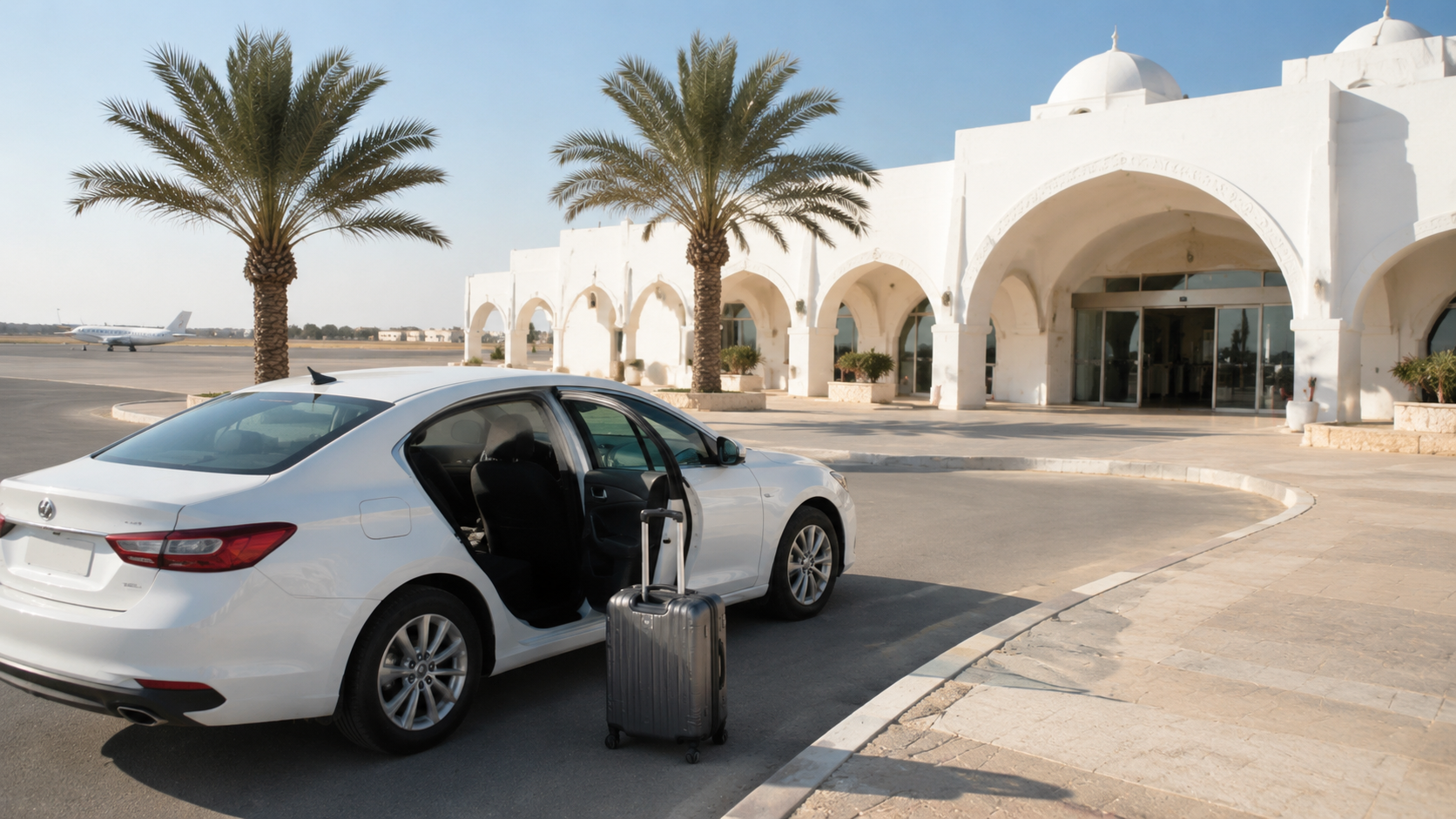
The plane banks over a flat expanse of olive groves and pale, low-slung houses, the Mediterranean glittering to one side, and then the wheels touch down on a runway that feels improbably close to the sea. You have arrived at Djerba-Zarzis, the small southern airport that for most visitors is the first and last thing they see of the island. What happens in the next hour — passport queue, baggage belt, the walk into the warm air, the question of how to reach your hotel — sets the tone for the whole trip.
Djerba’s airport is not large or complicated, which is good news. But it runs on its own quiet logic, and a little preparation turns arrival from a mild ordeal into a non-event. Here is everything worth knowing before you land.
The basics: one terminal, easy to read
Djerba-Zarzis International Airport carries the code DJE (or DTTJ to pilots), and is sometimes called Mellita Airport after the nearby town. It opened in 1970 specifically to bring European holidaymakers to the island, and that remains its job: it is a seasonal, tourism-driven airport, busiest in summer and noticeably quieter in winter.
Everything happens in a single terminal, which means no shuttle buses between buildings and no risk of ending up at the wrong concourse. The ground floor holds the check-in desks and the arrivals hall with its baggage carousels and customs. It’s the kind of airport you can read at a glance — a relief after a long travel day.
The airport sits roughly nine kilometres west of Houmt Souk, the island’s capital, and is well placed for the resort zones: the beach strip is a short drive away, Midoun is about twenty minutes, and even the furthest corners of the island are well under an hour. Wherever your hotel is, you are not far from it.
Who flies here
DJE handles a mix of seasonal European charters, scheduled flights, and domestic hops. Year-round connections link Djerba to Paris and a handful of other European cities, with the roster expanding considerably in summer as charter operators add routes for the beach season. Domestically, Tunisair Express runs the short hop up to Tunis, which is the sensible alternative to the long road journey north — the island is part of Tunisia’s four-airport network, and DJE is the deep-south gateway.
The practical takeaway: if you’re arriving in the high season, expect the terminal to be busy when several charters land in a cluster. In winter, you may find yourself nearly alone in the hall.
Arrival: passport control, baggage, and how long it really takes
For international arrivals, budget around an hour from touchdown to stepping outside, once you factor in passport control and waiting for checked bags. When two or three flights land close together — common on summer weekends — the passport queue is the bottleneck, so don’t plan anything tight for the first hour.
A few things that smooth the process. Have your passport and any accommodation details handy for the immigration desk. If you’ve checked luggage, note that the carousels can be slow when the hall is full. And the moment you clear customs and walk out, you’ll meet the one genuine decision point of the whole arrival: how to get to your hotel.
Getting from Djerba Airport to your hotel
This is where a little knowledge saves real money and stress. The single most important thing to understand — and it catches almost every first-time visitor off guard — is that there is no Uber, Bolt, or any ride-hailing app in Tunisia, Djerba included. The reflex to pull out your phone and summon a car simply doesn’t work here. (We cover the island’s whole transport picture in our guide to getting around Djerba; this section is just the airport leg.)
You have, broadly, three options.
The airport taxi rank. Yellow taxis wait outside arrivals, and for a straightforward trip to a nearby hotel this is workable. The catch is that airport runs are typically a negotiated flat fare rather than a metered ride, and the negotiation happens at the worst possible moment — jet-lagged, luggage in hand, possibly in a scrum when a charter has just disgorged two hundred people onto the rank at once. The fare depends entirely on where your hotel sits: Houmt Souk, Midoun, the zone touristique, or somewhere further out. Agree the number clearly, out loud, before the boot closes.
A hotel transfer. Many resorts, especially the larger package hotels, will arrange a pickup if you ask in advance. Convenient, but often priced at a premium and not always punctual if your flight shifts.
A pre-booked private driver. For most independent travellers this is the sweet spot. You arrange the pickup before you fly, the price is agreed up front with no kerbside haggling, and the driver tracks your flight — so if you land late, he’s still there. This is exactly what Marwen Gzam does: born and raised on Djerba, fifteen years behind the wheel, he meets arrivals with a sign, runs a brand-new air-conditioned car, and gives a fixed price for the transfer before you travel. You tell him your hotel and your flight number over WhatsApp (+216 98 617 679); he handles the rest. The advantage over the rank is continuity — the person who collects you from the airport is the same one you can call for the rest of your stay, for beach runs, island tours, or the trip back to DJE when it’s time to leave.
Renting a car at the airport. If your plan for the island involves ranging beyond the resort strip — Guellala, the wild western beaches, the causeway to the mainland — collecting a rental in the arrivals hall solves the transfer and the holiday transport in one move. Djerba’s flat, compact roads make it the gentlest place in Tunisia to drive, and agencies (chains and local) keep desks at DJE. Compare them for your dates on DiscoverCars — deposit, insurance excess, and agency ratings are shown before you book, which beats reading the fine print jet-lagged at the counter. The paperwork and the driving culture have their quirks; our guide to renting a car in Tunisia covers both.
Money, SIMs, and the small stuff
The terminal has the essentials: a few cafés, duty-free, souvenir stalls, currency exchange, and ATMs. A word on the Tunisian dinar — it’s a closed currency, meaning you can’t get it before you arrive and can’t easily change it back once you leave, so the airport exchange or an ATM in the hall is your first source of cash. Withdraw enough to cover your first day, including the taxi fare if you haven’t pre-booked a driver. Tipping is part of the culture here, so keep a few small notes accessible.
Data before you land: the smoothest arrival move is having your eSIM installed before boarding — Airalo’s Tunisia packages take five minutes to set up from a QR code and switch on the moment you hit Tunisian airspace, which means maps, taxi apps, and “just landed” messages all work before you’ve cleared passport control. Prefer a local SIM? The operator counters in arrivals sell tourist packages too — bring your passport, and see our full SIM & eSIM guide for the comparison.
Departure: how early to arrive
On the way out, the standard guidance applies: arrive about two hours before a short-haul European flight and three hours before anything long-haul. In peak summer, when multiple charters depart in a morning wave, lean toward the earlier end — the single terminal can bottleneck at security and check-in when several flights leave together. If you’ve used a private driver during your stay, booking the same person for the return run means one less thing to think about on your last morning.
The bottom line
Djerba-Zarzis is a small, legible, tourist-friendly airport, and arrival here is genuinely easy once you know the one thing the brochures don’t emphasise: there’s no app to summon your ride. Sort out how you’re getting to your hotel before you land — ideally with a fixed-price, flight-tracking driver — and the rest of the arrival is just a short walk through a sunlit terminal into the warm southern air. The island starts the moment you step outside.
From the Carthage Magazine Bookshelf
If the flight to Djerba is booked, three Carthage Magazine ebooks were built for the days between arrival and departure:
- All About Tunisia — the definitive English-language traveller’s guide. 572 pages, 27 chapters, all nine regions, every UNESCO inscription, five thematic trails, and the practical answers — visa, currency, transport, etiquette — most travellers wish they’d had on the plane. $24.99 · PDF & EPUB
- Speak Like a Local — 200+ Tunisian Arabic phrases with native audio recorded in Tunis. The phrases for the taxi, the souk, the café, and the dinner table. $14.99 · PDF, EPUB, MP3
- The Authentic Tunisian Cookbook — sixty traditional recipes from the heart of North Africa. For when you get home and find yourself missing the food. $9.99 · PDF & EPUB
All three available as a bundle for $39.99 — guide, language, and food, delivered together.
