
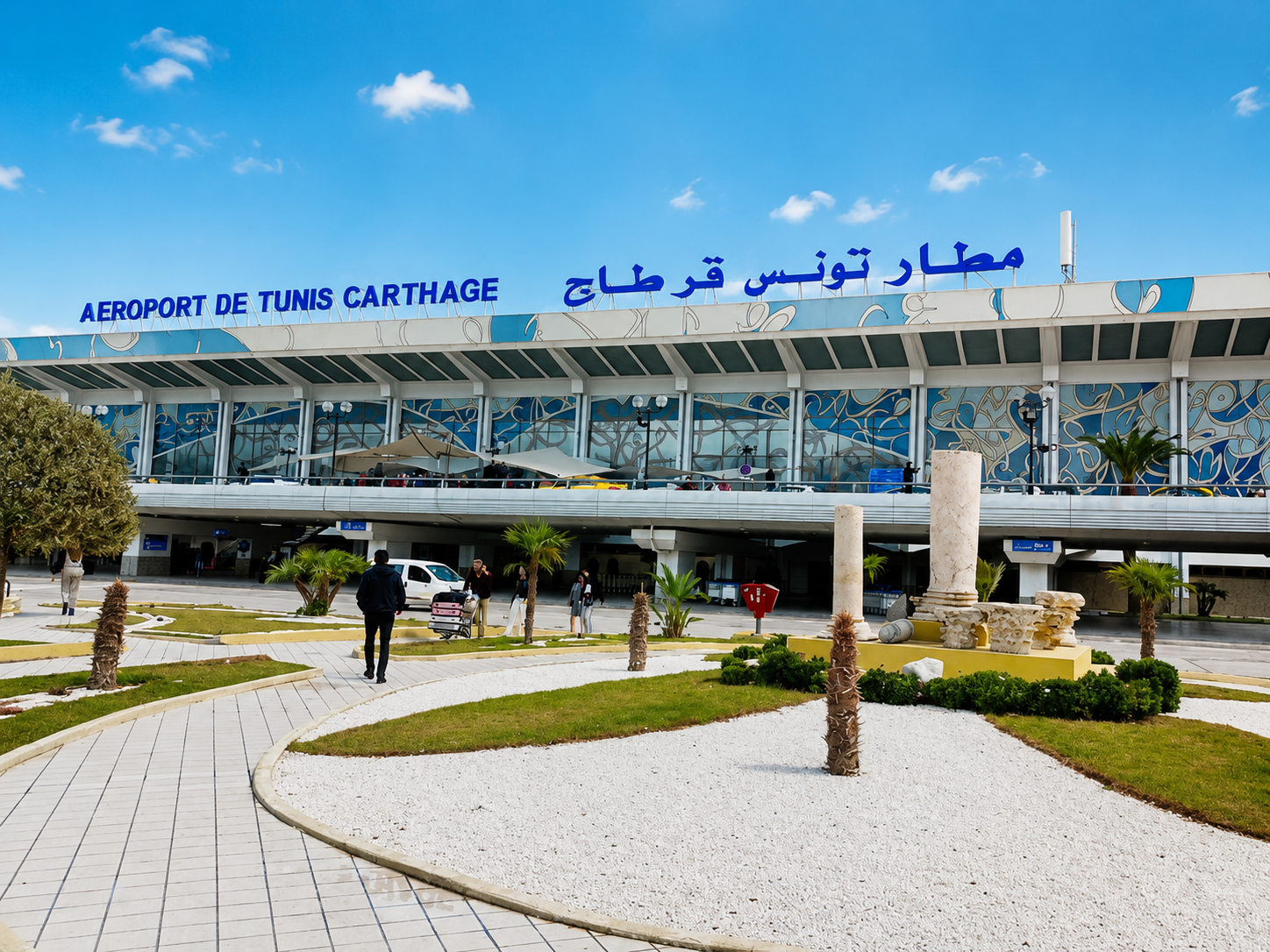
Quick Answer — Tunis-Carthage International Airport (TUN) is Tunisia’s main gateway, just eight kilometres northeast of central Tunis — one of the closest capital airports to its city anywhere on the Mediterranean. A metered taxi to the centre runs roughly 10–20 dinars by day (about $3–7), with a 50% surcharge after 9 p.m. and a small official per-bag fee; the coastal suburbs — Carthage, Sidi Bou Said, La Marsa — are 25–40 dinars. There is no rail link. Immigration takes 15–40 minutes, ATMs and exchange desks sit in arrivals (exchange only what you need for the taxi), and SIM-card kiosks are steps from the exit. Departing, arrive three hours early: check-in and the multiple security checks are the slow part. A $1 billion expansion, approved in the 2026 budget, will nearly quadruple the airport’s capacity by 2031.
Here’s the fuller picture.
There is a small, pleasing fact buried in the name of this airport, and it’s worth knowing before you land: Tunis-Carthage sits in the modern commune of Carthage, on ground that has been receiving arrivals from across the Mediterranean for around three thousand years. Phoenician sailors, Roman governors, Arab conquerors, Ottoman corsairs, French officials — and now you, on a Nouvelair A320 out of Orly. If you arrived in Tunisia, you arrived in Carthage. The runways sit on land partly reclaimed from the Lake of Tunis, flamingos loiter in the shallows off the approach path in winter, and the drive from the kerb to Avenue Habib Bourguiba takes about fifteen minutes. Almost no capital city lets you off the plane this close to the story.
The airport itself is honest, functional, and visibly overworked. Opened in 1940 and rebuilt in stages ever since, it was designed for around five million passengers a year and now handles well past that — which explains the crowded kerb, the occasionally chaotic check-in hall, and the government’s newly approved plan to transform the place (more on that below). Everything a traveler needs works; almost none of it is glamorous. Set your expectations there and the airport will quietly exceed them.
Arrival, Step by Step
Somewhere over the Mediterranean, cabin crew hand out the Tunisian arrival card. Fill it in on the plane — name, passport number, address of your first night’s accommodation — because doing it standing at a counter while three flights’ worth of passengers stream past is the first queue you can skip. At immigration, most Western passports enter visa-free for up to ninety days; the officer wants a passport valid at least six months beyond your entry date, and occasionally asks to see a return ticket or hotel booking. The full rules, country by country, are in our Tunisia visa guide. The wait runs fifteen minutes on a quiet morning to forty when several European flights land together.
Baggage claim is compact and trolleys are free when you can find one. Customs is a walk-through affair for most travelers — the allowances are one litre of spirits or two of wine and two hundred cigarettes, cash over the equivalent of €10,000 must be declared, and Tunisian dinars cannot be carried in or out at all. Then the doors open onto the arrivals hall, and with them the airport’s one genuine test of a tired traveler: the helpers. Men will offer to carry your bag, find you a taxi, change your money. A firm, cheerful “non, merci” — repeated as necessary — is the entire required skill. Walk past them to the official taxi rank. None of this is menacing, and the wider picture on that front is in our guide to safety in Tunisia; it is simply the standard arrival-hall commerce of the Mediterranean, and it evaporates the moment you stop being brand new.
Money and a SIM, Before You Leave the Building
The dinar is a closed currency — you cannot buy it before you travel — so the airport is where your Tunisian cash life begins. The exchange desks in arrivals offer the worst rates in the country: change only enough for the taxi and the first evening, 30–50 dinars, and do the rest at a bank in town. Better still, use one of the arrivals-hall ATMs, which dispense dinars at a fair rate with a typical per-withdrawal cap of 400–600 dinars. The complete strategy — fees, fintech cards, what to do with leftovers — is in our Tunisian dinar guide.
Data before you land: the smoothest arrival move is having your eSIM installed before boarding — Airalo’s Tunisia packages take five minutes to set up from a QR code and switch on the moment you hit Tunisian airspace, which means maps, taxi apps, and “just landed” messages all work before you’ve cleared passport control. Prefer a local SIM? The operator counters in arrivals sell tourist packages too — bring your passport, and see our full SIM & eSIM guide for the comparison.
Getting Into Tunis (and Beyond)
The metered taxi is the answer for almost everyone. Yellow cabs queue at the rank outside arrivals around the clock, and the metered fare to central Tunis is one of the great bargains of Mediterranean travel — roughly 10–20 dinars by day. The only official extras are a small per-bag fee and the legal 50% night tariff after 9 p.m. The catch is universal and predictable: some drivers at the airport rank prefer to quote foreigners a flat 40, 60, or 80 dinars. Insist on the meter — “le compteur, s’il vous plaît” — and if a driver refuses or announces the meter is broken, take the next car. There is always a next car. To the coastal suburbs, count 25–40 dinars: Carthage and Sidi Bou Said are close enough that starting your trip there directly is a defensible move. Bolt, the ride-hailing app that works well across Tunis, is useful at the airport too once you have data, though at busy hours the rank is usually faster.
Public transport exists but barely competes. City buses 35 and 635 run to central Tunis for under a dinar — slow, crowded, and worth it only on the tightest budgets. There is no metro, no train, and the TGM light rail does not come near the airport; the mooted airport metro link belongs to the expansion plans, not the present. Pre-booked transfers (30–50 dinars through most mid-range and better hotels, or from the private operators) earn their premium for late-night arrivals, when the flight lands after midnight and the negotiation appeals even less than usual. Car-rental desks — Hertz, Avis, Europcar, and a clutch of Tunisian firms — line the arrivals hall, though most visitors spare themselves central Tunis traffic on day one and rent later for regional trips.
Renting a car on arrival. A word of honest triage first: if your first days are Tunis, Carthage, and Sidi Bou Said, you don’t want a car yet — central Tunis is a place you escape driving in, and the TGM and taxis cover the sights. But if you’re landing and heading straight out — Cap Bon, the northwest, the road south — the rental desks are in the arrivals hall, chains and local agencies alike. Compare them for your dates on DiscoverCars, where the deposit, insurance excess, and agency ratings are visible before you book; the rest of the paperwork is covered in our guide to renting a car in Tunisia. Many visitors do it the other way round: city days first, then a taxi back to the airport to collect the car for the open-road half of the trip — airport pickup works just as well mid-trip as on day one.
Heading straight past the capital? There is no louage station at the airport — the intercity shared taxis leave from stations in town, explained in our louage guide — so budget a taxi ride to Moncef Bey or Bab Alioua first. For Hammamet or Sousse, a direct taxi transfer (negotiate or pre-book; think 80–100+ dinars to Hammamet) competes with the louage-plus-taxi shuffle. And Tunisair Express flies onward from the same airport to Djerba, Tozeur, and Sfax — genuinely useful hops covered in our guides to flights to Tunisia and getting around the country. If you came by sea instead, the port of La Goulette has its own arrival rhythm, mapped in our ferries to Tunisia guide.
Departing: The Three-Hour Rule
Leaving Tunisia through Tunis-Carthage is slower than arriving, and the reason is structural: check-in queues that move at their own pace, a document check, security screening, immigration, and often a second screening at the gate. Three hours before an international departure is the honest recommendation, not an airline’s caution. Two practical notes soften the wait. First, the dinar rule works in reverse — you cannot take meaningful amounts out, so spend down your cash or reconvert it at the departures exchange desk, where they may ask for your original exchange or ATM receipts. Second, the duty-free after security is better than the airport deserves: Tunisian dates, olive oil, harissa, and local perfume make superior last-minute gifts to anything in the whisky aisle, though prices run above what the medina charged you yesterday. There is no hotel inside the airport; for a dawn flight, sleeping in central Tunis or the northern suburbs — options in our hotels in Tunisia guide — still puts you at check-in within twenty minutes.
The Airport That’s Coming
A guide written in 2026 should say plainly that this airport is about to change. In the 2026 budget, the Tunisian government approved a roughly 3-billion-dinar (about $1 billion) expansion of Tunis-Carthage — an 80,000-square-metre new terminal, upgraded runways and taxiways, and a target of 18.5 million passengers a year by 2031, nearly four times the current design capacity. Plans for an entirely new airport at Utique, north of the capital, were shelved in favour of enlarging the site the city already has, and an elevated metro link to central Tunis is part of the discussion. Timelines in Tunisia are best treated as intentions rather than promises, and construction will overlap with normal operations — so expect some works, some detours, and, eventually, an airport that matches the country’s ambitions. Until then, the fifteen-minute taxi and the flamingos on the lake are compensation enough.
From the Carthage Magazine Bookshelf
Clearing arrivals takes twenty minutes; these three cover everything between the taxi rank and the flight home.
- All About Tunisia — the definitive English-language traveler’s guide. 572 pages, 27 chapters, all nine regions, every UNESCO inscription, five thematic trails — and the practical answers (visa, currency, transport, etiquette) most travelers wish they’d had on the plane. $24.99 · PDF & EPUB.
- Speak Like a Local — 200+ Tunisian Arabic phrases with native audio recorded in Tunis. The phrases for the taxi, the souk, the café, and the dinner table. $14.99 · PDF, EPUB, MP3.
- The Authentic Tunisian Cookbook — sixty traditional recipes from the heart of North Africa. For when you get home and find yourself missing the food. $9.99 · PDF & EPUB.
All three available as a bundle for $39.99 — guide, language, and food, delivered together.
