
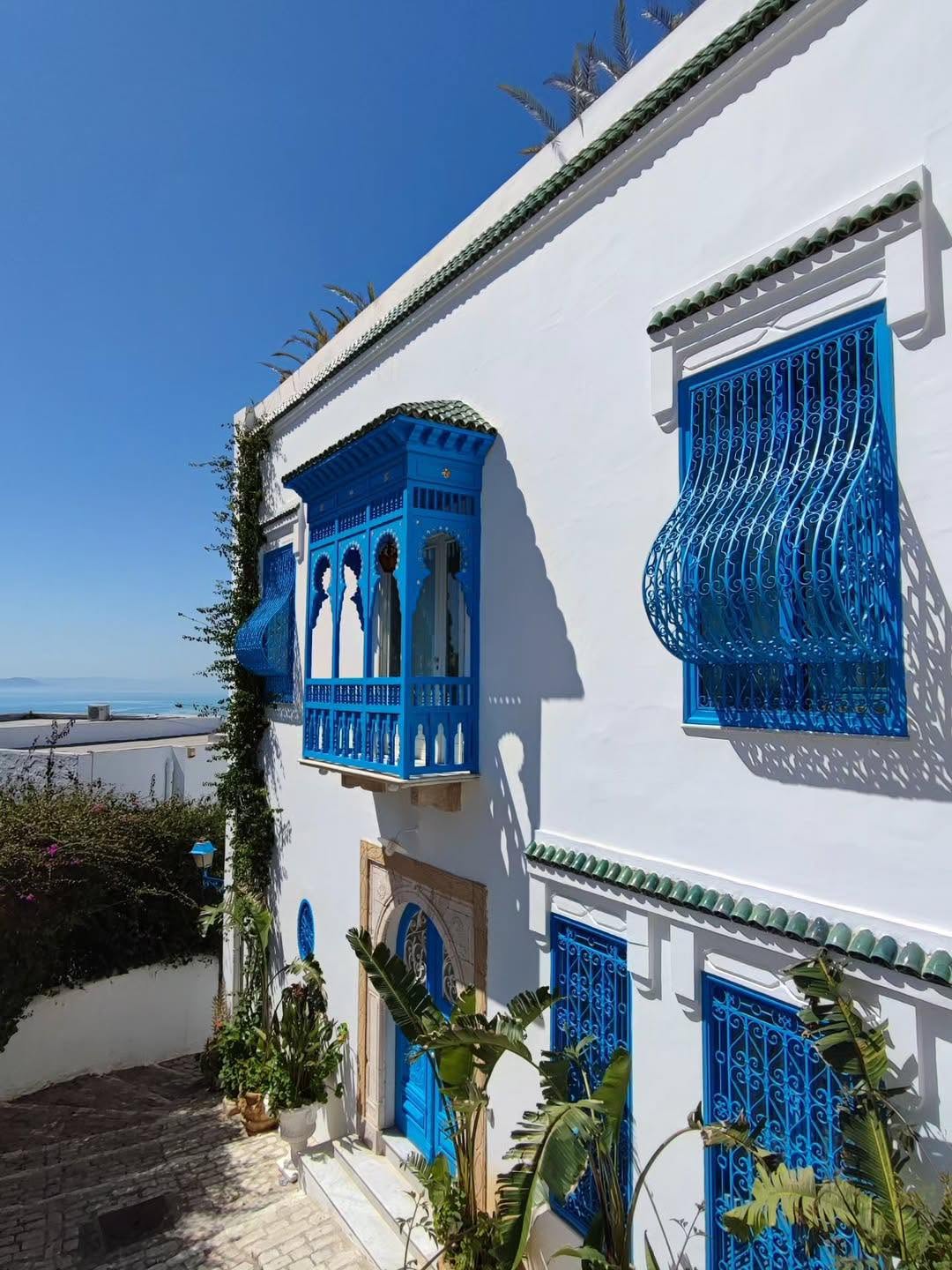
TUNIS — 25 July 2026. The UNESCO World Heritage Committee has inscribed the village of Sidi Bou Said on the World Heritage List, granting the cliffside village its own listing for the first time. The decision was adopted unanimously at the Committee’s 48th session, meeting in Busan, South Korea.
Tunisia submitted the file under the title Village de Sidi Bou Saïd: a centre of cultural and spiritual inspiration in the Mediterranean. It brings the number of Tunisian properties on the World Heritage List to ten.
What actually changed
The headline reads like the village was previously unprotected. It wasn’t. Sidi Bou Said already sat inside the perimeter of the Archaeological Site of Carthage, inscribed in 1979 — a listing built around Punic ports, Roman baths and the Byrsa acropolis, with the village attached to its edges almost incidentally.
That is the substance of Friday’s decision. Sidi Bou Said now stands on the list as a property in its own right, judged on its own terms: the Sufi shrine the village grew around, the Arab-Andalusian building tradition, and the cobalt-and-white palette that has drawn painters here for more than a century. Those things were never what Carthage was inscribed for.
The practical consequences follow from that shift. An autonomous inscription means its own boundary and buffer zone, its own management plan, and its own reporting obligations to the World Heritage Centre — separate from whatever Carthage is required to submit. Responsibility becomes specific rather than shared.
A file two years in the making
The nomination was launched in February 2024 and formally lodged with the World Heritage Centre in February 2025 by Tunisia’s permanent mission to UNESCO. The Ministry of Cultural Affairs coordinated the dossier with the Institut National du Patrimoine, with input from the Ministry of Foreign Affairs and several national bodies, and support from the African World Heritage Fund.
Addressing the Committee in Busan, Ambassador Dhia Khaled, Tunisia’s permanent delegate to UNESCO and head of the delegation, thanked member states for the unanimous decision and framed the inscription as a renewed commitment to preserving and transmitting Tunisian heritage rather than as an endpoint.
It is the country’s second UNESCO recognition this year. The Dahar Geopark joined the Global Geoparks Network in April.
The part that starts now
Inscription is a beginning, not a reward. A World Heritage listing creates obligations, and it arrives at a village already under strain.
Sidi Bou Said is a lived-in place before it is a monument — a few thousand residents, a handful of narrow streets, and a volume of visitors that the streets were never built to absorb. In February, landslides hit the village after a storm, a reminder that the cliff the postcards are taken from is not a stable object. Managing a working village to World Heritage standards means writing rules that residents have to live inside: what can be renovated, what can be sold, what can be built.
The listing also cuts both ways commercially. It is a marketing asset for a tourism sector that needs one, and more visitors is the last thing an over-visited village needs.
Whether the inscription protects Sidi Bou Said or simply certifies it will depend on the management plan — and on whether anyone enforces it.
For the full picture of the village — how to get there, when to go, and what the blue actually is — see our guide to Sidi Bou Said. Tunisia’s other listed properties are covered in UNESCO World Heritage Sites in Tunisia.
