
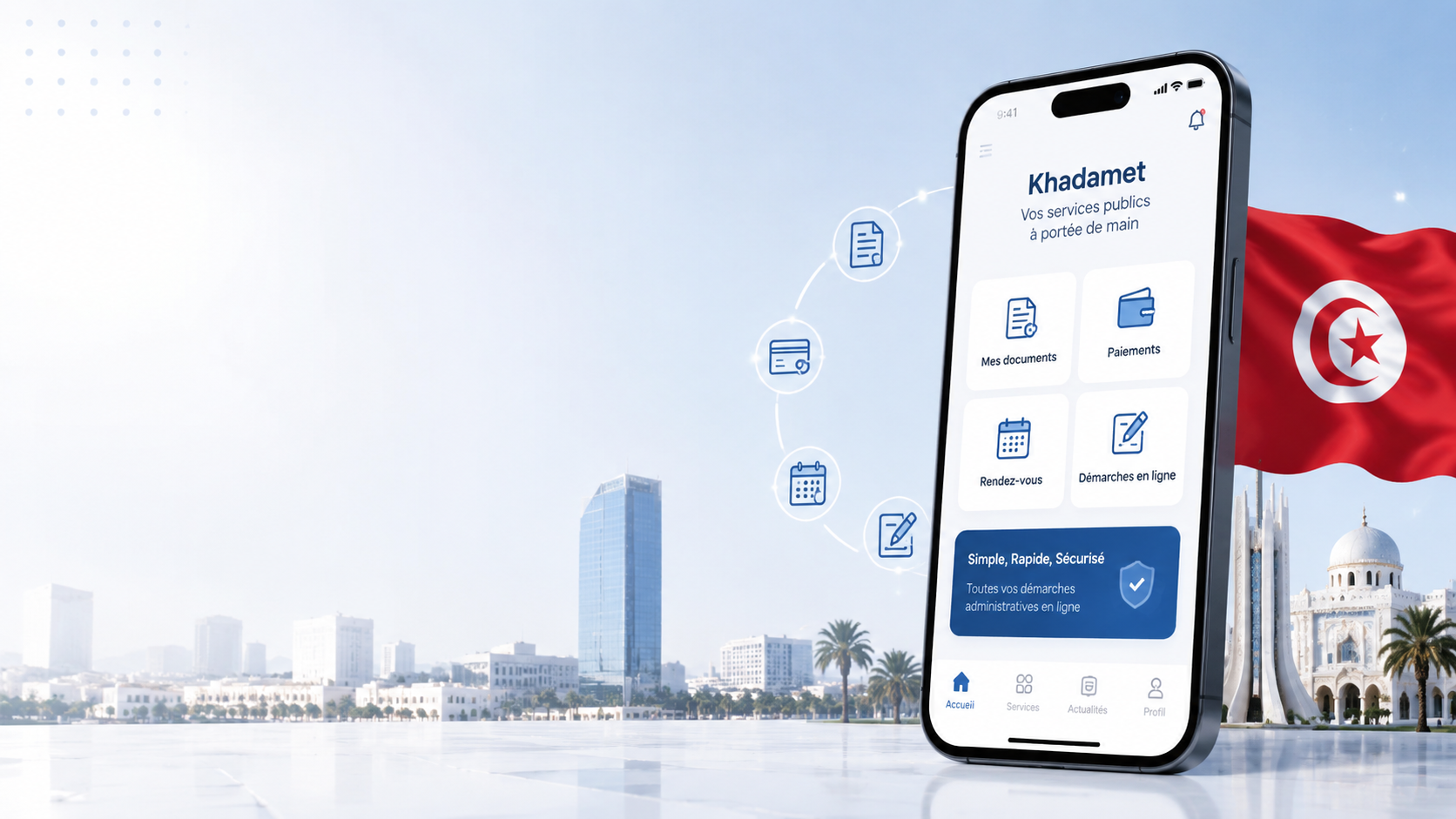
Tunisia’s new national app promises to replace queues, paperwork, and cross-country trips with a few taps on a smartphone. Here’s what Khadamet actually does — and what it will take for it to succeed.
Every Tunisian knows the ritual. You take a morning off work, gather a folder of documents, and head to a government office — only to discover you’re missing a stamp, the system is down, or the one clerk who handles your file is out until Thursday. For decades, dealing with the Tunisian administration has been less a procedure than a pilgrimage.
On August 31, 2026, the Ministry of Communication Technologies unveiled its answer: Khadamet (Arabic for “services”), a national mobile application designed to gather the country’s scattered digital public services into a single, secure platform — open around the clock, from anywhere.
One App, One Identity
At the heart of Khadamet is Tunisia’s digital identity, e-Houwiya — the mobile ID system first launched in 2022 that lets citizens aged 18 and over authenticate themselves online using their national ID card and a verified phone number. Khadamet uses this digital identity as its front door: log in once, and the administration recognizes you across every connected service.
Once inside, users can view and update the personal information tied to their digital identity — phone number, official email address for administrative correspondence, and home address — without setting foot in an office.
What’s in the Box
The first version of Khadamet is surprisingly broad. Among the services already available:
For drivers. The app displays data linked to your driving license and vehicle registration (carte grise), sends alerts before documents expire, lets you check traffic fines, pay the annual road tax (vignette), track vehicle inspection deadlines, and even book your contrôle technique appointment. Drivers can also register their car insurance and receive a reminder before it lapses.
For health and social security. Khadamet connects to the CNAM, allowing users to follow medical expense reimbursements and prior-approval requests. It also links to the CNSS for consulting your professional career record and declarations, and provides access to certain CNRPS attestations for public-sector workers.
For taxpayers. Online fiscal services include purchasing the travel stamp (timbre de voyage) and paying the vehicle tax. Users can also register their utility meters to be notified when new bills arrive — and settle them directly in the app.
For families and civil status. Perhaps the most quietly transformative feature: parents can access their children’s birth certificates and request a French translation remotely, with the request routed directly to the municipality where the birth was registered. A formality that once could mean a trip of hundreds of kilometers to a hometown registry office can now be done from the couch.
The app also includes a digital wallet for storing certain documents with expiration alerts, plus services touching education, residence certificates, the bulletin n°3 (criminal record extract), and passport services for Tunisians living abroad.
Available Now — With More Coming
Khadamet is already downloadable on Google Play, with an App Store release for iPhone users announced as imminent. Crucially, the ministry has also promised a web version for citizens who don’t own a smartphone — an important nod to digital inclusion in a country where access to devices remains uneven.
This is explicitly a “version one.” The ministry says new services will be added progressively as Tunisia’s e-government infrastructure matures, with the stated ambition of bringing the administration closer to the citizen through a centralized, secure, always-available gateway.
The Fine Print: An App Is Not a Reform
Tunisian commentators have greeted the launch with a mix of enthusiasm and healthy skepticism. As L’Économiste Maghrébin put it in its analysis, the real test isn’t the interface — it’s whether government departments are genuinely interconnected behind the scenes, whether requests are processed quickly, and whether the underlying data is reliable. Moving the guichet onto a screen means little if the procedures behind it remain unchanged.
That caution is fair. Tunisia has launched digital platforms before, and adoption of e-Houwiya itself — a prerequisite for using Khadamet — is still a work in progress. The app’s success will ultimately be measured not in downloads, but in trips not taken: the queues that never form, the days off work that no longer need to be sacrificed to bureaucracy.
Still, for a country where “Arja3 ghodwa” has long been the unofficial motto of public administration, Khadamet represents something genuinely new: a single, citizen-facing front door to the Tunisian state. If the back office can keep up with the front end, this unassuming app may end up being one of the most consequential launches of the year.
Related reading on Carthage Magazine:
- Tunisia Rolls Out Online Car Tax Payment Platform in 2026
- GovTech Tunisia: Towards Building a User-Centric Digital Public Sector
- Electric Cars in Tunisia: The Quiet Boom Nobody Saw Coming
Khadamet is available now on Google Play, with iOS and web versions to follow. Using the app requires an active e-Houwiya digital identity, available to all Tunisians aged 18+ holding a national ID card, in Tunisia or abroad.
