
Somewhere on the Tunisian coast this summer, a hotel generator coughed to life during an afternoon blackout while, in planning offices in Tunis and Rome, engineers refined the design of an undersea cable that will one day carry Tunisian electricity to Sicily. Neither fact is remarkable on its own. Held together, they form the question that will define Tunisia’s energy decade: who, exactly, is all this new power for?
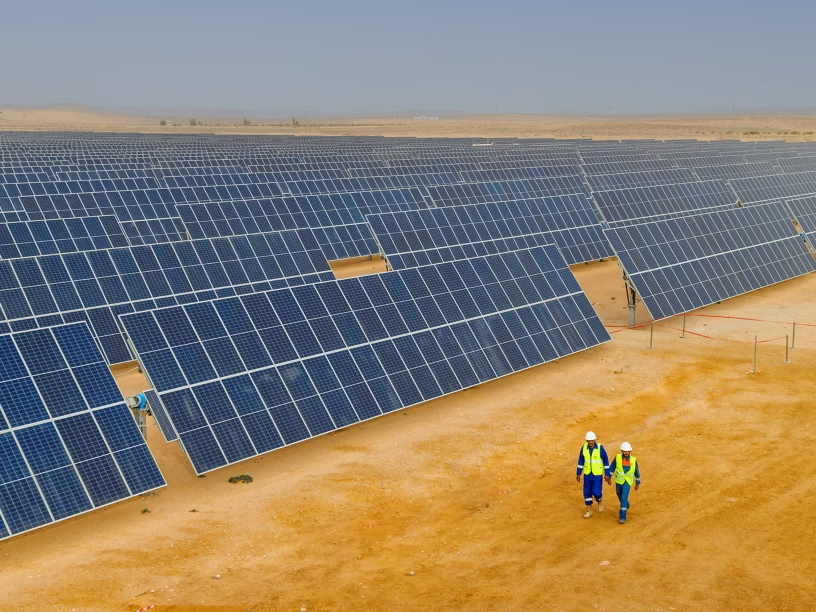
Because the build-out is real, and it is bigger than most Tunisians have noticed. In December, the country commissioned its largest power plant of any kind in years — a 120-megawatt solar facility near Kairouan, the first to feed the high-voltage grid directly. Two more plants, in Sidi Bouzid and Tozeur, came online this winter and spring under thirty-year contracts with the state utility. And the government has approved tenders for more than 2.3 gigawatts of new capacity — including a 600-megawatt wind farm in Kebili and a 350-megawatt solar plant with battery storage — against a total national fleet of about 6.9 gigawatts, three-quarters of it gas-fired. The official target is 35 percent renewable electricity by 2030.
In parallel runs ELMED, the planned interconnection with Italy: a cable that would tie Tunisia into the European grid and, in the fullness of time, let it sell the southern sun northward.
The pitch writes itself. So does the paradox. A country whose grid strained into rolling blackouts this very July is preparing to export electricity. Before applauding or condemning, it is worth understanding why the system works this way — because Tunisia is not an anomaly here. From Morocco to Egypt, the same pattern is repeating, and Tunisia is simply its clearest case study.
Why the plants get built and the grid doesn’t
The uncomfortable mechanics are financial, not technical.
A utility-scale solar plant with a long purchase contract is one of the most bankable objects in modern finance. A foreign developer builds it — Tunisia’s recent flagships were delivered by Emirati, Norwegian and Japanese groups — a contract guarantees the price of every kilowatt-hour for twenty or thirty years, and development banks line up behind it. The project’s revenues can be ring-fenced from the troubles of the host country. There is a ribbon to cut and a press release to issue.
A distribution grid is the opposite of bankable. It is tens of thousands of kilometres of wire and transformers, owned by a state utility carrying heavy debts and recovering its costs through tariffs held, for the sake of social peace, below what the system needs. There is no ring-fence and no ribbon. Nobody flies in for the inauguration of a replaced transformer — a sentence that readers of our water coverage will find familiar, because it is the same disease. Tunisia’s pipes and Tunisia’s wires are failing for the same reason: the glamorous half of infrastructure attracts capital, and the boring half carries the load.
So money flows to generation, and generation increasingly glances toward export, because a European buyer is a stronger counterparty than a strained domestic utility. None of this requires bad faith from anyone. It is simply what the incentives build when left alone.
Meanwhile, demand at home is not standing still. Air-conditioning spreads with every heatwave, electric cars are multiplying on Tunisian roads faster than anyone predicted, and the desalination plants meant to solve the water crisis are, in energy terms, among the hungriest machines in the country. Every plan that treats domestic consumption as a fixed quantity is already out of date.
The honest case for the cable
It would be easy to write this as a morality tale — Europe harvesting the southern sun while Tunisians sit in the dark. Easy, and lazy. The case for the export model is real, and it deserves its full weight.
An interconnection is a two-way cable. ELMED would let Tunisia import as well as export, and on an August afternoon when the domestic system is short, the ability to draw on the European grid is a security asset, not a colonial straw. Grid islands suffer longer and more frequent outages than connected systems almost everywhere on earth; Tunisia is currently, in electrical terms, very nearly an island.
Export revenue, meanwhile, is precisely the money the grid lacks. Hard-currency electricity sales are one of the few genuinely new revenue streams on Tunisia’s horizon, and the argument that they can fund domestic network investment is not a fig leaf — it is how more than one successful energy transition was financed. The question is only whether the earnings are actually routed there.
And every renewable kilowatt-hour, wherever it is finally sold, displaces imported gas. Official estimates around the recent project approvals already count the avoided fuel in tens of millions of dollars a year. For a net energy importer running a heavy trade deficit, that is not abstract climate virtue; it is balance-of-payments relief that eventually reaches every household through the dinar.
The critique and the defence can both be right. Which one history vindicates depends on choices that have not yet been made.
The number to watch
Analysis ages badly when it hides its predictions, so here is ours, stated plainly enough that a reader in 2030 can check it.
The build-out will have served Tunisians — and not only its financiers — if four things happen by the end of the decade. Summer outages decline measurably, year on year, rather than being managed rhetorically. A stated share of export and interconnection revenue is earmarked for grid investment in an actual budget document, with a number in it, not a speech. The state utility’s finances recover enough that it can sign domestic purchase contracts without sovereign guarantees doing all the work. And the 2030 renewables target is met in Tunisian sockets — not merely on Tunisian territory.
If those four things happen, this decade’s paradox will look, in hindsight, like a financing sequence: export projects first because they could be paid for, domestic benefit second because the exports paid for it. If they do not — if the cable hums while the coast still browns out every August — then Tunisia will have become a landlord renting out its sunlight while living by candlelight.
The plants are rising either way. The cable will likely be laid either way. The only genuinely open variable is the plumbing between the export economy and the household socket — and that gets built in budget lines and utility reforms, not at ribbon-cuttings. Watch the boring documents.
From the Carthage Magazine Bookshelf
Understanding where Tunisia is going starts with knowing the country as it actually is — on the ground, region by region.
- All About Tunisia — the definitive English-language traveler’s guide. 572 pages, 27 chapters, all nine regions, every UNESCO inscription, five thematic trails — and the practical answers (visa, currency, transport, etiquette) most travelers wish they’d had on the plane. $24.99 · PDF & EPUB.
- Speak Like a Local — 200+ Tunisian Arabic phrases with native audio recorded in Tunis. The phrases for the taxi, the souk, the café, and the dinner table. $14.99 · PDF, EPUB, MP3.
- The Authentic Tunisian Cookbook — sixty traditional recipes from the heart of North Africa. For when you get home and find yourself missing the food. $9.99 · PDF & EPUB.
All three available as a bundle for $39.99 — guide, language, and food, delivered together.
