
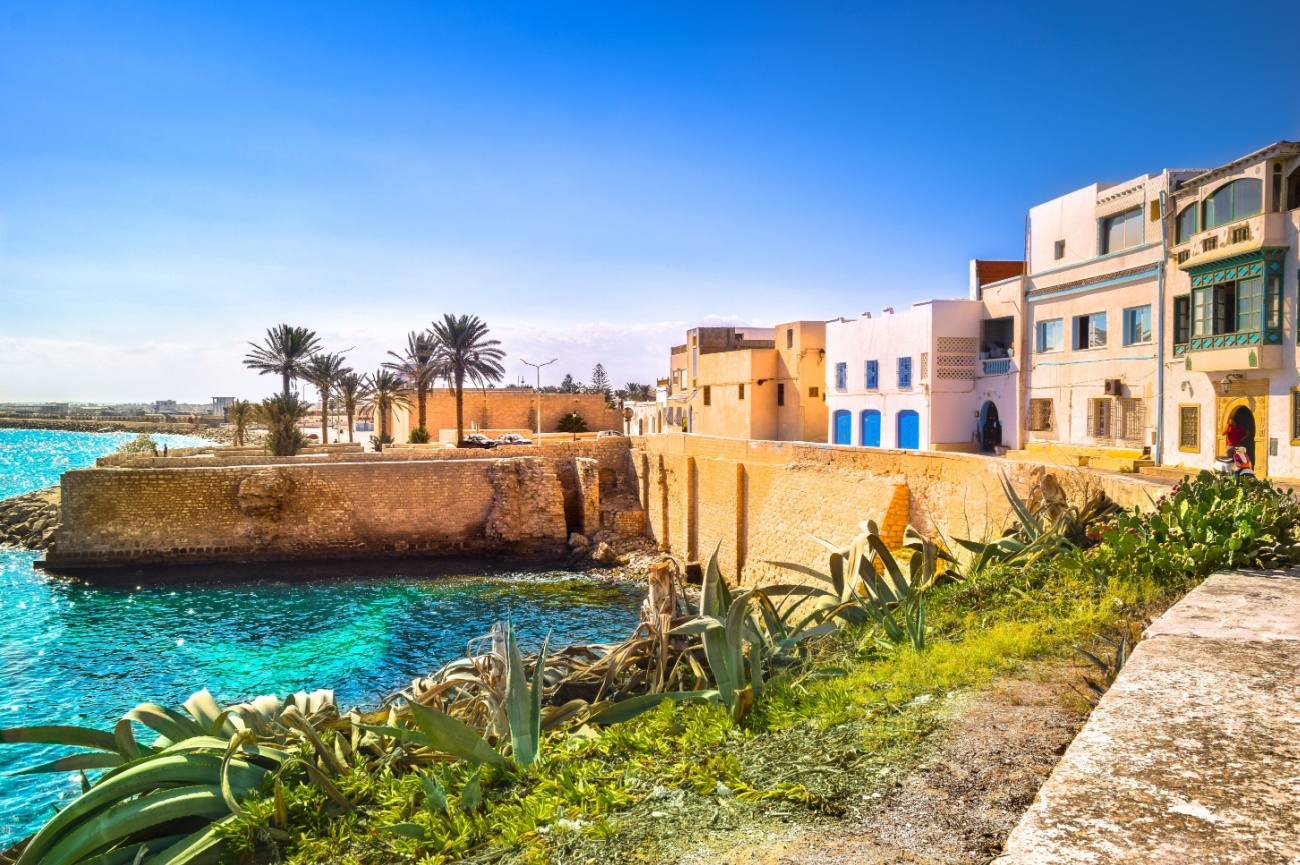
Quick Answer Mahdia is a coastal city of around 76,000 people on the central Tunisian Mediterranean, 200 kilometres south of Tunis and 50 kilometres south of Monastir. It sits on a narrow rocky peninsula that juts eastward into the sea — geography that made it, in 921 CE, the founding capital of the Fatimid Caliphate, the Shia dynasty that would go on to rule most of North Africa and eventually conquer Egypt and found Cairo. Today the medina is small, walkable, and almost entirely untouristed by the day-trip standards of Sousse and Monastir. The fishing port is one of the most important in the country. The beaches are among the longest on the Tunisian coast. If you want a quiet, historically important, mid-sized Mediterranean town that has not yet been overrun, this is the one.
Drive south from Monastir on the coast road. The Sahel — the resort coast that stretches from Hammamet through Sousse and Monastir — runs out of breath after thirty kilometres or so, and the road begins to thin, the olive groves take over, and the next forty minutes are quieter than anything you have seen since Tunis. Then, almost without warning, the road curves around a long crescent of sand and you arrive at a small city built onto a peninsula that points like a finger straight out into the Mediterranean.
This is Mahdia. The peninsula is two kilometres long and less than five hundred metres wide. The medina occupies the eastern third of it, walled off from the mainland by a single Fatimid gate that has been standing in roughly its current form since 916 CE. Beyond the medina, the peninsula tapers to a fortified point — Cap Africa, the easternmost land in Tunisia — from which, on a clear day, the next thing you can see is Italy.
It is one of the more striking pieces of geography on the Tunisian coast. The history that goes with it is even more striking, and most travellers who pass through never know it.
Why Mahdia Matters
Mahdia is the city the Fatimids built.
The Fatimids were a Shia Muslim dynasty descended — by the claim they themselves advanced — from Fatima, the daughter of the Prophet Muhammad. In the early 10th century they swept across North Africa from a base in modern Algeria, overthrew the Aghlabid emirate that had ruled Tunisia from Kairouan, and established themselves as a rival caliphate to the Abbasids in Baghdad.
In 921 CE their first caliph, Ubayd Allah al-Mahdi, decided to build a new capital. He chose this peninsula — defensible, sea-facing, easy to provision by ship, hard to attack from land. He gave it his own title: al-Mahdiyya, the city of al-Mahdi. He cut a kilometre-long ditch across the narrow neck of the peninsula and built a single great gate — the Skifa el-Kahla, the Dark Gate — through which the entire city was to be entered. The gate is still there. So is much of the wall. The ditch was filled in centuries ago, but the line of it is visible on any map.
From Mahdia, between 921 and 969 CE, the Fatimid caliphs ruled most of what is now Tunisia, Algeria, Morocco, Libya, and Sicily. They built up their navy. They sent missionaries east. They prepared, year by year, for the move that would define them: the conquest of Egypt. In 969 CE their general Jawhar took Cairo and founded the new city of al-Qahira — Cairo — which would replace Mahdia as the caliphate’s capital. The court packed up and sailed east. The Fatimids would go on to rule Egypt for two centuries; their cultural and architectural inheritance there is the foundation of medieval Cairo and the al-Azhar mosque-university, which they founded.
Mahdia did not vanish when the court left. It remained an important Mediterranean port — sometimes Sicilian, sometimes Genoese-occupied (1087), sometimes Norman, sometimes Hafsid, briefly Spanish under Charles V (1550), briefly Ottoman, then Tunisian again. The Ottoman corsairs used it as a base. The Hafsids rebuilt its walls. The 16th-century Spanish blew up much of the original Fatimid fortress when they retreated. The 17th-century Ottomans built a new one on top of the rubble. The result is a layered city in which nothing is purely any one thing, but the Fatimid bones are still legible if you know what you are looking at.
The wider story is at Tunisia’s rich history and in the imperial cities overview.
The Skifa el-Kahla
The first thing to do, in Mahdia, is to walk through the Dark Gate.
The Skifa el-Kahla sits across the western end of the peninsula, at the point where the city was once cut off from the mainland by a ditch. It is one of only two surviving Fatimid gates in the world. The other is the Bab al-Futuh in Cairo, built fifty years later by the same caliphate after they had moved east.
The Mahdia gate is the older one. It is built from limestone blocks the size of small refrigerators, set without mortar. The entrance passage runs forty-four metres through the wall, dark for most of its length (hence the name), with three successive iron-bound doors that could be closed against an attacker. Above the outermost gate, the original Kufic inscription has been lost; the visible carved decoration is later. The arch is monumental and almost completely austere — Fatimid military architecture at its purest.
Walk through it slowly. Take the side stair up to the parapet — you can do this without paying anyone — and look back over the medina. You are seeing the layout of a 10th-century palace city, much of it preserved in the street grid even after eleven centuries of rebuilding.
The Medina
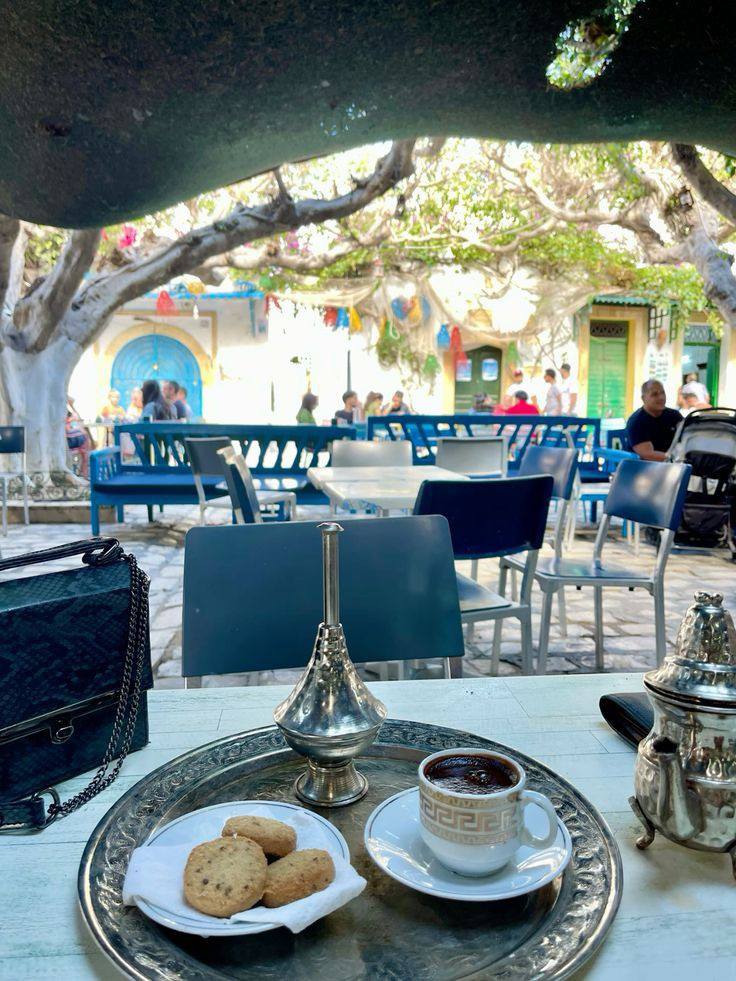
Inside the gate, the medina of Mahdia is small. It is also, by some distance, the quietest important medina in Tunisia. There are working shops, a few cafés, perhaps half a dozen modest guesthouses, and almost no organised tourism. You can walk the whole of it in two hours. You can spend two days getting to know it and not be done.
The principal axis runs from the Skifa el-Kahla due east to Place du Caire, the main square halfway down the peninsula, and then continues to the Great Mosque at the eastern end. Place du Caire — named for the city the Fatimids founded after they left — is shaded by a single old plane tree and circled by four small cafés. Sit at any of them in the late afternoon and you will see most of the medina pass by.
The Great Mosque of Mahdia stands at the seaward end of the main street, on the foundations of the original Fatimid congregational mosque of 921 CE. The Spanish destroyed most of the original structure in 1554 and the mosque was rebuilt in the 20th century in conscious imitation of the Fatimid model, using surviving fragments and historical drawings. The result is a careful reconstruction rather than an original — but the layout (the great courtyard, the prayer hall, the single dome, the absence of the minaret that Fatimid mosques traditionally lacked) is faithful and worth the visit. The courtyard is open to non-Muslim visitors; the prayer hall is not.
The Mahdia Museum, on the southern flank of Place du Caire, holds the city’s archaeological collection: Fatimid pottery, glazed tiles, manuscripts, a small but choice collection of bronzes from the Mahdia shipwreck (more on this below), and one of the country’s better assemblages of medieval Islamic ceramics. Entrance is around 5 dinars; allow an hour.
The Borj el-Kebir — the “Great Fortress” — occupies the easternmost tip of the peninsula at Cap Africa. It is Ottoman, built in 1595 on top of the demolished Fatimid arsenal, and it controls a magnificent view across the harbour, the open sea, and the Mediterranean to the east. There is a small archaeological garden inside, scattered with Punic, Roman, and Fatimid fragments. Climb to the ramparts at sunset for the single best view in Mahdia.
A short walk south of the fortress, on a small terrace overlooking the sea, is the Fatimid Cemetery — the Marabout of Sidi Jaber, around which lie the graves of perhaps a thousand Mahdians from the medieval period through to the 19th century. The headstones are weathered into illegibility, but the place itself, set on the sea cliff with the wind off the water, is one of the more moving small corners of the Tunisian coast.
The Mahdia Shipwreck
There is a single object — or rather a single category of objects — that pulls a particular kind of visitor to Mahdia.
In June 1907, Greek sponge divers working off the coast a few kilometres east of Cap Africa hooked their lines on something on the sea floor. When they brought up the first piece, it was a marble column. Over the next two years, an Alexandrian-based Tunisian-French team led by archaeologist Alfred Merlin recovered the cargo of a small Greek merchant ship that had sunk in around 80 BCE — almost certainly while transporting looted Greek art from the eastern Mediterranean to Roman Italy.
The cargo was extraordinary. Sixty bronze and marble sculptures, including original Greek bronzes from the 4th and 3rd centuries BCE — pieces of the kind that almost never survive elsewhere because they were melted down for the metal in late antiquity. The most famous is the Bronze Agon (the “Bronze Athlete”) and the dancing dwarves, both now in the Bardo Museum in Tunis. A few selected pieces remain in the Mahdia Museum.
The wreck is one of the most important underwater archaeological finds of the 20th century. The pieces it preserved would otherwise have been lost. It is worth knowing the story before you visit either the Mahdia Museum or the Bardo, where most of the find is now displayed.
The Port
South of the medina, the fishing port runs along the protected inner side of the peninsula. It is the second-largest fishing harbour in Tunisia, after Sfax, and the centre of the country’s sardine and octopus industry.
Sardine fishing, in Mahdia, is done at night. The boats — small wooden trawlers, blue-and-white, with the powerful single light on a pole that attracts the fish — leave the harbour around sunset and return between 4 and 6 a.m. with the catch. The morning auction on the quayside is brief, fast, and unmissable if you can be up for it. It runs from roughly 5:30 to 7 a.m. depending on the day’s haul.
Octopus is the other Mahdian speciality. The technique is the gargoulette — a small ceramic pot lowered to the sea floor on a long rope, into which the octopus enters thinking it is a shelter, and is then hauled up by the line. The boats lay long strings of these pots in the morning and pull them in the late afternoon. The cleaning, drying, and packaging happens along the harbour’s northern wall. Most of the catch is exported to Japan.
Even if you have no commercial interest in any of this, an hour on the port wall in the early morning or late afternoon is one of the most accurate pieces of working Mediterranean life you can see in Tunisia.
The Beach and the Coast
North of the medina, the Cap Mahdia beach stretches uninterrupted for nine kilometres — long, sandy, gradually-shelving, and significantly less developed than the parallel beaches of Sousse and Monastir. The resort zone (the Zone Touristique) is concentrated along a single road running north from the city, with perhaps fifteen large hotels — most of them all-inclusive operations catering to European package tourism, particularly German, French, and increasingly Polish.
If you want to swim and to walk on a quiet Tunisian beach, this is one of the better stretches. If you want a beach holiday in the resort sense, the hotels here are mid-range to good, the prices are below Sousse and well below Hammamet, and the crowds are thinner.
Just south of the city, the smaller Salakta beach — fronting an ancient Roman port (Sullecthum) — has the better archaeology and almost no tourism at all. The Roman ruins are modest but the small museum is interesting and the beach itself is local.
What Mahdia Eats
Like the rest of the Sahel, Mahdian cooking is fish-and-olive-oil centred.
The signature local dish is kamounia of octopus — octopus simmered slowly with cumin (kamoun), garlic, harissa, tomato, and oil, served with bread or rice. The Mahdian version is heavier on the cumin and lighter on the harissa than the Sfaxian karkanaiyya. Grilled sardines, freshly off the morning boats, are everywhere; the simple version — salt, lemon, oil, charcoal — is a complete meal with bread. Tunisian briks are excellent here, particularly the tuna brik with capers. The harissa of the region is local, family-made, and on every table.
For dessert, droo — sorghum porridge sweetened with date syrup and topped with chopped nuts — is a Mahdian winter speciality. Halwa Chamia, the sesame halva, is sold by weight from small shops along the main street.
Restaurants in the medina are mostly modest and unpretentious. Le Lido on the harbour and Le Quai in the medina are the reliable mid-range options for fish. Restaurant El Moez, just inside the Skifa el-Kahla, is a longstanding family kitchen serving the full Mahdian repertoire at around 25 dinars a head. Most resort hotels have their own restaurants; the better ones are decent but unremarkable.
For the wider Tunisian food landscape, the top foods piece and the Tunisian harissa and olive oil guides cover the staples.
The Silk Weavers
A small but important Mahdian tradition is the city’s silk-weaving craft.
Mahdian women have been weaving silk fouta-blouza — the traditional ceremonial dress of the city — and the lighter kichabia tunic for at least four centuries. The work is done at home, on wooden looms, using imported silk thread and indigenous dye recipes. The patterns — geometric, often featuring small fish or eight-pointed stars — are particular to Mahdia and instantly recognisable to other Tunisians.
The trade is centred on a few small workshops in the medina, mostly along Rue Borj Errassi. The cooperative Centre d’Artisanat de Mahdia, near the Great Mosque, sells finished pieces at fixed prices and is the easiest entry point for visitors. A good silk fouta runs from 200 to 800 dinars depending on the work; a ceremonial blouza with the full weaving, more. Cheaper machine-made imitations sold elsewhere on the coast are not the same thing.
Getting There, Getting Around
From Tunis, Mahdia is 200 kilometres south. By car the drive is two and a half hours on the A1 motorway via Sousse. By SNCFT train, three and a half hours direct (the Express runs twice daily, around 18 dinars in first class). By louage from Tunis (Moncef Bey), two and three-quarter hours, around 16 dinars.
The most convenient option for international arrivals is to fly into Monastir-Habib Bourguiba International Airport (MIR), 50 kilometres north — see Monastir for the airport details. Mahdia is then a 45-minute drive or one of the more practical uses of the Sahel Metro light rail, which runs from Sousse through Monastir down to Mahdia roughly every 30–60 minutes. The Mahdia terminus is at the western end of the medina, two minutes’ walk from the Skifa el-Kahla. The journey from Monastir takes about an hour and costs under 5 dinars.
Inside Mahdia, walking covers everything in the medina and the central waterfront. Taxis run between the medina, the resort zone, and the train station; insist on the meter, expect 3–8 dinars for most journeys.
When to Go
Mahdia has the central Tunisian coast climate: warm summers, mild winters, low rainfall.
May–June and September–October are the obvious sweet spots — 22–28°C, warm sea, fewer hotel-guests on the beaches, manageable evening temperatures in the medina. July–August are hot (30–34°C) and the beaches are busy with European package tourism, but the medina remains relatively quiet. November–April is mild (14–20°C daytime, occasional rain), the beaches are essentially empty, most resort hotels operate on reduced capacity, and the medina settles into its winter rhythm — which is, frankly, one of the more pleasant times to visit. The best time to visit Tunisia overview puts this in regional context.
A Few Practical Notes
Hotels. The medina has perhaps half a dozen small guesthouses; Dar Zarrouk and Dar el-Medina are the boutique options, well-restored Fatimid-era houses charging 80–150 dinars a night. The resort zone has the larger 4- and 5-star international hotels at 100–250 dinars; the Iberostar, Vincci, and Mahdia Beach properties are the long-running standards. A small number of city-centre business hotels (the Hotel Mahdia Cap Mahdia) offer a middle option.
Cash. Several ATMs along Rue Sidi Ali Hattab and around Place du Caire. The medina is a cash-only zone for almost all transactions; major hotels take cards.
Dress. Mahdia is moderately conservative — slightly less so than Kairouan or Sfax, more so than Sousse or Hammamet. Inside the medina, covered shoulders and knees are the comfortable choice. On the beach in the resort zone, full beachwear is fine.
Alcohol. Sold in licensed hotel bars and a small number of dedicated Magasin Général stores. Not sold in the medina. See alcohol in Tunisia for the wider rules.
Photography. Of the gates, walls, and mosque exteriors, freely. Of the fishing port, by all means — the fishermen are used to it. Of people, ask first.
Combining the trip. Mahdia is the natural southern anchor of a Sahel itinerary: Sousse, Monastir, El Jem (the great Roman amphitheatre, a 30-minute drive inland), and Mahdia together make a comfortable three- or four-day loop from a base anywhere on the coast.
What Mahdia Is, Honestly
Mahdia is not a major Tunisian destination in the way Sousse, Hammamet, or Djerba are. It does not have the resort infrastructure of the first two or the international name recognition of the third. It is not, by the standards of the tourist coast, a busy place.
What it is, instead, is a small mid-coastal town with one of the most distinctive geographies on the Tunisian Mediterranean, the founding capital of a caliphate that shaped North Africa for two centuries, a working fishing port that runs on the same rhythms it has for a thousand years, a medina that lets you walk through 10th-century Fatimid stone without anyone trying to sell you anything, a stretch of sea cliff at Cap Africa where the wind off the water carries the smell of the Mediterranean exactly the way the Fatimid caliphs must have smelled it, and one of the better silk-weaving traditions still alive in Tunisia.
For the right traveller — the one who likes a town that is quietly important and is in no hurry to explain itself — Mahdia is the part of the Tunisian coast you remember after you have forgotten the rest.
You should go.
From the Carthage Magazine Bookshelf
Mahdia is a city for slow travel. Three Carthage Magazine ebooks make the trip more rewarding:
- All About Tunisia — the definitive English-language traveller’s guide. 572 pages, 27 chapters, all nine regions — with full coverage of the Sahel coast and the Fatimid heritage that most guidebooks compress into a paragraph. $24.99 · PDF & EPUB
- Speak Like a Local — 200+ Tunisian Arabic phrases with native audio recorded in Tunis. The medina and the fishing port both speak Derja before they speak anything else. $14.99 · PDF, EPUB, MP3
- The Authentic Tunisian Cookbook — sixty traditional recipes from the heart of North Africa, including the octopus kamounia and the grilled-sardine traditions that built Mahdia’s kitchens. $9.99 · PDF & EPUB
All three available as a bundle for $39.99 — guide, language, and food, delivered together.
