
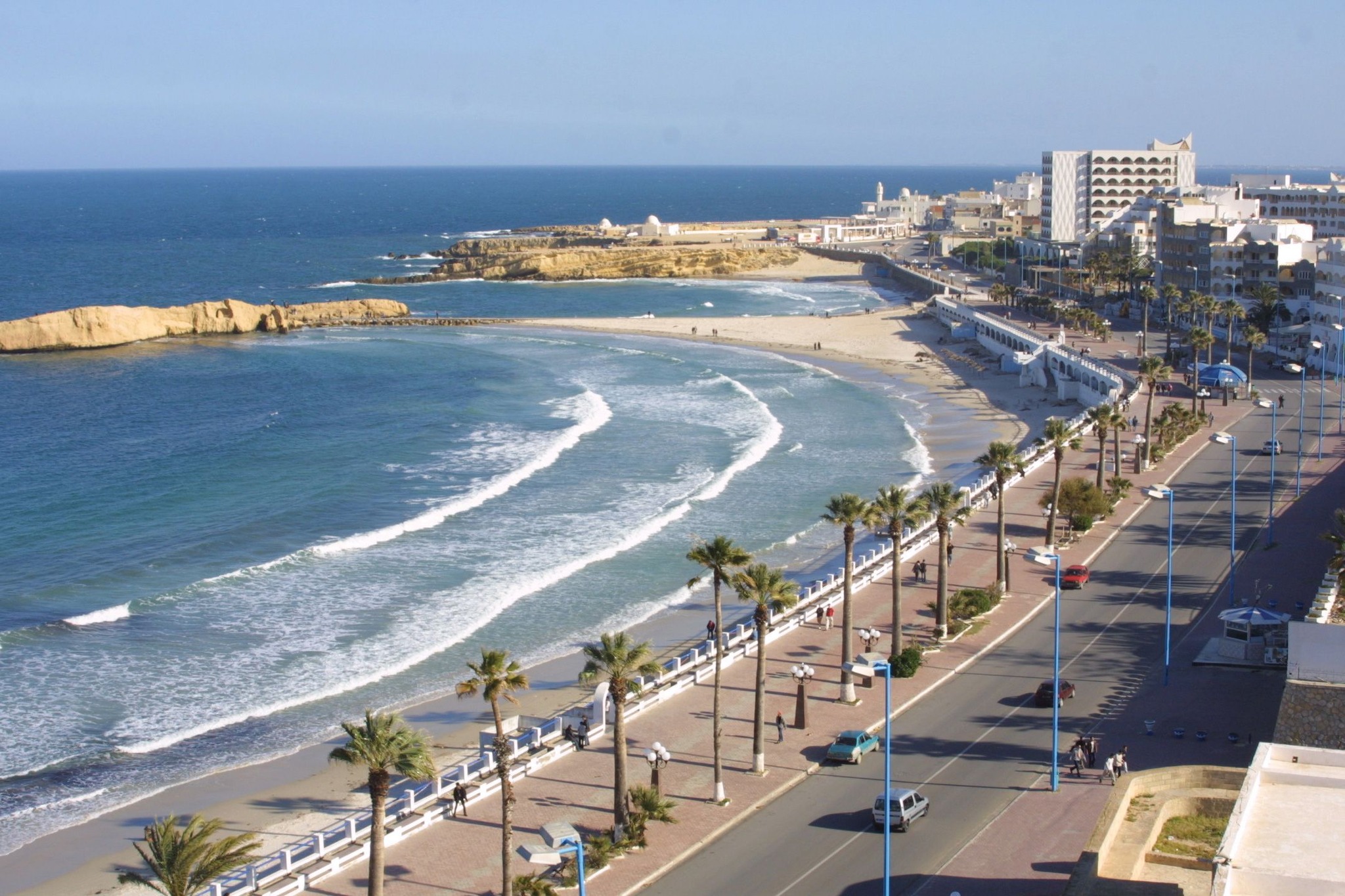
Quick Answer Monastir is a small coastal city of around 95,000 people on Tunisia’s central Mediterranean coast, 20 kilometres south of Sousse and 50 kilometres north of Mahdia. It contains three things worth a serious traveller’s time: the Ribat of Monastir, the oldest Islamic fortress in North Africa, founded 796 CE; the Bourguiba Mausoleum, where the country’s founding president is buried under a golden dome that he commissioned in his lifetime; and Monastir-Habib Bourguiba International Airport (MIR), which is the entry point most package tourists to the Sahel coast actually use, often without stopping in the city itself. The medina is modest. The beaches are good. The Skanes resort zone, immediately north of the city, is the country’s most polished package-tourism strip outside Hammamet. The whole place is best understood as a single afternoon’s worth of dense, layered Tunisian history wrapped around a working airport and a strip of European beach hotels — which is more interesting than that summary makes it sound.
There is a famous photograph of Habib Bourguiba, taken in 1956, the year he became Tunisia’s first president after independence from France. He is standing on the sea wall of his hometown of Monastir, looking out at the Mediterranean, in a white linen suit, with the Ribat behind him. It was the photograph the country used for thirty years to define what kind of nation it was: Mediterranean, modernising, founded on an ancient Islamic past but not enclosed by it, looking outward at the world.
Bourguiba ran Tunisia for the next thirty-one years, increasingly as a one-man state. He was deposed in 1987 by his prime minister Zine el-Abidine Ben Ali, in a coup that the constitution euphemistically called a medical declaration. He spent the last thirteen years of his life under house arrest in Monastir, in the family home a few blocks from where the photograph was taken, and was buried in 2000 in the mausoleum he had built for himself in 1963, on the road into the city, beneath the golden dome.
Monastir is the city that produced him. It is also the city that lived through every phase of his Tunisia, from the fortified Islamic outpost the dynasty was built on, to the modern resort and airport that the dynasty made possible, to the quiet seafront where the dynasty ended.
The whole story is here, if you know how to read it.
Why Monastir Matters
Monastir is older than its modern association with Bourguiba suggests. It is much older.
The Phoenicians built a small trading post here in the 5th century BCE; the Romans expanded it as Ruspina, a minor harbour town on the central Africa coast, and Julius Caesar used it as his base during the African campaign of 46 BCE against the supporters of Pompey. The Roman ruins of Ruspina are slight — a few cisterns, some scattered foundations — but the harbour and the fortified hill that the Romans used are recognisably the same harbour and the same hill the Phoenicians had.
The transformation came in 796 CE, when the Aghlabid emir Harthama ibn Ayan built the Ribat on the seaward edge of the town. A ribat is a fortified Islamic religious-military outpost — half monastery, half coastal watchtower — and the one at Monastir was the first of its kind in North Africa and the model for the network of ribats that would later guard the entire Maghreb coast against Byzantine and later European raids. The volunteers who served at the ribat — the murabitun — were warrior-monks, taking turns to garrison the fort, study religious texts, and watch the horizon for hostile sails. The institution gives English the word marabout, the name the French would later apply to the entire class of North African Muslim holy men.
For the next thousand years, Monastir was a Mediterranean coastal town with a working ribat at its heart, a small medina around it, a fishing harbour, and the agricultural hinterland of the Sahel olive groves behind. The Hafsids, the Ottomans, the corsairs, the French — each layer added itself to the town without quite displacing the one before.
The 20th century brought the modern overlay: independence in 1956 under Bourguiba (who happened to have been born here in 1903); the construction of his mausoleum in 1963; the development of the Skanes resort zone in the 1970s as part of Tunisia’s pivot to mass tourism; the international airport at the western edge of the city, named for him; and the slow re-coding of Monastir as a brand — Bourguiba’s hometown, the founding-president’s city — that the Tunisian state spent the rest of the century reinforcing.
The wider arc is at Tunisia’s rich history from Phoenicians to independence.
The Ribat

The Ribat of Monastir is the single most important monument in the city and one of the most important pieces of early Islamic military architecture anywhere in the Mediterranean.
It is also, fairly often, missed by visitors who fly into MIR airport, transfer directly to a resort hotel in Skanes, and spend a week on a beach without ever seeing the building that gave the country its identity.
Don’t make that mistake.
The ribat sits on a rocky outcrop above the small fishing harbour, surrounded on three sides by the sea. It is 35 metres on each side, four storeys tall, with corner towers, a central courtyard, prayer rooms, cells for the murabitun, and a watchtower (the nador) from which, on a clear day, you can see the Ribat of Sousse twenty kilometres up the coast. The two were built within a few years of each other, in the same Aghlabid military style, as part of a single coordinated coastal defence.
Entry is currently around 8 dinars. The climb to the watchtower is a hundred-step spiral staircase, moderately challenging in a way that justifies stopping at each platform to look out a slot window and see the sea. The view from the top is one of the great views on the Tunisian coast. Allow an hour to ninety minutes for the full visit.
The Ribat has had a second life as a film location. Franco Zeffirelli’s Jesus of Nazareth (1977) used it as Jerusalem. Monty Python’s Life of Brian (1979) was filmed here and at locations around the medina; if you have seen the film, the Romanes eunt domus graffiti scene was shot in the courtyard. Raiders of the Lost Ark (1981) also used the fort. None of this is signposted at the site. It is part of what you carry away.
The deeper architectural and historical account is at the Ribat of Monastir piece.
The Bourguiba Mausoleum
Two hundred metres west of the Ribat, set on the edge of the old town along Avenue Habib Bourguiba, stands the Mausoleum of Habib Bourguiba.
You see it first from the road in: two slim minarets in glazed green tile flanking a single great golden dome, the whole thing set in a walled courtyard at the head of a long ceremonial avenue. It is not subtle. Bourguiba commissioned it in 1963 — five years after independence — and it was completed in the 1970s, decades before he actually died. He was buried here in 2000, under the dome, with his first wife Mathilde, his parents, and his older brother.
The architectural style is what could be called modern North African mausoleum: the visual vocabulary of the medieval Sahel — domes, minarets, glazed tile, zellige — scaled up and simplified for ceremonial effect. It is closer in spirit to the Mohammed V mausoleum in Rabat than to anything actually medieval. The interior is open and quiet: a large central chamber under the dome, with Bourguiba’s marble sarcophagus in the centre, and a smaller chamber beside it for his immediate family. The decorative panels — calligraphic, geometric, almost entirely abstract — are accomplished without being remarkable.
The complex sits next to the Sidi el-Mezri cemetery, which is the city’s main historic burial ground and where Bourguiba had originally expected to be buried before he changed his mind in the 1960s. The cemetery itself is worth a short walk: it holds Bourguiba’s parents in their original modest graves, the marabout of Sidi el-Mezri (a 16th-century local saint), and a quiet expanse of Sahel limestone graves that has been the city’s resting ground for four centuries.
A note on the politics, because honest writing requires it. Habib Bourguiba was the founder of modern Tunisia. He led the independence movement, abolished polygamy in 1956, gave women the vote in 1957, made primary education compulsory and free, secularised the legal system, and built the institutional state that, with all its imperfections, made Tunisia what it is. He was also, by the late 1970s and through the 1980s, an increasingly authoritarian one-man ruler, deposed in 1987 on a manufactured medical pretext by the man who would prove to be much worse than he was. The mausoleum honours the founder. The founder was a complicated man. A serious visitor leaves the mausoleum with both facts intact.
The Medina and the Marina
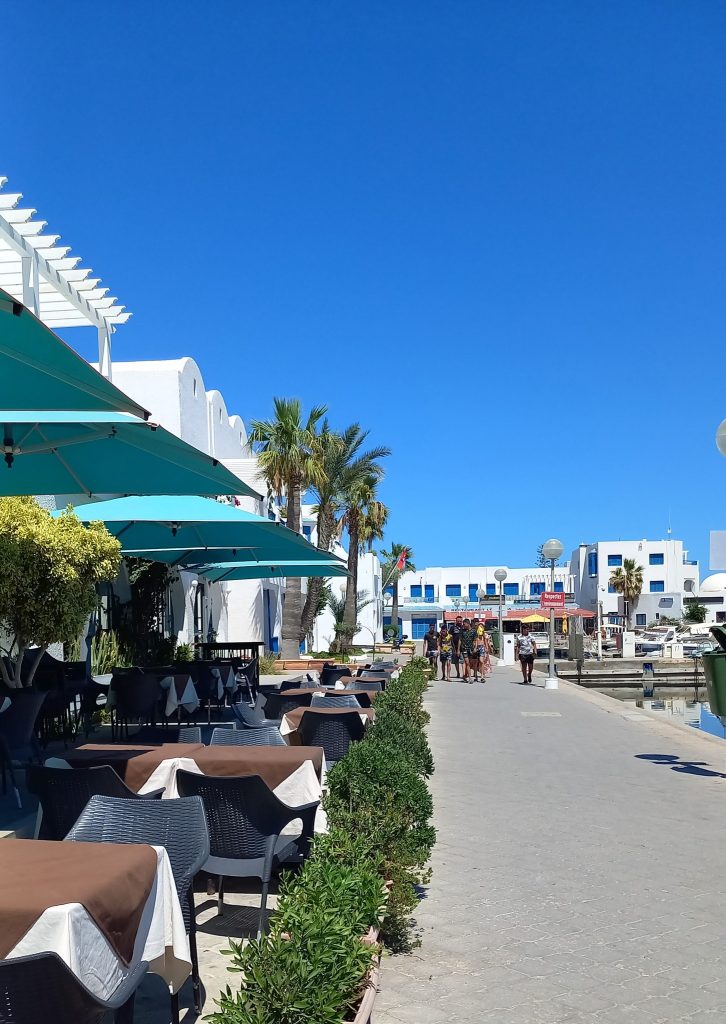
The medina of Monastir is small — perhaps a tenth the size of the medina of Sousse — and was extensively rebuilt in the 19th and 20th centuries. What remains is pleasant rather than spectacular: a few working alleys, the Great Mosque (founded in the 9th century, rebuilt many times, with a notably austere Aghlabid courtyard), the Karraka (a 17th-century Ottoman prison-fortress on the harbour, now a small archaeological museum), and the Marabout of Sidi Dhouib (a small whitewashed shrine that gave the city its nickname).
Forty-five minutes is enough for the medina. An hour with a long coffee, if you want.
The Cap Marina, the modern marina complex on the south side of the harbour, is a different proposition — a 1990s leisure development with cafés, restaurants, fish shops, and a long quay full of pleasure boats. It is moderately polished, moderately pleasant, and the obvious place for a sunset drink. The fish restaurants here are reliable. Le Pirate and Restaurant du Port are the long-running options.
The Skanes Resort Zone
North of the city, separated from it by the airport and by the railway, the Skanes strip runs for about eight kilometres along the coast: a continuous chain of 3-, 4-, and 5-star hotels, mostly built between 1975 and 2010, almost entirely catering to package tourism from France, Germany, the UK, Belgium, Poland, and the Czech Republic.
This is not the Tunisia most readers of this magazine come for. But it is a significant part of what Monastir actually is, and worth understanding on its own terms.
The Skanes hotels run from acceptable mid-range (the older El Habib, Skanes Beach) to genuinely good (the Royal Thalassa Monastir, the Iberostar Mehari, the One Resort Premium). Prices, in season, run from 60 to 250 dinars per person per night, almost always on a half-board or all-inclusive basis. The beach is sandy, the sea is shallow and warm, and the hotels are competent at what they do.
What they do not particularly do is connect their guests to Monastir itself. A traveller who flies in, takes the airport shuttle to a Skanes hotel, and spends a week between the beach and the pool may never see the Ribat or the Mausoleum. This is the country’s choice and the operators’ choice, and arguments can be made for it. But if you are reading this guide you are presumably the kind of traveller who can do better. A taxi from Skanes to the medina is 8–12 dinars and ten minutes. Make the trip. Twice if possible.
What Monastir Eats
Monastir is on the Sahel coast and eats more or less what the rest of the Sahel eats: fish, octopus, olive oil, brik, lablabi, slow-cooked stews. The signature local dish is kabkabou — a fish stew made with white fish (typically grouper or sea bass), tomato, capers, preserved lemon, and olives, served with bread or couscous. Done well, it is one of the great Tunisian fish dishes; done badly, it is forgettable. The best version in Monastir is at Le Trou Normand in the medina, a small French-Tunisian kitchen running since the 1970s.
For octopus, sardines, and the wider fish-grill repertoire, the Cap Marina restaurants are reliable. For everything else, the small workmen’s restaurants along Rue Trabelsia, just inside the medina, serve full Sahel lunches at around 15 dinars a head until 2 p.m.
The wider Tunisian food landscape is at top foods to eat in Tunisia.
Getting There, Getting Around
Monastir-Habib Bourguiba International Airport (MIR), three kilometres west of the city, is one of Tunisia’s two principal international gateways alongside Tunis-Carthage. It handles a heavy volume of European charter and low-cost traffic — Nouvelair, TUI fly, Ryanair, Eurowings, Smartwings — particularly from Germany, France, the UK, Poland, and the Czech Republic. There are no direct flights from North America; connections through Paris, Frankfurt, or Istanbul are standard. The airport is small, efficient, and rarely chaotic. See flights to Tunisia for the wider routing picture.
From the airport, taxis to the Skanes resort zone are 10–20 dinars, to the Monastir medina 8–12 dinars, to Sousse 25–35 dinars, to Mahdia 50–70 dinars. The Sahel Metro light rail has a station at the airport entrance and runs north to Sousse (40 minutes) and south to Mahdia (one hour) every 30–60 minutes for under 5 dinars.
From Tunis, Monastir is 165 kilometres south. By car, two hours via the A1 motorway. By SNCFT train, three hours direct from Tunis Ville (15 dinars first class). By louage, two and a half hours from Moncef Bey, 12 dinars.
Inside the city, walking covers the medina, the Ribat, the Mausoleum, and the Marina — all within a kilometre of each other. The Skanes resort zone requires a taxi or the Sahel Metro.
When to Go
The Sahel climate is the standard central-Mediterranean: hot summers, mild winters, low rainfall.
May–June and September–October are the best months — 22–28°C, warm sea, manageable evening temperatures, and Skanes hotel rates a third below August peak. July–August are hot (30–34°C) and busy, with the resort zone running at near-full capacity; the medina itself stays manageable in the sea breeze. November–April is mild (14–20°C), the beach hotels operate at reduced capacity, and the city settles into a quieter winter rhythm. The Ribat and the Mausoleum, both stone-built, are most pleasant to visit between October and April. See the best time to visit Tunisia for the regional context.
A Few Practical Notes
Hotels. In the city itself: a small number of mid-range options, mostly along Avenue Habib Bourguiba (Hotel Yasmine, Hotel Esplanade Bourguiba) at 80–150 dinars. In the medina: a handful of restored dar-style guesthouses at 100–200 dinars (Dar el Medina, Dar Hi). For everything else, Skanes — the prices and quality range described above.
Cash. ATMs widely available along Avenue Habib Bourguiba and inside the airport. Marina restaurants and resort hotels take cards; the medina is mostly cash-only.
Dress. Monastir is on the relaxed end of the Sahel coast — somewhere between Sousse and Mahdia. Beachwear on the beach, covered shoulders and knees in the Ribat and the Mausoleum, modest dress in the medina but no need for headcoverings.
Mausoleum etiquette. The Bourguiba Mausoleum is treated as a state monument and a working religious site. Shoes off at the entrance. No talking loudly. Photography of the interior is allowed but not flash. Closed during Friday midday prayers.
Combining the trip. Monastir works extremely well as one day in a Sahel itinerary that pairs it with Sousse (its larger sister, 20 minutes north), Mahdia (its smaller sister, 45 minutes south), and El Jem (the great Roman amphitheatre inland, 50 minutes west). All four are reachable in a long day from a base in any of them.
What Monastir Is, Honestly
Monastir is not, by Tunisian standards, a major destination. It is smaller than Sousse, less photogenic than Sidi Bou Said, less historically rich than Kairouan, less untouristed than Mahdia. It is also not, in the deep sense, a city built for travellers — most of its tourist economy runs through the resort zone, which sits adjacent to but does not really overlap with the city itself.
What it is, instead, is the working hometown of the country’s founding president, a small Mediterranean port with a 1,230-year-old fortress that defined the architectural vocabulary of the entire Maghreb coast, the burial place of the man who made modern Tunisia and the airport that brings most of the country’s European visitors in, and a strip of fairly well-managed beach hotels for the sort of holiday many people actually want.
For a serious visitor, the right approach is to fly in through MIR, spend a full afternoon in the city itself — the Ribat first, the Mausoleum second, the Marina at sunset — and then either stay in a Skanes hotel for the week or push on to Sousse or Mahdia for the heavier travel. The Monastir part of that itinerary is not the headline. But it is, when you look at it carefully, one of the more accurate single afternoons in Tunisia.
You should go.
From the Carthage Magazine Bookshelf
Monastir is best understood with the wider Tunisia in mind. Three Carthage Magazine ebooks make the trip more rewarding:
- All About Tunisia — the definitive English-language traveller’s guide. 572 pages, 27 chapters, all nine regions — with full coverage of the Sahel coast and the Bourguiba years. $24.99 · PDF & EPUB
- Speak Like a Local — 200+ Tunisian Arabic phrases with native audio recorded in Tunis. Useful in the medina, the souk, and (occasionally) at the resort restaurant. $14.99 · PDF, EPUB, MP3
- The Authentic Tunisian Cookbook — sixty traditional recipes from the heart of North Africa, including the Sahel fish stews and the slow-cooked Tunisian classics. $9.99 · PDF & EPUB
All three available as a bundle for $39.99 — guide, language, and food, delivered together.
