
Quick Answer Tunisian food is one of the great underrated cuisines of the Mediterranean — a slow, spiced, olive-oil-rich kitchen built at the crossroads of Berber, Arab, Andalusian, Jewish, Ottoman, and French traditions. The country’s most beloved salad was recently ranked the world’s second best. Its hot sauce sits on UNESCO’s intangible heritage list. Its national dish is older than the Roman Empire. If you came here looking for the definitive what-to-eat list, these are the twenty dishes that will get you closest to how Tunisia actually eats — and where to find them.
A Tunisian table does not announce itself.
It arrives slowly, with small plates first — a dish of olives, a saucer of harissa, a basket of bread torn into pieces — and continues without urgency for the better part of an afternoon. The Berber, Arab, Andalusian, Jewish, Italian, and French traditions that shaped the country are all on it somewhere, sometimes on the same plate. Almost everything has olive oil in it. Almost everything has a little fire. Almost nothing is in a hurry.
What follows is the working list: twenty dishes that, taken together, give you the closest thing to a complete picture of how Tunisia actually eats. Some are famous beyond the country’s borders. Most are not. All of them are worth ordering at least once.
We’ve grouped them into the categories a Tunisian meal moves through, more or less in the order they’d appear on a real table.
Salads and Starters

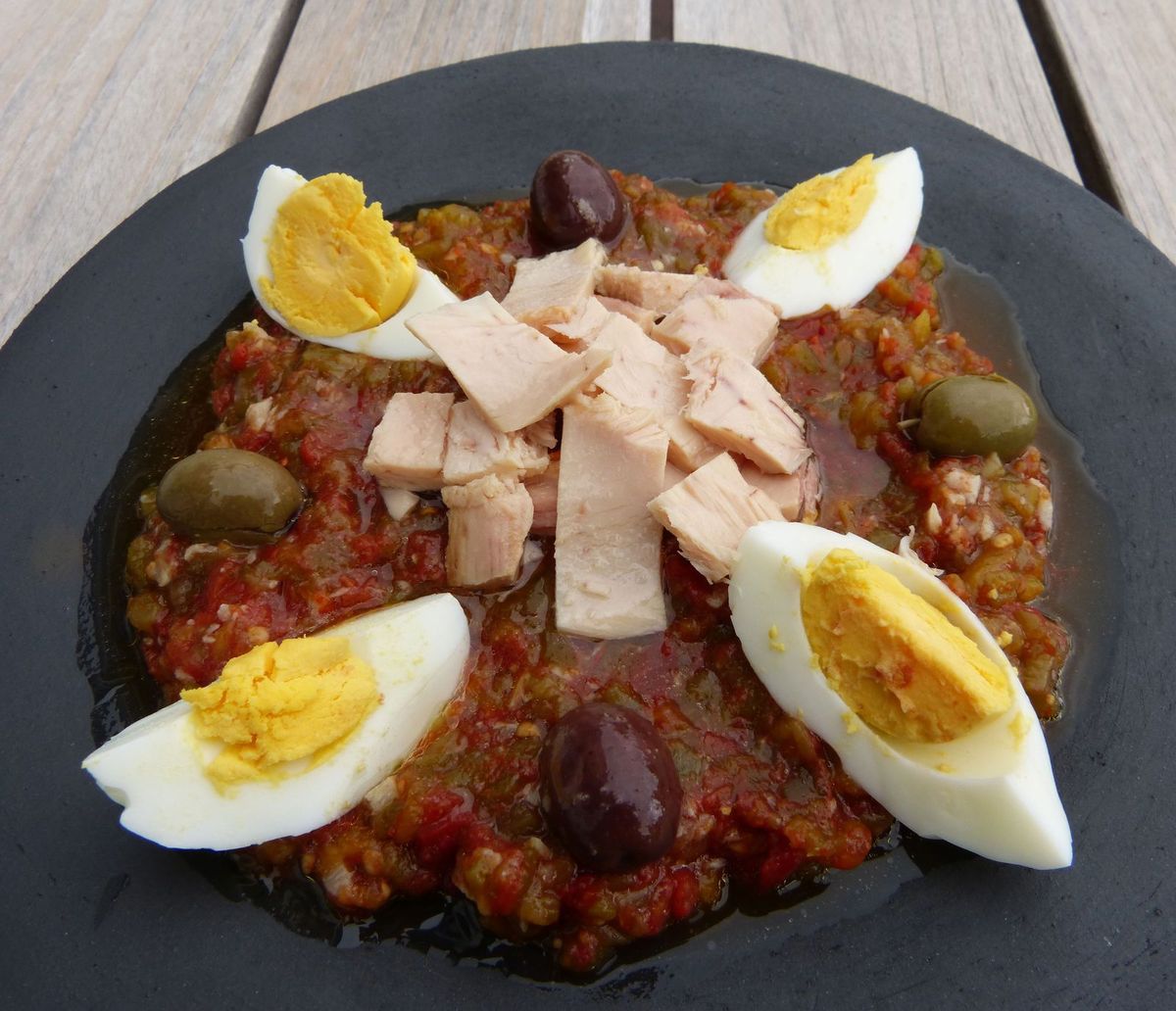
1. Slata Méchouia — the smoke-grilled salad
The world’s second-best salad according to TasteAtlas, and the dish that most reliably converts a first-time visitor into a Tunisian-food evangelist. Peppers, tomatoes, garlic, and onion are charred whole over an open flame, peeled, then chopped fine and folded with olive oil, caraway, and flakes of tuna. Eaten scooped up with warm bread. The smoke is the whole point — méchouia literally means “grilled.” The recipe is here.
2. Slata Tounsia — the Tunisian chopped salad
The country’s everyday salad: tomato, cucumber, onion, green pepper, all diced very small, dressed simply with olive oil, lemon, salt, and a pinch of dried mint. Often topped with tuna chunks and slices of hard-boiled egg. It is the salad that appears on every Tunisian table at lunchtime — modest, fresh, almost aggressively simple, and difficult to stop eating.
3. Lablebi — Tunisia’s national breakfast
A steaming bowl of chickpeas in a cumin-scented broth, poured over torn bread, finished with harissa, olive oil, capers, lemon, garlic, and a soft-cooked egg cracked over the top. The country’s most beloved street food and its true working-class breakfast. Order it at a lablebi counter rather than a restaurant — the queue at six in the morning outside Lablebi El Hout or Lablebi Bab Jedid in the Tunis medina tells you everything you need to know. Full recipe and tradition.
The Iconic Mains
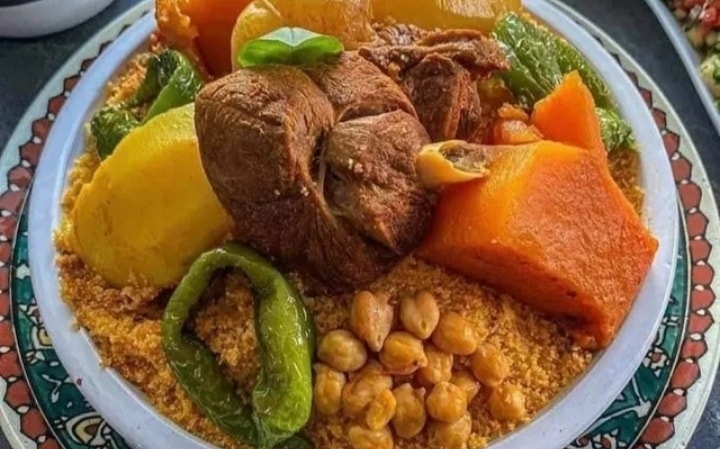
4. Couscous — the national dish
Tunisia’s Sunday dish, its wedding dish, its funeral dish, its homecoming dish. Semolina steamed three times over a tomato-and-spice broth, served with lamb, chicken, fish, or vegetables according to region and occasion. UNESCO inscribed couscous on its intangible cultural heritage list in 2020, jointly recognising Tunisia, Algeria, Morocco, and Mauritania — but the Tunisian version, generally spicier and more sea-influenced, is distinct. Eaten with a spoon, slowly, with bread on the side for what the spoon can’t reach. Our full guide.
5. Mloukhiya — the grandmother dish
A dark, slow-cooked stew of powdered jute leaves and beef, simmered for four to six hours until it deepens to a near-black sauce with the texture of something between soup and gravy. Originally Tunisian-Jewish, now universal. Mloukhiya is the dish Tunisian families argue about — whose grandmother makes it best, how much coriander is too much, whether the meat should be on or off the bone. Eat it with bread, never with cutlery. The longer story is here.
6. Tajine Tunisien — not what you think it is
A Tunisian tajine is not a slow-cooked Moroccan stew. It is a thick savoury frittata baked in the oven — beaten eggs folded with cheese, parsley, chicken or lamb, and whatever else the cook has on hand, baked until set and cut into squares. Served warm or at room temperature. Most Tunisian families make one for a long Sunday lunch and finish what’s left for dinner Monday. The classic appetiser version.
7. Kafteji — the vegetable medley
Tunisia’s most beloved vegetable dish. Peppers, pumpkin, potatoes, tomatoes, and zucchini are fried separately until golden, then chopped fine on a wooden board and folded with eggs. Eaten on a plate at home; eaten in a baguette as a sandwich on every Tunisian street. Often served with grilled liver or merguez sausage on top, though the vegetarian version is the everyday one. Recipe and method.
8. Rouz Jerbi — Djerba’s signature rice
The dish that defines the island of Djerba. Rice is steamed alongside a green mixture of parsley, spinach, fennel, mint, and liver, until every grain absorbs the colour and the perfume of the herbs. The result is intensely fragrant, soft, deep green, and unlike any rice dish made elsewhere in the Mediterranean. Order it at any restaurant in Houmt Souk; cook it from the recipe if you can’t get to the island.
The Egg and Pepper Classics

9. Ojja — the Tunisian breakfast eggs
A spicy tomato base built on harissa, garlic, and caraway, finished with eggs cracked directly into the simmering sauce and cooked until just set. Almost always served with slices of merguez sausage. The country’s morning-after dish — restorative, warming, eaten with a hunk of bread and a coffee strong enough to remind you why you came.
10. Chakchouka — the peppers-and-tomato stew
Tunisia’s chakchouka is the original — peppers, tomatoes, onion, garlic, harissa, slow-cooked into a dense vegetable stew. Eggs are sometimes added, sometimes not. The Israeli-Levantine shakshuka that now appears on every Western brunch menu is a descendant of this dish. The Tunisian pumpkin variation is one of the country’s quiet seasonal favourites.
11. Felfel Mehchi — stuffed bull’s-horn peppers
Long bull’s-horn peppers stuffed with seasoned ground beef and rice, simmered in a spicy tomato sauce until the peppers slump and the filling absorbs the sauce. A weeknight dish, a Ramadan dish, a “company is coming” dish. The Tunisian answer to the stuffed-vegetable tradition that runs across the entire Mediterranean. Recipe.
The Street Food
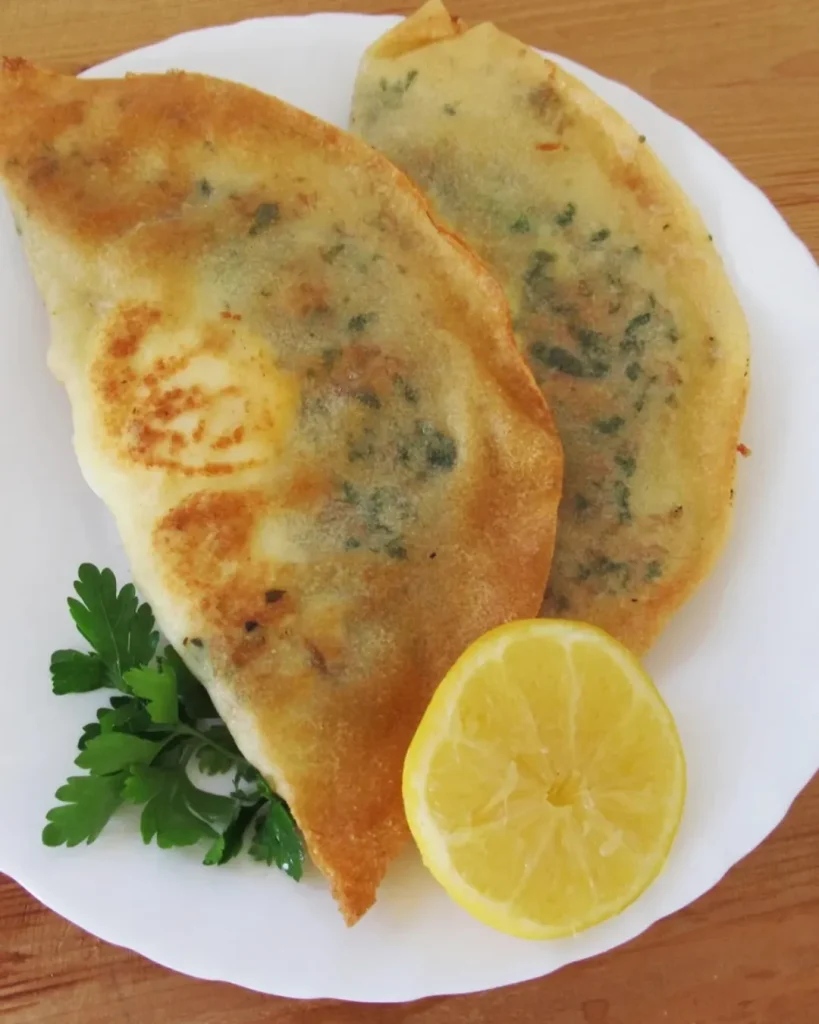
12. Brik — the country’s most photogenic snack
A thin sheet of malsouka dough folded around a runny egg, a flake of tuna, capers, parsley, and a smear of harissa, then deep-fried until the pastry shatters at first bite. The yolk runs down your wrist. You will not avoid the stain. The brik is the dish most likely to surprise a visitor; it is also the dish most likely to be the one they remember a year later. Our full guide to eating it properly.
13. Fricassé — the small fried sandwich
A miniature deep-fried bread roll, slightly sweet from the dough, slit open and stuffed with tuna, harissa, olives, hard-boiled egg, potato, and preserved lemon. Sold from glass cases at every café in the country for about a dinar. The New York Times wrote about them in 2023; Tunisians have been eating them at four in the afternoon for a century.
14. Mlewi — the layered flatbread sandwich
A pan-fried flatbread folded in many thin oily layers, then split and filled with whatever the corner shop has on hand — tuna and harissa, egg, cheese, sometimes merguez. The Tunisian working person’s lunch when there is no time for lablebi and kafteji is too elaborate. Underrated, ubiquitous, and the most reliably satisfying two-dinar meal in the country.
The Pantry That Holds It All Together
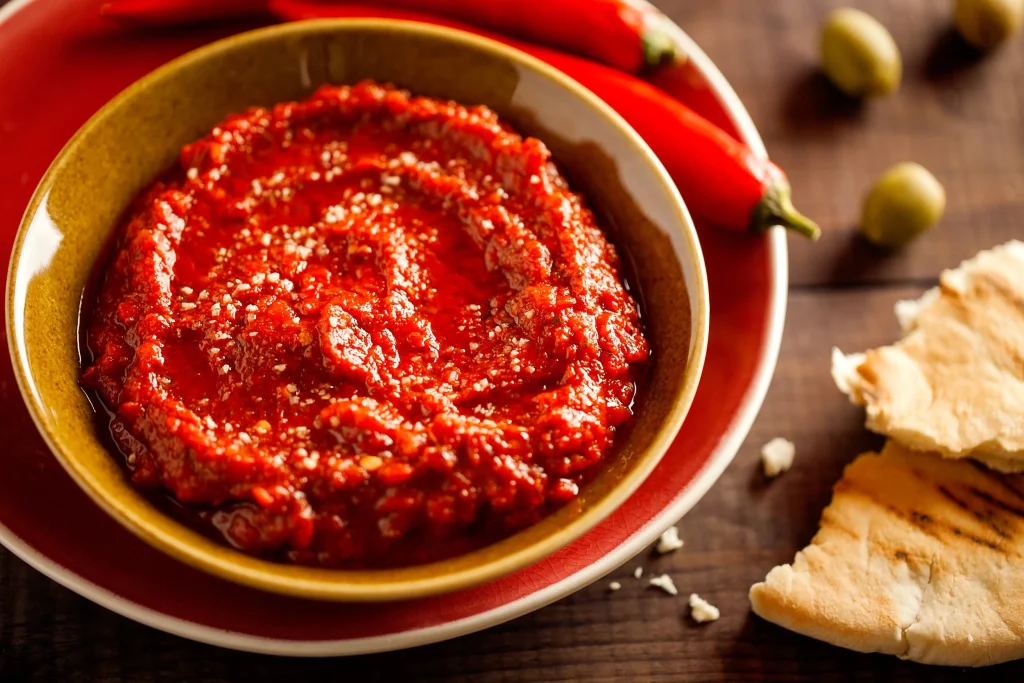
15. Harissa — the country’s signature
The deep-red chilli paste that runs through almost every Tunisian dish, made from sun-dried chillies (often the Baklouti pepper of Cap Bon), garlic, caraway, coriander, salt, and olive oil. UNESCO inscribed harissa on its intangible cultural heritage list in 2022. It is on every Tunisian table, in every sandwich, in every stew. The longer story is here.
16. Olive oil — Tunisia’s gold
The country is one of the world’s three largest producers of olive oil, with a tradition that predates Rome. Tunisian extra virgin is buttery, peppery, deeply green, and almost everything in the cuisine assumes it. Buy a bottle at a Carrefour or Monoprix for under ten dinars; you will not find an equivalent for the price anywhere in Europe. The longer piece.
The Sweets

17. Kaak Warka — the bracelet pastry
A delicate ring of almond paste enclosed in paper-thin pastry, often glazed with honey or syrup, scented with rosewater or geranium water. Served at every Tunisian wedding and most major holidays. The dough is rolled so thin that good kaak warka almost dissolves on the tongue. Recipe.
18. Makroudh — Kairouan’s date diamond
A small, dense, diamond-shaped semolina cake stuffed with date paste, fried, and dipped in honey or sugar syrup. The signature sweet of Kairouan — every Tunisian holy city has its sweet — sold in honeycomb cases at sweet shops across the country. The tooth-aching, deeply satisfying ending of many Tunisian meals.
19. Assidat Zgougou — sweetness from a famine
A black, smooth, profoundly distinctive pudding made from the ground seeds of the Aleppo pine, topped with vanilla cream and decorated with pine nuts and pistachios in elaborate patterns. Traditionally prepared for the Mawlid, the Prophet’s birthday. The dish was born during the 1864 famine, when Tunisians in the north discovered they could grind pine seeds into a nutritious flour; the modern dessert is the elegant descendant of that improvisation. Recipe.
One Last Essential
20. Bambalouni — Sidi Bou Said’s doughnut
A simple ring of yeasted dough deep-fried to gold and dusted with sugar, eaten standing up at the bambalouni stand at the entrance to Sidi Bou Said, with the Mediterranean a hundred metres below. The whole experience — the warm doughnut, the cold sea air, the sugar on your jacket — is one of the small things visitors to Tunisia talk about for years.
And the Drinks Worth Knowing
A short coda on what to wash it all down with.
Tunisian mint tea — green tea with fresh mint and sugar, often finished with a handful of pine nuts in the glass. The country’s universal sign of hospitality. Turkish coffee — strong, sweet, and served in tiny cups, the morning fuel of the Tunisian medina. Tunisian wine — the country has a three-thousand-year viticulture tradition and produces about thirty million bottles a year; the dry Muscat sec de Kelibia with grilled fish at sunset is one of the great underrated pairings in the Mediterranean. Boga Cidre — the bright-orange Tunisian apple soda that is somehow both terrible and addictive, and which every Tunisian who has emigrated brings back a case of when they visit.
How to Eat in Tunisia — A Few Honest Rules
The food works best when you know how to meet it.
- Skip the buffet. The all-inclusive resort hotels of Hammamet and Sousse will serve you something they call Tunisian food. They are lying. Eat outside the compound.
- Order brik early in your trip. It is the dish that converts skeptics, and it is also the dish that takes a meal or two to learn to eat without humiliating yourself. Get started.
- Order lablebi before noon. It is a breakfast dish. Restaurants will serve it at any hour, but the version at a proper lablebi counter at eight in the morning is the version Tunisians actually eat, and there is no real substitute.
- Accept the harissa. It is on the table because it is supposed to be on the food. A tiny smear at first; you’ll calibrate from there.
- Eat with bread. Most of these dishes were designed to be scooped, not forked. The bread is the cutlery. Cutlery is fine; bread is better.
- Say saha. It is what the cook will say to you when the plate arrives — roughly, to your health — and it is what you should say back at the end of the meal. The word does more work than its length suggests.
From the Carthage Magazine Bookshelf
If you want to keep cooking what you ate, three Carthage Magazine ebooks were built for exactly that:
- The Authentic Tunisian Cookbook — sixty traditional recipes, including most of the twenty dishes on this list. Written in Tunis by Amira Ben Harcha, the cooks behind Carthage Magazine’s most-read recipe pages. $9.99 · PDF & EPUB
- Speak Like a Local — 200+ Tunisian Arabic phrases with native audio recorded in Tunis. The phrases for ordering, asking what’s in the dish, and complimenting the cook are all in chapter four. $14.99 · PDF, EPUB, MP3
- All About Tunisia — the definitive English-language traveler’s guide. 572 pages, 27 chapters, with full regional context for the food: which dishes come from Djerba, which from Sfax, which from Kairouan, and where to eat them in the city itself. $24.99 · PDF & EPUB
All three available as a bundle for $39.99 — guide, language, and food, delivered together.
