
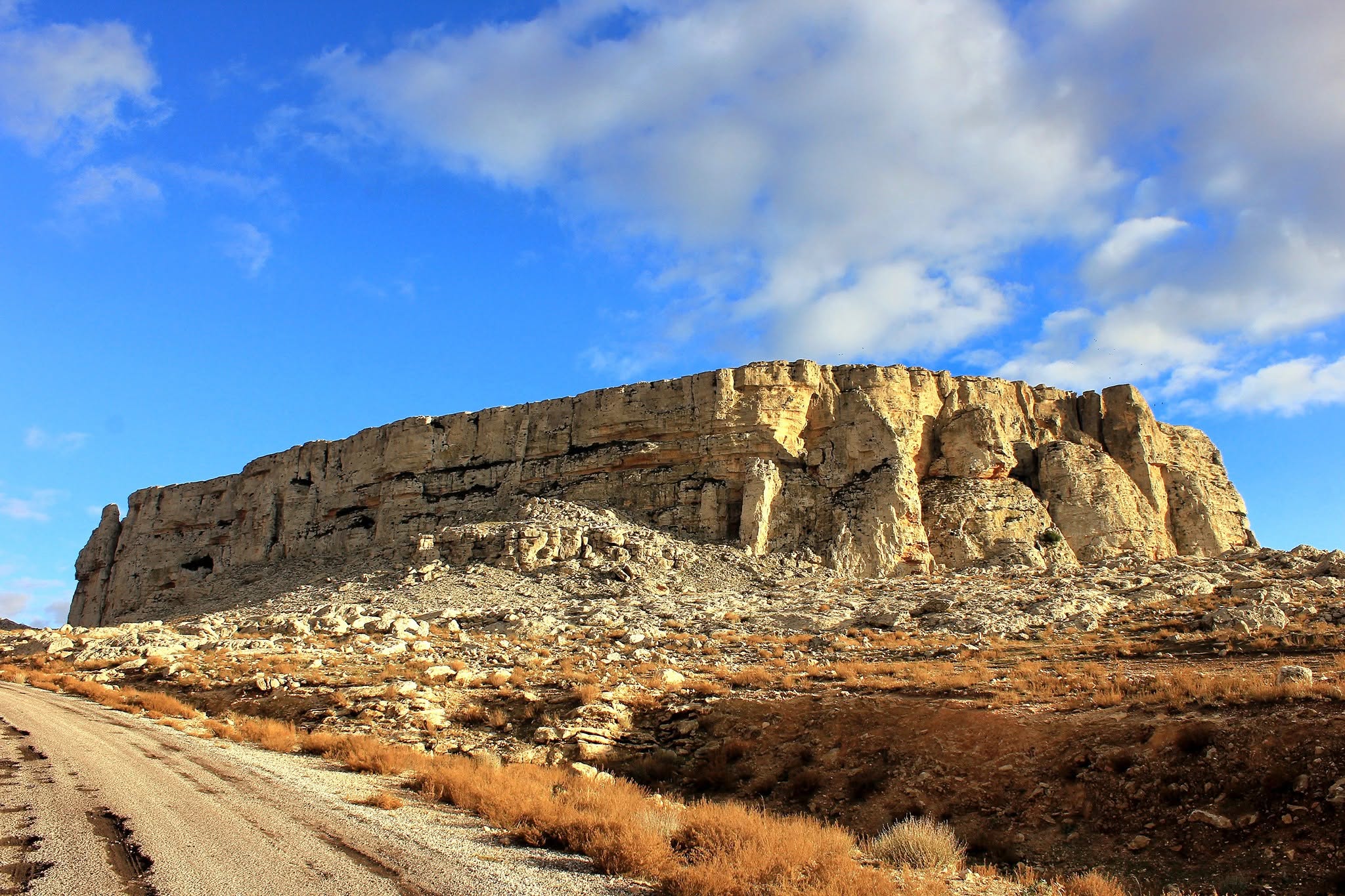
From the road out of Tajerouine it looks like a mistake in the landscape: a mountain with the top sliced off flat, as if someone had planed it, standing alone above a plain of wheat and almond trees with Algeria behind it. The plateau is a kilometre and a half long and half a kilometre wide, eighty hectares of rock at 1,271 metres, and its cliffs drop sheer for forty or fifty metres before the scree takes over. There is one way up: a staircase cut into the north face, through a fortified gate. Tradition says Jugurtha, the Numidian king who fought Rome to a standstill for six years, used it as a stronghold. The name has stuck for two thousand years, and so has the habit of anyone who sees it from the road of stopping the car.
Two readers asked for it in the replies to our northern road trip map. It is the one stop on that loop that needs a guide of its own, because it is also the one that needs the most planning.
The Short Answer
The Table de Jugurtha (Jugurtha’s Table, Kalaat Senan in Arabic) is a limestone mesa 55 kilometres southwest of El Kef, reached from the village of Kalaat Senan by a rough track and then a staircase of about 150 rock-cut steps. On top are the ruins of a fortified village, a marabout, cisterns, caves, and a 360-degree view across two countries. The climb from the foot of the cliff takes half an hour; the whole outing from El Kef, with the drive and an hour on the plateau, is four to five hours. Go in spring or autumn, hire a guide in the village, and read the travel-advice section below before you decide, because the mesa stands inside a border zone that several governments advise against visiting.
What It Is
The Table is a geological accident: a block of hard limestone that resisted the erosion that carried off the softer rock around it, leaving a flat-topped island about 20 million cubic metres in volume with no natural way up. Nobody designed it as a fortress, but every people who lived under it used it as one.
The Numidians came first. Jugurtha, grandson of Massinissa, fought Rome from 112 to 105 BC in a war that Sallust wrote up as a study in Roman corruption, and the tradition that he held out on this rock is old, though Sallust himself describes a stronghold near a river that may be somewhere else entirely. The identification is a tradition, not a proof; it is also, like most such traditions in the Maghreb, the reason the place has a name. Later fortifications, the gate and the stairs are attributed to the Byzantines, to a seventh-century Berber chief, and to Senan, the eighteenth-century warlord who gave the village its name and rebuilt the walls; the cisterns on top, which made a dry rock habitable, are the work of whoever held it longest. Local memory adds that the Hanencha tribe used the plateau to sit out the Bey of Tunis’s tax collectors, which is probably the truest story of all. For the longer arc of the people who built and held it, see our guide to Tunisia’s Amazigh heritage.
The Climb
From the centre of Kalaat Senan, a sign points left to “Table de Jugurtha.” The track beyond the last houses is rocky but driveable in dry weather with care in an ordinary car, and comfortably in a 4×4; it ends below the north face, where a café serves tea in season and the guides wait. On foot from the village it is about two hours. The staircase starts at the fortified gateway and climbs through a cleft in the cliff, roughly 150 steps worn smooth by use, with a handrail in places and none in others; it takes twenty to thirty minutes, and anyone reasonably fit can do it. Vertigo is the only real obstacle.
On top, the plateau is a grassland of ruined stone houses, the whitewashed marabout of Sidi Abd el-Jouad, cisterns cut into the rock, caves that were lived in within living memory, and the remains of what may have been a basilica. Walk the rim; it takes an hour and the drop is unfenced everywhere. The view east is the plain of El Kef, south the mountains toward Kasserine, west the Algerian hills. Dolmens dot the lower slopes toward Kef Rebiba, which the hiking clubs of Tunis include in an eleven-kilometre circuit.
Getting There
Kalaat Senan is 55 km from El Kef via Tajerouine (turn off four kilometres past the town), about an hour’s drive, and 250 km from Tunis, three and a half hours by the A3 and the Kef road. A rental car is the realistic way; louages reach Tajerouine and, less often, Kalaat Senan, but the track to the foot of the Table is another matter. A taxi from El Kef for the half-day, waiting included, is the alternative and costs around 80 dinars. Hire a guide at the foot: they are local, inexpensive, and know the cisterns, the caves and the stories, which is most of what there is to see.
Spring (March to May) is the time, when the plain is green and the almonds have flowered; autumn works too. Summer on an unshaded limestone plateau at 1,271 metres is harder than it sounds, and winter brings wind, fog and occasionally snow. Take water, a hat, and shoes with grip; there is nothing on top.
Travel Advice: Read This First
Kalaat Senan is about ten kilometres from the Algerian border, and the UK Foreign Office advises against all but essential travel within 20 km of that border in El Kef and Jendouba governorates south of Jendouba town; the French and Canadian governments draw similar lines, and the advice has been in place in one form or another since the security operations in the Chaambi mountains a decade ago. What this means in practice: the road and the village are open, Tunisians and foreign hikers visit, there are routine police checkpoints, and we are not aware of incidents involving visitors to the Table. What it also means: a standard travel insurance policy from a country whose government issues that advice may not cover you there, which is worth a phone call before you go. See our travel insurance guide and Is Tunisia Safe? for the wider picture; carry your passport, tell your hotel where you’re going, and don’t hike beyond the Table toward the border. Decide with that in front of you rather than after.
Frequently Asked Questions
About 150 steps cut into the rock, twenty to thirty minutes, steep but not technical. Fine for anyone fit enough for a long staircase; not for anyone with vertigo.
By tradition, yes. By evidence, nobody knows; Sallust’s account of the war doesn’t name it. The fortifications you see are much later.
No ticket at the time of writing. Expect to pay a guide and a tip at the café.
It is on Tunisia’s tentative list, not inscribed.
Yes: El Kef’s kasbah and museum in the morning, the Table in the afternoon, or the reverse if you want the plateau before the heat. It is Day 5 of the northern loop.
From the Carthage Magazine Bookshelf
For Jugurtha, Massinissa and the Numidian kingdom that Rome spent a century trying to swallow, three ebooks to read on the plateau.
- All About Tunisia — the definitive English-language traveler’s guide. 572 pages, 27 chapters, all nine regions, every UNESCO inscription, five thematic trails — and the practical answers (visa, currency, transport, etiquette) most travelers wish they’d had on the plane. $24.99 · PDF & EPUB.
- Speak Like a Local — 200+ Tunisian Arabic phrases with native audio recorded in Tunis. The phrases for the taxi, the souk, the café, and the dinner table. $14.99 · PDF, EPUB, MP3.
- The Authentic Tunisian Cookbook — sixty traditional recipes from the heart of North Africa. For when you get home and find yourself missing the food. $9.99 · PDF & EPUB.
All three available as a bundle for $39.99 — guide, language, and food, delivered together.
