
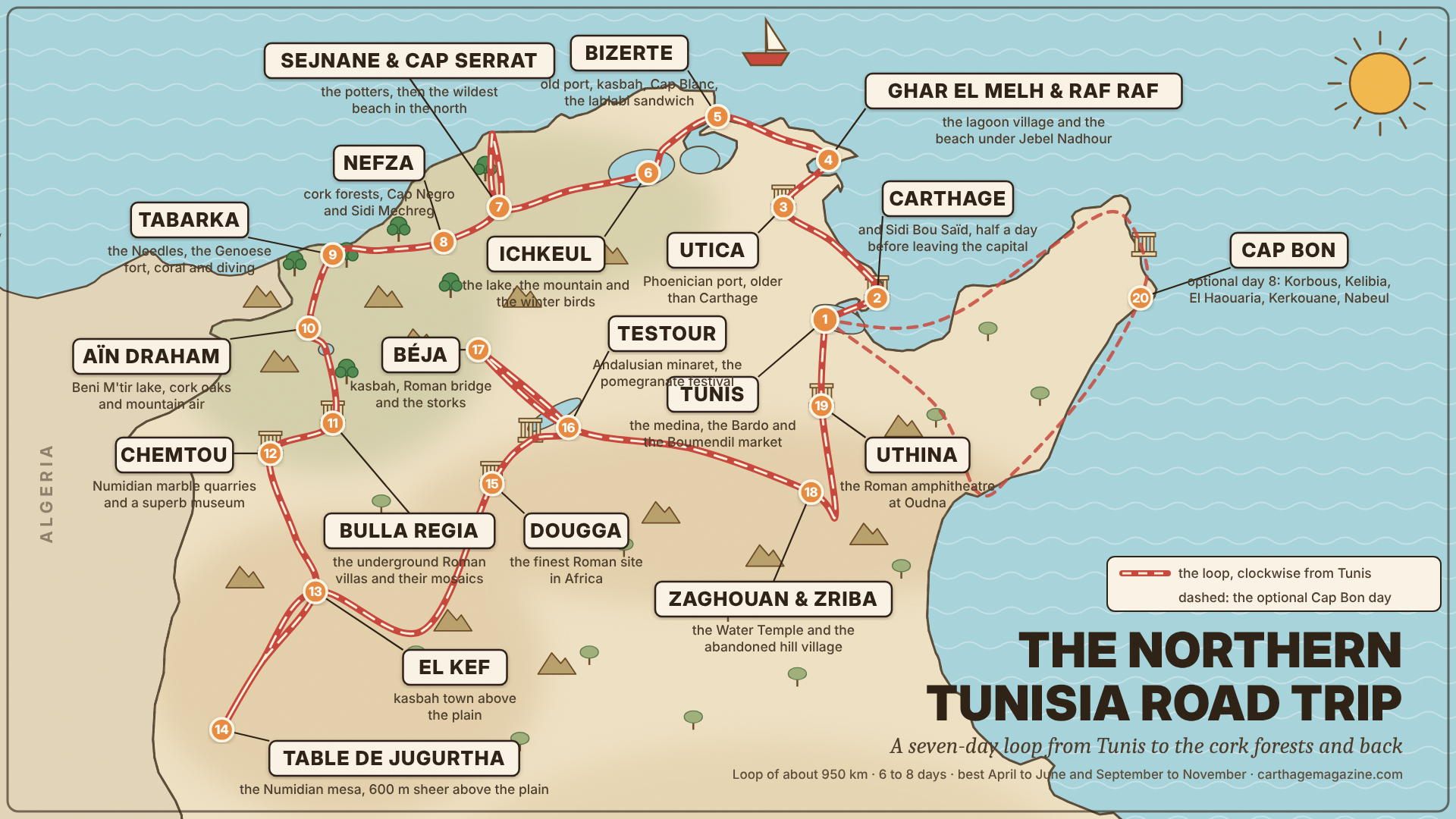
An hour out of Tunis on the road to Bizerte, the country changes colour. The olive-grey of the capital’s hinterland gives way to green, then to a green most visitors don’t associate with North Africa at all: wheat, cork oak, lake, marsh, and a coastline of red headlands and empty coves that runs west to the Algerian border. This is the Tunisia the Romans called their granary and the package tours never reach, and it fits inside a loop of about 950 kilometres that a rental car can drive in a week.
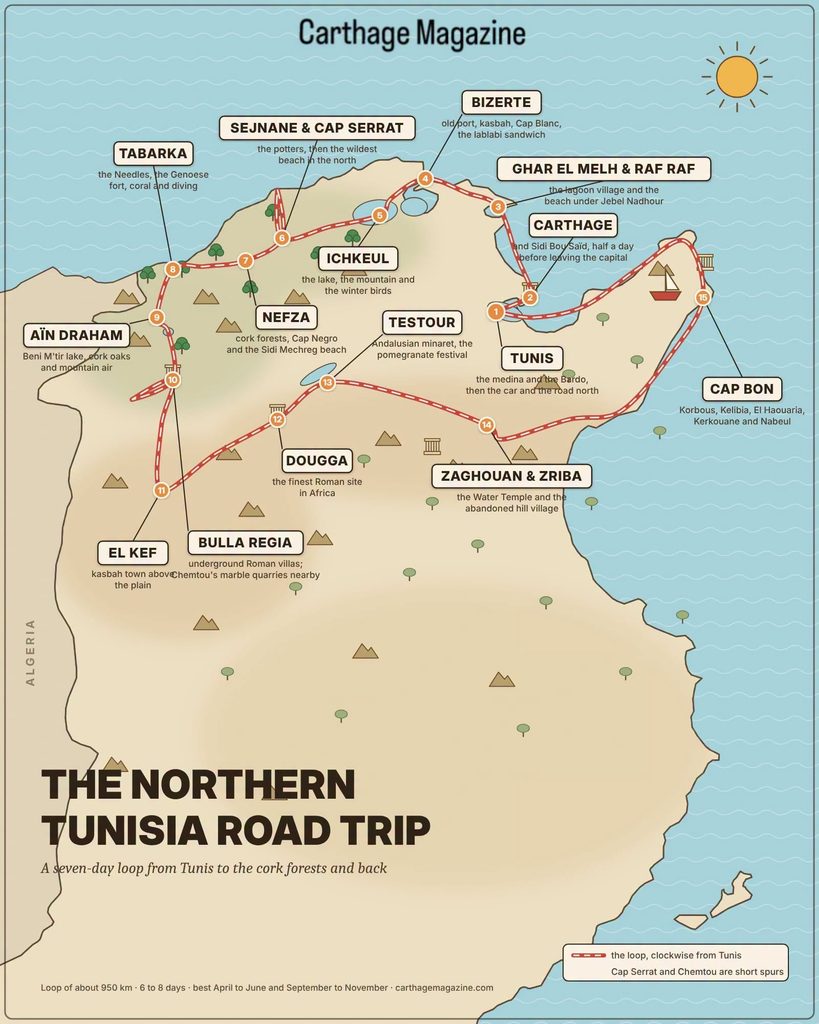
When we posted a map of this loop on Facebook, the replies came in four languages and several of them were corrections. The best of the additions, Utica, Chemtou, Béja, the Table de Jugurtha, Korbous, are now in the guide below, with thanks at the end. One reader noted that our poster had olive trees growing in the sea. It did; it doesn’t any more.
This is the second of our three Tunisian loops. The southern loop runs from Djerba to the Sahara; the central loop, from the Sahel coast to Kairouan and the Roman steppe, follows. Our national road trip samples all three in a week for anyone who only gets one.
The Short Answer
Rent a car in Tunis and drive clockwise: Carthage and Sidi Bou Said → Utica → Ghar el Melh and Raf Raf → Bizerte → Ichkeul → Sejnane and Cap Serrat → Nefza → Tabarka → Aïn Draham and Beni M’tir → Bulla Regia and Chemtou → El Kef and the Table de Jugurtha → Dougga → Testour (with Béja as a detour) → Zaghouan and Zriba → Uthina → back to Tunis, with Cap Bon as an eighth day if you have one.
Seven days is comfortable, five is possible if you cut Cap Serrat and El Kef, ten lets you do Cap Bon properly and sleep twice in the mountains. Every stop is on tarmac. Go in spring (April to June) or autumn (September to November); the north is wet in winter and, unlike the south, perfectly bearable in summer, which is when Tunisians themselves drive it.
Before You Set Off
Collect the car at Tunis-Carthage airport or from a downtown agency; our car rental guide covers deposits, the excess and what to photograph before you drive off. The north’s roads are the best in the country, the A4 motorway reaches Bizerte and the A3 runs west toward Béja and Bou Salem, but the pleasure of this loop is in the secondary roads through the hills, and those are narrow, winding, and shared with tractors, so allow more time than the map says.
Rain between November and March can close the mountain roads around Aïn Draham for a day at a time. The ten road habits to expect from other drivers apply here as everywhere; so does the rule of finishing each day’s driving before dark, and the advice to check your insurance covers driving. A local SIM holds up well in the north except in the deep Kroumirie.
Day 1 – Tunis → Carthage → Utica → Ghar el Melh · 90 km
Give the morning to Tunis on foot before you touch the car: the medina, the Bardo if you haven’t seen it, and, for the readers who insisted, the street markets of Rue Boumendil and Marché Moncef Bey, which are where the city actually shops. Then Carthage and Sidi Bou Said in the early afternoon; our Tunis to Carthage guide has the practicalities.
Then the first thing most itineraries miss. Utica, thirty-five kilometres north on the Bizerte road, is older than Carthage, a Phoenician port that was Rome’s capital of Africa before Carthage was rebuilt, and its ruins sit in a field by the village of Utique with a small museum, the House of the Cascade’s mosaics, and almost nobody there. Three readers asked for it; they are right. From Utica it is half an hour to Ghar el Melh, the lagoon village with its three Ottoman forts, and the beach at Raf Raf under Jebel Nadhour, where you sleep.
Day 2 – Ghar el Melh → Cap Zbib → Bizerte → Ichkeul · 120 km
Take the coast road east first: Ras Jebel, the beach at Cap Zbib and the headlands toward Metline, a short loop that two readers named and that puts you in Bizerte by late morning. The old port, the kasbah, Cap Blanc at the northernmost tip of Africa, and a lablabi sandwich for lunch; Bizerte is the city Tunisians tell you to visit and foreigners rarely do.
In the afternoon, Ichkeul, twenty-five minutes southwest via Mateur: a lake, a marsh and a mountain in a single UNESCO site, where the ducks and geese of northern Europe spend the winter and water buffalo graze the shore. The eco-museum on the mountain and the track along the south bank are the visit; come between November and February for the birds, any time for the view. Sleep in Bizerte.
Day 3 – Bizerte → Sejnane → Cap Serrat → Nefza → Tabarka · 200 km
West on the road to Sejnane, where the women potters still fire their clay in the open as they have for three thousand years; buy from the house, not the roadside stall. Then the detour north to Cap Serrat, twenty-five kilometres of winding road to the wildest beach on the Tunisian coast, a lighthouse, a few fishermen’s cafés and nothing else. It is the stop on this loop people photograph most and remember longest.
Back on the main road, Nefza is the gateway to the Mogods: cork forests, the beach at Sidi Mechreg with its Roman ruins at the water’s edge, Cap Negro, and the village of Ouchtata, which a reader named for its honey and its walnut groves. Then the last forty kilometres along the coast to Tabarka: the Needles, the Genoese fort on its island, coral jewellery in the shops and, if you have a day to spare, the best diving in the country.
Day 4 – Tabarka → Aïn Draham → Beni M’tir → Bulla Regia → Chemtou · 140 km
The road south from Tabarka climbs into the Kroumirie, the mountains that catch the rain and grow the cork oaks and chestnuts that make this corner of Tunisia look like the Pyrenees. Aïn Draham, at 800 metres, is the hill station with the red-roofed houses and the cold air; Beni M’tir, ten minutes beyond it, is the lake behind the 1950s dam, ringed by forest, with a village built for the dam-workers that now has guesthouses and the best walks in the north. Two readers added it; one of them wrote only its name, in Arabic, which is the strongest endorsement in the thread. The Oued Zen national park and the village of Fernana are the detours for anyone with a hiking day in hand.
Down from the mountains to the Medjerda valley and the two Roman sites that justify the whole trip. Bulla Regia is the one with the underground villas, whole houses dug into the ground to escape the summer heat, their mosaics still in place; it is also, as the internet discovered, where a certain logo came from.
Chemtou, twenty minutes west, is the one three readers told us not to leave as a footnote: the quarries that supplied the yellow marble of Rome’s temples, a Numidian altar on the hilltop, a Roman bridge in the river, and a museum built with German help that is among the best in the country. Ghardimaou and the El Feija national park, with its Barbary deer, are forty minutes further toward the Algerian border for anyone who wants to see where the road ends. Sleep in Jendouba, or back up in Aïn Draham.
Day 5 – Jendouba → El Kef → Table de Jugurtha · 180 km
South through the wheat country to El Kef, the kasbah town on its cliff, with the best-preserved medina in the northwest, a Byzantine basilica, a synagogue, and a museum of Berber and nomad life in a former zaouia. Several readers were adamant that El Kef is not a place you merely pass through, and they’re right: give it the afternoon.
The excursion, if the morning allows it, is the Table de Jugurtha, fifty kilometres southwest at Kalaat Senan: a flat-topped mesa rising 600 metres sheer out of the plain, nearly a kilometre and a half long, where the Numidian king held out against Rome. You climb by a staircase cut into the rock and walk a plateau of ruins, cisterns and troglodyte shrines with Algeria spread out below. It is on Tunisia’s UNESCO tentative list, two readers named it, and it is the one place on this loop that nobody who goes ever regrets. Sleep in El Kef.
Day 6 – El Kef → Dougga → Aïn Tounga → Testour (→ Béja) · 160 km
The morning drive east through Le Sers brings you to Dougga, which is the finest Roman site in Africa and is not a matter of opinion: a whole hillside town with its theatre, capitol, forum, baths, temples and brothel intact, and olive groves running down to the valley below. Arrive by nine and you will have it to yourself for an hour.
On the road to Testour, Thignica, the Roman and Byzantine fortress town at Aïn Tounga, is a twenty-minute stop that one Italian reader insisted on and almost no guidebook mentions. Then Testour, the Andalusian town founded by Muslims and Jews expelled from Spain, with its minaret, its pomegranates and, if you’ve timed it for late autumn, its festival.
Béja, half an hour north, is the detour four readers asked for and the town most worth adding to the map: a kasbah on the hill, a Roman bridge over the oued that locals call Trajan’s, a nineteenth-century church, and the storks that nest on it every spring. The surrounding plain is the heart of the Medjerda wheat country, and the Thursday market at Bou Salem (Souk el Khemis to anyone over sixty) is the region’s biggest. Sleep in Testour or Béja.
Day 7 – Testour → Zaghouan → Uthina → Tunis · 170 km
East along the Medjerda and up to Zaghouan, where the Water Temple marks the spring that fed Carthage through the aqueduct, and the abandoned village of Zriba el Alia clings to the mountain above the plain. Then Uthina, at Oudna, half an hour north: the amphitheatre, the capitol and the cisterns of a Roman town on the road to Tunis that three readers named and that you will likely have to yourself. The aqueduct’s arches walk beside the road for the last stretch into the capital.
Day 8 (Optional) – Cap Bon · 220 km
If you have the day, Cap Bon is the loop within the loop and five readers made the same first request: Korbous, the thermal village on the gulf, where the spring of Aïn Atrous pours hot water straight into the sea and people sit in the rock pools at its mouth. Then clockwise round the peninsula: Kelibia’s fort and El Haouaria’s Roman caves, the Punic town of Kerkouane, Nabeul’s pottery and orange-blossom water, the beach at Maamoura, and Hammamet to finish. It makes a long day; two, with a night in Kelibia, is better.
How to Stretch or Shrink It
Five days: Tunis → Bizerte and Ichkeul → Tabarka → Bulla Regia and Chemtou → Dougga and Testour → Tunis, which is the version one reader did in September and is already planning to repeat. Ten days: add Cap Serrat, the Table de Jugurtha, Béja, two nights in Cap Bon, and a night at Beni M’tir. For anyone who wants to keep going from El Kef, as one reader urged, the road south runs to Haïdra, Sbeitla, Makthar and Kairouan, which is where our central loop begins, and the village of Kesra, the highest in Tunisia, is on the way. Without a car, Bizerte, Tabarka, Dougga and El Kef are all reachable by louage, but Cap Serrat, Chemtou and the Table de Jugurtha need wheels or a driver.
When to Go
April to June is the north at its best: green hills, wildflowers, the storks back in Béja, warm but not hot. September to November is the second choice, with the olive harvest in the Medjerda valley and the pomegranate festival in Testour; our autumn guide has the month-by-month detail. Winter is wet and the Kroumirie gets snow, which is its own attraction if you don’t mind the odd closed road. Summer, which empties the south, is fine here; the north coast is where Tunis goes on holiday.
What Readers Would Add
The replies to the map were, as with the southern loop, mostly additions, and most of the good ones are now above. The rest, for a longer trip: the honey villages of the Mogods around Ouchtata; the forest road from Aïn Draham to Hammam Bourguiba; Mateur and the farmland south of Ichkeul; Ras Jebel and the coast to Metline; and Kesra, the Berber village above Siliana that belongs to the central loop but is worth the detour from Dougga.
One reader pointed out that Kasserine governorate alone holds a third of Tunisia’s registered monuments, Thala, Thelepte, Cillium and Sufetula among them; that is the case for the central loop, which comes next. Two others asked for Gabès and Kebili; those are in the southern loop.
Frequently Asked Questions
Yes. Every stop, including Cap Serrat, Chemtou and the Table de Jugurtha, is on tarmac. The last kilometre to the Table’s staircase is a rough track that a small car manages slowly.
Five at a minimum, seven comfortably, ten with Cap Bon and a mountain night or two.
Yes. The roads near the Algerian border around El Feija and Kalaat Senan have routine checkpoints and the usual rural hazards of animals and unlit bends; keep your passport in the car and finish driving by dusk. See Is Tunisia Safe? for the wider picture.
Yes. The staircase is obvious from the village of Kalaat Senan and takes about half an hour up. Take water, a hat and shoes with grip; a local guide at the bottom is cheap and knows the cisterns and shrines on top.
All of them. Béja and El Kef are the current Tunisian spellings; Le Kef is the French one still on older signs; Thugga is the Roman name of Dougga, as Bulla Regia, Chemtou’s Simitthus and Uthina are of theirs.
Bizerte for the coast (days 1–3), Aïn Draham for the mountains and the Roman sites (days 4–5), Testour or El Kef for Dougga and the south (days 6–7).
With thanks to the readers of the Carthage Magazine Facebook page, whose additions, and one correction about olive trees, shaped this guide.
From the Carthage Magazine Bookshelf
Three ebooks for the glovebox, one of which has a chapter on every Roman site on this road.
- All About Tunisia — the definitive English-language traveler’s guide. 572 pages, 27 chapters, all nine regions, every UNESCO inscription, five thematic trails — and the practical answers (visa, currency, transport, etiquette) most travelers wish they’d had on the plane. $24.99 · PDF & EPUB.
- Speak Like a Local — 200+ Tunisian Arabic phrases with native audio recorded in Tunis. The phrases for the taxi, the souk, the café, and the dinner table. $14.99 · PDF, EPUB, MP3.
- The Authentic Tunisian Cookbook — sixty traditional recipes from the heart of North Africa. For when you get home and find yourself missing the food. $9.99 · PDF & EPUB.
All three available as a bundle for $39.99 — guide, language, and food, delivered together.
