

Quick Answer Tabarka is a small port town of around 18,000 people on Tunisia’s far northwest coast, where the cork-oak mountains of the Kroumirie run straight down into the Mediterranean. It is known for four things: a Genoese fort on an island that is no longer an island, the red coral divers still pull from the deep water offshore, some of the best scuba diving in the country, and a jazz festival that made the town famous in the 1970s and has been flickering on and off ever since. It is about three hours from Tunis by road, greener and cooler than anywhere else on the Tunisian coast, and almost entirely free of the package-tourism machinery that shaped Hammamet and Sousse. Come for the landscape and the diving. Stay for the quiet.
There is a stretch of road between Tabarka and the Algerian border where the forest comes down to meet the sea, and if you did not know which country you were in you would not guess Tunisia. There are no palms here. There are cork oaks, their trunks stripped waist-high to a raw orange where the bark has been harvested. There are pines. There is, in winter, the occasional improbable dusting of snow on the high ground inland. The light is northern and soft. The hills are the green of a place that actually gets rain.
This is the Coral Coast, and Tabarka is its capital — such as it is. The town is small, a little faded, and entirely aware that its best-known years are behind it. That is precisely its charm. While the rest of the Tunisian littoral was being rebuilt around all-inclusive resorts, Tabarka was too remote, too mountainous, and too far from an airport to bother. What survived is a real town with a real fishing port, a spectacular fort, and a setting that has no equal anywhere else in the country.
Here is what to know before you go.
The Fort That Used to Be an Island

The thing you will photograph first is the Genoese fort, and it deserves the attention.
For most of its history Tabarka was not a coastal town at all but an island — a rocky outcrop a few hundred metres offshore, easily defended, perfectly placed to control the coral beds and the coastal trade. The Genoese understood this. In 1540 the Lomellini family, a Genoese merchant dynasty, took control of the island as part of a deal involving the ransom of the corsair Dragut, and they built the fort that still crowns it. For nearly two centuries Tabarka was a Genoese trading enclave on the African coast, run for coral and commerce, until the bey of Tunis reclaimed it in 1741.
The island stopped being an island in the twentieth century, when a causeway was built to connect it to the mainland. Today you can walk or drive out to the base of the fort, and the climb up is rewarded with the best view on this part of the coast — the harbour below, the town behind, and the long green sweep of the Kroumirie mountains running west toward Algeria. The fort itself is not always open to the interior, and the structure has suffered from long neglect, but the climb and the setting are the point.
The Needles and the Coast
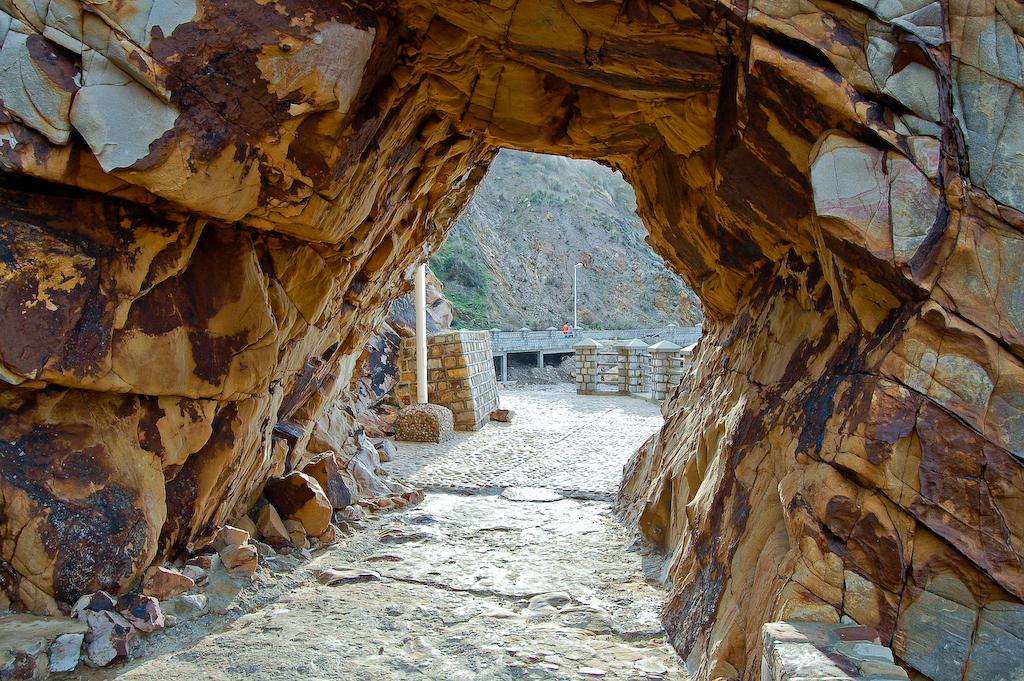
Just west of the harbour stand les Aiguilles — the Needles — a row of weathered sandstone spires rising straight out of the sea and the shoreline, sculpted by wind and water into shapes that have become the town’s second emblem after the fort. They are best in the late afternoon, when the low sun turns the rock amber and the whole formation throws long shadows across the water. A footpath runs out along the shore toward them; it is an easy walk and an essential one.
The coast on either side of Tabarka is a different proposition from the beaches of the Sahel. Some of it is sandy — the long beach east of town is genuinely good — but much of it is rocky cove and clear deep water, sheltered and excellent for swimming. The water clarity here, helped by the rocky bottom and the absence of the heavy development that clouds the water elsewhere, is the best on the Tunisian mainland.
The Coral
Tabarka’s wealth, for most of its history, came from under the water. The deep beds offshore produce red coral — corallium rubrum, the dense, blood-red Mediterranean coral prized since antiquity for jewellery — and the harvesting of it is the reason the Genoese came, the reason the town existed at all, and the reason its old crest carries the coral branch.
Coral is still worked here, though the trade is a shadow of what it was and is now tightly regulated to protect the remaining beds. You will see it in the jewellery shops in town, set into silver, sold by weight. If you buy, buy from an established shop and ask about provenance; genuine, legally harvested Tabarka coral is a real and beautiful thing, and there is a good deal of dyed substitute sold to the unwary.
Diving the Coral Coast
The same deep, clear, life-rich water that produced the coral makes Tabarka the best scuba diving destination in Tunisia.
The underwater landscape here is dramatic — canyons, tunnels, vertical walls, caves, and the coral itself, all within easy reach of the harbour. The visibility is excellent, the marine life is abundant by Mediterranean standards, and the dive sites suit everyone from first-timers to experienced divers looking for the deeper coral walls. Several dive centres operate out of the port and the marina, running courses and guided dives through the warmer months. If you have ever wanted to learn to dive, this is the place in Tunisia to do it.
For those who would rather stay dry, the marina runs boat trips along the coast, and snorkelling off the rockier coves gives a free, shallow version of what the divers go down for.
The Jazz Festival — A Story in Itself
No account of Tabarka is honest without the jazz festival, which is both the best and the most frustrating thing about the town.
It began in 1973, when the promoter Lotfi Belhassine started an international music festival in what was then a small fishing village. For a decade and more it was extraordinary. Miles Davis played here. So did Dizzy Gillespie, Al Di Meola, and Césária Évora. For a brief period in the 1970s and 1980s, this remote corner of the Tunisian coast was a genuine stop on the international music map, and the town’s identity fused with the music in a way that still defines how Tunisians think of it.
Then it got complicated. From the late 1980s onward the festival suffered repeated interruptions — funding shortfalls, management changes, and, at the municipal level, corruption scandals that drained both money and credibility. Editions were cancelled. The festival shifted focus, formats, and even months, sometimes billed for July, sometimes August. The twentieth edition, planned for 2023, was cancelled for lack of funding, and 2024 passed without a festival, though efforts to revive it continue.
The honest advice: do not plan a trip around the festival unless you have confirmed, close to your travel dates, that a specific edition is actually happening and ticketed. Treat it as a wonderful possibility rather than a fixed event. What endures regardless is the legacy — the sense that this small town once punched far above its weight, and the venues, including the open-air sites and the third-century Roman basilica, that hosted the legends.
The Mountains Behind the Town

Tabarka does not end at the shoreline. Behind it rise the Kroumirie mountains, a range of cork oak and pine forest that is unlike anything else in Tunisia — and the gateway to it is the hill town of Aïn Draham, about 25 kilometres inland and a thousand metres up. If your idea of Tunisia is desert and palm, the northwest will reset it. This is hunting-lodge and walking country, cool in summer and genuinely cold in winter, and it pairs naturally with a few days on the coast. We cover it in full in our guide to Aïn Draham.
The wider region also rewards a detour for nature. Inland toward Bizerte lies Ichkeul, a UNESCO-listed wetland and one of the most important migratory bird sites in the Mediterranean, covered in our guide to Tunisia’s national parks.
When to Go
Tabarka is a summer town for the beach and the diving, and a year-round town for the landscape. The water is warm and the diving best from June through September. Spring and autumn are lovely — mild, green, and quiet — and ideal if your interest is walking, the fort, and the coast rather than swimming. Winter is cool, wet, and atmospheric, the season when the contrast between snow-dusted mountains and Mediterranean shore is at its most surreal; the diving centres scale back, but the town is at its most authentic. Note that Tabarka is reliably several degrees cooler and a great deal greener than the rest of Tunisia in every season, which in a Tunisian July is a feature, not a flaw.
Getting There
Tabarka sits in the far northwest, and getting there is part of the experience. By road it is roughly three hours from Tunis, the last stretch a winding, scenic coastal-and-mountain drive. Louages (shared taxis) run from Tunis and from Béja and Jendouba; they are the standard way Tunisians make the trip. There is a small airport nearby — Tabarka–Aïn Draham — but scheduled commercial service has been intermittent at best, so do not count on flying in. Most visitors come by car, either their own rental or a hired driver, which also gives the freedom to combine the coast with Aïn Draham and the Kroumirie. For the bigger picture on moving around the country, see our guide to transport in Tunisia, and for the practical groundwork, our Tunisia travel guide.
Why Bother

Tabarka asks more of a traveller than Hammamet does. It is farther, quieter, and less polished. There is no resort strip engineered to keep you fed and entertained without leaving the grounds. What there is instead is a real place — a fishing port with a Genoese fort on a hill, coral in the deep water, the best diving in the country, a forest at its back, and the long faded glamour of a town that once hosted Miles Davis and never quite forgot it.
It is the corner of Tunisia that looks least like the brochure, and for exactly that reason it is one of the most rewarding. Come for a few days. Dive the coral walls, climb the fort at sunset, drive up into the cork oaks, and let the northwest show you a Tunisia most visitors never see.
From the Carthage Magazine Bookshelf
The northwest is the part of Tunisia the guidebooks thin out on — which is exactly where having the full picture in your pocket helps most:
- All About Tunisia — the definitive English-language traveler’s guide. 572 pages, 27 chapters, all nine regions including the northwest, every UNESCO inscription, and the practical answers (visa, currency, transport, etiquette) most travelers wish they’d had on the plane. $24.99 · PDF & EPUB
- Speak Like a Local — 200+ Tunisian Arabic phrases with native audio recorded in Tunis. The phrases for the louage, the dive shop, the café, and the fish market. $14.99 · PDF, EPUB, MP3
- The Authentic Tunisian Cookbook — sixty traditional recipes from the heart of North Africa. For when you get home and find yourself missing the grilled fish on the harbour. $9.99 · PDF & EPUB
All three available as a bundle for $39.99 — guide, language, and food, delivered together.
