
This article contains affiliate links. If you book through them, Carthage Magazine earns a small commission at no extra cost to you — it’s part of how we keep our guides free and independent.
Quick Answer — Tunisia may be the best self-drive country nobody talks about: compact enough to loop in a week, varied enough that each day changes worlds, with good main roads, cheap fuel, and rental cars from major aggregators at some of the Mediterranean’s lowest rates (compare on DiscoverCars, which shows deposits and insurance excess before you book). The classic loop: Tunis → Cap Bon → Kairouan → Tozeur → the chott crossing → Douz → Matmata → El Jem → the coast → Tunis — roughly 1,400 km, seven days, Roman cities, a holy city, two oasis capitals, a salt lake, Star Wars, and a night in the dunes. Three rules before anything else: never drive rural roads after dark, read our road habits field guide before your first roundabout, and go October–April, when the south is at its best.
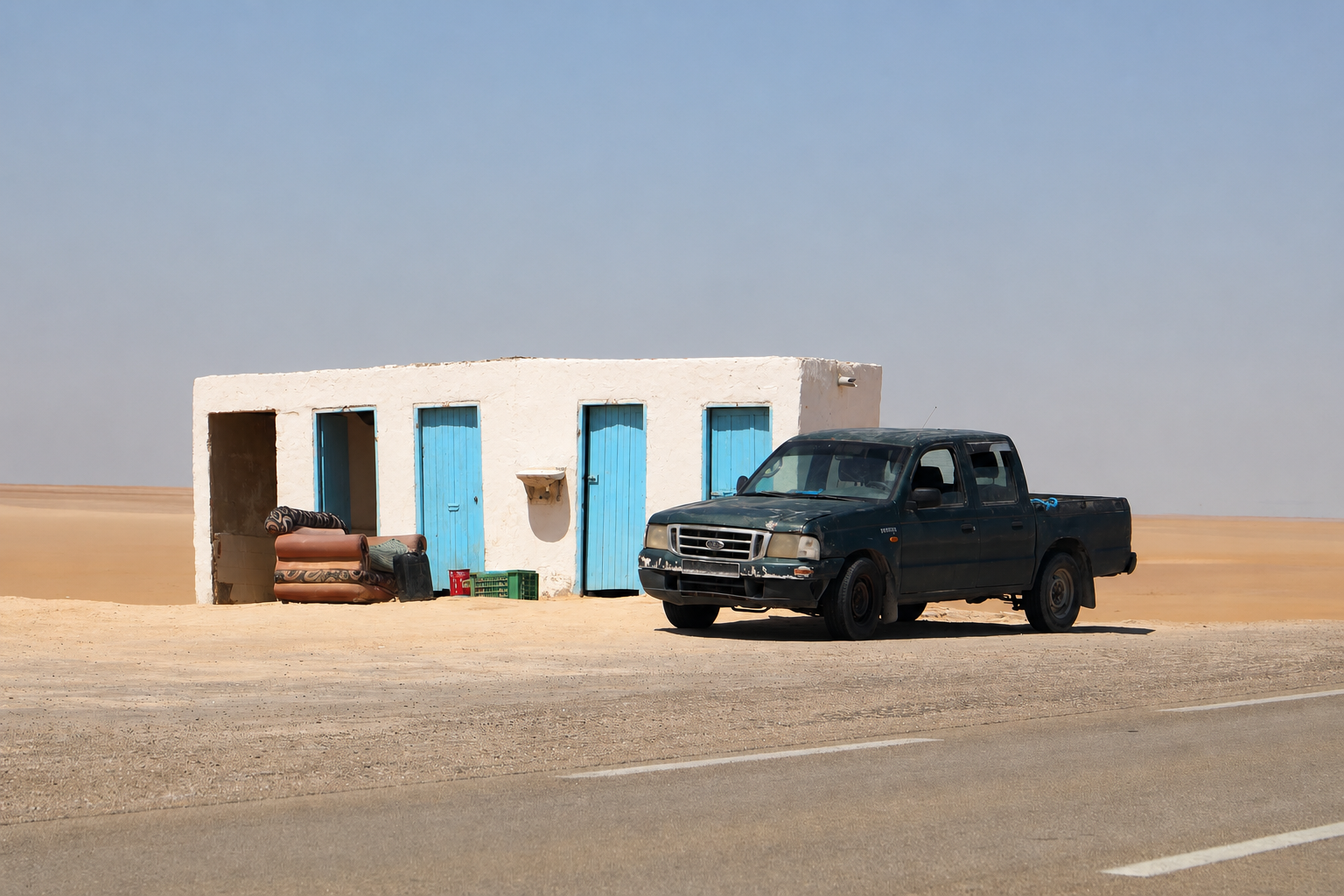
There’s a moment on every Tunisian road trip — usually somewhere on the causeway across the Chott el-Jerid, salt flats running white to both horizons — when you understand why this country was built for the steering wheel. In one week of driving you can cross more distinct worlds than a month of European motorways delivers: vineyard peninsula, Roman granary plains, the Islamic world’s fourth holiest city, a hundred-thousand-palm oasis, the Sahara, and a colosseum standing alone in olive country. This is the route, day by day, honestly annotated.
Before You Turn the Key
The car: a standard compact handles this entire loop — every stop below sits on tarmac. (The only exceptions are deep-sand runs like Ong Jmel/Mos Espa, which you do by local 4×4 from Tozeur anyway.) Book ahead through DiscoverCars to compare the local and international desks with deposits and excess visible up front, and walk through our renting a car in Tunisia guide for the paperwork, the walk-around photos, and the insurance fine print.
The rules that matter: plan every driving day to end by dusk — unlit rural roads are the one genuine hazard here; keep cash for fuel and the occasional toll (stations are plentiful on this route, but fill at half-tank in the south); expect police checkpoints, which for tourists mean a friendly wave-through with passport and rental papers handy; and internalize the ten road habits — especially the national relationship with lane markings.
The kit: offline maps downloaded before the south, data running from day one (an eSIM installed before you fly — the SIM guide compares options), water always, and cover that includes road mishaps — our insurance guide explains what actually matters.
Day 1 — Tunis → Cap Bon (Kelibia) · ~120 km
Collect the car on your way out of the capital (you don’t want it in Tunis traffic) and point east into the Cap Bon peninsula — vineyards, citrus, and the coast road. Stop at Nabeul for pottery and lunch, then run up the east coast to Kelibia: climb the mightiest fortress in the country and swim below it at El Mansoura, the beach Tunisians call their finest. Night in Kelibia or up at El Haouaria by the cliffs. First-day rule applies: park before sunset.
Day 2 — Cap Bon → Kairouan · ~200 km
Round the peninsula’s tip (the Punic ghost town of Kerkouane is twenty minutes from El Haouaria and worth every one), then cut south past Hammamet and inland to Kairouan. Afternoon and evening in the holy city: the Great Mosque, the Aghlabid basins, the carpet souks, and makroudh from the source. Sleep in the medina if you can.
Day 3 — Kairouan → Tozeur · ~300 km, the long one
The transition day: steppe, then desert, via Gafsa. Leave early, lunch in Gafsa, and roll into Tozeur by mid-afternoon — time for a first walk in the brick lanes of Ouled el-Hadef and sunset over the palmeraie. Two nights here; our where to stay in Tozeur guide has the bases, from old-town dars to the Anantara.
Day 4 — Tozeur: Oases and Tatooine · local day
Leave your car resting and take the local 4×4 circuit: the mountain oases of Chebika, Tamerza, and Midès in the morning, Ong Jmel and the Mos Espa set for the late-afternoon light. Evening back in Tozeur among the palms. (Self-driving the mountain-oasis tarmac loop is possible; the dunes to Mos Espa are 4×4-with-local-driver territory, full stop.)
Day 5 — Tozeur → the Chott → Douz · ~130 km
The drive you came for: the causeway across Chott el-Jerid — a salt lake the size of a small country, white and rose and hallucinating mirages by mid-morning. Stop often; it costs nothing and photographs like another planet. Arrive in Douz, gateway of the Sahara, by lunch — then give the afternoon to the dunes: a sunset camel trek at minimum, or better, hand the evening to a camp in the erg and sleep under the entire sky. (Alternative for the hardier: detour to Ksar Ghilane’s hot-spring oasis and camp there.)
Day 6 — Douz → Matmata → El Jem → the Coast · ~330 km
North-east through the moonscape to Matmata — coffee inside a troglodyte pit-house that doubled as Luke Skywalker’s — then down to the plain and up the highway to El Jem for the late-afternoon colosseum, Rome’s third-largest, usually near-empty in the golden hour. Push the last easy hour to the coast: Mahdia for the soft sand and fish dinner, or Sousse for the city (bases for both in our Sousse and Monastir guides).
Day 7 — The Coast → Tunis · ~150 km
A swim, a slow breakfast, then the A1 motorway home — with an optional last flourish at Hammamet’s medina-by-the-sea for lunch. Return the car with the tank matching the contract and the odometer reading like a novel.
Stretching and Shrinking It
With 10 days: add Dougga and the northwest up front, or push deeper south from Douz to Tataouine and the ksour and Chenini — the loop our 10-day itinerary details. With 5: cut Cap Bon, run Tunis → Kairouan → Tozeur → chott → Douz → El Jem → Tunis. Two weeks: the whole country — that itinerary is here. And if driving isn’t your holiday, every leg above has a louage-and-train equivalent in getting around Tunisia — slower, cheaper, sociable.
One closing truth from many laps of this loop: the road trip’s best moments won’t be the famous stops. They’ll be the roadside pomegranate seller outside Kairouan, the mint tea a checkpoint officer insists you accept, the unnamed dune you pulled over for because the light demanded it. Tunisia rewards the traveler with a steering wheel and no particular hurry. Fill the tank, download the maps, and go.
From the Carthage Magazine Bookshelf
Three ebooks for the glovebox.
All About Tunisia — the definitive English-language traveler’s guide. 572 pages, 27 chapters, all nine regions, every UNESCO inscription, five thematic trails — the full country this loop samples. $24.99 · PDF & EPUB
Speak Like a Local — 200+ Tunisian Arabic phrases with native audio recorded in Tunis. Checkpoint small talk included. $14.99 · PDF, EPUB, MP3
The Authentic Tunisian Cookbook — sixty traditional recipes from the heart of North Africa. For recreating the roadside lunches. $9.99 · PDF & EPUB
All three available as a bundle for $39.99 — guide, language, and food, delivered together.
