
Ten days is the number that changes everything. With a week, Tunisia makes you choose between the north and the desert; with ten days, you stop choosing. This is the itinerary that finally crosses the line every shorter trip has to draw — the one between the Roman north and the Saharan south — and it does it without turning the holiday into a forced march. You’ll start in the capital, work down through the holy city of Kairouan and the Roman interior, spend three unhurried days in the oases and dunes of the south, touch the island of Djerba, and climb back up the coast to Tunis with a head full of mosaics, minarets, and Milky Way. It is, if we’re being honest, the trip most people should take.
A word on logistics before the days begin. This route covers real distance, so a rental car is the most flexible way to run it, though trains and louages link most of the stops — our guide to getting around Tunisia lays out both, and the one stretch worth flying is noted below. Travel in the shoulder seasons if you can; the southern sun is no joke in high summer. Sort a local SIM, some dinar, and check the visa rules before you fly.
Day 1 — Tunis: Arrive and Wander
Land at Tunis-Carthage and give the first day to the capital. The medina of Tunis — thirteen centuries of covered souks and tiled palaces — rewards an afternoon of getting deliberately lost, with a mint tea on a rooftop terrace as the reward. Drift down Avenue Habib Bourguiba in the evening and let the jet lag dissolve. Our honest guide to Tunis shows you the parts worth your time.
Day 2 — Carthage, Sidi Bou Said, and the Bardo
Take the TGM north to ancient Carthage, the city that once rivalled Rome, and spend the morning among the Antonine Baths and the heights of Byrsa Hill above the gulf. In the afternoon, climb to Sidi Bou Said, the blue-and-white village on the cliff, and stay for the golden hour. Fit in the Bardo National Museum and its incomparable Roman mosaics either side of the day — it’s the best collection of its kind anywhere, and you won’t get a better one for the rest of the trip.
Day 3 — South to El Jem and Kairouan
Now you move. Break the southbound drive at El Jem, where the third-largest Roman amphitheatre on earth erupts out of a flat modern town with no warning at all — walk the tunnels beneath the arena floor where gladiators once waited. Push on to Kairouan, Islam’s fourth-holiest city, and arrive in time for the medina in the late-afternoon light. Overnight here.
Day 4 — Kairouan to the Edge of the Desert
Give Kairouan a full morning. The Great Mosque — an austere forest of columns salvaged from Carthage and Rome — is one of the most atmospheric buildings in the Maghreb, and the surrounding medina still works for a living, famous for its carpets and its honeyed makroudh. Then turn southwest. Break the long drive at the Roman ruins of Sbeitla, where three honey-coloured temples stand almost intact in a row, before continuing to Tozeur, the great oasis town and your base for the south. The landscape will have changed completely by the time you arrive.
Day 5 — Tozeur, the Oases, and Tatooine
This is desert country at its most cinematic. Spend the day among the mountain oases northwest of Tozeur — palm groves spilling out of bare rock at Chebika and Tamerza — and out on the blinding white crust of the Chott el Jerid, the vast salt lake that shimmers with mirages at midday. Nearby, the abandoned Star Wars sets that became Tatooine still stand half-buried in the sand at Ong Jmel — a strange, joyful pilgrimage whatever your feelings about the films.
Day 6 — Douz and a Night in the Sahara
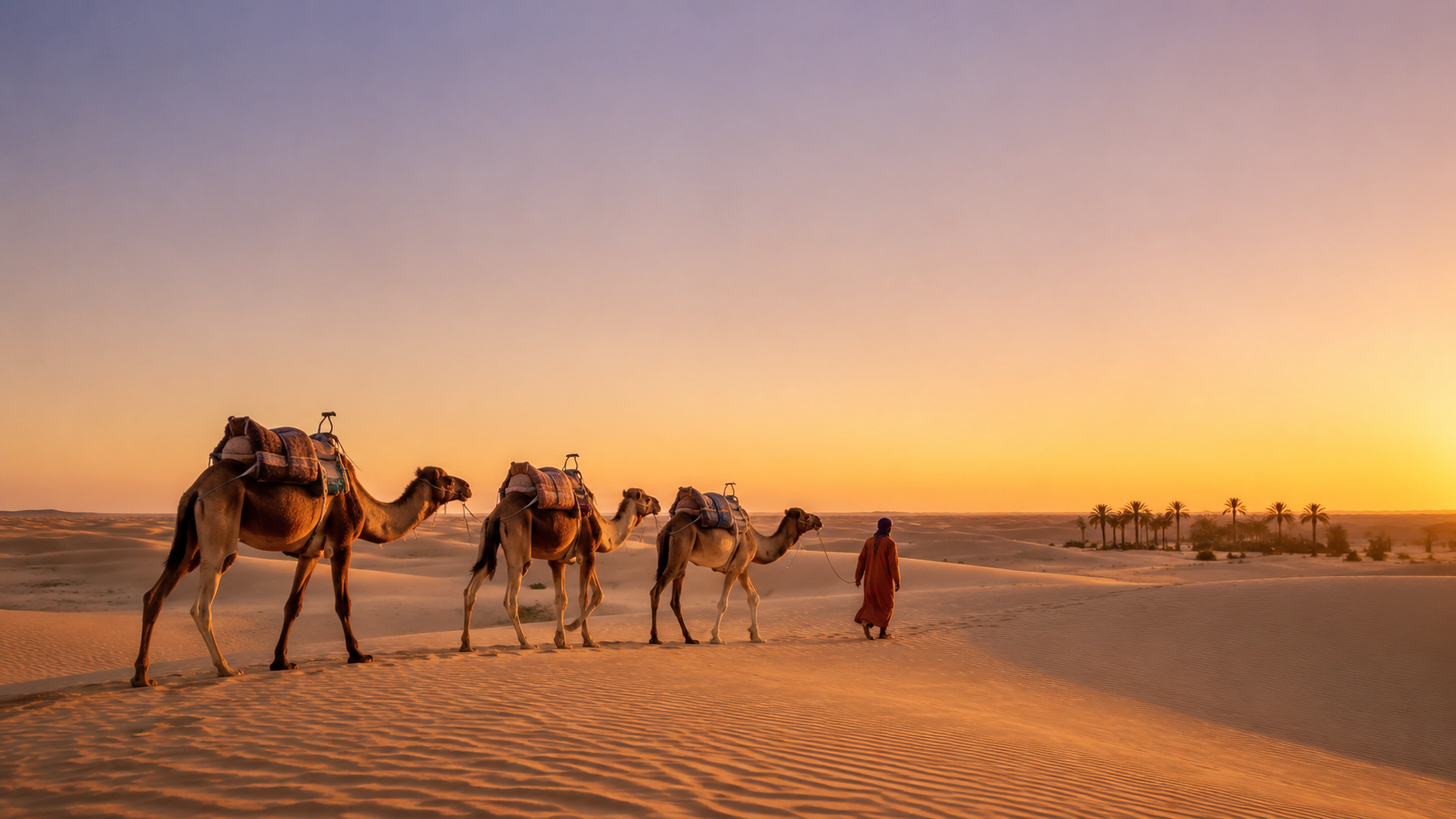
Drive to Douz, the town billed as the gateway to the Sahara, and trade the car for a camel. A desert trek out to a camp among the dunes is the centrepiece of the whole trip: tea by a fire, a dinner cooked in the sand, and a night sky with no light pollution for hundreds of kilometres. Our guide to the Tunisian Sahara covers how to choose an operator and what to bring. Sleep under the stars; wake for the sunrise over the sand sea. Most travelers count this as the morning they remember longest.
Day 7 — Matmata to Djerba
Head east into the lunar hills of Matmata, where Berber families still live in homes carved underground around sunken courtyards — one of them, the Sidi Driss, served as the Lars homestead in the films, and you can have lunch in it. From there, drop to the coast and cross the causeway to the island of Djerba for the night. The mood shifts the moment you arrive: whitewashed, palm-shaded, slow.
Day 8 — Djerba: A Day to Breathe
Earn a slower day. Djerba mixes long Mediterranean beaches with one of the oldest continuous Jewish communities in the world, centred on the El Ghriba Synagogue, the oldest in Africa. Wander the souks of Houmt Souk, eat well, swim, and do very little. After three hard-charging desert days, this is the rest the itinerary is built around — not a wasted day, but the point of having ten.
Day 9 — Up the Sahel Coast
Begin the journey north along the coast. The central Sahel is Tunisia’s holiday heartland and an easy place to break the drive: base yourself in Sousse, the “Pearl of the Sahel,” with its walled medina and kasbah, with luminous Monastir and its sea-facing ribat, and quieter Mahdia, the old Fatimid capital on its slim peninsula, all within easy reach by a local metro line. Pick one as a base and graze across the other two.
Day 10 — Back to Tunis, and Home
The last hop returns you to the capital. If your flight is late, spend the morning on the medina shopping you skipped on day one — the carpet, the Nabeul ceramics, the olive-wood bowl; our guide to what to buy in Tunisia is the honest field manual. Then to the airport, already half-planning the next trip.
The Honest Part: Drive It, or Fly a Leg?
Ten days is enough to do this loop overland, but the long southern legs — Tozeur and Djerba are a full day’s drive each from the capital — are where people lose hours they’d rather spend in the dunes. The honest fix is to fly one leg. Domestic flights and the resumed Tozeur–Tunis service can collapse a brutal drive into an hour, and Djerba’s airport connects straight back to Tunis. The scenic Red Lizard train through the Selja Gorges, meanwhile, is one journey worth taking purely for itself. If even ten days feels tight, our 7-day itinerary keeps you in the north and the Sahel and saves the desert for next time; if you’ve only a long weekend, three days in the Tunis triangle is its own complete trip.
A Few Honest Notes
Distances look small on the map and feel longer on the road, so resist the urge to add a stop — one major site a day, fully enjoyed, beats three half-seen. Book your nights with the route in mind rather than all in one city; our where-to-stay guide breaks it down town by town. Tunisia is welcoming and broadly easy to travel — see our notes on staying safe and our guide for solo and female travelers. And if you want the wider menu of what to fold in, our things-to-do hub gathers it all in one place. Ten days, one loop from sea to Sahara and back, and a country that will spend the whole flight home convincing you it was the start of something.
From the Carthage Magazine Bookshelf
If the route’s taking shape — or the flight’s already booked — three Carthage Magazine ebooks were built for the days between arrival and departure:
- All About Tunisia — the definitive English-language traveler’s guide. 572 pages, 27 chapters, all nine regions, every UNESCO inscription, five thematic trails — and the practical answers (visa, currency, transport, etiquette) most travelers wish they’d had on the plane. $24.99 · PDF & EPUB
- Speak Like a Local — 200+ Tunisian Arabic phrases with native audio recorded in Tunis. The phrases for the taxi, the souk, the café, and the dinner table. $14.99 · PDF, EPUB, MP3
- The Authentic Tunisian Cookbook — sixty traditional recipes from the heart of North Africa. For when you get home and find yourself missing the food. $9.99 · PDF & EPUB
All three available as a bundle for $39.99 — guide, language, and food, delivered together.
