
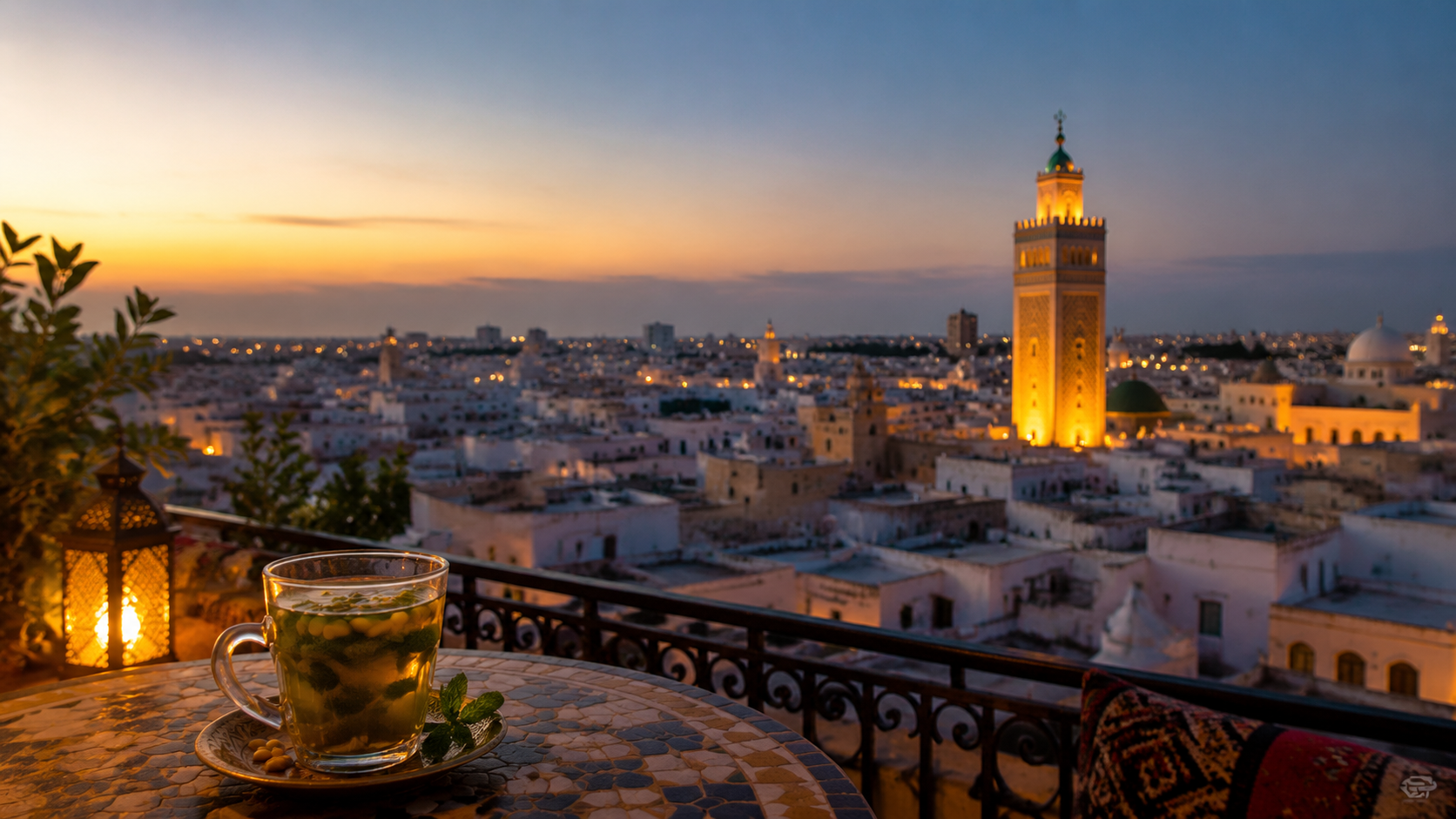
Three days in Tunisia will not show you the country. It will show you the best corner of it — and that turns out to be plenty. A long weekend here is a city break with a coastline attached: a thousand-year-old medina, the ruins of the empire that rivalled Rome, and a blue-and-white village on a cliff, all strung along a single suburban train line that costs less than a coffee to ride. The honest move with seventy-two hours is not to chase the Sahara or the southern oases — they are a day’s drive away and deserve a trip of their own. It’s to stay north, slow down, and let the Gulf of Tunis do the work.
A word on logistics before the days begin. You won’t need a car for this one — the whole itinerary runs on the TGM light rail and your own two feet, which is exactly why it works as a weekend. Sort a local SIM and a little Tunisian dinar at the airport, check whether you need a visa before you fly (most visitors don’t), and aim for spring or autumn if the dates are yours to choose.
Day 1 — Tunis: Land and Get Lost
Land at Tunis-Carthage, drop your bags, and do nothing ambitious. The first afternoon belongs to the medina of Tunis — a UNESCO-listed warren of covered souks, tiled doorways, and hidden palaces that has been trading for thirteen centuries. Don’t navigate; just walk, and let the lanes pull you toward the great minaret of Ez-Zitouna at the medina’s heart. When the heat tips over into late afternoon, climb to a rooftop café for a mint tea and watch the city lay itself out below you.
As the light softens, drift down Avenue Habib Bourguiba — the grand French colonial boulevard, all jacaranda and Parisian façades — and find dinner. Start the trip the right way with a plate of something local: our guide to the foods worth eating in Tunisia tells you what to order. Our honest guide to the capital maps the parts worth your time and the parts you can skip.
Day 2 — Carthage and Sidi Bou Said
This is the day you came for. Take the TGM north along the lake to ancient Carthage, the city that once rivalled Rome and now lies scattered in fragments across a leafy seaside suburb. Spend the morning at the Antonine Baths on the water’s edge and on Byrsa Hill, where the Acropolium crowns the old citadel and the whole Gulf opens out beneath you.
In the afternoon, ride three stops further to Sidi Bou Said, the blue-and-white village on the cliff. Climb the cobbled main street, find a café terrace near the top, and time it so you have a coffee in your hand when the sun goes down and the whole place turns gold. If you have the appetite for one more thing, the Bardo National Museum — home to the finest collection of Roman mosaics on earth — folds neatly into the start of this day before you head for the coast.
Day 3 — One Good Choice
Your last full day is a fork, and the honest advice is to pick one road, not three. If you want sun and stillness after two days on your feet, loop out to the Cap Bon peninsula and end up in Hammamet, the original Tunisian beach town, for a swim and a long lunch by the seaside medina. If you’d rather have one more piece of the ancient world, El Jem — the third-largest Roman amphitheatre on earth — is a doable day trip by train, and standing in that arena is the single most cinematic hour in the country.
Or stay in town and do the medina properly: the shopping you were too jet-lagged to do on day one, a hammam, a slow last meal. A few words of Tunisian Arabic turn the final haggle into a pleasure, and our guide to what to buy in Tunisia tells you what’s worth the suitcase space. Then to the airport, already plotting the return.
The Honest Part: What You Have to Leave Out
Here’s what a long weekend cannot give you, and it’s worth naming so you don’t try. The Tunisian Sahara — Douz, Tozeur, the salt flats of Chott el Jerid, the cave dwellings of Matmata, the Star Wars sets that became Tatooine — is a serious distance south, and folding it into three days means spending the whole weekend in a car. The same goes for the island of Djerba and the green forests of the northwest. Leave them. They are the reason to come back.
If you can stretch the trip even a little, the country opens up fast: our 7-day itinerary adds the holy city of Kairouan and the whole Sahel coast, and the 10-day version finally lets you cross into the desert. But there is no shame in a perfect weekend. Tunis, Carthage, and the blue village are a complete experience at this length — and a quietly persuasive argument, on the flight home, for a longer second visit.
A Few Honest Notes
Keep it loose. Three days disappear quickly, and one site fully enjoyed beats three half-seen. Everything in this itinerary is walkable or a short train ride, so you can travel light and skip the rental car entirely. Tunisia is welcoming and broadly easy — see our notes on staying safe and comfortable and our dedicated guide for solo and female travelers. For where to lay your head, base yourself in central Tunis or the northern suburbs near Sidi Bou Said; our where-to-stay guide breaks down the options. And if the weekend leaves you wanting more — it will — our full things-to-do hub is the map for next time.
From the Carthage Magazine Bookshelf
If the route’s taking shape — or the flight’s already booked — three Carthage Magazine ebooks were built for the days between arrival and departure:
- All About Tunisia — the definitive English-language traveler’s guide. 572 pages, 27 chapters, all nine regions, every UNESCO inscription, five thematic trails — and the practical answers (visa, currency, transport, etiquette) most travelers wish they’d had on the plane. $24.99 · PDF & EPUB
- Speak Like a Local — 200+ Tunisian Arabic phrases with native audio recorded in Tunis. The phrases for the taxi, the souk, the café, and the dinner table. $14.99 · PDF, EPUB, MP3
- The Authentic Tunisian Cookbook — sixty traditional recipes from the heart of North Africa. For when you get home and find yourself missing the food. $9.99 · PDF & EPUB
All three available as a bundle for $39.99 — guide, language, and food, delivered together.
