
This article contains affiliate links. If you book through them, Carthage Magazine earns a small commission at no extra cost to you — it’s part of how we keep our guides free and independent.
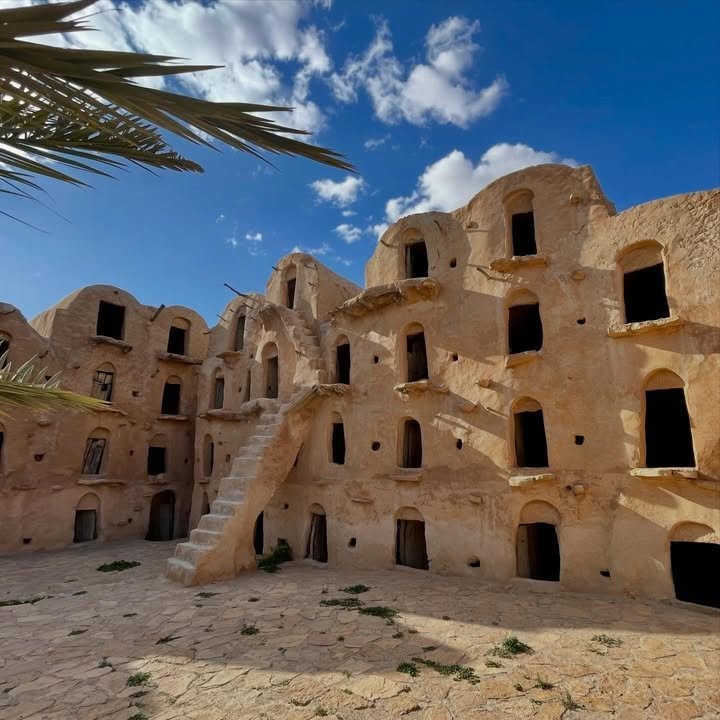
The road into Tataouine runs out of green long before it runs out of road. The Sahel’s olive groves give way to scrub, then to bare ochre hills, and then, on the ridgelines, to something that stops first-time visitors cold: clusters of honeycombed stone cells stacked four storeys high, curving around hidden courtyards, looking less like architecture than like something grown or extruded — or, to a certain kind of traveller, beamed in from another planet. These are the ksour, the fortified granaries of southern Tunisia, and they are the reason a remote governorate most of the world can’t place on a map lent its name to one of the most famous fictional worlds ever invented. Welcome to the real Tatooine.
We’ve written the wider field guide to Star Wars in Tunisia. This is the honest guide to the place the name actually came from — and to why it’s worth the long drive for reasons that have nothing to do with the films.
First, the Name
Yes, it’s true. When George Lucas was scouting locations and working through early drafts of Star Wars in the mid-1970s, he borrowed the name of a real town in southern Tunisia — Tataouine — and respelled it slightly for his desert planet. The word itself is Amazigh (Berber), meaning roughly “springs” or “water sources,” and the town was long known as Foum Tataouine, “the mouth of the springs” — a wry name for somewhere this arid. The connection is real and the locals know it, but here’s the first honest correction: the famous films were shot across two different corners of Tunisia. The iconic Lars homestead and many desert scenes were filmed around Matmata and the western oases near Tozeur and Nefta; the Tataouine region’s contribution was its ksour, standing in for the slave quarters of Mos Espa. Keep the geography straight and you’ll plan a far better trip.
What the Ksour Actually Are
Strip away the cinema and the ksour are extraordinary on their own terms. A ksar (plural ksour) is a communal fortified granary, built by the Amazigh communities of the south to store and protect their most precious resource — grain — through lean years and against raiding parties. The individual storage cells, called ghorfas, are long, narrow, barrel-vaulted chambers, and they were stacked one atop another, sometimes four or five high, around a central courtyard, reached by precarious external stairs. Each ghorfa belonged to a family; the structure as a whole was managed collectively. Built of mud-brick, stone, and gypsum, perched on hilltops for defence, they kept the harvest cool in fierce heat and safe behind a single guarded entrance. They are, in effect, a piece of Amazigh social engineering — cooperation, defence, and survival rendered in clay — and they predate any film set by centuries. To understand them properly is to understand the deep-south chapter of Tunisia’s Berber heritage.
The Ones to See
Ksar Ouled Soltane is the showpiece — the most spectacular and best-preserved of them all, two linked courtyards ringed by ghorfas rising four storeys, beautifully restored, about 20 kilometres south of Tataouine town. It’s the image most associated with the region’s Star Wars fame, though here’s the second honest note: accounts differ on whether Lucas actually filmed at Ouled Soltane or simply visited and was inspired by it, with the confirmed Mos Espa slave-quarter scenes shot at nearby Ksar Hadada (today partly a hotel where you can sleep on the set). Either way, Ouled Soltane is the one you’ll remember.
Beyond the granaries lie the cliff-clinging villages. Chenini is the great set piece — a near-vertical Amazigh village draped over a ridge, crowned by a white mosque, its old troglodyte dwellings carved into the rock. Douiret is its quieter, equally dramatic cousin. Both reward the climb with views across an immense, empty south, and with a glimpse of a way of life — Berber-speaking, cliff-dwelling, fiercely self-sufficient — that has all but vanished. The cave-houses link naturally to the underground homes of Matmata to the northwest, the other half of the south’s troglodyte story.
A Festival and a Falling Star
Two footnotes that locals love. Each March, Tataouine hosts the Ksour Festival (the Festival International des Ksour Sahariens), a celebration of southern heritage — poetry, music, horsemanship — that is the deep south’s quieter answer to the Sahara Festival at Douz. And in 1931, a meteorite fell just outside the town; the rare “Tatahouine” meteorite turned out to be a fragment of the asteroid Vesta, and a desert bacterium later found on it was named Ramlibacter tataouinensis in the town’s honour. Even the rocks here have stories.
Doing It Honestly
This is Tunisia’s deep south, and it asks for a little planning. Tataouine sits in the far southeast, most easily reached via Medenine, with the nearest airport on the island of Djerba — itself a Star Wars site, since the village of Ajim doubled for the Mos Eisley spaceport. The ksour circuit (Ouled Soltane, Ksar Hadada, Chenini, Douiret) is spread over rough back-roads; a 4×4, a hired driver, or an organised tour makes it far less stressful than going it alone. Most travellers fold it into a southern loop with Matmata and the Sahara — our Sahara desert field guide and camel-trekking guide cover the wider routes, and the day-trip gateways from Djerba are a practical way in. Go in the cooler months — roughly October to April — since high summer here is genuinely punishing. And give it more than a rushed half-day: the silence, the light, and the scale of the place are the point, and they don’t reveal themselves at speed. For where it fits in a bigger trip, see our things to do in Tunisia bucket list.
You can come for Tatooine. You’ll leave talking about the ghorfas.
By the way, the ksour reward wheels more than almost anywhere in Tunisia: Hadada, Ouled Soltane, and the hill villages sit at the ends of quiet, sealed roads that a louage serves rarely or not at all, and half the pleasure is stopping where the ridgeline demands it. Most visitors collect a car at Djerba’s airport and cross the causeway; DiscoverCars compares the agencies there for your dates, deposit and excess included, and our rental guide handles the rest of the paperwork.
From the Carthage Magazine Bookshelf
If the deep south is on your map — the ksour, the cave villages, the long desert roads — three Carthage Magazine ebooks were built for the journey:
- All About Tunisia — the definitive English-language traveler’s guide. 572 pages, 27 chapters, all nine regions including the Saharan south, five thematic trails, and the practical answers most travelers wish they’d had on the plane. $24.99 · PDF & EPUB
- Speak Like a Local — 200+ Tunisian Arabic phrases with native audio recorded in Tunis. The phrases for the road, the guide, and the village café. $14.99 · PDF, EPUB, MP3
- The Authentic Tunisian Cookbook — sixty traditional recipes from the heart of North Africa, including the breads and stews of the south. $9.99 · PDF & EPUB
All three available as a bundle for $39.99 — guide, language, and food, delivered together.
