
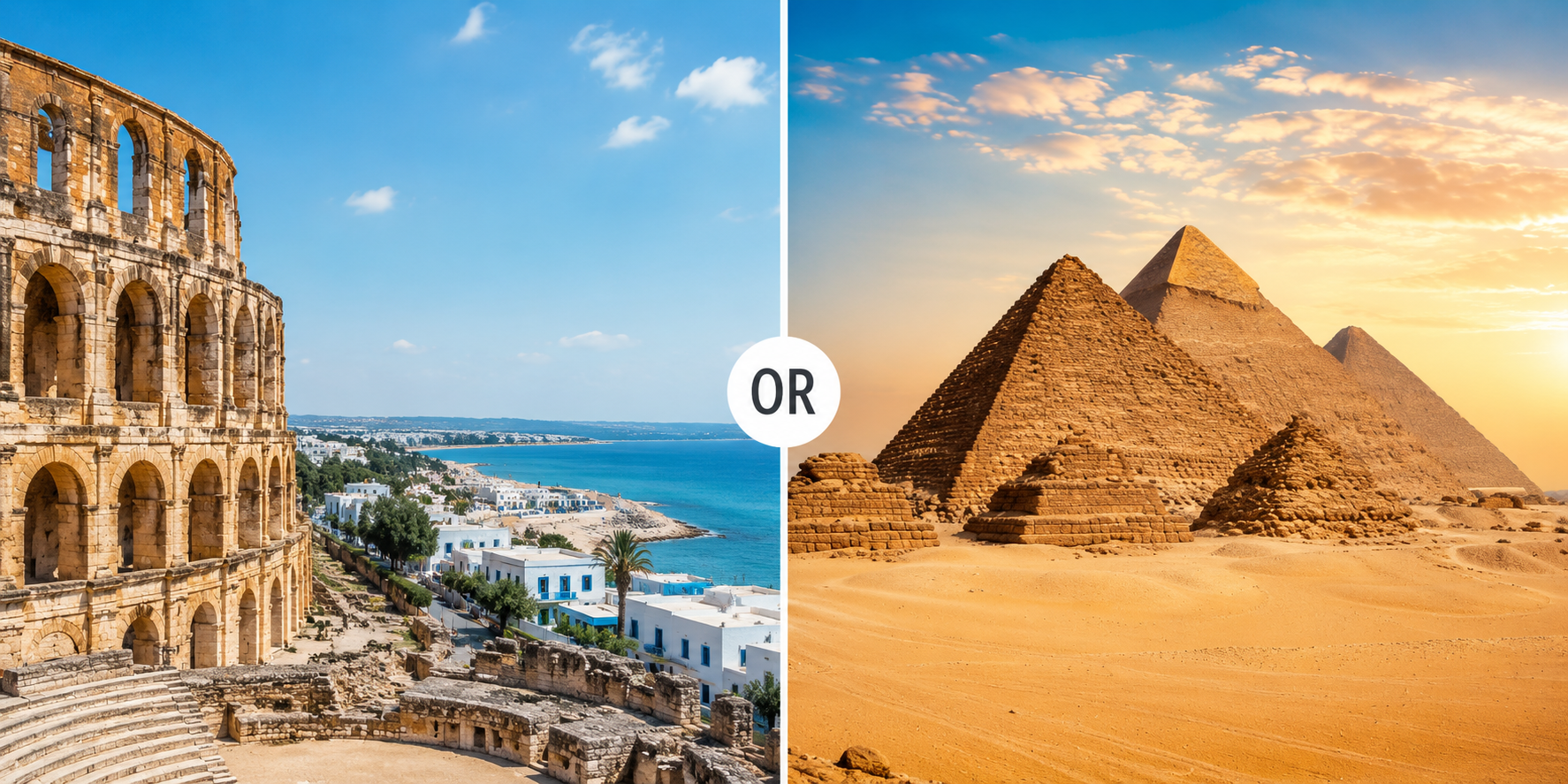
Quick Answer These are the two most different trips in this part of the world, which makes the comparison easier than it looks. Egypt is the heavyweight — the Pyramids, the Nile, Luxor, the new Grand Egyptian Museum, five thousand years of pharaonic deep time, and a bucket-list weight nothing in the Mediterranean can match. Tunisia is the lighter, gentler, more relaxed trip — Carthage and Rome instead of the pharaohs, warm Mediterranean beaches, far fewer crowds, far less hassle, and a small country you can actually see in a week. Egypt wins, decisively, on monumental antiquity and once-in-a-lifetime spectacle. Tunisia wins on ease, beaches, quiet, and the absence of the constant transactional pressure that wears travelers down at the Egyptian monuments. Prices are close — both are cheap. If you have one trip and you have never stood in front of the Pyramids, go to Egypt. If you want the calm Mediterranean version of the ancient world, go to Tunisia. If you can do both, do both: they barely overlap.
Let me be straight about where I’m sitting before you weigh a word of this.
I’m writing from Tunis. You can see the masthead, and you should apply whatever home-team discount feels right. I’ve tried hard to be fair to Egypt, a country I admire without reservation and one that does several things no other country on earth can do. Where Egypt wins — and it wins some categories so completely that there is no argument to be had — I’ll say so plainly and early.
The second thing is that, of all the “Tunisia or—?” questions, this is the one where doing both makes the most sense. Egypt and Tunisia are not variations on a theme the way Tunisia and Morocco are. One is a river civilization built around the pharaohs and the desert; the other is a Mediterranean country built around Carthage, Rome, and the sea. They scratch different itches. Most travelers who can manage two trips over the coming years should take both, in either order, and never feel they repeated themselves.
But most people reading this can only do one in the near future. So: which one fits the trip you actually want?
The Honest Short Answer
If you want the single greatest hits of the ancient world — the Pyramids of Giza and the Sphinx, a slow boat down the Nile, the temples of Karnak and Luxor, the painted tombs in the Valley of the Kings, and the brand-new Grand Egyptian Museum with the full treasure of Tutankhamun under one roof — go to Egypt. Nothing in the Mediterranean competes with this, and you should not pretend otherwise. It is a once-in-a-lifetime trip and it earns the phrase.
If you want a calmer, warmer, beach-leaning Mediterranean trip with a different ancient world attached — Carthage, the Roman cities, the world’s greatest collection of mosaics, swimmable sea from May to October, and the chance to walk extraordinary ruins with almost no one else in them — go to Tunisia. It is the gentler, lower-effort, lower-stress country, and in 2026 it is significantly underrated.
Most readers will already know which of those they are. The rest of this is for the ones who don’t.
How They Compare — Geography, Scale, Climate
Egypt is a country of more than a hundred million people strung along a single river through an otherwise near-total desert. It is large in distance and larger in logistics: Cairo to Luxor is a flight or an overnight train, Luxor to Abu Simbel another long haul south, the Red Sea resorts off in their own direction entirely. A proper Egypt trip is really three or four trips stitched together — Cairo and the Pyramids, the Nile between Luxor and Aswan, and usually a stretch of Red Sea coast — and it runs on internal flights, cruise boats, and early starts. Egypt had around fifteen million international visitors in 2024, a record, and the infrastructure is built for them, hassle and all.
Tunisia is a country of twelve million on the eastern edge of the Maghreb, just south of Sicily, with one long Mediterranean coast and the Sahara beginning about five hours south of the capital. It is small — you can drive its full north-to-south length in a day — and most trips orbit a single base in Tunis or on the coast, with manageable day trips out to the ruins and the sea. The logistics are light. You are rarely more than a few hours from where you started.
Both are hot, dry, and sunny for most of the year. Egypt is the more extreme — Upper Egypt in summer is punishing, and the season that works for the Nile and the temples (roughly October to April) is the opposite of a beach season. Tunisia is milder and more uniform, with a long warm Mediterranean summer that is the whole point of the coast. If your image of the trip is a swim, Tunisia’s calendar is friendlier; if it’s a temple at dawn, Egypt’s cooler months are when you go.
Where Egypt Wins
Let me start with the categories where Egypt is simply the better choice — and some of them are not close.
The Pyramids. There is one wonder of the ancient world still standing, and it is on the edge of Cairo. The Great Pyramid is around four and a half thousand years old, and standing at its base reorganizes your sense of scale and time in a way photographs never prepare you for. Tunisia has remarkable antiquity. It does not have this. Nothing does. If the Pyramids are on your list, the comparison is over before it starts.
The Nile. A few days on a boat between Luxor and Aswan — temples in the morning, the green ribbon of farmland sliding past in the afternoon, the desert pressing in behind it — is one of the great experiences in travel, and it has no equivalent anywhere on the Tunisian map. The Nile cruise is the spine of an Egypt trip and a genuine reason to choose the country.
The density of pharaonic monuments. Karnak. Luxor Temple. The Valley of the Kings and its painted tombs. Abu Simbel. Egypt’s concentration of monumental, intact, world-historic sites is unmatched, and the civilization behind them ran for three thousand years before Carthage was even founded. Tunisia’s headline antiquity — Punic and Roman — is younger and, for all its richness, a different and smaller story.
The Grand Egyptian Museum. Egypt’s single biggest recent draw opened fully on the Giza plateau in November 2025. It is the largest museum in the world dedicated to a single civilization, it holds more than a hundred thousand objects, and for the first time it displays the entire Tutankhamun treasure in one place, within sight of the Pyramids. It is a new and powerful reason to go now.
Red Sea diving. Sharm el-Sheikh, Hurghada, Dahab, Marsa Alam — warm water, world-class coral, and some of the best and most affordable diving on the planet. Tunisia’s Mediterranean is lovely for swimming but is not a diving destination in this league. If your trip is partly underwater, Egypt wins.
These are real, and several are decisive. If any of them is the reason you’re going, book Egypt and don’t look back.
Where Tunisia Wins
Now the other side of the ledger — and there is more here than people expect.
The hassle factor. This is Tunisia’s biggest honest advantage, and anyone who has done both trips knows it. Egypt’s major monuments run on an intense, persistent culture of tipping, unsolicited “help,” and transactional pressure — baksheesh at every turn, a hand out beside every photograph, a negotiation attached to every small thing. Most travelers learn to manage it; many find it genuinely tiring by the end. Tunisia has the same dynamic in its tourist concentrations, but at a far lower volume. The medinas are working districts where most shopkeepers don’t depend on visitors, and the relief of moving through a country without the constant low hum of being sold to is, after a week in Egypt, hard to overstate.
Crowds at the ruins. Egypt’s headline sites are busy in the way world-famous sites are busy — Giza, Karnak, and the Valley of the Kings are shared with very large numbers of people. Tunisia’s ancient sites are nearly empty. The amphitheatre at El Jem is the third-largest Roman colosseum ever built and you may share it with a dozen others. Dougga on a weekday morning will have a handful of visitors in it. If the experience you want is great ruins without the crowd, Tunisia is uniquely well-placed right now.
Beaches. Egypt’s beach life is mostly on the Red Sea, in its own resort world, separate from the antiquities — and its Mediterranean coast is thin. Tunisia’s entire coastline is Mediterranean, the water is warm from May through October, and the beaches sit close to everything else: the ruins, the medinas, the food. From Djerba and the Kerkennah Islands to the long sand of Cap Bon, the swim is built into the trip rather than bolted on.
Ease and compactness. Tunisia is a small, single-coast country you can actually grasp in a week. There are no internal flights to schedule, no overnight repositioning, no three-region itinerary to assemble. Egypt rewards effort and planning; Tunisia rewards just showing up. Our seven-day itinerary does the whole arc — capital, ruins, coast — without a single internal flight.
Proximity to Europe. Most of Western Europe reaches Tunis in two to three hours. Egypt is further — four to five hours from the same cities — and a heavier journey at both ends. For a short trip from Europe, Tunisia is the easier landing; the full breakdown of getting there is here.
Wine and openness. Tunisia is relaxed about alcohol — wine, beer, and spirits are widely and unremarkably available, and the country has a quietly excellent wine industry with three thousand years of viticulture behind it. Egypt is more restrictive in daily life, though tourist zones manage. If a cold glass of wine with grilled fish on a Mediterranean evening is part of the picture, Tunisia is the easier country.
Where It’s Genuinely Close
A few categories where the honest answer is “it depends.”
Value. Unlike the comparison with Morocco — where Tunisia clearly wins on price — this one is close. Egypt is also a very cheap country for foreign visitors, and after recent currency moves it can be cheaper than Tunisia on a raw price-tag basis. Where Tunisia pulls ahead is value without friction: the price you see is closer to the price you pay, without the running tax of tips and negotiations that quietly inflates an Egypt trip. Both are excellent value. Egypt may win on the sticker; Tunisia wins on the total. Our cost-of-living guide has the Tunisian numbers.
Food. Closer than the food world admits. Egypt’s cooking is hearty, ancient, and distinctive — koshari, ful medames, ta’meya, the street food of Cairo. Tunisian food is more Mediterranean, more vegetable- and sea-driven, and considerably spicier, built around the brik, couscous, grilled fish, and harissa, which is Tunisian, UNESCO-listed, and now globally famous. Egypt has the more filling comfort food; Tunisia has the brighter, more varied table. Most travelers come away having loved both for different reasons — which is the honest verdict on Tunisian food generally.
The desert. Both countries deliver a serious Sahara. Egypt’s Western Desert — the surreal chalk formations of the White Desert, the oasis of Siwa — is otherworldly and unlike anything in Tunisia. Tunisia’s south — the Grand Erg Oriental around Douz and Tozeur, and the original Star Wars film sets — is closer, cheaper, and far less touristed. Egypt’s desert is the more astonishing; Tunisia’s is the more accessible. Both are the real thing.
The ancient world, by era. This is taste, not quality. Egypt is the place for the pharaonic — pyramids, pharaohs, hieroglyphs, deep time. Tunisia is the place for the Punic and Roman — Carthage, the rival that made Rome tremble for a century; the largest Roman mosaic collection on earth at the Bardo; cities like Dougga and Sbeitla among the best-preserved anywhere. If the ancient world you’ve always wanted to see is the world of the pharaohs, Egypt. If it’s the world of Hannibal, Rome, and the Mediterranean, Tunisia.
A Decision Matrix: Who Should Choose Which
Choose Egypt if:
- You have never seen the Pyramids and they are a life-list item
- A Nile cruise is central to the trip you’re imagining
- You want the densest concentration of monumental antiquity on earth
- The new Grand Egyptian Museum and the full Tutankhamun treasure are a draw
- You want world-class Red Sea diving
- You don’t mind crowds, heat, internal flights, and a persistent hassle culture as the price of the spectacle
- The trip is, frankly, a once-in-a-lifetime bucket-list expedition and you want it to feel like one
Choose Tunisia if:
- You want a calmer, warmer, lower-effort Mediterranean trip
- Carthage, Rome, and the world’s best mosaics are the ancient world you’d rather walk
- You want to swim — warm, easy, close to everything
- You’d rather have great ruins largely to yourself than famous ones full of tour groups
- You’re tired of being sold to and want hospitality without the hard edge
- You’re flying from Europe and want a short hop, not a long haul
- You want wine with dinner
- You can only spare a week and want to actually see the country in it
Do both if:
- You have two trips’ worth of time and budget over the next few years
- You care about the ancient Mediterranean and the ancient Nile as two halves of one story
- You want the contrast — because these two trips are different enough that one makes the other better
Almost no one who does both regrets it. The smart order, if you’re asking, is Egypt first — it’s the heavier, more demanding trip, and it’s a hard act to leave for last — then Tunisia as the gentler, slower reward. The contrast does the rest.
A Word on Combining Them
You cannot drive between them: Libya sits in the middle, and that border is not a traveler’s route. But unlike some pairings, you can stitch these together by air — there are direct flights between Cairo and Tunis, a little over two hours apart — so a single long trip with a Cairo leg and a Tunis leg is genuinely feasible. The catch isn’t logistics; it’s tempo. Egypt is intense and Tunisia is calm, and most people who try to do both back-to-back find the contrast works best with a clear break between them rather than a hurried hand-off. If you only have two weeks, pick one and do it properly. If you have three, Egypt then Tunisia, with a breath in between, is a magnificent month.
A Last Honest Word
Egypt is one of the genuinely unmissable countries on earth, and I won’t pretend a small Mediterranean neighbor can answer the Pyramids. If you have one trip in you and you’ve never seen them, that’s your trip, and you’ll come home changed by it. Egypt earns every superlative it gets.
But Egypt is also a lot — the heat, the distances, the crowds, the steady transactional pressure that turns a great day at Karnak into a slightly exhausting one. Tunisia is the opposite kind of trip. It is small, warm, calm, and quietly extraordinary: the ruins are empty, the sea is open, the wine is good, and the welcome you get as a foreign visitor is the unembarrassed warmth of a country that still plainly wants you there. It is, in 2026, very much worth visiting — and almost no one expects how much.
If you want the experience everyone will recognize the moment you get home, Egypt. If you want the one that surprises you most — the quieter ancient world, with a beach attached — Tunisia.
And if you can do both, do both. Just don’t try to do them in the same breath.
From the Carthage Magazine Bookshelf
If the Tunisian half of the trip is booked — or close to it — three Carthage Magazine ebooks were built for the days between arrival and departure:
- All About Tunisia — the definitive English-language traveler’s guide. 572 pages, 27 chapters, all nine regions, every UNESCO inscription, five thematic trails — and the practical answers (visa, currency, transport, etiquette) most travelers wish they’d had on the plane. $24.99 · PDF & EPUB
- Speak Like a Local — 200+ Tunisian Arabic phrases with native audio recorded in Tunis. Egyptian Arabic is the dialect the world learned from films; Tunisian Derja is its own language, and the phrases for the taxi, the souk, the café, and the dinner table are here. $14.99 · PDF, EPUB, MP3
- The Authentic Tunisian Cookbook — sixty traditional recipes from the heart of North Africa, for when you get home and find yourself missing the food. $9.99 · PDF & EPUB
All three available as a bundle for $39.99 — guide, language, and food, delivered together.
