
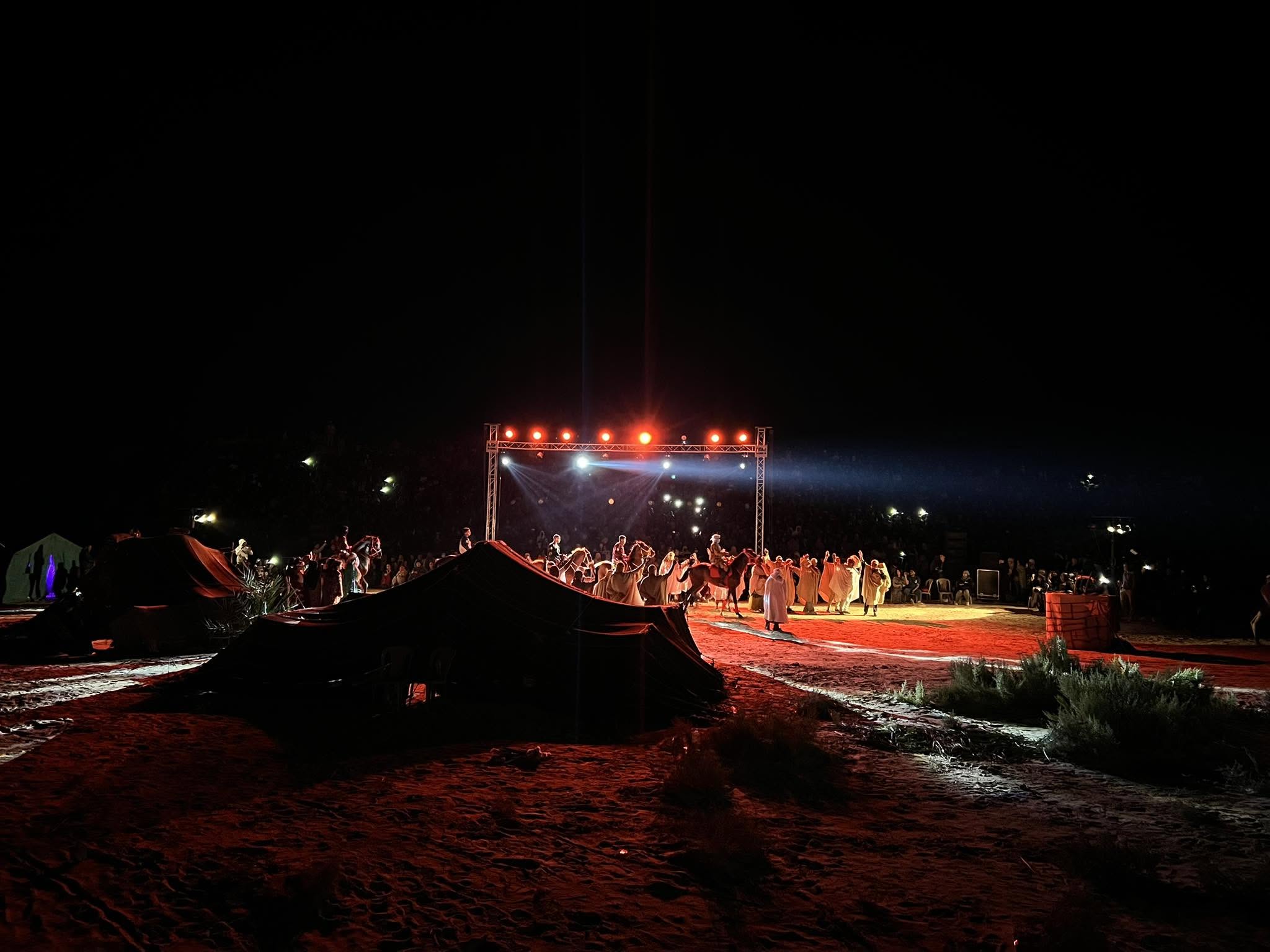
The dunes begin where the town ends. In Douz, the last real settlement before the open Sahara, the palm groves simply stop and the sand takes over, and it is there — on the edge of nothing — that the country stages one of its oldest and strangest celebrations. For four days each December, the H’naïch grounds fill with Bedouin tents, the air thickens with dust and drumming, and riders thunder across an improvised arena on camels and Arab horses while thousands watch from the slope of the dunes. This is the Festival International du Sahara de Douz, and it is the closest thing Tunisia has to a living museum of the nomadic world — held not behind glass, but out in the wind.
For travellers, Douz is already known as the gateway to the Tunisian Sahara. The festival is the one week of the year when the gateway throws itself open.
A Festival That Began as a Marriage Market
The event’s origins are humbler and more human than the spectacle suggests. It began in 1910, under the French protectorate, as a camel festival and a gathering of the desert tribes — and, by long tradition, as a kind of marriage market, where nomadic families met across the dunes to trade, to talk, and to size up prospective husbands and wives for their sons and daughters. After independence, the celebration was reshaped into a national showcase: it took its modern identity in 1967, championed by President Habib Bourguiba as a way to honour and preserve the desert heritage, and from 1981 it widened its doors to performers and visitors from across the Maghreb and beyond. Much of the credit for keeping the nomadic memory alive belongs to the writer M’hammed Marzougui, who devoted his life to recording the traditions of the south.
What has not changed is the festival’s anchor in the Mrazig, the Arab-Berber nomadic tribe of the Douz region, whose music, poetry, dress, and horsemanship still set the tone of the whole event.
What Actually Happens at H’naïch Square
After an opening ceremony, the main events unfold on the H’naïch grounds at the edge of the sand, ringed by Bedouin tents. The programme leans hard into the skills of desert life. There are camel races — long, chaotic, exhilarating sprints across the open ground — and meharis (racing dromedary) displays. There is the fantasia, that heart-stopping set piece in which lines of riders gallop their Arab horses at full tilt and fire muskets into the air in a single crack of smoke and noise. There are demonstrations with sloughis, the elegant desert greyhounds bred by the nomads for the hunt, and exhibitions of traditional camel-handling that can edge, for some visitors, into uncomfortable territory.
Woven between the arena events is the gentler half of the festival: Bedouin poetry recitals and contests, where the oral tradition of the desert is performed and judged; a reenacted nomad wedding, the bride carried through the crowd in a jahfa, the canopied litter mounted on a camel’s back; folk music and dance late into the cold desert evenings; a date fair celebrating the prized deglet nour; craft stalls, exhibitions, and conferences on the future of nomadic culture. It is part rodeo, part folk concert, part family reunion for a way of life that modernity has all but ended.
An Honest Note Before You Go
Two honest caveats. First, the festival involves working animals and traditional hunting and handling displays; travellers who are sensitive to that should know it in advance and can simply choose which events to watch. Second — and this trips up almost everyone — the dates are notoriously fluid. The festival lands at the end of December and usually runs four days, but the exact dates are frequently confirmed only weeks beforehand and can shift, and the daily programme often runs on desert time rather than the printed schedule. Treat any advance date as provisional, build in slack, and arrive at events early to claim a spot. Douz’s hotels fill fast in festival week, so book well ahead.
When It Happens and How to Get There
Plan for late December — typically the third or fourth week — and confirm closer to the time through the festival’s official channels. Douz lies in the Kébili Governorate, roughly 500 kilometres south of Tunis and about three and a half hours by road from Djerba. Most visitors reach it as part of a southern circuit rather than a standalone trip; our Sahara desert guide and our honest guide to camel trekking and desert tours cover the routes and operators. If you’d rather sleep among the dunes than in town, our piece on glamping under the stars at Douz is the place to start.
Make a Trip of It
December is, in many ways, the ideal month for the deep south — the heat has broken and the desert light is at its clearest. Douz pairs naturally with the cave-dwellings of Matmata, the cliff-side oasis of Chebika, and a ride on the Lézard Rouge, the restored beylical train that threads the Selja gorges. Build the festival into a week down south and it stops being an event you attend and becomes the centrepiece of a journey. For inspiration on the rest, our things to do in Tunisia bucket list is written from Tunis, with the south firmly in mind.
From the Carthage Magazine Bookshelf
If the desert is calling — Douz, the dunes, the long road south — three Carthage Magazine ebooks were built for the journey:
- All About Tunisia — the definitive English-language traveler’s guide. 572 pages, 27 chapters, all nine regions including the Saharan south, five thematic trails, and the practical answers most travelers wish they’d had on the plane. $24.99 · PDF & EPUB
- Speak Like a Local — 200+ Tunisian Arabic phrases with native audio recorded in Tunis. The phrases for the road, the market, and the campfire. $14.99 · PDF, EPUB, MP3
- The Authentic Tunisian Cookbook — sixty traditional recipes from the heart of North Africa, including the dates and desert dishes of the south. $9.99 · PDF & EPUB
All three available as a bundle for $39.99 — guide, language, and food, delivered together.
