
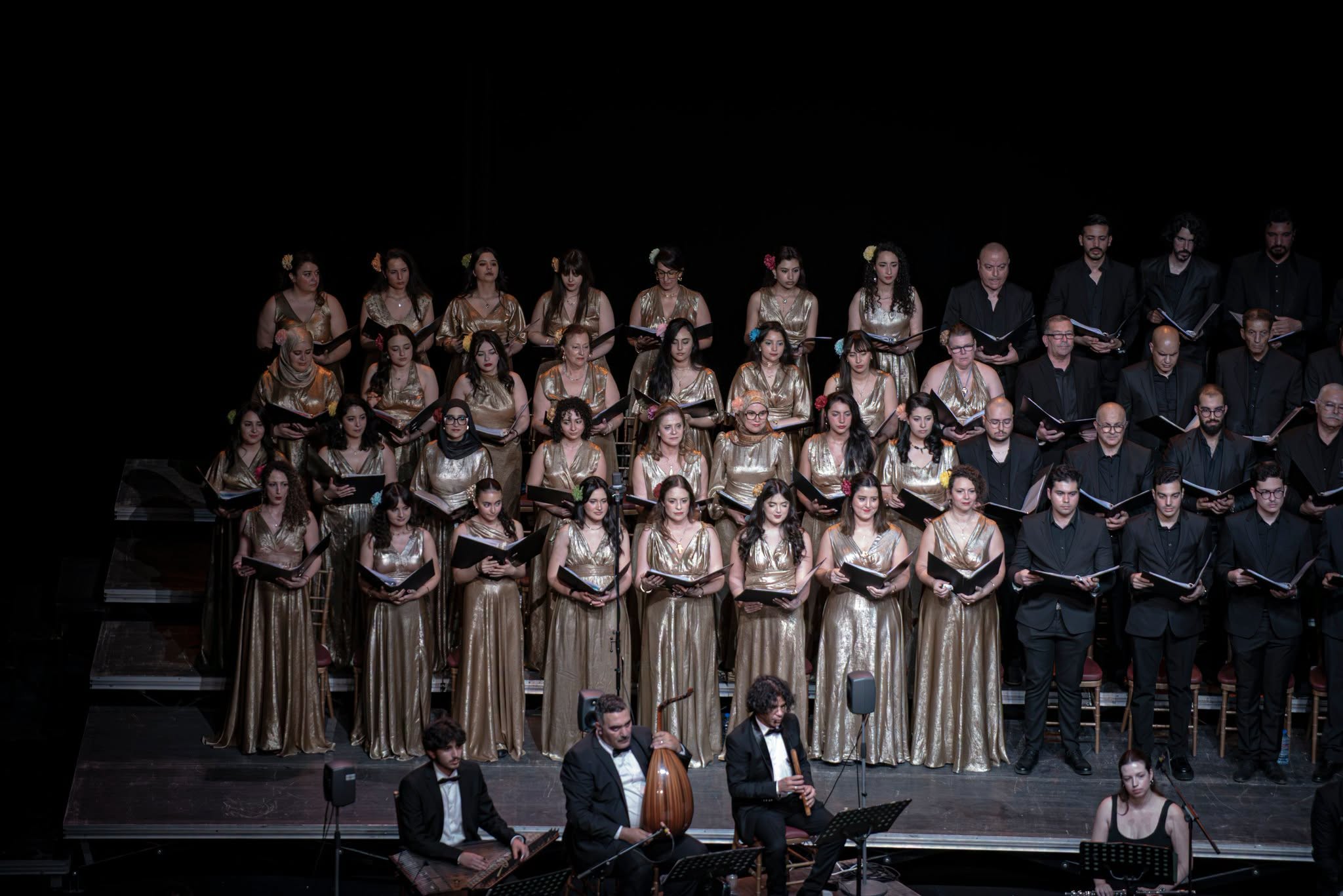
There is a particular hush that falls over El Jem on a summer night, just before the music starts. Several thousand people have taken their seats on stone tiers raised eighteen centuries ago. The floodlights catch the great ochre arches against a darkening sky. An orchestra tunes in the centre of an arena where Roman crowds once roared — and then a conductor lifts a baton, and the opening bars of Beethoven or Ravel rise up the walls and hang in the warm air. This is the El Jem International Festival of Symphonic Music, and it is, without exaggeration, one of the most spectacular settings in which you will ever hear a live orchestra.
We’ve written about the amphitheatre of El Jem as a monument. This is the story of what happens when it becomes a stage.
A Stage Eighteen Centuries in the Making
The venue is the whole point, so it’s worth knowing what you’re sitting inside. El Jem — Roman Thysdrus — grew rich in the second and third centuries on the olive oil it shipped to Rome, and around 238 AD that wealth raised an amphitheatre to match the city’s ambitions. At 148 metres long and 36 metres high, it is the third-largest Roman amphitheatre in the world, after the Colosseum and the arena at Capua, and one of the best-preserved Roman monuments anywhere in Africa. It once seated something like 35,000 spectators. Inscribed as a UNESCO World Heritage Site in 1979, it rises straight out of the flat Sahel plain, visible for miles, improbably intact.
Since 1986, that arena has hosted the only festival in the Arab world dedicated to symphonic music. The idea is simple and irresistible: take the European classical repertoire and place it inside a Roman colosseum, under the stars, on a summer night. The result is less a concert series than a kind of time travel.
What a Night at El Jem Feels Like
Concerts are held after dusk, when the heat of the Sahel day has finally lifted and the stone has cooled. The lighting is dramatic — the arches lit from below, the orchestra pooled in light at the centre, the audience banked up the ancient tiers. The acoustics of the open bowl are unexpectedly intimate; with no roof and relatively modest crowds, there’s a directness to the sound that grand concert halls rarely manage. People dress up a little, arrive early to watch the light fade on the ruins, and stay late. It is romantic in the proper sense of the word, and it draws an audience from across Tunisia and from well beyond it.
The programme is the festival’s pride. Across roughly nine evenings, it brings international symphony orchestras, renowned soloists, and chamber ensembles — in recent years from France, Italy, Spain, Switzerland, Austria, and Tunisia itself — alongside the occasional jazz night and home-grown productions, including operas staged by the Théâtre de l’Opéra de Tunis. The core, though, is the great symphonic canon: Beethoven, Mozart, Rossini, Ravel, the music whose scale seems to suit the architecture. Each season carries a theme, and the full line-up is typically announced in late June, around World Music Day.
When It Runs in 2026
The festival unfolds across July and August, with concerts on selected evenings rather than every night. The 2026 season is scheduled to run from roughly 11 July to 22 August, with performances dotted through the weeks — confirm the exact programme and dates on the official festival site before you build a trip around a particular night, as the line-up firms up close to the start. Tickets for the marquee performances sell quickly; book ahead, and arrive early to explore the monument in daylight before the music begins.
Getting There and Making a Day of It
El Jem sits in the Mahdia Governorate, in the heart of the Sahel, roughly an hour from Sousse and well under three hours from Tunis by road or on the main rail line. Most festival-goers come for the evening from the coast, which makes it easy to pair the concert with a full day of sightseeing. Spend the afternoon in the amphitheatre and the excellent El Jem Archaeological Museum, whose mosaics rival anything in the country — part of the story we tell in our guide to Tunisian mosaics. Base yourself in Sousse, Monastir, or Mahdia and you can fold a night at the festival into a wider Sahel itinerary. For where the summer concert window sits against the rest of the year, see our best time to visit Tunisia guide; for the logistics, our transport guide has you covered.
It is, in the end, the rare event that satisfies two appetites at once — the music lover’s and the history lover’s — and does so in a place that makes both feel larger than usual. Of all the things to do in a Tunisian summer, few are as quietly unforgettable as Mozart at midnight in a Roman arena.
From the Carthage Magazine Bookshelf
If a summer of Roman Tunisia and open-air music is taking shape, three Carthage Magazine ebooks were built to go with it:
- All About Tunisia — the definitive English-language traveler’s guide. 572 pages, 27 chapters, all nine regions, every UNESCO inscription including El Jem, five thematic trails, and the practical answers most travelers wish they’d had on the plane. $24.99 · PDF & EPUB
- Speak Like a Local — 200+ Tunisian Arabic phrases with native audio recorded in Tunis. The phrases for the train, the café, and the box office. $14.99 · PDF, EPUB, MP3
- The Authentic Tunisian Cookbook — sixty traditional recipes from the heart of North Africa, for the long table after the concert. $9.99 · PDF & EPUB
All three available as a bundle for $39.99 — guide, language, and food, delivered together.
