
This article contains affiliate links. If you book through them, Carthage Magazine earns a small commission at no extra cost to you — it’s part of how we keep our guides free and independent.
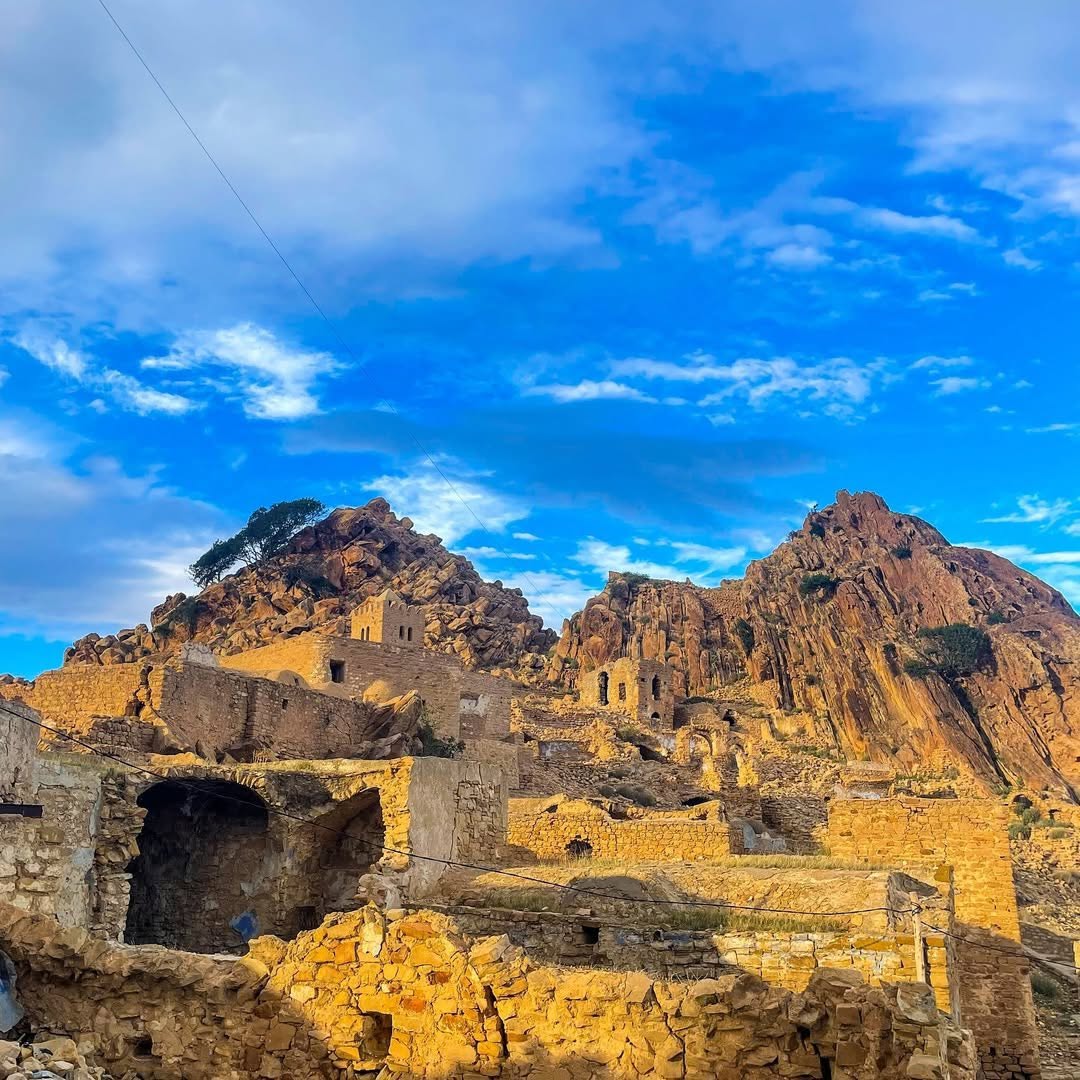
Quick Answer — An hour south of Tunis, the mountain town of Zaghouan and the abandoned hilltop village of Zriba El Alia make the best off-radar day trip in northern Tunisia. Zaghouan, an Andalusian-flavoured town at the foot of the 1,295-metre Djebel Zaghouan, holds the Temple des Eaux — the Roman water sanctuary where the spring rises that fed Carthage through the longest aqueduct Rome ever built. Ten kilometres away, above the thermal-bath town of Hammam Zriba, the stone village of Zriba El Alia has stood empty since its last families left in the 1960s: a hauntingly intact Amazigh ghost town with a restored café, a small mosque, and panoramic views to the sea. Free to enter, best in the golden hours, easiest by rental car or organised tour; wear real shoes and carry water.
Every day, without knowing it, the visitors photographing the great arches that stride across the plains south of Tunis are looking at a road sign. The Zaghouan aqueduct — whose ruined arcades you pass on the drive down, and whose story we told in our piece on water supply in Roman Carthage — points like a ninety-kilometre stone arrow back to its source: a mountain that catches clouds, a spring that never stops, and a temple the Romans built around the water as if around a god. Follow the arrow to its beginning and you arrive at one of the most quietly rewarding corners of the country — and, on the next hill over, at the most atmospheric ruin in Tunisia that almost no foreign visitor has heard of.
Zaghouan: The Town Under the Mountain
Zaghouan is a small governorate capital pressed against the north face of Djebel Zaghouan, whose limestone summit — at 1,295 metres among the highest in this corner of the country — pulls moisture off the sea and turns it into the springs that made the town matter for two thousand years. The place wears its history in layers you can walk in an hour: a Roman triumphal arch embedded in the streets, and above it the old quarter built by Andalusian Muslims who settled here after their expulsion from Spain in the early 1600s, bringing tiled roofs, a distinctive Great Mosque, rose-water distilling, and a mountain-town neatness that still sets Zaghouan apart. It is a working town rather than a tourist one — a café stop, a bakery, a wander — and better for it.
The reason to climb above it is the Temple des Eaux, a half-hour walk (or five-minute drive) up the mountain’s lower slope. Built in the reign of Hadrian in the second century, this is a nymphaeum — a monumental sanctuary wrapped around the sacred spring itself: a horseshoe of columned portico and statue niches embracing a great basin where the water of Djebel Zaghouan was gathered, honoured, and sent on its way to Carthage. The statues left long ago (some survive in the Bardo’s collections in Tunis); nearly everything else remains, improbably intact, with the mountain wall rising behind and the plains falling away in front all the way, on a clear day, toward the sea. There is no ticket booth and usually no crowd — just the sound that has not stopped in nineteen centuries, of water moving. From here the aqueduct ran roughly ninety kilometres to Carthage — with its branches, the longest aqueduct system the Roman world built — and standing at the source recalibrates every arch you’ve seen from the highway.
The mountain above has become northern Tunisia’s modest adventure hub: marked trails through the Djebel Zaghouan national park’s juniper and raptor country (routes in our hiking in Tunisia guide), rock-climbing on the limestone faces, and kayaking on the small Sidi Madyen lake below, run by young local outfits that have grown up around weekend traffic from Tunis. If Korbous is the coast’s hot-spring escape — see our Korbous guide — Zaghouan is becoming the mountains’ equivalent.
Zriba El Alia: The Village That Emptied
Zriba El Alia’s hilltop perch is the kind of place Tunisia hides at the end of a small road — under an hour and a half from Tunis by car, awkward any other way, and best combined with the Temple des Eaux at Zaghouan in a single unhurried half-day. If you’re renting for it, DiscoverCars lines up the agencies for your dates, and our guide to renting a car in Tunisia walks through the paperwork.
And then, in the space of a generation, it emptied. The twentieth century offered roads, schools, and running water in the plain below, and by the 1960s the last families had moved down to Zriba Nouvelle beside the hot springs, leaving the old village to the wind. What makes Zriba El Alia extraordinary is that nothing replaced them. The houses stand roofless but whole; the lanes are still paved; the mosque still holds its silence; and the views — across to Djebel Zaghouan on one side and toward the Gulf of Hammamet on the other — belong to the cats and the occasional photographer.
A café has been sympathetically rebuilt among the ruins, one traditional house restored to show how the village lived, and informal local guides materialise at weekends to walk you through it for a tip. There is no entry fee, no barriers, and no infrastructure to speak of: sturdy shoes for the uneven stone, water, sun protection, and respect for the mosque are the whole rulebook. Come in the late afternoon if you can — the low light turns the stone honey-coloured, and the hush as the plain’s sounds fall away below is the entire point of the trip. Its sister village Takrouna, whose fate we’ve written about with some heartbreak, makes the natural companion stop for anyone doing the hill villages properly.
The Practicalities
Zaghouan is about sixty kilometres from Tunis — an hour to seventy-five minutes by car down the P3/C133, with the aqueduct arches for company — and Zriba El Alia another fifteen minutes beyond, past Hammam Zriba (whose no-frills thermal baths, a living cousin of the tradition in our Tunisian hammams guide, make a fitting final stop). There is no practical public-transport route to Zriba itself; a rental car gives the day its ideal shape, taxis can be hired from Zaghouan for the hop, and organised day tours now run the Zaghouan–Zriba–Takrouna circuit from both Tunis and Hammamet.
Combined, temple plus village plus mountain make a full and satisfying day out of the capital — one we’d rank alongside anything in our day trips from Tunis — and spring, when the mountain is green and the light is kind, is its finest season, per the calendar in the best time to visit Tunisia. Fifty kilometres of highway separate these hills from the coast’s crowds; on most days of the year, you will have Rome’s spring and Tunisia’s ghost village very nearly to yourself.
From the Carthage Magazine Bookshelf
Days like this one — a temple, a mountain, an empty village — are exactly what these three were written for.
- All About Tunisia — the definitive English-language traveler’s guide. 572 pages, 27 chapters, all nine regions, every UNESCO inscription, five thematic trails — and the practical answers (visa, currency, transport, etiquette) most travelers wish they’d had on the plane. $24.99 · PDF & EPUB.
- Speak Like a Local — 200+ Tunisian Arabic phrases with native audio recorded in Tunis. The phrases for the taxi, the souk, the café, and the dinner table. $14.99 · PDF, EPUB, MP3.
- The Authentic Tunisian Cookbook — sixty traditional recipes from the heart of North Africa. For when you get home and find yourself missing the food. $9.99 · PDF & EPUB.
All three available as a bundle for $39.99 — guide, language, and food, delivered together.
