
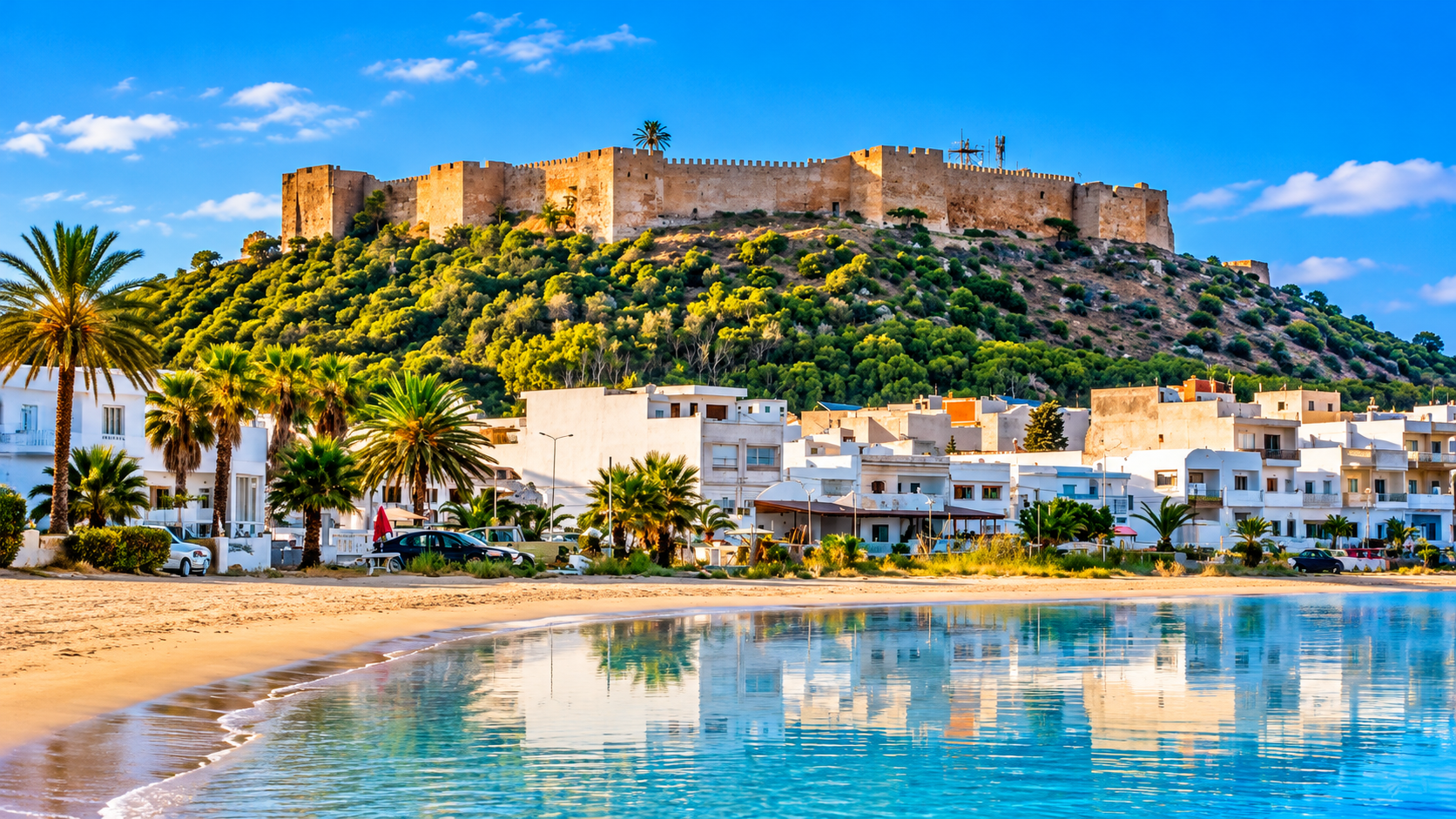
Quick Answer — Kelibia is a fishing town on the east coast of Cap Bon, two hours from Tunis, crowned by a fortress on a 150-metre rock that the Byzantines built over a Punic citadel and that gives the finest view in the peninsula. Two kilometres north is Mansoura, a beach of white sand and clear water that many Tunisians rank among the country’s best. Twenty kilometres further, at the very tip of the cape, El Haouaria has the Roman quarry caves that supplied the stone for Carthage, a June falconry festival, and the island of Zembra filling the horizon. Between the two lies Kerkouane, the only Punic town ever excavated intact. Together they make the best two days on Cap Bon; most visitors give them none. Here’s the whole story.
The road up the east coast of Cap Bon leaves Nabeul and Hammamet behind within half an hour, and with them most of the tourism. What replaces it is agriculture: orange groves, vines, then as the peninsula narrows, a landscape of low hills and sea on both sides. Kelibia announces itself from a long way off. The fort sits on a bare rock above the town like something out of a crusader chronicle, and from the moment you see it the question is how soon you can climb it.
The Fort
The Carthaginians fortified this rock as Aspis; the Romans called the town Clupea; the Byzantines, in the sixth century, built the walls that stand today, and the Aghlabids, the Hafsids, the Spanish and the Ottomans each repaired them in turn. The result is a compact fortress with square towers, a walled enclosure holding the ruins of a small mosque and a lighthouse, and a rampart walk that circles the whole thing.
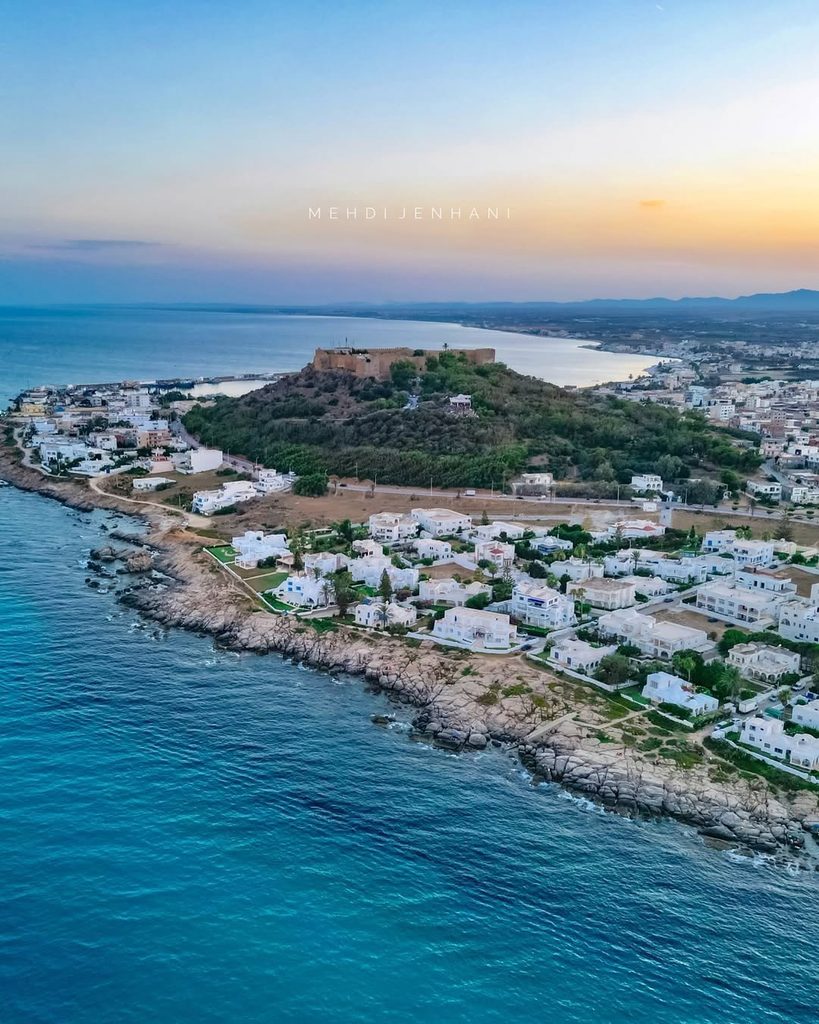
The walk is the point. To the south the coast runs away towards Nabeul; to the north, Mansoura’s white sand and the long shoulder of the cape; to the east, open sea, and on the clearest winter mornings the volcanic hump of Pantelleria, 70 km off and Italian. Admission is a few dinars, the climb from town takes 20 minutes on foot, and there is a car park at the top for the less energetic. Go at the end of the afternoon when the fishing fleet is heading out.
The Port and the Muscat
Kelibia is one of the largest fishing ports in Tunisia, and the fleet works at night with lamps, drawing sardines and anchovies to the surface. From the fort at dusk you watch the lights scatter across the gulf; in the morning the catch is on the quay and in the restaurants along the harbour, which serve the best grilled fish on Cap Bon at fisherman’s prices.
The town’s other product is wine. The Muscat de Kelibia, a dry white with the grape’s full perfume, is the one Tunisian wine most foreign drinkers remember, and the cooperative and a few private estates sell it locally; our guide to Tunisian wine explains where it fits. Each August the town also hosts the oldest amateur film festival in Africa, which fills the fort with screenings.
Mansoura
North of the fort the coast curves into a bay, and the bay is Mansoura: a beach of fine, almost white sand with water so clear that the rocks at the headland show through it, backed by low dunes and a scatter of cafés and summer houses. It is in our coast-by-coast guide to Tunisia’s beaches for good reason.
In July and August it is popular with families from Tunis and Nabeul; in June and September it is nearly empty. There is a second, rockier stretch under the fort itself, La Petite Mansoura, good for snorkelling. For a town without a single resort hotel, Kelibia has an extraordinary beach, and that is the heart of its appeal.
Kerkouane, on the Way North
Twelve kilometres up the road to El Haouaria, by the sea, is Kerkouane: the only Punic town the Romans never built over, abandoned in the third century BC and excavated in the 20th, with its street grid, its bathtubs and its pink mortar floors still in place. It is a UNESCO site and takes an hour. Our guide to the Punic civilisation is the background reading.
El Haouaria and the Caves
The road ends at El Haouaria, a village at the tip of the cape with Zembra island rising 15 km offshore and, on a point north of the village, the Ghar El Kebir caves. These are not natural: they are the quarries, worked from Punic times, from which the pale sandstone of Carthage was cut and shipped across the gulf. Enormous chambers open to the sky through square shafts, the chisel marks still on the walls, and the sea booms in the lowest ones. Admission is cheap and a guide will attach himself to you at the gate.
El Haouaria is also Tunisia’s falconry village: in spring, as sparrowhawks cross the strait on migration, local men trap and train them, and in June the festival shows them off before the birds are released. The headland itself is the best walking on the peninsula, with paths out to the lighthouse and views across to Zembra, whose story is in our piece on Tunisia’s 62 islands. The tuna fishery at Sidi Daoud, a few kilometres west, is the subject of our report on the matanza.
Honestly
This is the part of Cap Bon that has not been developed, and the trade-off is real. Kelibia has guesthouses and a couple of small hotels, not resorts; El Haouaria has less. Restaurants are fish, fish and fish, which is fine. Transport without a car is slow: louages reach Kelibia easily but the caves and Kerkouane need a taxi.
In August Mansoura is crowded. Outside summer the beach cafés close and the towns feel shut. The fort is the one sight that is worth the trip in any month. If you want a resort, stay in Hammamet and come for the day; if you want the peninsula as it is, stay in Kelibia for two nights and eat on the port.
Practicalities
Getting there. Kelibia is roughly 110 km from Tunis, two hours by car via Grombalia and Menzel Temime, or two and a half by louage from the capital’s southern station; from Hammamet or Nabeul it is about an hour. El Haouaria is 20 km beyond Kelibia. With a hire car the whole circuit, Kelibia, Kerkouane, El Haouaria and back via the west-coast road to Korbous and Tunis, makes a single long day or a relaxed two. The regional overview is in our Cap Bon guide and the day-trip logistics in day trips from Tunis.
Staying. Small hotels and guesthouses in Kelibia town and near Mansoura; a few in El Haouaria. Book ahead in July and August. Wild and organised camping on the cape is covered in our camping guide.
Eating and buying. Grilled fish on the port; Kelibia muscat from the cooperative; Nabeul’s harissa and orange-blossom water on the way back.
When. May–June and September for beach and weather; June for the falconry festival; August for the film festival and the crowds; spring for the hawks and the wildflowers on the cape.
From the Carthage Magazine Bookshelf
Cap Bon is a place to drive slowly, order fish in Arabic, and come home wanting to cook it; these three books help with all three.
- All About Tunisia — the definitive English-language traveler’s guide. 572 pages, 27 chapters, all nine regions, every UNESCO inscription, five thematic trails — and the practical answers (visa, currency, transport, etiquette) most travelers wish they’d had on the plane. $24.99 · PDF & EPUB.
- Speak Like a Local — 200+ Tunisian Arabic phrases with native audio recorded in Tunis. The phrases for the taxi, the souk, the café, and the dinner table. $14.99 · PDF, EPUB, MP3.
- The Authentic Tunisian Cookbook — sixty traditional recipes from the heart of North Africa. For when you get home and find yourself missing the food. $9.99 · PDF & EPUB.
All three available as a bundle for $39.99 — guide, language, and food, delivered together.
