
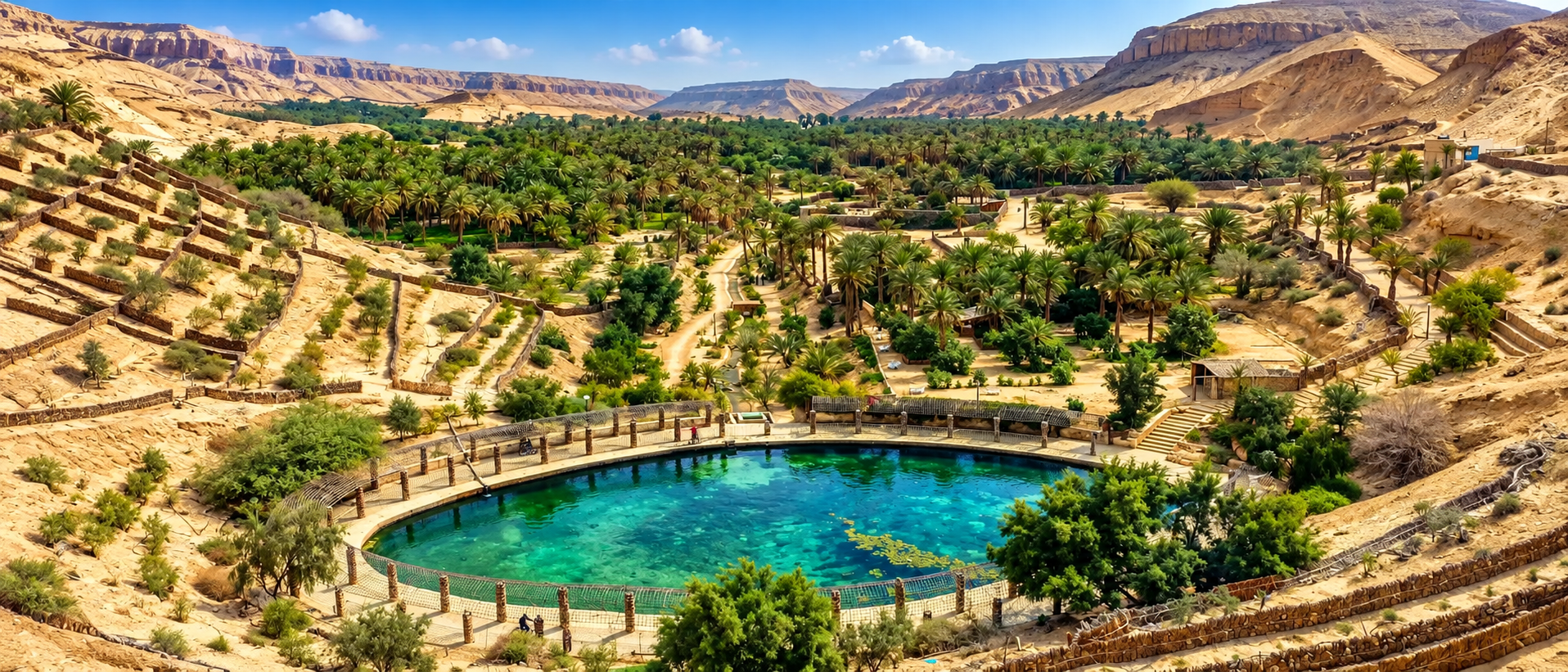
Quick Answer — Nefta is the oasis town 25 kilometres west of Tozeur, the last stop on the road before the Algerian frontier at Hazoua. It is built around the Corbeille, a natural hollow in the rock that was once fed by more than 150 springs, and it is the historic heart of Sufism in Tunisia, with a hundred-odd white-domed shrines and the tomb of Sidi Bou Ali, the saint who made the town Sunni in the 13th century. Most visitors come for the Star Wars set at Mos Espa in the dunes to the north, and leave without walking the old quarters, which is the wrong way round. A louage from Tozeur takes 25 minutes; give the town a half-day, or a night at Dar Hi if the budget allows. Go between October and April. Here’s the whole story.
The road out of Tozeur runs dead straight, with the salt crust of the Chott el Jerid catching the light on the left and bare, biscuit-coloured hills on the right, and for twenty minutes there is nothing to suggest that another town is coming. Then the palms begin: not scattered, but in a mass, two hundred thousand of them, filling a valley you cannot see until you are in it. Nefta announces itself with shade.
It has been doing so for a very long time. The Romans knew it as Nepte, a watering stop on the southern edge of their African province, and the caravans that crossed from the Sahara into the Jerid knew it as the place where the water came up out of the ground on its own. Norman Douglas, who wandered through in 1912 and wrote Fountains in the Sand about it, spent pages on the springs. A century later, the springs are mostly a memory, the pilgrims still come, and the film crews have been and gone. Nefta is quieter than Tozeur, holier, and a good deal less explained. This is the explanation.
The Corbeille: A Basket of Palms
The French named it the Corbeille, the basket, and once you are standing on its rim the word is exact. The ground simply drops away into a bowl perhaps a kilometre across, and the bowl is full of date palms, their crowns level with your feet, with white domes and the brick minarets of the old quarters crowding the far edge. The town sits on the lip; the oasis sits in the hollow; and a channel at the bottom once carried the spring water out through a gap in the rock and down into the main palmeraie that spreads south of the town towards the chott.
Those springs, 152 of them by the traditional count, are what built Nefta. They weakened through the 1980s and 1990s as deep wells were drilled for the date plantations, and today the Corbeille is kept green by pumps rather than by nature. The guides will tell you this with a shrug. It matters less for a visitor than you might think: the view from the rim at the end of the afternoon, when the palms go gold and the domes go pink, is still one of the finest in the south. There is a café on the edge of the Corbeille near the Dar Hi hotel where you can sit with a glass of mint tea and watch it happen. The path down into the basket is steep but short, and the walk along the bottom, in the green dark under the fronds, is the coolest thing you will do in the Jerid.
The palmeraie proper, the big one south of town, is where the Deglet Nour dates grow. If you are here in October or November, as this guide goes to press, the harvest is on, and you will see men going up the trunks with ropes and knives and bringing the heavy amber bunches down on their shoulders. Our guide to Tunisian dates explains why the Jerid’s fruit is the best in the country; Nefta is where you can watch it being picked.
The Kairouan of the South
What separates Nefta from every other oasis in Tunisia is not the palms but the domes. There are, by the usual count, around a hundred marabouts (the tombs of holy men) and two dozen mosques in a town of twenty thousand people, enough to earn it the nickname “the Kairouan of the South.” Where Kairouan is the seat of orthodox learning, Nefta is the seat of Sufism, the mystical, saint-venerating current of Islam that has run through the Maghreb since the 12th century.
The reason is a man named Sidi Bou Ali. Tradition says he came from the west in the 13th century, found Nefta in the hands of the Ibadi sect, and converted the town to Sunni Islam by force of personality. His zaouia, a shrine-and-lodge complex with a green-tiled dome, sits on the edge of the Corbeille in the quarter named after it, Ez Zaouia, and it is still the most important pilgrimage site in southern Tunisia. People come from Algeria for it. Non-Muslims are not expected to go inside the tomb chamber, and you should not try, but the courtyard and the surrounding lanes are open and nobody minds a respectful visitor. For a sense of how this folk religiosity fits into the country’s wider picture, our piece on religion in Tunisia is a good companion.
The old town is four quarters: Ouled Cherif, El Bayadha, Ez Zaouia and Beni Ali, stacked around the rim of the basket. Walk them. The houses are built in the same ochre brick as Tozeur’s medina, laid in raised geometric patterns (chevrons, lozenges, stepped diamonds) that exist nowhere else in Tunisia. In Tozeur the brickwork has been restored and lit for tourists; in Nefta it is crumbling, unlabelled, and alive, with chickens in the courtyards and children on the steps. El Bayadha, the “white quarter,” has the densest cluster of domes. The Great Mosque, the Mosquée Sidi Salem, is near the centre.
Mos Espa and Ong Jmel
Now the part most people actually come for. North of Nefta, across a stretch of dunes that requires a 4×4 and a driver who knows the way, stands the set of Mos Espa, the spaceport slave-town on Tatooine from The Phantom Menace (1999). George Lucas’s crew spent months building it for twelve minutes of screen time, then walked away, and because the Sahara does not get round to demolishing things, it is still there: a street of domed adobe houses, moisture vaporators, and a hangar, slowly filling with sand.
Beside it is Ong Jmel, the “camel’s neck,” a wind-carved rock that does look, from the right angle, like a dromedary lying down. It appears in the film, and the climb to the top of it gives a full-circle view over the dunes, the set, and the white blur of the chott. The site is roughly 25 kilometres from Nefta by track. Go in the morning before the heat and the tour buses from Tozeur. A second, lesser-known location, the exterior of the Lars homestead, sits on the edge of the chott west of town on the Hazoua road.
Two honest notes. First, the set is deteriorating. A dune has been pushing into it for years, some walls have gone, and every photograph online is a year older than the reality. Second, you cannot reach it independently without a serious vehicle and some experience. Book the 4×4 through your hotel the night before. Our full guide to the Star Wars locations in Tunisia covers the whole circuit from Matmata to Tataouine, and the Tunisian Sahara field guide covers the broader desert logistics.
Dar Hi and Where to Sleep
For most of its modern history Nefta had one hotel, the Sahara Palace, which stood on the rim of the Corbeille and is now a shell. Then in December 2010, a few weeks before the revolution, a French pair opened Dar Hi: an “eco-retreat” designed by the industrial designer Matali Crasset, built on stilts above the edge of the basket, with seventeen rooms in four different styles, a heated pool, a hammam, and a kitchen that cooks from the oasis. It is the only genuinely design-led hotel in the Tunisian south and one of the most photographed buildings in the country. It is not cheap by Tunisian standards, but it is the reason a number of people come to Nefta at all, and it earns its reputation.
Below that tier are a handful of guesthouses in the old quarters and on the Sahara Palace road, Dar Zargouni and Riad Dar Maya among them, with pools and palm views for a fraction of the price. Most travellers, though, sleep in Tozeur, which has far more choice, and treat Nefta as a half-day. That works. Our where to stay in Tozeur guide lays out the options.
Honestly
Nefta is not a destination you build a trip around, and it would be dishonest to pretend otherwise. The springs have gone. The Sahara Palace is a ruin. There is no museum, no restaurant worth a detour, and the old quarters, while beautiful, have none of the polish of Tozeur’s Ouled el Hadef. If you come expecting a smaller Tozeur you will be disappointed; it is a different thing, less curated and more lived-in.
What it does offer is the one view in the Jerid that nobody has yet managed to spoil, an hour’s walk through brick lanes that have not changed in a century, and the chance to see a form of Tunisian religious life, the saint, the pilgrim, the dome on the hill, that has largely disappeared from the north. Pair it with the Mos Espa morning and the Chott el Jerid at sunset, and it is one of the best days in the south. And unlike the mountain oases of Chebika, Tamerza and Midès, it has not yet been discovered by the coach parties.
Practicalities
Getting there. Nefta is 25 km west of Tozeur on the P3 road. Louages leave from the Tozeur station when full and take about 25 minutes; the fare is a few dinars. Buses run too but less often. A taxi for the round trip with waiting time can be negotiated. If you have hired a car, the drive is straightforward and the road is good; our guides to louages and to renting a car in Tunisia cover both. Tozeur-Nefta International Airport sits between the two towns, about 15 minutes from Nefta; for the longer journey from the capital, see how to get from Tunis to Tozeur.
When to go. October to April. Summer temperatures here regularly pass 45°C and the Corbeille, for all its shade, is no refuge at two in the afternoon. The date harvest (October to December) is the most interesting season; spring is the greenest. The month-by-month guide to visiting Tunisia has the full picture.
How long. A half-day covers the Corbeille rim, the walk into the basket, the four old quarters and the zaouia. Add a morning for Mos Espa and Ong Jmel with a 4×4. A night at Dar Hi turns it into a proper stop.
Dress and conduct. This is a conservative, religious town. Shoulders and knees covered, especially around the zaouias; do not enter tomb chambers; ask before photographing people. See our guide to what to wear in Tunisia.
Combine with. Tozeur’s medina and the Dar Chraiet museum; the Red Lizard train through the Selja gorge from Metlaoui; the mountain oases; the chott crossing to Kebili and Douz. The full regional context is in our Tozeur guide and the Tunisia in autumn seasonal guide.
From the Carthage Magazine Bookshelf
Nefta is one of the Jerid’s quiet corners, and the three books below are the ones we would want in a bag on the louage out of Tozeur.
- All About Tunisia — the definitive English-language traveler’s guide. 572 pages, 27 chapters, all nine regions, every UNESCO inscription, five thematic trails — and the practical answers (visa, currency, transport, etiquette) most travelers wish they’d had on the plane. $24.99 · PDF & EPUB.
- Speak Like a Local — 200+ Tunisian Arabic phrases with native audio recorded in Tunis. The phrases for the taxi, the souk, the café, and the dinner table. $14.99 · PDF, EPUB, MP3.
- The Authentic Tunisian Cookbook — sixty traditional recipes from the heart of North Africa. For when you get home and find yourself missing the food. $9.99 · PDF & EPUB.
All three available as a bundle for $39.99 — guide, language, and food, delivered together.
