
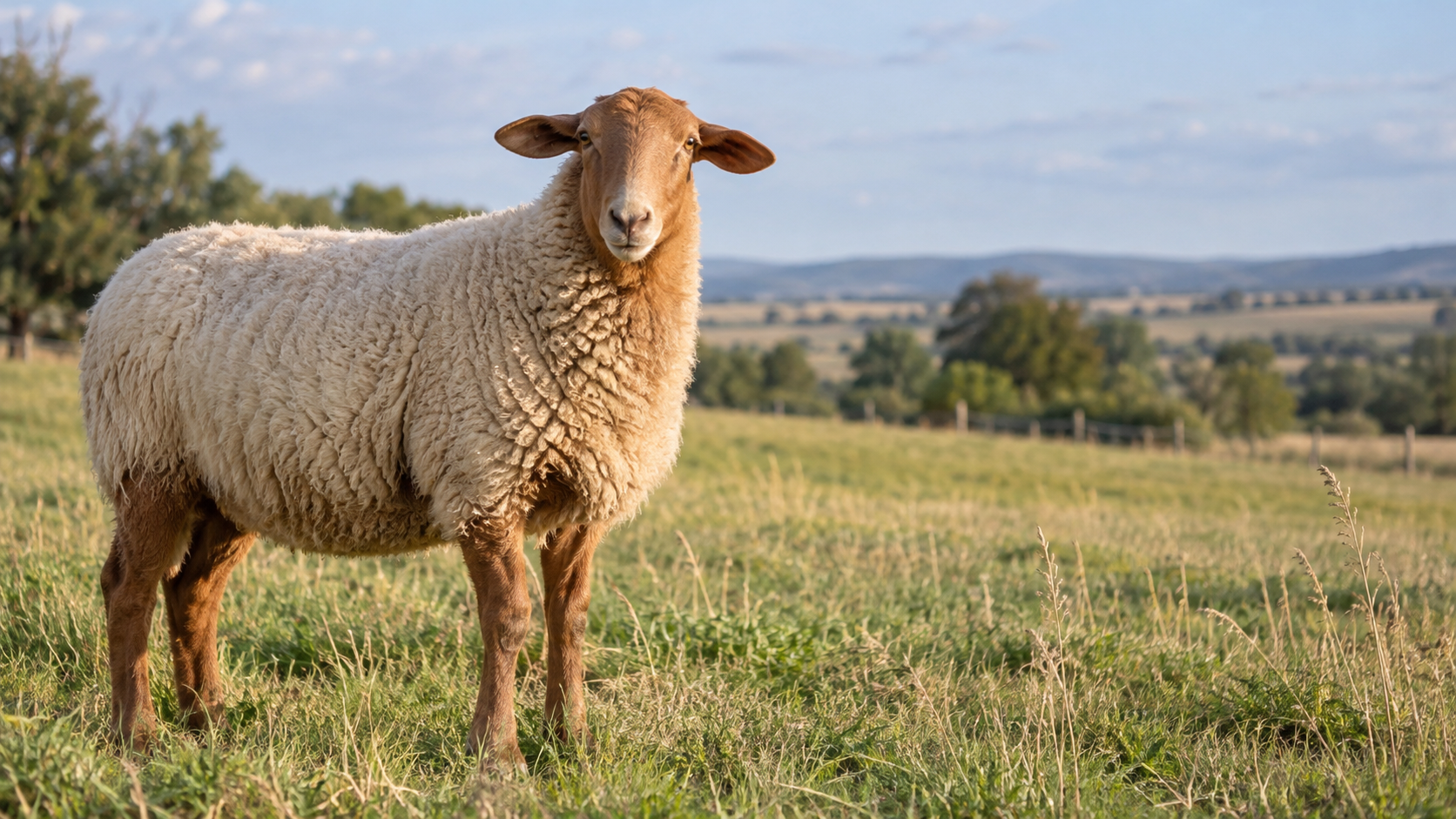
Walk any road in Tunisia in the weeks before Eid and you will see them: cream-colored sheep with bare red faces and long, drooping ears, grazing the highway verge, tethered in a courtyard, riding home in the back of a pickup. The Tunisian word is allouch, and the animal is so ordinary here that nobody looks twice.
Now picture the same sheep in a show ring in Pennsylvania, or on a hillside in Vermont, with a blue ribbon on its halter and a registry number in a ledger. Same red face, same ears, same cream fleece. In the United States it is called the Tunis, it is one of the oldest breeds the country ever developed, and it got there as a diplomatic present from a Bey of Tunis to George Washington.
Quick Answer — The Tunis is an American heritage sheep breed descended from Tunisian Barbarine fat-tailed sheep sent in 1799 by Hammouda Pasha, Bey of Tunis, as a gift to the United States. The surviving animals were placed with Judge Richard Peters of Belmont, Pennsylvania, who spread the breed through the mid-Atlantic and the South. Nearly wiped out in the Civil War, it survives today as a “Watch” listed heritage breed with a few thousand registered animals, while its Tunisian ancestor remains the most common sheep in Tunisia.
A gift between two very new relationships
In 1799 the United States was twenty-three years old and Tunisia was a Beylik of the Ottoman Empire that had, for all practical purposes, run itself for generations. The two had signed a treaty of peace and friendship in 1797, and the relationship ran on the currency every Barbary court understood: presents. Jewels, cloth, naval stores, and the occasional ship flowed from Washington to Algiers and Tunis in exchange for leaving American merchantmen alone in the Mediterranean.
William Eaton, the American consul who arrived in Tunis in February 1799, found the Bey irritated that Algiers was receiving better gifts than he was. Hammouda Pasha, who ruled from 1782 to 1814 and is remembered in Tunisia as one of the ablest of the Husainid Beys, was not a man who received without giving. Among what went the other way, in that same year, were ten sheep.
The details beyond that are thin, the way details of livestock on 18th-century ships usually are. Ten animals were sent; two reached land. The gift was addressed to Washington, but the pair was placed on the Belmont estate of Richard Peters, a federal judge outside Philadelphia and president of the city’s Society for Promoting Agriculture, which is to say the most influential farmer in the young republic. Peters lent his rams to neighbors and gave away lambs, and he wrote about the breed with the enthusiasm of a convert. Within a generation the red-faced sheep from Tunis were in Maryland, Virginia, the Carolinas, and Georgia.
The names that turn up in the early records tell you how seriously it was taken. Thomas Jefferson kept a flock. John Adams and George Washington Parke Custis, Washington’s step-grandson, both mention the sheep in their papers. By the 1820s, butchers in eastern Pennsylvania were asking for Tunis lamb by name.
What the Bey actually sent: the Barbarine
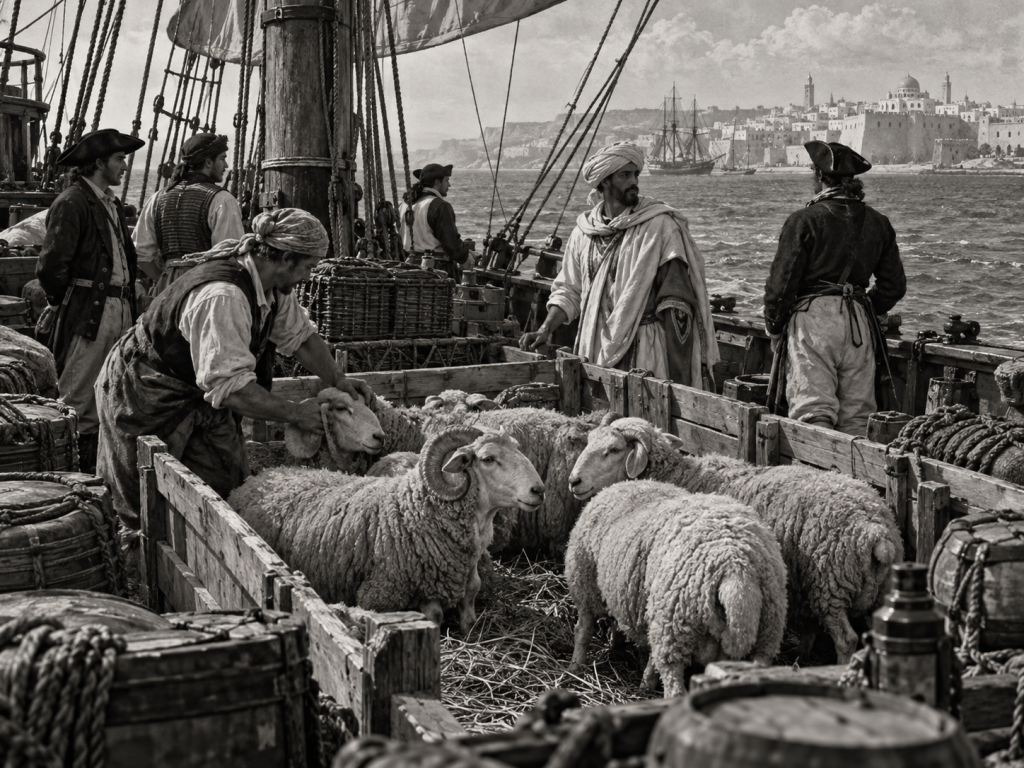
The animal that went up the gangplank in La Goulette was not a breed anyone had written down. It was the ordinary sheep of the Tunisian countryside, which Europeans called “Barbary” or “broad-tailed” and which Tunisians today call the Barbarine.
It is a fat-tailed sheep. The tail is the whole point. In a landscape where the rains fail every few years, the Barbarine stores fat in its tail the way a camel stores it in its hump, and draws it down through a dry summer. Tunisian agronomists have measured ewes carrying close to three kilos of fat in the tail when well fed and surviving months of short rations on it. The breed is hardy, long-legged, calm, and content on the scrub of the steppe. It is also, by long Tunisian consensus, the best-tasting lamb in the country, which is why a Barbarine ram commands a premium at the markets described in our guide to Eid al-Adha in Tunisia.
It is still the national sheep. In 2008 the Barbarine made up roughly sixty percent of Tunisia’s flock of some four million ewes, down from about eighty percent a generation earlier, and a 2024 genomic study by Tunisian and Italian researchers confirmed both its distinct genetic identity and its role as the progenitor of the American Tunis. The study also flagged the honest problem: thin-tailed Algerian breeds, favored by butchers for a leaner carcass, are crossing into Barbarine flocks across central Tunisia, and the pure fat-tailed line is thinning out in its own heartland around Sidi Bouzid.
That is the quiet irony of this story. The sheep is on a conservation watch list in America and under genetic pressure at home, and for the same reason: modern markets want lean, fast, and uniform, and the Barbarine is none of those things. It is built for drought, not for a supermarket.
From Barbary sheep to American breed
The Tunis of today is not a pure Barbarine. Peters and the farmers who followed him crossed the Tunisian stock with European breeds already in America to put more meat on the frame, and over half a century a new animal emerged. It kept the Tunisian face, the long ears, the red legs, and a trace of the fat tail, visible as a small deposit of fat over the dock. It gained a heavier body and a finer, cream-to-ivory fleece prized by hand-spinners. Lambs are born red or tan and lighten as they grow; the face and legs stay copper. Rams run 175 to 225 pounds, ewes 125 to 175. They are hornless, docile, and famously good mothers, with a habit of breeding out of season that farmers in the South valued and that the breed almost certainly inherited from the Tunisian steppe.
By the 1850s the Tunis was the mainstay of sheep farming across the upper South and the mid-Atlantic. Then came the Civil War. Armies on both sides ate their way through the Southern flocks, and when the fighting stopped the breed had been reduced to a handful of animals, most famously a single flock in South Carolina kept going by an importer named Charles Roundtree from 1858 to 1877. The American Tunis Sheep Breeders’ Association formed in 1896 to pull the survivors together, and the National Tunis Sheep Registry was incorporated in New York in 1929.
The Livestock Conservancy, which tracks endangered American breeds, lists the Tunis as “Watch”: fewer than 2,500 registrations a year in the United States and a global population under 10,000. The direction is up. The registry passed a thousand lamb registrations a year around 2010, and the breed has found a second life on small farms in New England and the Mid-Atlantic, where its tolerance for heat and humidity, its easy keeping on grass, and the flavor of its meat suit exactly the kind of pasture-raised, farmers’-market agriculture that has grown since. Public television in Pennsylvania ran a segment on the breed’s comeback; breeders describe a sheep that will walk up to a stranger in the field.
The flavor, incidentally, is not folklore on either side of the Atlantic. The Conservancy has judged Tunis lamb the best-tasting of the American heritage breeds. Tunisians could have told them. It is the lamb that goes into the Sunday couscous, the mechoui at a wedding, and the osban and kamounia that follow the sacrifice.
Why a Tunisian should care about an American sheep
Because it is one of the few cases where something left Tunisia, kept its name, and was treated as precious.
Tunisian history is mostly a story of things arriving: Phoenician script, Roman engineering, Andalusian oranges, Ottoman tiles, French boulevards. We traced the inheritance in the other direction in our piece on the Carthaginian habits Tunisians still practice, but the list of Tunisian things the world adopted and credited is short: harissa, perhaps, and the chechia, and a few words of Derja hiding inside Maltese and Sicilian. The Tunis sheep belongs on that list. For two hundred and twenty-seven years, every ewe in a registry in Ohio has carried the name of the city it came from.
It also tells you something about Hammouda Pasha’s Tunis that the clichés about “Barbary pirates” do not. A court that sent livestock across the Atlantic, and chose its hardiest, best-eating breed to send, was a court that knew the value of its own countryside. The Bey was, in effect, gifting the United States the one piece of Tunisian agricultural genius that would survive on a different continent. He was right.
For the roughly thirty thousand people of Tunisian origin in Canada and the far larger community in the United States, whose stories we began telling in our guide to Tunisians in Canada, the Tunis is a small, concrete thing to point to. There is a flock in Vermont that is, in a real sense, from home.
Where to see them
In the United States. The best place to see Tunis sheep is a state or county fair in Pennsylvania, New York, Ohio, Virginia, or New England between August and October, where the breed shows in its own class. The National Tunis Sheep Registry lists member farms by state, and most small breeders will happily show visitors a flock. Several farms sell fleece and roving to hand-spinners by mail, which is probably the easiest way to own a piece of the breed without owning the breed.
In Tunisia. You do not need to look for the Barbarine; it will find you. Any weekly livestock market (the souk el-ghnem) in the center and south of the country, Sidi Bouzid’s above all, is Barbarine country. In the two weeks before Eid al-Adha the markets at Ouardia and Borj El Amri on the edge of Tunis are the most accessible, and the most expensive: in 2025 a ram sold for anywhere between 920 and 1,800 dinars. Look for the broad tail, the bare red face, and the ears. Then look at a photograph of a Tunis ewe at a Pennsylvania fair and notice that two centuries and an ocean have changed almost nothing.
For the older kind of Tunisian craft that travelled nowhere and survived anyway, read our story on the women potters of Sejnane. The sheep and the pots are the same lesson in different materials: what is built for the steppe lasts.
The red face in the ledger
There is a line in the old American breed descriptions that is easy to miss. The sheep, they say, were sent “by the Bey of Tunis,” and then the writers move on to fleece weights and lambing rates. Nobody in those pages ever wondered what Tunis was, or who Hammuda Pasha had been, or whether the animal was still grazing the hills it came from.
It is. Drive the road from Kairouan toward Sidi Bouzid in spring and the flocks are everywhere, red faces down in the green, tails swinging. Somewhere in Pennsylvania their cousins are doing the same thing. The gift was never returned, and it never needed to be. It is still being given.
Suggested Read: Eid al-Adha in Tunisia: A Country Prepares for the Sacrifice
Suggested Read: Tunisian Tiles: A Guide to Qallaline, Nabeul, and the Patterns on the Wall
From the Carthage Magazine Bookshelf
If a sheep could carry Tunisia to another continent and keep its name, these three will carry the rest of the country home with you.
- All About Tunisia — the definitive English-language traveler’s guide. 572 pages, 27 chapters, all nine regions, every UNESCO inscription, five thematic trails — and the practical answers (visa, currency, transport, etiquette) most travelers wish they’d had on the plane. $24.99 · PDF & EPUB.
- Speak Like a Local — 200+ Tunisian Arabic phrases with native audio recorded in Tunis. The phrases for the taxi, the souk, the café, and the dinner table. $14.99 · PDF, EPUB, MP3.
- The Authentic Tunisian Cookbook — sixty traditional recipes from the heart of North Africa. For when you get home and find yourself missing the food. $9.99 · PDF & EPUB.
All three available as a bundle for $39.99 — guide, language, and food, delivered together.
