
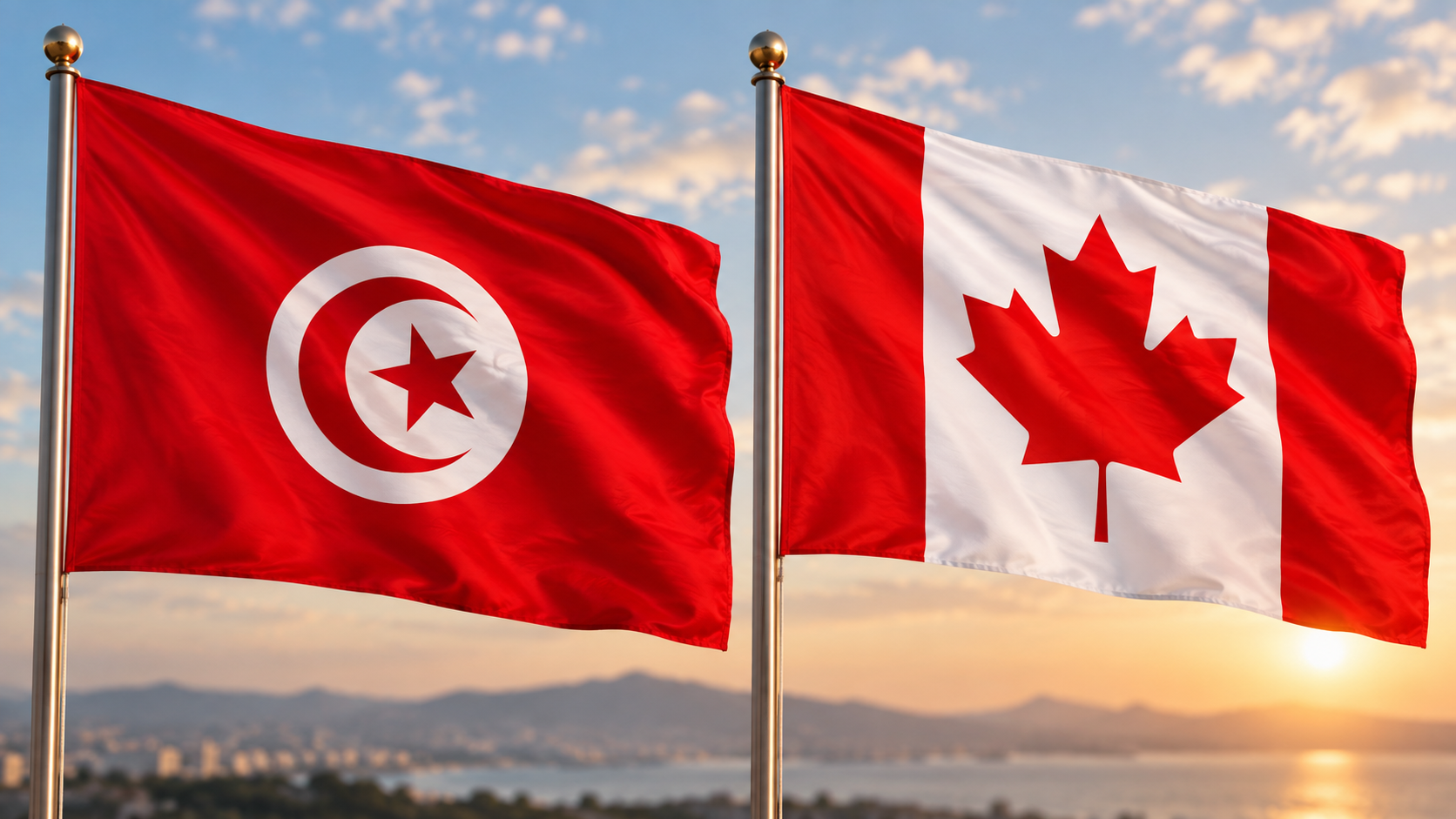
Quick Answer — Around 30,000 people in Canada report Tunisian origin, and the great majority live in Quebec: the 2021 census counted 30,465 Tunisian Canadians, 26,015 of them in Quebec and 2,430 in Ontario. The reason is language. French made Montreal the obvious North American destination for Tunisian students and professionals, and the community has grown steadily since the 2000s. Its informal heart is Montreal’s Petit Maghreb, along Jean-Talon Street East — but Tunisians are spread across the city’s universities, hospitals, engineering firms and tech companies, with smaller communities in Ottawa and Toronto.
There is a moment every Tunisian in Montreal knows. It is January, it is minus twenty, and you are standing in a queue that doesn’t seem to be moving. After months of unfamiliar Québécois vowels, a voice somewhere behind you complains about the cold — in Derja. Nobody introduces themselves. Somebody laughs. And for a few seconds, in the middle of a Canadian winter, you are home.
More than 30,000 people in Canada share that moment. Most Tunisians abroad head for France, Italy or Germany; the ones who choose Canada build something rather different — a community that is younger, highly educated, francophone, and a long, expensive flight from home.
Why Quebec?
The short answer is French. Since 2001, the Maghreb — Tunisia, Algeria and Morocco — has been the third-largest source of immigrants to Quebec, and in 2011 more than 96% of Quebec residents of Maghrebi origin spoke French. For a Tunisian engineer, doctor or student, Montreal offers North American salaries and universities without the language barrier of Toronto or New York.
The community’s roots are academic. Tunisians arrived first as students, and many stayed on after graduating; skilled-worker immigration followed. In 2001 the City of Montreal counted 5,040 Tunisians. Two decades later, Tunisian Canadians number around 30,000 nationwide — a community that has grown largely one degree, one job offer and one family reunion at a time.
Where the Community Gathers
Montreal’s Petit Maghreb stretches along Jean-Talon Street East, roughly between Saint-Michel and Pie-IX boulevards, close to Saint-Michel metro station on the blue line. It is shared by Tunisian, Algerian and Moroccan families, and it is where you go for the things that are hard to find elsewhere: fresh bread in the morning, sweets before Eid, a butcher who knows what you mean by merguez, and cafés where the football is always on. For a refresher on the dishes to look out for, see our guide to Tunisian cuisine.
Beyond Petit Maghreb, the community is less a neighbourhood than a network: university student associations, professional groups, WhatsApp chats and Facebook pages that organise everything from iftars to job referrals. Ottawa’s smaller community is shaped by the embassy, the federal government and the universities; Toronto’s is growing, pulled by the tech and finance sectors.
The Moments That Bring Everyone Together
Independence Day, March 20. In 2021, Niagara Falls was lit up in the red and white of the Tunisian flag at a ceremony organised with Tunisia’s diplomatic mission in Toronto — we covered it here.
Ramadan and Eid. Community iftars, mosque gatherings and long family dinners. Being far from home is felt most in these weeks — and the community works hardest to fill the gap.
Football. When the Eagles of Carthage play, the cafés of Jean-Talon fill up, whatever the time difference. Tunisia’s World Cup history is a subject of passionate — and sometimes painful — debate.
Going Home: Practical Notes
Flights. There are no direct flights between Canada and Tunisia; most travellers connect through Paris, with Frankfurt, Istanbul and the Gulf hubs as alternatives. Summer fares climb steeply, because everyone goes home in July and August — the diaspora summer is its own phenomenon. Our flights guide has the routes.
Consular services. Tunisia has an embassy in Ottawa and a consulate general in Montreal, which handle passports, civil-status documents and other paperwork. Check their official pages for current appointment procedures before you go — requirements change.
Visas. Canadian passport holders do not need a visa for short visits to Tunisia (details here). Tunisian passport holders need a Canadian visa to visit Canada, so relatives planning a trip should apply well in advance. For Tunisians travelling elsewhere, see our list of visa-free countries for Tunisian passports.
Between Two Countries
Ask Tunisian Canadians what they miss and the answers are always specific: the sea in Bizerte, a grandmother’s couscous on Sunday, the noise of a Tunis café, the particular blue of Sidi Bou Said doors. Ask what they have gained and the answers are specific too: a career, a second language of belonging, children who switch between French, English and Derja in a single sentence. For that feeling of living between places, read The Tunisia I Kept Meeting Abroad.
FAQ
How many Tunisians live in Canada? About 30,000 people reported Tunisian origin in the 2021 census — 30,465 in total, most of them in Quebec.
Where do Tunisians live in Montreal? Across the city, with a concentration around Petit Maghreb on Jean-Talon Street East, near Saint-Michel metro station.
Why do so many Tunisians choose Quebec? Mainly the French language, along with Quebec’s universities and skilled-immigration programmes.
Is there a Tunisian consulate in Canada? Yes. Tunisia has an embassy in Ottawa and a consulate general in Montreal.
Are there direct flights from Canada to Tunisia? No. Travellers usually connect through Paris or another European or Gulf hub.
From the Carthage Magazine Bookshelf
For the trip home — or for the Canadian friends who keep asking about it:
- All About Tunisia — the definitive English-language traveler’s guide. 572 pages, 27 chapters, all nine regions, every UNESCO inscription, five thematic trails. $24.99 · PDF & EPUB.
- Speak Like a Local — 200+ Tunisian Arabic phrases with native audio recorded in Tunis. Perfect for children growing up with Derja as a third language. $14.99 · PDF, EPUB, MP3.
- The Authentic Tunisian Cookbook — sixty traditional recipes from the heart of North Africa. For Sunday couscous, nearly seven thousand kilometres from home. $9.99 · PDF & EPUB.
All three available as a bundle for $39.99 — guide, language, and food, delivered together.
