
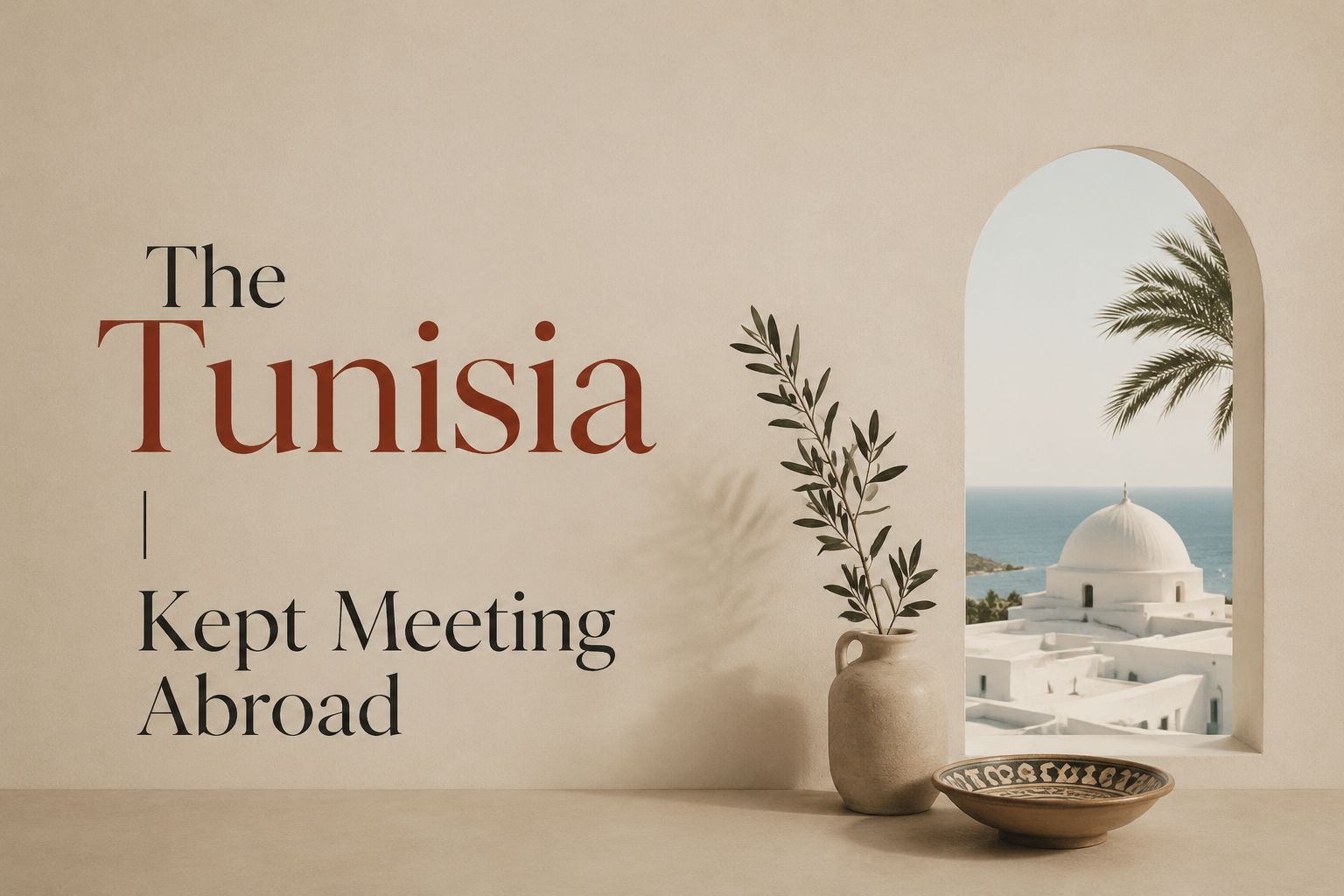
Eya Bouabidi – Tunisia is not just a simple or passive word for people who are away from the land of jasmine; it carries a weight of love, familiar streets, longing, nostalgia, family reunions, Ramadan gatherings, green tea with mint in Sidi Bou Said, summer nights, and voices that once emerged naturally into everyday life—a combination that transforms the country into something hard to explain, more like a feeling than a place. One can only realize the feeling of the country when moving abroad, but does Tunisia really have a feeling?
I kept asking myself this question each time Tunisia appeared unexpectedly in conversations at university. I found myself smiling unintentionally, and suddenly a wave of nostalgia would hit me—memories of my childhood, the walks I had in the old cities, and the soft scent of jasmine drifting through evening streets. A few seconds were enough to bring me back to my home country and fuel my longing for Tunisia. Hearing the stories of my professors, colleagues, and staff about my beloved country made the answer reveal itself slowly through the warmth with which people shared their experiences.
I still remember the brief silence after mentioning my nationality. “Tunisia?” a professor repeated, almost surprised. Then came a smile, followed by stories of the streets of Tunis and a trip he still remembered years later with unexpected clarity. What surprised me most was the amount of knowledge people seemed to have about my country—I was astonished at how foreigners could know it.
It was when I wished a good friend of mine a happy birthday, and she replied, “Ayshek Eya, Yaatik Sahha,” which basically means “Thank you Eya, may you be blessed with good health.” Although it was just a simple reply for her, to me, those were more than simple words. A moment like this reminded me how culture is a powerful tool in building bridges between people.
Another friend excitedly jumped after I mentioned Tunisia and started telling me about her journey there—the places she visited, starting from the capital to Hammamet and Carthage, where she showed me pictures of the ancient monuments she had taken, and even began singing some of the traditional Tunisian songs she heard during her trip.
Hearing different personal stories made me travel to my country without even taking a flight. I shared the same feelings as them and sensed the impact Tunisia leaves on everyone, not just its citizens. The pride I feel each time Hannibal Barca is mentioned in my history class, or when a familiar Arabic expression like “تونس الخضراء” appears in conversations, are all small moments that build up the answer to my question.
My message to the people who are currently in Tunisia is to invest their time while in the country: explore hidden gems, make the best out of Tunisia, attend as many cultural events as possible, engage in volunteering programs, and help improve the country even with small gestures. And don’t forget to document every single moment you enjoy, because once abroad, memories start to blur, leaving photographs as small reminders of moments we once lived so fully.
Many of the encounters I had lasted less than five minutes, yet they transformed the way I view Tunisia—not solely as a homeland, but as something more vivid, something that deepened my sense of belonging. Through the few pictures I have in my gallery, I can hear every laugh, smell every jasmine flower, taste every traditional dish, and see the authenticity and uniqueness of my heritage.
Perhaps this is why, even while being in the diaspora, Tunisia continues to feel more like something familiar than a place—warm, generous, and quietly unforgettable.
Written by: Eya Bouabidi. A Tunisian student at Georgetown University in Qatar. Her writing explores culture, memory, and the emotional ties to home. In “The Tunisia I Kept Meeting Abroad,” she reflects on nostalgia and the ways her homeland surfaces in conversations with people from different backgrounds.
